


Chris here. Between my wedding, honeymoon, and all related matters, I will be pretty busy throughout this month. Because of that, some friends have volunteered to take over this newsletter while I’m away. Today’s piece comes from Eric at Track Ten.
A self-described pop obsessive, Eric publishes a weekly column tracking what’s trending on the charts and why, as well as longer essays analyzing key moments from pop’s past and present, whether that’s Mariah Carey’s dominance of the 90’s or Chappell Roan’s unconventional release strategy. He recently wrapped up publishing a collection of guest essays called Resurrection which traces some of the biggest comeback moments in pop history and why they matter.
Adapt or Die: How Country Took Rap’s Place Atop The Charts
By Eric of Track Ten
At first glance, Beyoncé and Post Malone may not seem to have much in common beyond their unexpected collaboration “LEVII’S JEANS.” Both artists, though, have the distinction of hitting number one on both Billboard’s Hot Rap Songs and its Hot Country Songs charts in the past decade.
Post Malone first topped the Rap chart with “Rockstar” featuring 21 Savage for 15 weeks in 2017, and Beyoncé spent three weeks at #1 in 2020 as the guest on Megan Thee Stallion’s “Savage.” Jump forward to 2024, and both earned the top slot on the Country chart, Beyoncé with “Texas Hold ‘Em” for 10 weeks and Post Malone with “I Had Some Help” featuring Morgan Wallen for seven.
Why were artists who had success with rap suddenly pivoting to country? Well, all four of these songs also hit #1 on the all-genre Hot 100. What Bey and Posty seemed to realize was that the tide was turning in pop music, and rather than fight the current, they decided to swim with it. This wasn’t the only sign showing me that rap was no longer at the top of its game and that country was the genre usurping it. But two artists aren’t enough to prove a trend, so I set out to see if the data backs it up.
Billboard’s charts, including the all-genre Hot 100, Hot Country Songs, and Hot Rap Songs, all use a formula which incorporates streaming, radio, and sales to count down the most popular songs in America. I didn’t want to arbitrarily label songs on the Hot 100 as country or rap, but instead to see which hits among country and rap listeners were crossing over to the mainstream.
To do this, I catalogued all songs that went #1 on the Hot Country and Hot Rap Songs charts from 2010 through 2025. Then, I assessed their peak on the Hot 100 in the year they hit #1. Of these songs, I analyzed the data to see the percentage that hit the Hot 100’s top ten, top five, or #1 slot.
Is Rap Really Past Its Peak?
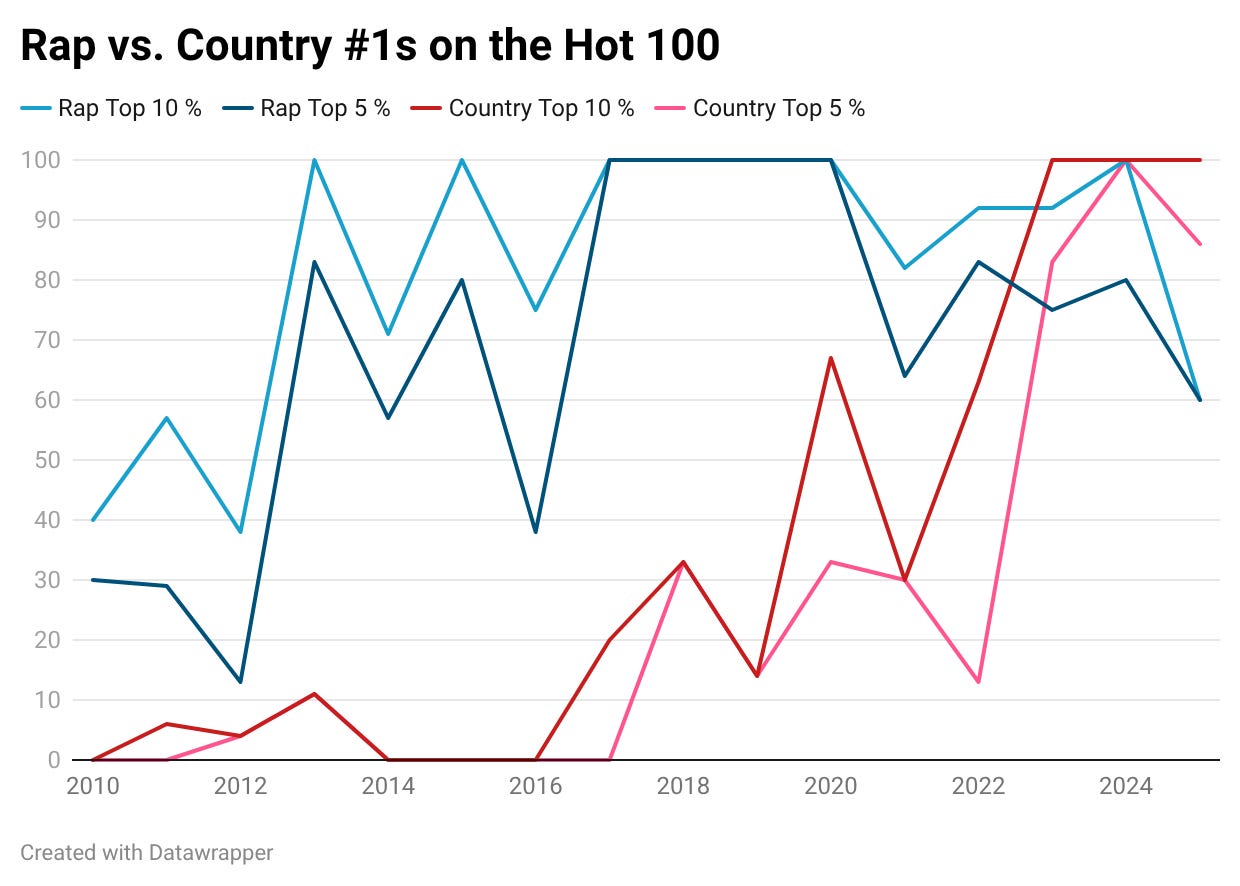
From 2010 to 2020, 86 songs went #1 on the Hot Rap songs chart and 79% of those songs became a Hot 100 top ten hit. These hits aren’t evenly distributed. The story of Rap #1s during the 2010s goes from underdog, to contender, to absolute domination. To illustrate this, let’s look at the most dominant rapper of this period, Drake.
In 2012, Drake’s “The Motto” managed to spend 14 weeks at #1 on Hot Rap songs without cracking the top ten of the Hot 100. By 2015, a song like “Hotline Bling”—tied for second most weeks at #1 on the Rap chart that decade with 18—was reaching a very comfortable top five peak of #2 on the Hot 100. From 2017-2020, though? Drake had four #1 hits on Hot Rap Songs, each hitting #1 on the Hot 100 for 30 total weeks.
Beyond Drake, across Rap #1s from 2017 to 2020, every one hit the Hot 100 top five, but that golden era wasn’t made to last forever. Since then, rap took a dip that it has never fully recovered from. Again, Drake proves illustrative, with his takeover of pop music beginning to wane in 2020 to 2022. His four Rap #1s of this period each hit #1 on the Hot 100, but for only one week, compared to the eight-plus weeks for earlier hits.
Then in 2022, the unthinkable happened: Drake’s “Rich Flex” with 21 Savage missed #1, peaking at #2 on the Hot 100. Beyond rap’s top performer, 2021 saw a massive drop in rap top fives from 100% down to 64%. Despite some uptick in between, 2025 left rap even worse off, with only 60% of #1s making the top five. This was matched in top tens, the lowest percentage to reach the tier since 2012.
Part of rap’s decline can be attributed to the timeless story of a sound or style becoming so dominant that it’s no longer cool. As Daniel Parris writes, one hypothesis for rap ceding the top spot is that like rock before it, rap became so commercially saturated that it lost its affiliation as the music of youth culture. But where Parris sees rap’s failure to keep innovating, I see rap failing to adapt to the sonic landscape of the 2020s in a way that goes beyond just cultural momentum.
Country’s Rise Is Part of a Sonic Shift in Pop
From 2010 to 2020, 79% of rap #1s went top ten while only 6% country #1s did the same. In the 2020s, though, trends began to change and country saw an uptick in popularity. There was only one country star who dominated the transitional moment the way Drake did in the late 2010s: Morgan Wallen.
In 2019, his first Country #1, “Whiskey Glasses,” only peaked at #17, but his next five #1s all went top ten on the Hot 100 from 2020 to 2022. The takeoff really accelerated in 2023, though, when “Last Night” hit #1 on the Hot 100, going on to spend a massive 16 weeks at #1.
With Wallen leading the charge, 2023 became the first year where every country #1 also hit the top ten on the Hot 100. Since then, he has topped the Hot 100 three more times, including six weeks alongside Post Malone on “I Had Some Help” for a total of 24 weeks at #1.
Beyond Wallen, every country #1 over the last three years has gone top ten on the Hot 100, showing just how strongly the genre is resonating with mainstream audiences. While artists like Beyoncé and Post Malone are following suit explicitly, it’s not as though every #1 on the Hot 100 is a country song. What we do see, though, is that on average, #1s sound a lot different than they did in the 2010s, and the trends line up well with country’s traditional sound.
In the late 2010s, the sonic elements that made rap songs of the era popular—like strong basslines, synth production, and danceability—were present across pop. Taylor Swift was topping the charts in 2015 with bombastic, bass-y pop songs like “Bad Blood,” which included a rap verse from Kendrick Lamar. Meanwhile in 2025, Swift’s #1-charting “The Fate of Ophelia” uses piano, hand claps, and live instrumentation.
The actual sound of popular music in 2025 is significantly different from that of the 2010s, and we can measure this using Spotify metadata. The streamer assigns scores out of 100 to every song in categories, like “acousticness” and “danceability,” that allow us to numerically track what sounds are trending. Weighted for total weeks spent at #1, the chart below shows danceability on the y-axis and acousticness on the x-axis for all the #1 hits of 2015 and 2025.
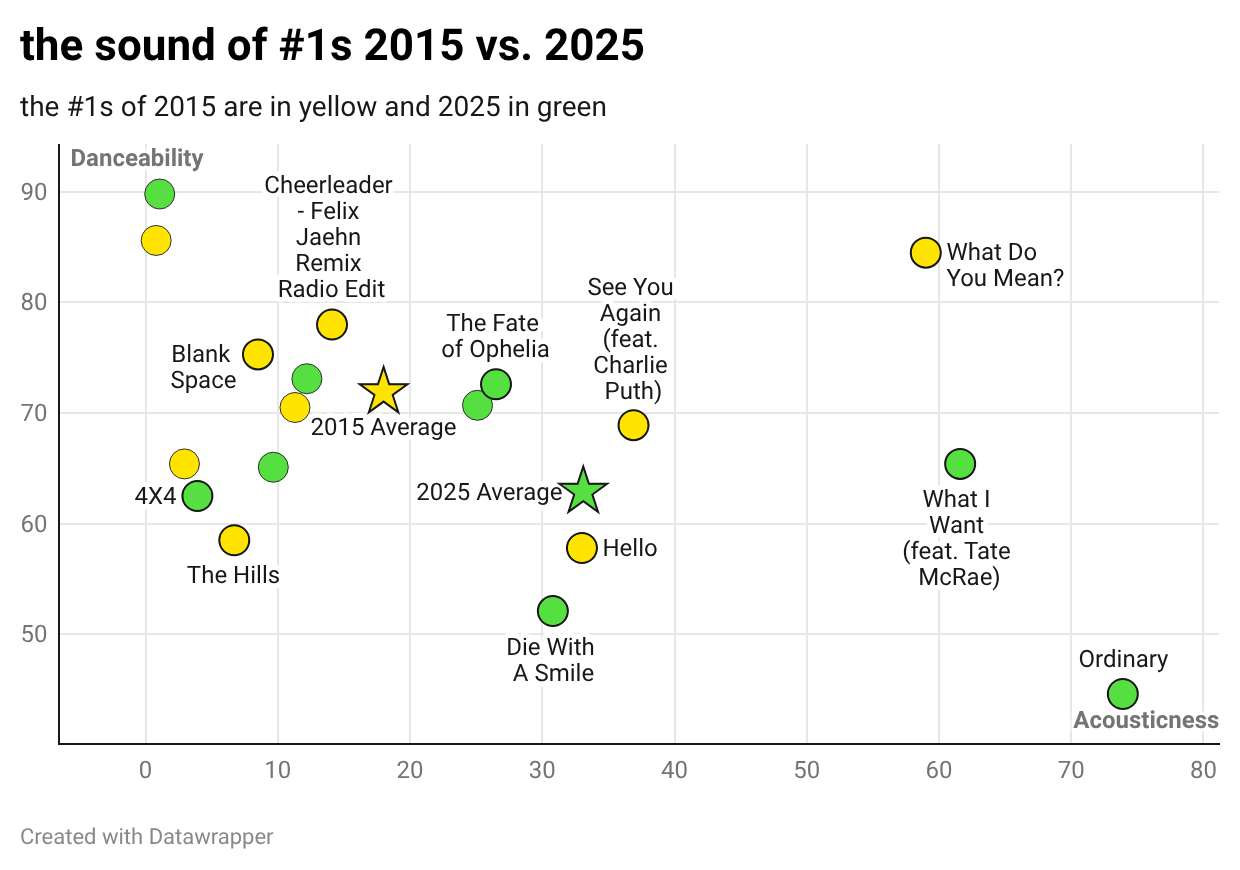
From 2015 to 2025, the average song dropped 10 points in danceability while becoming 15 points more acoustic. This means an outlier for 2015 like “Hello” by Adele (58 danceability, 33 acousticness), would be pretty close to the norm in 2025 (63 average danceability, 33 average acousticness). This includes tracks across genres, like “Ordinary” by Alex Warren and “Manchild” by Sabrina Carpenter, but has provided an opportunity for country music in particular to take over the charts because its sound is aligned with the broader trends.
Country’s traditional sound, leaning on acoustic-sounding live instruments and without the sort of percussion and bass styles that make a song “danceable,” is particularly well-suited to the sonic moment. But that doesn’t explain why rap as a genre isn’t adapting to the moment.
Is It Too Late For Rap to Stage a Comeback?
Rap of the 2010s relied on rhythmic basslines and synthesizers (or samples) rather than live instrumentation, sounds that are no longer topping the Hot 100. But rap originated as “rhythm and poetry,” in reality a style of vocal delivery more than a specific production sound. There’s no reason that rappers couldn’t adapt to the rising acousticness while retaining the core identity of Rap.
In fact, Kendrick Lamar provides us with a great example of what happens when rappers do adapt. He had two shorter-running Hot 100 #1s in 2024 with “Squabble Up” (1 week) and “Not Like Us” (3 weeks) built around more typical 2010s Rap sounds: synths, 808s, and drum programming. However, follow-up single “Luther” featuring SZA opens with guitars and is built around a serene Luther Vandross sample and orchestral elements. “Luther” went on to spend 13 weeks at #1, more than three times the total of the previous two singles combined.
In general, though, rappers are not taking this route and are seeing fewer rap hits on the Hot 100 as a result. Compare “Luther” to fellow 2024 Rap #1 “Sticky” by Tyler, the Creator. While the latter always hits hard on my gym playlist, the production just isn’t suited to the sounds of the moment. Where Kendrick hit #1, Tyler only reached #10.
Rap is coming out of a period where the songs that were most popular among rap fans were also the most popular songs in America. While that’s not the case today, music fans love a comeback (in fact, I’ve published a whole series about “resurrection” in pop music). Rap’s late 2010s streak was actually a comeback: in 2003, five Rap #1s went #1 on the Hot 100, then in 2012 not a single one did, before Drake eventually led a rebound for the genre. Country has gone through ebbs and flows of popularity, too, as Chris has previously written about.
Rappers will need to decide whether they want to lean into what’s popular, or double down on making the sort of songs that were hits in the late 2010s. Kendrick shows us that rap can still hit #1, but leaning into the mellower sound of the moment makes it more likely to connect with wider audiences.
In 2026, Country has ascended to the top and Rap is just doing its best to stay afloat on the charts. The thing about pop music, though, is that as soon as we adapt to the new normal, you can be sure another trend is coming to take its place. By 2030, if not sooner, you can expect the takes on the death of country music to start piling up. Maybe then I’ll be writing a follow up on the emerging dominance of polka.
Want more stories like this? Subscribe to Track Ten, a data-driven newsletter from a pop music obsessive.
Want more from Chris Dalla Riva? Get a copy of his debut book, Uncharted Territory: What Numbers Tell Us about the Biggest Hit Songs and Ourselves.

I think that country has adopted some of the style of rap over the last several years. More songs with spoken words and/or simpler melodies and fewer harmonic vocals. Not all of it obviously, but enough to broaden the base. Credit to some very creative artists who managed to blend what were two very distinct styles.
Cool use of the Spotify danceability score and such!
Your thoughts at the end, outlining a potential path forward for rap, are insightful. Recent years we have seen some more acoustic live performances in hip-hop get shining feedback, such as nobigdyl.'s annual "unplugged" concert where he plays new arrangements of his songs with an all-live backup band. It's sold out several years in a row, and he even released a successful live album from it. Your data here certainly helps illuminate why those performances, and similar, would resonate so well with audiences.