


Something very strange happened to me last week. I posted something to Instagram that flopped. That itself is not strange. My posts flop all the time. What’s strange is that Reese Witherspoon tagged Sheryl Crow in the post and Sheryl Crow responded. I’m still very confused.
Anyway, that has nothing to do with what we are going to be talking about today. I just felt like I had to tell someone. If you enjoy the stuff that I do here, consider purchasing a copy of my book Uncharted Territory: What Numbers Tell Us about the Biggest Hit Songs and Ourselves. It’s a data-driven history of popular music that I wrote as I spent years listening to every number one hit in history.
Against Cultural Stuckness
By Chris Dalla Riva
A few weeks ago, Willa Paskin’s excellent podcast Decoder Ring weighed in on a question that people just can’t seem to get enough of: Is culture stuck? Paskin opened up the episode with an anecdote from her life:
A funny thing happened to me a couple of months ago. I was in the car with one of my children. She’s 10 years old, and she started out of the blue, not off the radio or anything, singing a song that I did not know she knew, [Kelis’s “Milkshake.”]
My daughter was not born when this song, “Milkshake” by Kelis, was first released in 2003 and became an inescapable top 10 hit. But, of course, I was. So, I started to sing along. And when I started to sing, my daughter looked at me in true surprise. She could not believe that I knew this song. The song that, as far as she was concerned, was a new song for young people, not an old song for old people like her mother. Turns out she knew “Milkshake” because it had been used in a GAP ad being danced to by the girl group Katseye.
The commercial spiked streams of the song and kicked off a viral dance challenge that had reached fifth graders across the world. I’ve thought about this moment frequently since it happened. I listened to a lot of my parents’ music as a kid, and I liked a lot of it. But I don’t think I once mistook their music for my music, for contemporary music, for music for young people. And that’s because for much of the 20th century, every generation’s music was very obviously different than what came before.
Paskin is expressing the core thesis of culture being stuck. You would never confuse a song from 1963 as being from 1983, but you could easily confuse a song from 2003 as being from 2023. The rate of musical change has really slowed down over the last few decades.
I think this claim is overstated for a few reasons. First, people often conflate a change in sonic quality for a change in musical style. Yes, popular music changed very rapidly during, say, the 1960s, but part of the reason it sounds so different from music of the 1930s is that the quality of sound got dramatically better. This was not the case between 1990 and 2020.
Second, these examples are often cherry-picked. Sure, there are some sonic signifiers in “Milkshake” by Kelis that are emulated today, but if you go look at the entire year end Hot 100 from 2003—the year “Milkshake” came out—you will see tons of music that you would never think came out recently.
Relatedly, while there were dramatic changes between the 1970s and 1980s, for example, I think we understate how consistently popular certain styles have been. Big, mellow dramatic ballads have played well during every decade of the 20th century. If we focused on those, it would look like culture was stagnant.
Finally, each time someone implies that young people are listening to more old music than new music, I must remind them of this chart from Luminate, the data-aggregator that powers the Billboard charts. Among all listeners in 2024, nearly 80% of streams were for music released after 2010, with a heavy skew toward the most recent years. A fifth grader listening to a song from 2003 is not common.
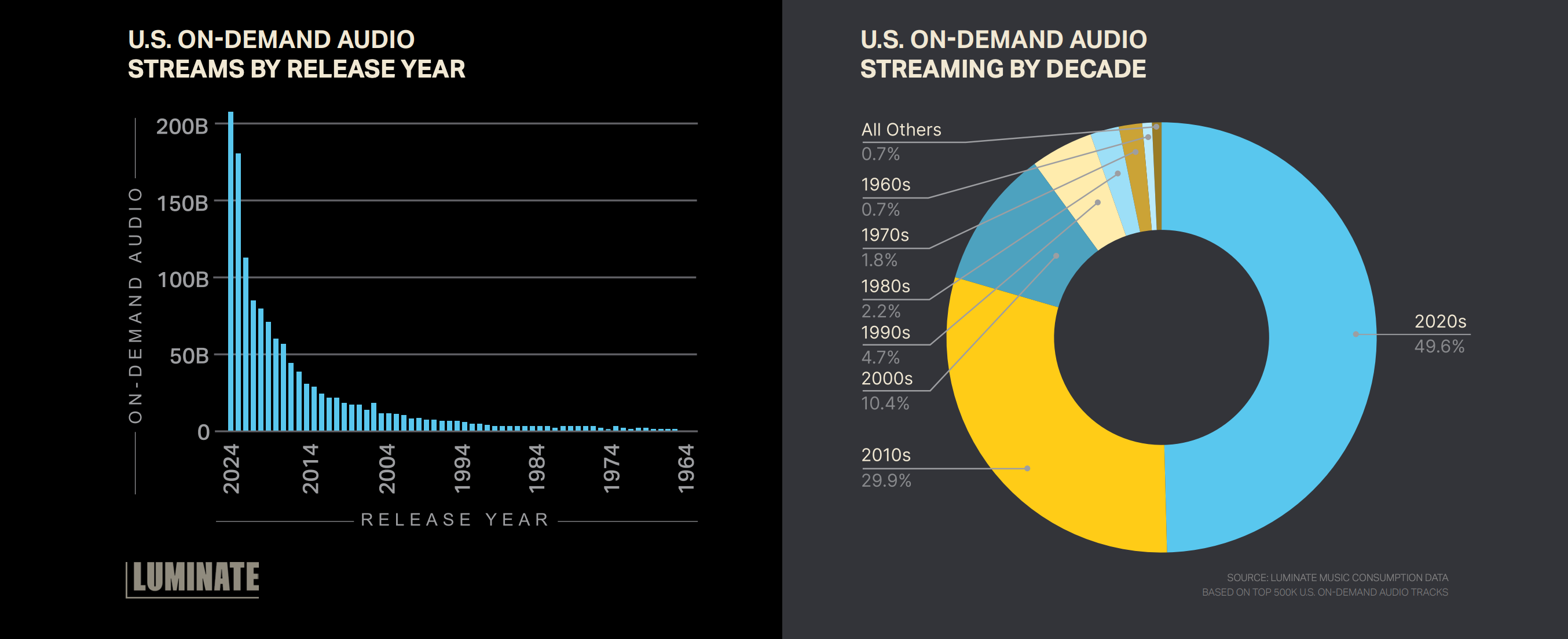
Is it more common than earlier periods? I’m not sure. Streaming distorts this data. Older music is more accessible than ever before, and current charts count consumption. Back in the day, charts were largely driven by purchases. If you already owned The Beatles catalog and wanted to listen to them in 1985, that wouldn’t come up on the charts. Today, your listening could push The Fab Four onto the Hot 100.
This is not to say that I don’t harbor any concerns about cultural stagnation. Last year, I wrote a piece about how exorbitant copyright terms lead to less investment in the future of culture. A few months before that, Adam Mastroianni wrote a great piece on this topic. Still, I think these claims are overstated, especially in music.
To further explore this topic, I want to look at the 2010s. If popular music were truly stuck, we would expect the most recently completed decade to not see any musical evolution.
Were the 2010s Different from the 2000s?
I find the 2010s to be a fascinating decade because this is the decade that culture supposedly went to die. Streaming services took over the music industry. Superhero sequels dominated the box office. Reboots took hold of television.
Again, I won’t argue that these claims totally lack merit. But I think when you look at the details of popular music, you’ll see that things did change sonically in many ways during this decade.
I associate the beginning of the 2010s with both pop maximalism and stomp clap folk. The former is best illustrated by Katy Perry’s Teenage Dream, and the latter is captured by Mumford & Sons’ Babel.
The instrumental make-up of these genres is different. Pop maximalism was mostly crafted on computers, while stomp clap was built around acoustic guitars and banjos. That said, they both shared thumping rhythms and massive choruses. In fact, a song like “I Will Wait” by Mumford & Sons bears tremendous structural similarity to the big, electronic pop hits released around the same time.
I don’t think either of these sounds were particularly revolutionary. But they were specific to this era, so specific that when I see the popularity of someone like Noah Kahan in the 2010s, it’s clear that he is paying homage to Mumford and Sons and The Lumineers and other stomp-clappers of the 2010s. Still, I think other sounds that emerged during the 2010s represented radical shifts. Let me give you three examples.
1. Dubstep
Originating in the United Kingdom in the 2000s, dubstep crossed over into the mainstream in the US during the 2010s with the rise of artists like Skrillex. Dubstep is a dark electronic genre characterized by syncopated rhythms and buzzsawing synth basslines.
From Justin Bieber’s “As Long As You Love Me” to Britney Spears’ “Hold It Against Me,” dubstep breaks were commonly heard in pop songs during the first half of the 2010s. Taylor Swift even gave one a try on her 2012 hit “I Knew You Were Trouble.”
2. Trap
As I note in my book, “Trap is a branch of hip-hop defined by hi-hats exploding in short bursts at inhuman speeds, booming 808 kick drums that double as bass lines, and dark lyrics focused on street life.” Like dubstep, the genre emerged before the 2010 but only came to infect every form of pop music later. By the end of the 2010s, it was rare to hear a major pop hit without a tittering trap hat.
While notable rappers in the 21st century’s first decade, like T.I. and Gucci Mane, helped push the genre to the fore, the strain of trap that dominated the 2010s was so distinct that you couldn’t mistake it as coming from an earlier time period. The genre redefined how rhythm and bass lines work in pop songs.
3. Internet Rap
Online music platforms of the 2010s also helped incubate new styles. These styles are referred to by many different names, including melodic rap, mumble rap, and emo rap. Though these styles co-opted some of the aesthetics of trap, they were distinct.
To turn my book again, these genres “traded the wordiness that typically characterized hip-hop for hazy, dreamlike atmospheres.” Songs in this genre, I go on, “feel like hip-hop songs shot with a tranquilizer, MCs functioning more like lethargic singers than rappers.” You would never confuse the rappers associated with these scenes, like Juice Wrld and 21 Savage, as having emerged in any other era.
The Max Martin of It All
Max Martin is arguably the most successful songwriter of all-time. Since Britney Spears topped the charts in 1999 with his “…Baby One More Time,” he has been an unstoppable musical force. He has produced more number one hits than anyone ever and has written more number one hits than anyone other than Paul McCartney.
Max Martin has never invented styles of music. He is an unparalleled melody writer who can apply his skills to basically any style. Here are a handful of songs that Martin has worked on over the last 30 years:
“I Want It That Way” by Backstreet Boys (1999)
“U + Ur Hand” by P!nk (2007)
“California Gurls” by Katy Perry (2010)
“Style” by Taylor Swift (2015)
“Blinding Lights” by The Weeknd (2020)
While you might be able to argue that this is further evidence that nothing changes, I think it’s more exemplary of the fact that whatever styles Max Martin is working in are the styles that are popular.
He helped craft Kelly Clarkson’s “Since U Been Gone” during the pop punk boom of the 2000s. He made stomp clap go full pop maximalism on Taylor Swift’s “We Are Never Ever Getting Back Together.” He was playing with dubstep drops on Justin Bieber’s 2012 Nicki Minaj collaboration, “Beauty and a Beat.” He even used trap hats to flesh out the percussion on Ariana Grande’s 2019 smash “break up with your girlfriend, i’m bored.”
Sure, you can convince me that the shift in popular music between 1958 and 1978 was more radical than that from 1998 to 2018. But I need everyone to stop pretending that nothing has changed on the radio in the last few decades. If you think everything sounds the same, I implore you to expand what you are listening to.
A New One
"Omens" by EsDeeKid
2026 - UK Trap
Some of the most unique music I’ve heard in the last year has been from EsDeeKid, an anonymous British rapper who has been on the come up over the last few years. Though his music is defined by trap aesthetics, it is packed with strange, syncopated rhythms that you are more likely to hear in a jazz song. “Omens,” his latest single, illustrates these points well.
An Old One
"Road" by Nick Drake
1972 - Singer-Songwriter
My friend Ken and I have been listening to a different album every day this year. Two weeks ago, we listened to Nick Drake’s Pink Moon. Pink Moon is a spare acoustic record that sees Drake experimenting with unexpected tunings and inventive arpeggios.
Had I not listed the year this record came out, I think many people would have a hard time pinning it down. Over the last 20 years, there have been scores of folksy artists who have experimented with a similar sound. You could take that as a point in favor of cultural stagnation. But you could also take it as a point that there are certain sounds that just feel contemporary, whether they were originally made in 1972 or 2002. This is not a totally new phenomenon.
Thanks for reading. If you enjoy my work, please consider ordering a copy of my forthcoming book Uncharted Territory: What Numbers Tell Us about the Biggest Hit Songs and Ourselves. It’s a data-driven history of popular music that follows my journey listening to every number one hit from 1958 to 2025.
Interesting piece. Personally I'm more interested to see an analysis from 2016 to now. It seems that is when the relative musical stagnation is the most obvious
Great Piece! Stomp clap makes me think of the music on suburban supermarket playlists - every song has this distinctly yell at the top of your lungs chorus a la Imagine Dragons. I blame the Champions League theme song and the intro to QOTSA "no one knows" for starting it lol