


Chris here. Between my wedding, honeymoon, and all related matters, I will be pretty busy throughout this month. Because of that, some friends have volunteered to take over this newsletter while I’m away. Today’s piece comes from John Taylor, the writer and “Billboard chart nerd” behind Time to Play B-Sides.
I’ve always been fascinated with how tastes in popular music differ across country borders. I think the differences are especially interesting between the US and the UK given that those two countries share so much culture. Taylor decided to do a deep dive into this phenomenon. If you enjoy this piece, subscribe to his newsletter.
Big in the UK, Not So Much in the US
By John Taylor
Let’s start with an easy one. Well, easy if you live in the UK, perhaps. Which artist played the very first note at Live Aid back in 1985? It’s easily one of the most popular British bands of all time with 50—count ‘em 50— visits to the Top 40. They had the place of pride at the biggest music festival the world had seen, and it was well deserved.
So, who was it? It was the mascot for “Big in the UK, Not So Much in the US” … Status Quo.
Status Quo is a great band—legendary in some circles—but not many of those circles can be found in the US. “Classic Rock” stations play “Sympathy for the Devil” and “Hotel California” 20 times a day, but they’ve probably never played “Rockin’ All Over the World” (the song that opened Live Aid) or even their huge hit “Down Down.”
I’ve been spending the past couple of weeks going down a rabbit hole looking at artists and songs that were extremely popular in the UK in the 1970s, 1980s, and beyond but were—for a number of reasons I will soon present—somewhat of an afterthought here in the U.S.
NEVER HEARD OF YA, MATE
As I went through this exercise, there were more than a few bands I have never heard of:
Alvin Stardust
Blue Mink
Brotherhood of Man
C.C.S.
Chicory Tip
Darts
Dollar
Mr. Bloe
Mud
Demis Roussos
Showaddywaddy
Smokie
The Wombles
Each one of these artists were at least semi-regulars on the UK charts for several years—Mud and Showaddywaddy were absolutely HUGE—but they are, for all intents, complete mysteries in the US. So, why is that?
Today, popular music is (excuse the obvious reference) a worldwide web of interconnections. If you like a particular genre of music, a particular song or an artist, the algorithms will quickly jump in and guide you to other music that’s just like it … no matter where in the world you are, or where in the world the music comes from.
In the past, though, there were a lot of walls that stopped music from flowing across oceans. Most everything was local, if not parochial. The news was whatever your local TV news or newspaper said it was. The only “influencer” was your favorite deejay, or, at the very least, Casey Kasem.
So it’s not surprising some music never made it off the shores on which it was originally created.
Let’s start by looking at a few bands you probably have heard of. You might not be able to name many of their songs, but they’ve seeped into American popular culture over the years.
BIGGER THERE THAN HERE.
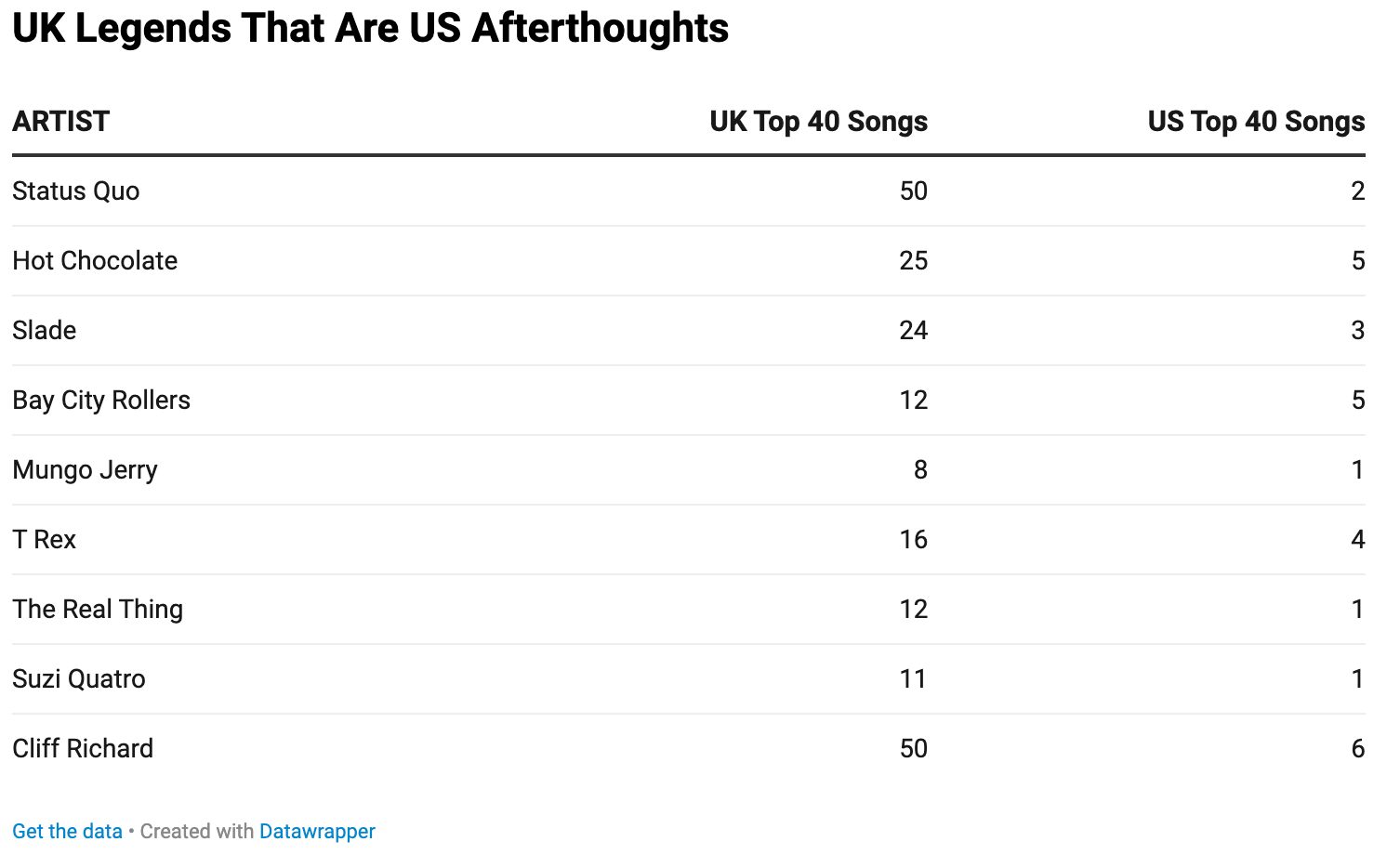
Of course, you know Mungo Jerry. For goodness sake, they had one of the biggest hit singles of all-time with “In the Summertime”—big in the US and across the globe. It remains, nearly 60 years after it was recorded, one of the ultimate vibes songs. It’s sold in excess of 15 million singles. But Mungo were no one-hit wonders in their home country and across Europe as they were in the US.
We know Hot Chocolate from “You Sexy Thing” but not a lot else. And, as successful as The Real Thing were in the UK, they never broke through in the States. Boney M were the biggest European hitmakers this side of ABBA. In the US, you maybe, maybe heard “Rivers of Babylon.”
And, if an American knows Suzi Quatro, it probably for her epic performance as Leather Tuscadero on the TV show Happy Days, not for her hit-after-hit across the pond.
If you take out “Merry Christmas Everybody” which re-charts pretty much every year, Slade had another 25 Top 40 hits, including 6 Number Ones. Slade is mostly known in the US via the Quiet Riot cover of their “Cum On Feel The Noize”— but gems like “Take Me Bak ‘ome” and “Mama Were All Crazee Now” are largely a mystery to U.S. audiences.
The British public loved a good teenage heartthrob. So David Soul, the man who played Hutch—a one-hit wonder stateside (“Don’t Give Up On Us”)— had 2 UK Number Ones and 4 top 20 hits overall. David Cassidy has been in the UK charts 10 times, twice as many times as he hit stateside (where he never hit #1). The Osmonds were so big, even 9 year-old Little Jimmy Osmond had a #1 (“Long Haired Lover from Liverpool”) and their Donny-less attempt to rock out, “Crazy Horses” went to #2.
Here’s the part where I pompously present a few of the reasons I think certain songs and artists never hit as hard in America as the did in England.
GLAM DIDN’T TRAVEL
With a few isolated exceptions, glam didn’t land in the US. Sure, folks were quite aware of Bowie’s Ziggy Stardust persona. One of the greatest and most influential American bands ever, the New York Dolls, paid very close attention. Some American glam-adjacent bands tickled the fringes of the Top 40, but, for the most part, glam and glitter seemed to lose something in translation. In the UK, though, glam ruled defiantly.
T. Rex were the pacesetters, with every single they released between October 1970 and December 1972 hitting #1 or #2. US fans are certainly aware of “Get it On,” but what about #1 hits “Telegram Sam” or “Metal Guru”?
David Essex, had over 20 UK chart hits over nearly 15 years. In the US, he’s known only for the execrable “Rock On.”
Sweet were said to have created the template for the glam/glitter hit. They had some nibbles in the US, most notably “Little Willie” and “The Ballroom” Blitz.” But they never hit like they did in the UK charts where they had 15 Top 40 songs which spanned a decade. Sweet helped light the path for bands such as Wizzard, and, some might argue, the aforementioned Slade.
One thing we might be thankful for is that the contagion known as Gary Glitter was largely isolated to the UK. No need to sully this article with a retelling of Glitter’s horrendous crimes. Before he was caught, Glitter had 12 Top 10 hits. His sound was so popular that his backing band, The Glitter Band, had another 7 top 40 hits on their own.
THE WEST INDIAN INFLUENCE
With travel between the Caribbean and Britain becoming more prevalent following WWII, West Indian music began to influence British popular music in ways that would not reach the U.S. until years later. Although Harry Belafonte and his calypso were extremely popular in America beginning in the 1950s, there was a greater diversity of Caribbean sounds heard in Great Britain, particularly following Jamaican independence in 1962.
Millie Small had a huge hit with “My Boy Lollipop”, but that was considered a novelty, a one-off. As the 1960s rolled into the 1970s, reggae- and ska-tinged songs started to become hits. The movement really gained steam in April of 1969, when Desmond Dekker and the Aces took “Isrealites” to #1.
In 1970, the duo Bob & Marcia put their spin on Nina Simone’s anthem “To Be Young, Gifted and Black”, which peaked at #5 in March of 1970. Here are a few other Carribean-flavored hits that remained unknown in the US:
“Montego Bay” Bobby Bloom
“Return of Django” The Upsetters
“Johnny Reggae” The Piglets
“Double Barrel” Dave and Ansell Collins
“Uptown Top Ranking” Althea & Donna
By the time Clapton’s snoozy, milk-mild take on “I Shot The Sheriff” gained attention in the US, the UK had been giving rapt attention for almost a decade.
IT’S JUST SO BRITISH
Before worldwide mass media and the internet began to homogenize popular culture across the English-speaking world, there were hit songs—novelties mostly—that never left the shores of England. The Barron Knights, for example, had 8 top 40 hits. Ever heard of them? Me neither. Looks like they were a British comedy troupe.
Comedians did pretty well on the British charts; and, even if we’re familiar with the comics, we probably don’t know their hit “songs”
“Ernie, Fastest Milkman in the West” Benny Hill
“D.I.V.O.R.C.E” Billy Connolly
“A Taste of Aggro” The Barron Knights
My favorite “it’s just so British” hit has got to be “Moldy Old Dough” by Lieutenant Pigeon, which also happens to be the only UK #1 hit performed by a mother and son. It’s just so weird it could have, just maybe, been a hit if anyone in the US had heard it.
I SAW IT ON TELLY!
Americans had no idea what was going on with televised extravaganzas like Eurovision and Opportunity Knocks.
Folks would see songs performed on their televisions, right in their living rooms and want to capture the moment (and support their country when it came to Eurovision) by purchasing the 45. The best and most famous case of this is ABBA and “Waterloo.”
But there were a number of other artists who owed their success to the TV programs. The Real Thing got their start on Opportunity Knocks, for example, and we’ve seen how popular they became.
The Real Thing notwithstanding, what played best on British TV, it seems, was overly sentimental, often treacly songs. If they were performed by a child, or children, even better. The ultimate example is “Mother of Mine” which shot to Number One after being performed on Opportunity Knocks by 9 year-old Neil Reid.
IN A BRITISH DISCO
Like every other county on the globe, Britain, Scotland, Ireland and Northern Ireland had a disco boom. If anything, it was bigger in the UK and across Europe, where the discotheque was the center of teen and young adult life in big cities and small towns alike.
Here we find our old friends Boney M, who righteously ruled UK and European dance clubs and the pop charts. A couple of family acts found their way from the TV shows to the charts, including The Dooleys, and The Nolans, a sister act that hit the charts 8 times. Speaking of sisters, there was also Bacarra, whose mega hit “Yes Sir I Can Boogie” was, lets just say EXTREMELY influenced by Thelma Houston’s “Don’t Leave Me This Way”.
Okay, okay. I can hear you saying “will you wrap this up already?” I will. But let me leave you with a wonderful UK disco hit, one that is guaranteed to bring a smile to your face. Now tell me why THIS song was never a hit in the US!
Want more writing like this? Subscribe to John Taylor’s Time To Play B-Sides for musical deep dives.
Want more from Chris Dalla Riva? Get a copy of his debut book, Uncharted Territory: What Numbers Tell Us about the Biggest Hit Songs and Ourselves.

Really interesting post. From the other direction: The Outfield sounded about as American as a band could manage, "Your Love" was everywhere over there yet they were a London trio barely anyone at home had heard of. My dad worked with them, which makes me one of the few people in Britain who'd have recognised the name. And the Blur inversion is lovely: a band who defined a British decade, reduced in the States to "Song 2," (or as most of my American friends call it, 'the woo hoo song') the one track that sounds least like them. The Atlantic does odd things to a back catalogue.
Yes! When I moved from the US to the UK, I was shocked to find so many names in music and entertainment that I didn't know, and how different the musical tastes were.
I think you've put your finger of a big difference with sentimentality. And like the Japanese Brits love things that are 'twee,' and they've always put the quirky on a pedestal, two things that are often looked down upon in US culture.
Some of the bands and artists you name are ones I only discovered when I arrived there. Another one was Take That (and Robbie Williams as a solo act), who had had only one hit in the US but were absolutely huge there. I'm now a big fan myself but find none of my US friends and family know who they are.
Eurovision and euro-pop, Americans would wonder "Is this a joke? C'mon, get real!"