


If you enjoy this newsletter, consider ordering a copy of my debut book, Uncharted Territory: What Numbers Tell Us about the Biggest Hit Songs and Ourselves. It’s a data-driven history of popular music covering 1958 to 2025.
Today’s newsletter is another mailbag edition of Can’t Get Much Higher, or the newsletter where I answer reader questions. This month we cover questions about where hit songs fall in album track lists, how jazz musicians make money, the legacy of Captain Beefheart, and so much more.
One of my hobbies—I hope it is not as lame as it sounds—is to create playlists on Spotify of songs that follow similar themes, moods, and eras. I basically listen to albums and add songs that like most from those albums into onto playlists. What I’ve noticed is that songs that are earlier in the album are more likely to end up in my playlists. Granted there might be some bias here because I tend to get excited when listening to an album’s unique sound for the first time. I’m wondering if “better” songs end up earlier in an artists’ album. Is there data to prove this? - Ziev
This seems like a very non-lame hobby. And your question is very interesting. I wrote about it a few years ago. First, I looked at where the most popular track was on the 50 most popular albums on Spotify. Among those albums, the most popular track is one of the first four tracks 60% of the time. I think this makes intuitive sense. You’ve got to put something strong near the front of your album to keep people engaged.
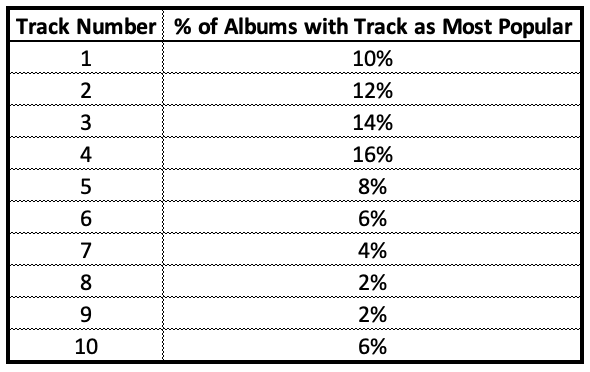
Of course, there is some bias here. First, I’m only looking at 50 albums. Second, albums are different lengths. The earlier track numbers have an advantage because while every album has a track one, not every album has a track eleven.
Given that I work for the streaming service Audiomack, I decided to look at this across more albums but break them up by the number of streams the albums has. The results were fascinating:
People listen to albums differently based on how popular the album and the artist are. For the unknown artists of the world (i.e., artists whose albums are getting fewer than 100,000 streams), listening is focused on singles. Track 3 is the most common place for a single to be located among those albums. Interestingly, we see the same thing with the most popular artists (i.e., artists whose albums are getting more than 10,000,000 streams). Among albums with more than 10,000,000 streams, track 2 is the most common location for a single. Among albums with more than 100,000,000 streams, track 6 is.
I actually don’t think this is that shocking. If you come across a super small artist, you’re probably going to play a single before you play an album. It’s a great way to get a taste of what the artist is about. For superstars, singles can be genuine hits. By definition, people listen to hit songs a lot.
But something strange happens for mid-tier artists (i.e., artists whose albums are getting more than 100,000 streams and less than 10,000,000 streams). These are artists who you might be familiar with, but who don’t have massively popular singles. Because of this, listeners are invested enough to click play on that album, but not invested enough to listen to a single endlessly. Since not everyone is going to make it through your entire album, track 1 is going to be inherently advantaged.

All that said, nearly anyway you slice it, the most popular track on an album is probably somewhere near the beginning. It probably has to do with some combination of human attention spans and artists wanting to put a strong work near the beginning of their record. So, you’re onto something.
What are the economics of artists like Seth MacFarlane, John Pizzarelli, Matt Forbes, Todd Murray, Stacey Kent, Jane Monheit, Erin Boheme, and Jessica Molesky? They have released multiple albums so their record companies must be making some money, but you hardly ever hear about them in the media. Do they sell well? - Jim