


Spotify fascinates me. Not only are they the biggest music streaming service by a sizable margin, but they also have the most legitimate claim to ending the music industry’s decade-plus decline after the launch of Napster. That bigness comes with a price, though.
Spotify also faces much criticism, especially for how they compensate artists. To try to demystify that compensation, the streaming giant has been publishing a royalty report for each of the last five years under the name Loud & Clear. Sam Duboff, Spotify’s Global Head of Marketing & Policy for Music, was nice enough to sit down and talk about this report, along with answering any question that I had about music royalties, independent artists, and AI.
Let’s start with some basic facts. What are the headline numbers from the latest Loud & Clear report from Spotify?
In 2025, Spotify paid out over $11 billion to rights holders. That number is big and exciting. It’s the most any single retailer paid out to the music industry in one year in history. But because it’s such a big number, it’s easy to just kind of get lost in the size of it. So, we are really trying to spotlight the growth rate.
Royalties grew over 10% year-over-year from 2024 to 2025. And this is at a time where other recorded revenue sources are growing closer to 4%. A lot of the story we’re showing with Loud & Clear is not just the size of the payout but that the payout is continuing to grow.
So, what do you think has driven that large increase? Is it subscriber growth? Better ad monetization? Something else?
Subscriber growth is the big thing we continue to make our number one focus. This year is Spotify’s 20th birthday. It’s easy to forget that 20 years ago piracy ravaged the entire industry. Much of our mission from our very founding has been to build a product that inspires people to want to pay for music again. We’ve shipped a ton of new features in the past year that keep users engaged and moving to our premium tier.
Do any specific features come to mind?
I’m most excited about bringing music video and performance video onto the platform. We’re seeing really strong engagement with that so far. It was also one of the biggest requests for years. Though we will always be an audio-first platform, we want video to be a big part of our future. When you fall in love with an artist, we think it’s very powerful if you can see that song performed by the person behind the music.
The report notes that half of that $11 billion in royalties went to independent artists. Could you specify what Spotify means by independent here?
This includes all independent distributors. It includes artists self-releasing to the platform. It also includes the independent distribution arms of major labels, including Warner’s ADA, Universal’s Virgin, and Sony’s The Orchard. We think it’s valuable to look at those who, we assume, probably have different and potentially more favorable deal structures.
Does that also include the Merlin consortium of labels?
Yes, it includes all of Merlin. Our benchmark is really the type of deal that it’s safe to assume artists are getting.
Here is the part of the report that I found the most striking:
In 2025, there were more than 13,800 artists who generated at least $100,000 a year from Spotify alone … There are now more artists generating over $100K a year from Spotify alone than were getting stocked on record store shelves at the height of the CD era.
Artists have always levied a ton of criticism at Spotify for their royalty payouts. When I hear a stat like that, it makes it feel like there’s a general disconnect between actual payouts and artist perceptions. Why do you think that is the case?
That growth is really exciting. But I think criticism from artists comes from a good place. I think the disconnect is due to two factors. First, I think as the biggest platform, we have a lot of responsibility to artists. And we are happy to have that responsibility.
Second, I think attitudes are a lagging indicator of where streaming was a decade ago. It is taking time for people’s perceptions to catch up. A decade ago, the industry only generated $13 billion, $1 billion of which was from Spotify. At the time, there were real questions about if streaming would ever scale to be an economic engine of the industry.
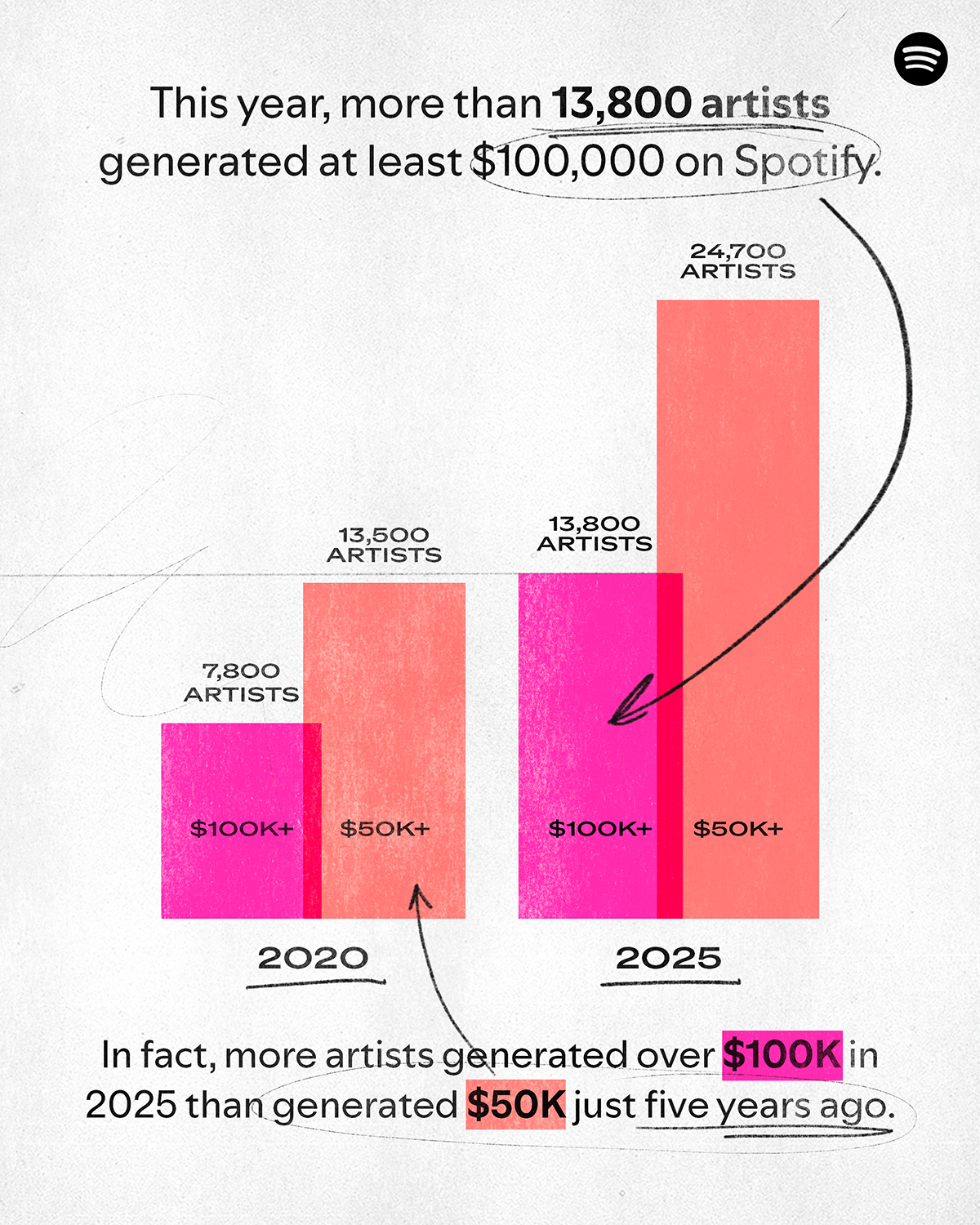
The last 10 years has been proof that streaming can be that engine. It’s also why we are so excited by the 10% growth in royalties in the last year. Even at our size, we continue to get bigger. I think many people’s opinions crystalized long ago. We want Loud & Clear to show people that things are changing. We are at the frontier.
One thing we are really excited about is that 85% of those artists that are generating more than $100,000 in royalties are outside the US. So, it’s new genres, new releases, and new strategies that are driving this growth. In the past, you might have had a leg up if you were in North America or Western Europe. That’s not the case anymore. Spotify represents a global opportunity.
The report notes that two years after debuting, the average artist will see 50% of their royalties coming from outside of their home market. Is it important for Spotify to cultivate a global listener base?
One of our key growth engines in our early years was investing in emerging markets where the music industry was not huge during the CD era. Now, you can see the impact of those efforts with artists like Bad Bunny and KPop Demon Hunters.
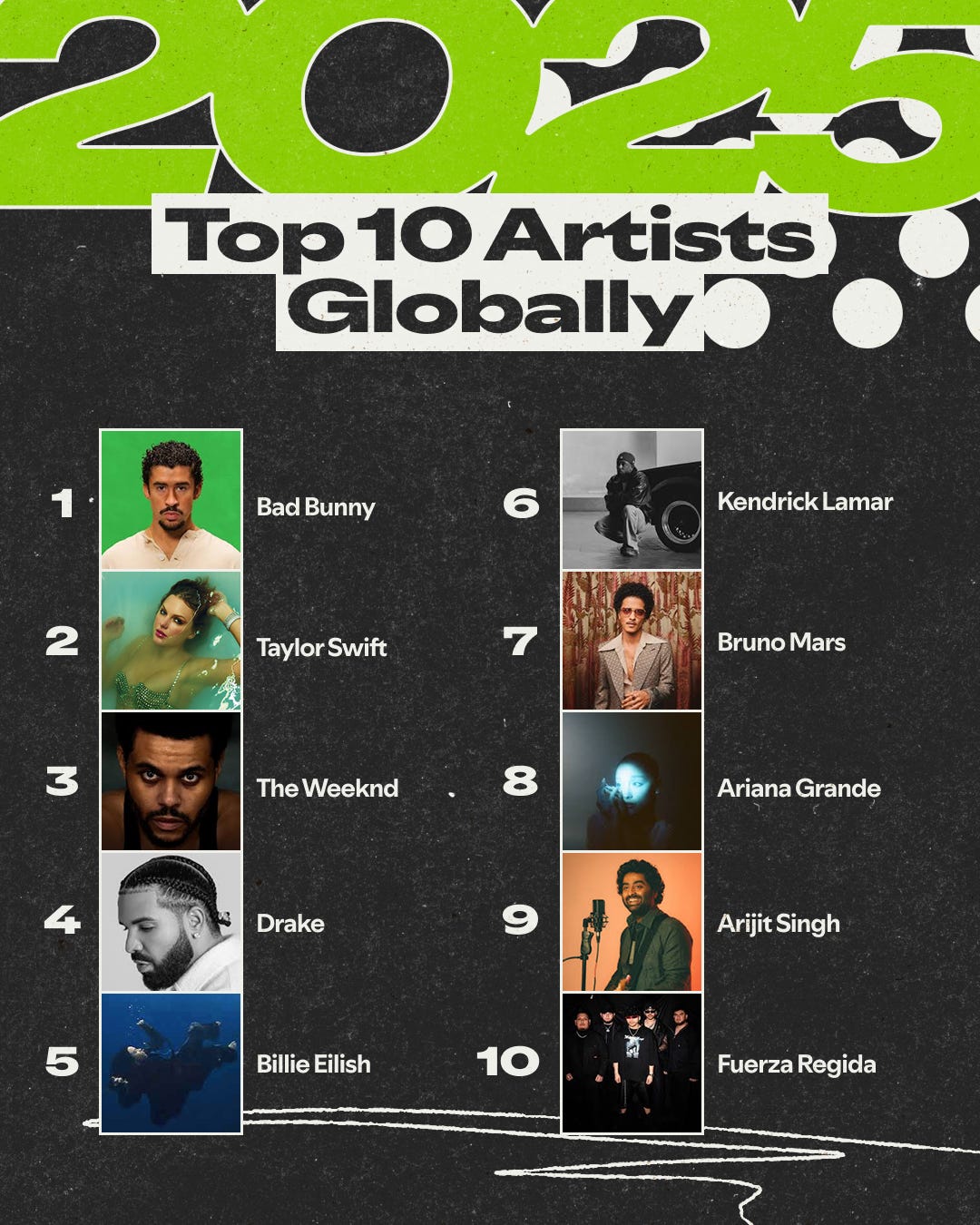
Last year, there were 16 different languages among our global top 50. I think what we’re seeing is that when you remove gatekeepers, fans get to choose what they want to listen to. They listen to languages they don’t speak. They listen to the music that they most connect with. That growth is exciting for us.
I also noticed in the report that you said you’ve driven a billion dollars in ticket sales all time. What efforts does Spotify take to turn casual listeners into people who are going to come out to shows?
We think we can offer a lot in terms of concert discovery. You read a lot about superstar artists that have no problem filling stadiums. Smaller artists are also trying to make it in the live industry, though. We think we can play a unique role in getting listeners to shows. We know where people are. We know what they like. We are trying to build discovery features that leverage location information to let people know when their favorite artists are in the area.
Last year, we launched “Concerts Near You,” which is a personalized playlist where we show you songs from artists who are touring around you in the near future. Then you can click right from the song into the concert listing and buy a ticket. We also launched venue pages, so you could follow the venues you like most. I, for example, follow the Brooklyn Paramount. I’ll go see almost any show there.
25% more artists are using our concert discovery features from last year. And the ticket sales impact is getting pretty significant. We’re hoping that can become an increasingly big part of artist revenue on Spotify.
Does Spotify share in those ticketing revenues? Or does it purely accrue to the artists?
We collect a standard affiliate fee.
A few minutes ago, we touched on some criticisms that are levied at Spotify. Let’s turn back to that. Not long ago, Spotify instituted a 1,000-stream minimum for artists to collect royalties. Can you provide some insight on why that decision was made and if Spotify intends to keep it in place?