


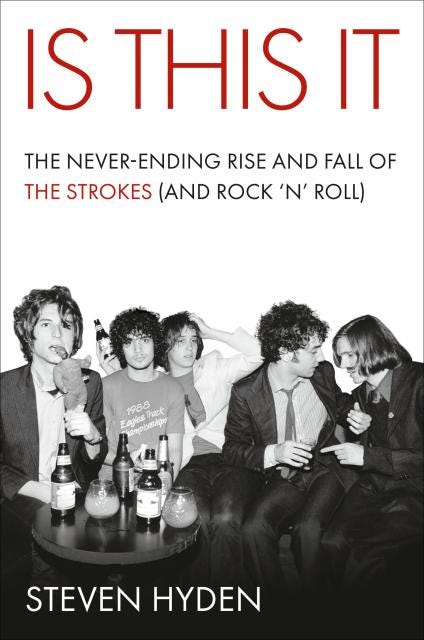
Steven Hyden? Back again? Yes! For the second time in three weeks, we’re talking to journalist and critic Steven Hyden. As I noted during our last conversation, we were initially supposed to talk about his latest book, Is This It: The Never-Ending Rise and Fall of the Strokes (and Rock ‘n’ Roll). But we got carried away talking about the state of music journalism. Because that conversation was so interesting, I sequestered it off by itself.
Today, we’re talking about The Strokes, though. As with any Steven Hyden book, this book is about more than the titular subject. Sure, you get all the gory details about the making of Is This It, but you also get insightful, sometimes hilarious meditations on how the way we think about and experience music has changed in the last 25 years. Whether you’re a fan of The Strokes or just interested in the cultural shifts of the 21st century, I recommend you pick up a copy.
I want to begin with a trivia question. On Spotify’s Rock Classics playlists only four of the 200 songs were released after the year 2000. What do you think those four songs are?
“Mr. Brightside” by The Killers?
Yep.
“Seven Nation Army” by The White Stripes
Nailed it.
What I’m thinking about now is how we define rock. Like does Spotify call “Are You Gonna Be My Girl” by Jet a rock classic?
They do not.
“I Believe in a Thing Called Love” by The Darkness?
Nope.
“Do I Want to Know” by Arctic Monkeys?
No, oddly that’s not there. But let me give you the last two. The first I found unexpected: “No One Knows” by Queens of the Stone Age. But the second is the reason I’m asking the question: “Last Nite” by The Strokes.
Wow. I was assuming you were setting me up for a trick question.
Nope. I start with this question because only four songs from the last 26 years being “classics” says a lot about the state of rock music in the public consciousness. But The Strokes, as you note, were first billed among other things as the saviors of rock. Just to paint a picture of the era, what were they billed as saving rock from? Obscurity? Something else?
I think at the time the idea was that The Strokes were saving genre from the more popular rock bands of the time, which would have been the nu-metal and post-grunge groups. I write about this a lot in the book, but I think the narrative of Nirvana is really important in understanding how The Strokes were talked about when Is This It came out.
I think that there were a lot of critics at the time that were basically transposing what they remembered from Nevermind and putting it on The Strokes. They were going back to this idea that there are cycles in music. You have these periods where things aren’t exciting and then a band comes along that is a revolutionary force.
Honestly, that idea goes all the way back to Elvis and The Beatles. Then in the 1970s, you get that narrative around punk. The same thing happens with Nirvana in the 1990s allegedly displacing hair metal. I say “allegedly” because there were hair metal groups after Nirvana and some are still touring today, like Motley Crue.
Anyway, there were a lot of people in the press that hated groups like Limp Bizkit and Creed. They looked at The Strokes as being the band that derived from the 1970s New York scene that they liked. That said, as I write in the book, I think The Strokes also have a lot of 1990s qualities to them.
How so?
They looked a lot like a band from New York in the 1970s, but I think Nirvana and Pearl Jam really informed how Julian Casablancas thought about music and how he approached being in a band.
But, to get back to your question, they were allegedly going to save rock from the crappy bands that were dominant at the time.
It’s interesting, as you point out in the book, that despite the hype, The Strokes never achieved the popularity of, say, Nickelback and the other groups they were supposedly saving rock from. I assume Nickelback is playing larger venues than The Strokes these days.
The Strokes were playing amphitheaters this summer!

That is true.
But The Strokes are weird because they honestly never toured in a real way in a long time. Like I wrote a book about The Strokes and have been a fan of them for decades, but I hadn’t seen them until this latest tour.
And it wasn’t for lack of trying. It was hard to see them, especially if you lived in the middle of the country and weren’t going to Lollapalooza. They hadn’t played Wisconsin in like 15 years.
That is a long time.
But what was interesting when I finally saw them was that the show was dominated by younger people. This was not a nostalgia show. I was the only gray-beard in my vicinity. These people were there for The New Abnormal. That was their Strokes album. It wasn’t Is This It.
I wish I had written about this more in the book, but there is a weird disconnect between The Strokes’ original followers and this new audience. You’d expect there to be all this nostalgia with older fans and lots of skepticism from the new generation, but it’s the reverse. People who grew up with The Strokes are dismissive of everything they’ve done for at least a decade.
I feel like you note in the book how this is the endless dilemma of The Strokes.
Yes. It’s kind of baked into them. From the beginning, there were two camps: These guys are the saviors or these guys are overhyped. I tried to capture that push-and-pull in the title of the book. I can’t really think of another band like that.
I’m glad you brought this up because I wanted to touch on this phenomenon a little. If you go to The Strokes profile on Spotify, “The Adults are Talking” from The New Abnormal just surpassed “Last Nite” as their most played song. I found that shocking. I feel like you are the master of the artist analogy. Are there any other artists that have a career trajectory like that?