


When Spotify’s former chief economist Will Page told me that he would read my forthcoming book, Uncharted Territory: What Numbers Tell Us about the Biggest Hit Songs and Ourselves, I was nervous. Few people know the music business like Will. You can’t imagine how thrilled I was when he wrote the following after finishing it:
Chris Dalla Riva’s beautiful mind navigates the intersection of culture and data, making us appreciate art by looking and listening again and again.
There are many things that I try to do with my writing, but there’s nothing I try to do more than get you to look and listen at songs you’ve heard many times in new ways. I’m glad that came across to Will. If you want to see what he’s talking about, consider pre-ordering a copy of the book. Now, let’s talk about Rick Beato.
Rick Beato and the Miracle of YouTube
By Chris Dalla Riva
Even when I disagree with him, Rick Beato has my full respect. As I noted in the introduction of this piece, my whole schtick is trying to get people to think about music in new ways. Sometimes I dress that up with numbers and charts, but creating new perspectives is my ultimate goal. There are few people right now who are accomplishing that goal more than Rick Beato.
Rick Beato has been all over the music industry. He’s had record deals. He’s done studio work. He’s produced well known bands. But in the last decade, he’s amassed over 5 million subscribers on YouTube by posting conversations with musical luminaries and in depth analyses of great musical works. In fact, I don’t think anyone else exclusively talking about music on YouTube has a larger audience. Rick Beato has a problem, though.
Like most people who post about music on YouTube, Beato has to occasionally deal with copyright claims. What does that mean? To understand, let’s talk about two things: copyright and the Digital Millennium Copyright Act.
Copyright: A type of intellectual property that gives the owner the exclusive right to distribute, display, adapt, and (of course) copy their creative ideas for a limited time.
Digital Millennium Copyright Act (DMCA): A 1998 law passed in the United States that established how copyright would interact with the internet. The two most important pieces of this law were that (a) it prevented internet service providers from getting sued for copyrighted material being circulated online and (b) it provided a process for copyright owners to get infringing content removed from a website without the need for litigation.
Now, imagine you upload a version of Madonna’s “Like a Virgin” to YouTube. You don’t own the copyright to that song, so Madonna and her team can file a DMCA notice to YouTube and have your upload removed. That seems fair. It’s not your song. If you uploaded that song to any other website, they’d have to follow the same protocol if Madonna complained.
Given the scale of content being uploaded to YouTube, they decided to get a bit more sophisticated, though. First, they scan the audio and video of everything being uploaded to their site and see if it matches any copyrighted material. If it does, it will notify the copyright holder. The copyright holder has three choices.
Take the infringing content down
Leave the infringing content up but collect any revenue associated with it
Leave the infringing content up and let the uploader continue to collect revenue associated with it
This might seem simple, but it has actually allowed YouTube to dominate the world. Search for a random song on YouTube, and you will probably see an upload belonging to the relevant artist. But you will also likely see an upload from a random account. That’s not a problem with YouTube’s content ID system. YouTube takes care of monetization while allowing people to upload freely. This technological miracle has allowed the site to bloom into a bastion of creative freedom.
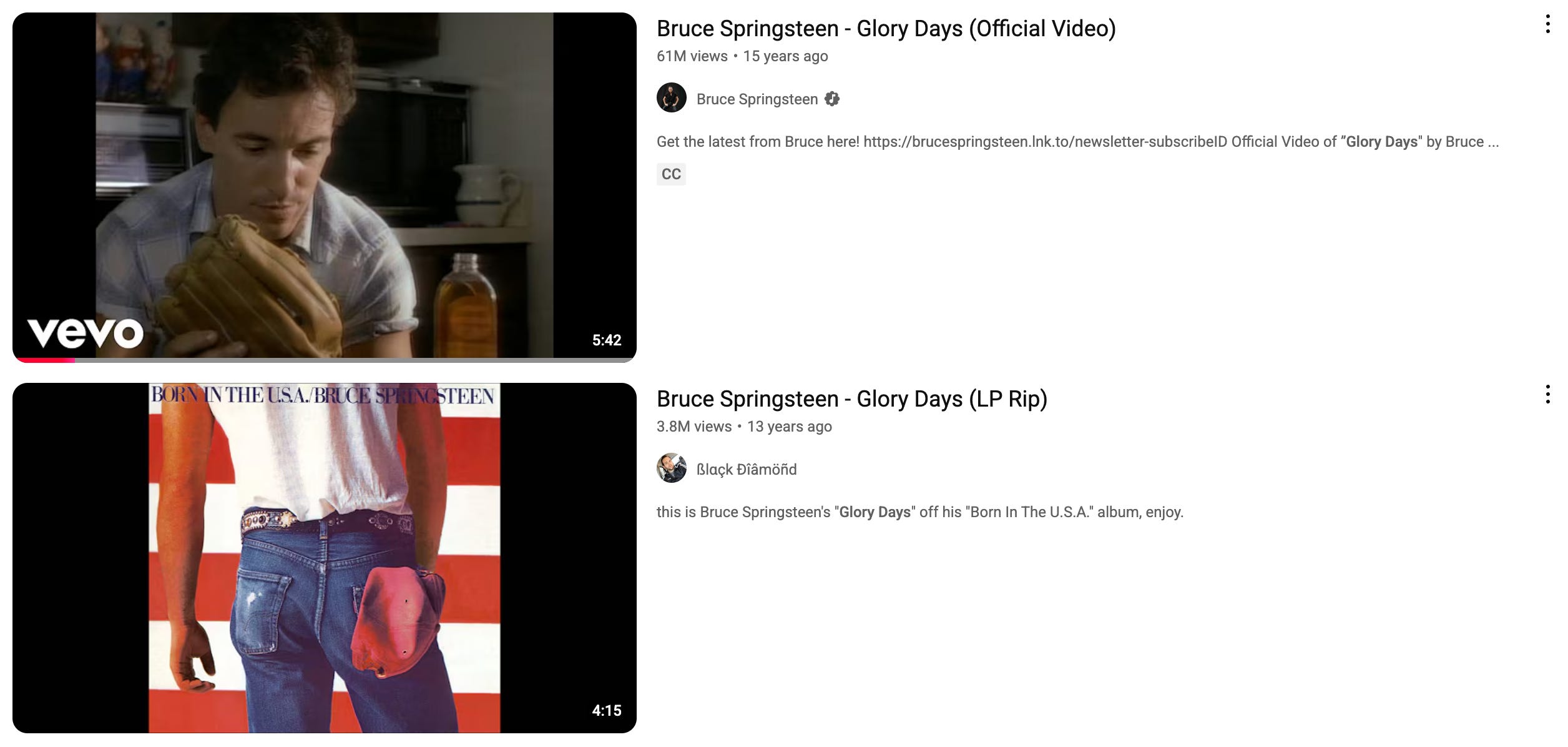
Well, mostly creative freedom. Enter Rick Beato. Throughout most of his videos, Beato includes short snippets of songs, often not longer than 10 seconds. Of course, he does not own the copyrights to these songs. You can’t do that, right? It’s a bit more complicated than that.
In the world of copyright, at least in the United States, there is a concept called “fair use.” Fair use allows people to use copyrighted material without the consent of the original copyright holder, usually for criticism, research, reporting, or education. Fair use is not always straightforward — for example, though my book is a work of history and criticism, I still couldn’t print the entirety of the lyrics to “Ode to Billie Joe” as much as I wanted to — but Beato’s usage seems like it should mostly qualify.
And nobody has given him much trouble until recently. Over the last few weeks, Universal Music Group (UMG) has flooded Rick Beato with takedown notices for scores of his videos. Beato and a lawyer have been fighting these by citing fair use, but the claims have continued to roll in. The problem is that if a YouTube channel gets three successful copyright strikes in a 90-day period, YouTube will remove their channel. That seems like a crazy possibility for a channel with over 5 million subscribers.
So, what is going on here? Why would Universal Music Group be filing all of these copyright claims against a YouTube channel that, in all likelihood, is probably driving more traffic to music in their catalog. I spoke with a friend who works in the label system, albeit not at Universal, and two scenarios struck us.
UMG Doesn’t Know It’s Happening: Along with YouTube scanning uploads, labels are constantly scanning content across the web with the help of companies like Orfium. Many of these claims are just filed automatically. It’s possible nobody within the UMG ecosystem with the power to stop it is aware of this.
UMG Knows It’s Happening: Major labels manage masses of intellectual property. Monetizing YouTube content that they did not upload is part of the business model.
Admittedly, both of these explanations leave you wanting more. Given Beato’s stature, it would be shocking if nobody of consequence knew of the issue. At the same time, he is just a single channel. Collecting the revenue from all of his videos would be a rounding error on UMG’s balance sheet. (Though I have zero evidence of this, part of me honestly thinks somebody might just have beef with him.)
Alas, will Rick Beato’s channel get removed from YouTube? Probably not. There is a very strong incentive from all sides to resolve this without any litigation. Of course, labels and industry groups have the power here, but they try to avoid the courtrooms at all costs for fear that a rogue judge could weaken intellectual property protections. The status quo is desirable, and I would be shocked if it didn’t prevail.
A New One
"100 Horses" by Geese
2025 - Indie Rock
For my money, there are few bands more interesting right now than Geese. Their latest single “100 Horses” illustrates why. It’s a song that goes left when you are expecting it to go right. But not in a way that jolts you. In a way where you constantly saying to yourself, “I didn’t expect that, but I am here for it.” I hope you’re here for it too.
An Old One
"Super Stupid" by Funkadelic
1971 - Blues Rock
Last week, I got into a few internet arguments that aren’t worth rehashing here. But one good thing that came out of them was me getting reminded that Funkadelic threw down some of the hardest rock riffs of the 1970s. In fact, Funkadelic guitarist Eddie Hazel might be on my Mt. Rushmore of guitar gods.
Thanks for reading. If you enjoy my work, please consider ordering a copy of my forthcoming book Uncharted Territory: What Numbers Tell Us about the Biggest Hit Songs and Ourselves. It’s a data-driven history of popular music that follows my journey listening to every number one hit from 1958 to 2025.
Amen on Eddie Hazel. I'm so glad I got to see him with P-Funk before he passed.
I wish they could at least clarify what is and isn't fair use, but I suspect you're exactly right on why no one wants to risk disturbing the status quo. It could backfire on them if the courts end up having to rule on something like this where the laws have almost certainly failed to keep up with the technology. And for most of the parties involved, the current ambiguity can work in their favor. They can ignore some violations when it benefits them to do so, or use the threat of action to control what gets shared.
The party that gets hurt most by ambiguity is (as is normally true) the little guy. Like a person who records videos and doesn't notice that there's music playing somewhere nearby that is audible in the video. Or a church that streams worship music between services and some of it makes it into the broadcast of the service by mistake. Three strikes and the channel is gone.