


Thank you to everyone who has pre-ordered my book Uncharted Territory: What Numbers Tell Us about the Biggest Hit Songs and Ourselves so far! I’m thrilled that the book has been getting some great press. Here are a few favorites from the last two weeks:
Switched On Pop: I joined my favorite music podcast to talk about the Great American Songbook. Actor John C. Reilly also appeared.
On Repeat: My friend Kevin Alexander published a short op-ed that I wrote about AI-generated music.
No Such Thing: I popped one this podcast to weigh in on if Taylor Swift is more popular than Michael Jackson.
The Analytics Power Hour: I chopped it up about music and data with one of my favorite analytics podcasts.
The Music Week: A very cool music newsletter was kind enough to interview me.
New Books Network: I guested on one additional podcast to have maybe the most in depth conversation about the book so far.
If you still haven’t, I’d love it if you picked up a copy of the book. Along with the link below, you can get it from Amazon, Barnes and Noble, Walmart, or basically anyone that sells books. And if you’re in the NYC-area and feeling rather dedicated, you can also come out to our book release party. Now, let’s talk algorithms.
The Algorithm Giveth and The Algorithm Taketh Away
By Chris Dalla Riva
As someone who works on personalization for a music streaming service, I’ve spent a good amount of time in this newsletter dispelling many myths about how personalization algorithms work. I do this because there seems to be fear lurking online when the word “algorithm” comes up.
THE FACEBOOK ALGORITHM IS FEEDING YOU MISINFORMATION!
THE SPOTIFY ALGORITHM IS SERVING YOU AI-GENERATED MUSIC!
THE TIKTOK ALGORITHM IS POISONING YOUR MIND!
While I don’t want to waste my time here trying to support or deny any of those statements, I do want to remind you of two things. First, an algorithm is a very specific set of instructions laid out in order to complete a task, usually by a computer. Second, the aims of those instructions, along with the instructions themselves, are (currently) defined by humans.
Could Facebook be optimizing their newsfeed algorithm to make you spend as much time on the platform as possible? Sure. Might they realize that the best way to do that is to feed you more content that will make you upset? It’s a possibility. But, for that to happen, that decision would have to be actively made by someone somewhere within the Facebook organization.
In the same sense, Facebook could optimize their newsfeed algorithm to lead to user satisfaction. Algorithms themselves are relatively neutral tools. The effects of using a specific algorithm is usually based on choices that we make. But sometimes those choices can have unexpected outcomes.
Spotify, Apple, and Algorithmic Bias
Spotify and Apple Music are two of the biggest music streaming platforms in the world. Of course, we wouldn’t expect the usage of the platforms to be exactly the same. The geographic composition of users isn’t exactly the same. Similarly, the income composition isn’t the same. Along with its monthly subscription, Spotify has an ad-supported tier. Apple does not. Still, we would expect popular songs to be similar on both platforms.
And we generally see that. The top two songs in Spotify history are The Weeknd’s “Blinding Lights” and Ed Sheeran’s “Shape of You.” Those are also the top two songs in the history of Apple Music. In fact, half of the all-time top ten songs on each platform are the same. And the ones that aren’t are still quite popular on the other platform.
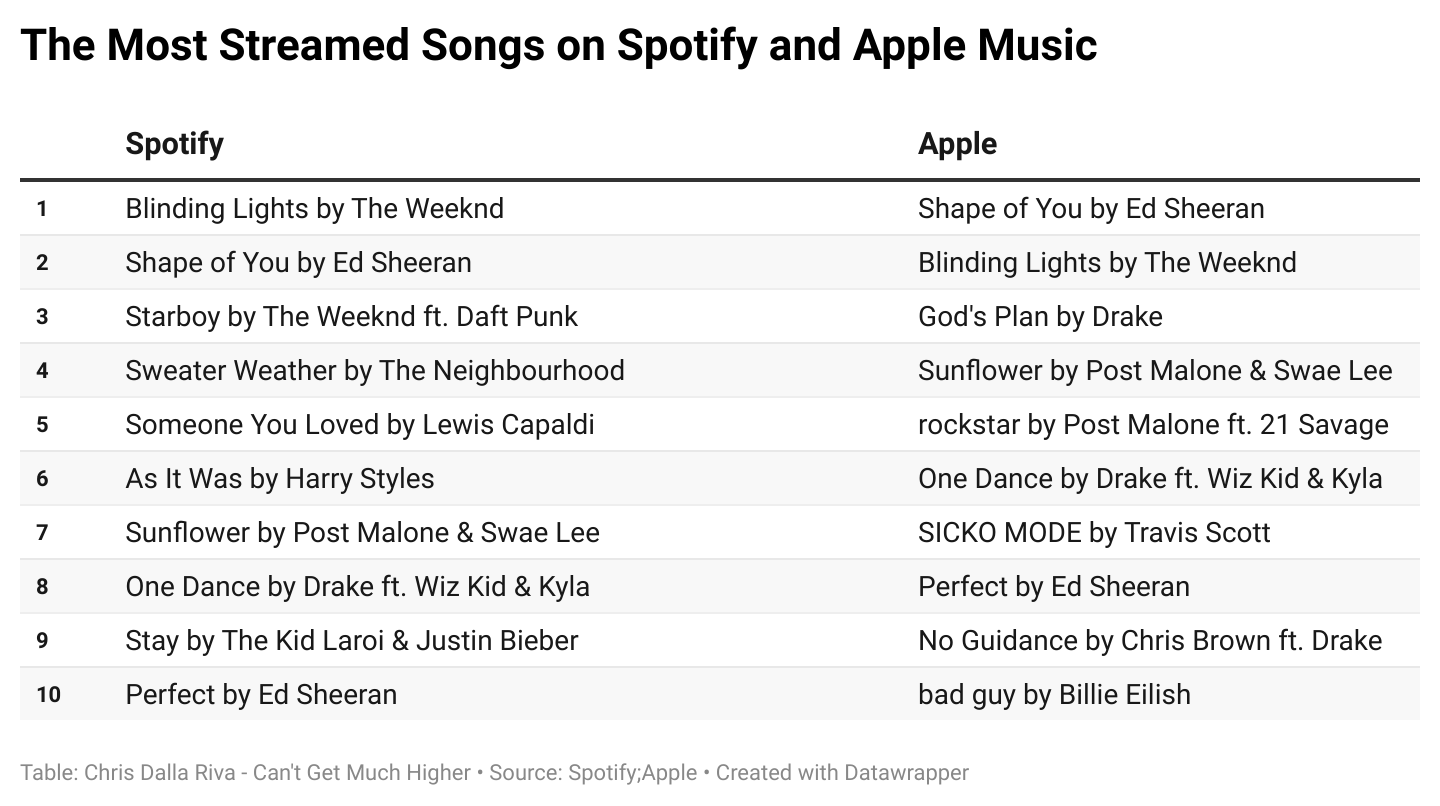
For example, The Weeknd’s “Starboy” is the 3rd most popular song in Spotify history. It falls to number 12 on Apple Music. No, not in the top ten, but it’s still quite popular. One song stands out in these respective top ten lists, though: The Neighbourhood’s “Sweater Weather.”
When it was originally released in 2013, “Sweater Weather” was a well received alternative rock song. It got decent radio play, even peaking at 14 on the Billboard Hot 100. Over the next few years, it would rack up streams on Spotify, but it was far from one of the most popular songs on the platform. In fact, by 2019, it was still outside the top 1,000 most streamed songs in the history of the platform. Then TikTok happened.
During 2020, “Sweater Weather” went viral on TikTok. This turned a well regarded rock track into a modern classic. Spotify reflected this. The song rocketed up its all-time charts. Apple Music, on the other hand, did not. When Apple released a list of their most streamed songs of all-time in celebration of their 10th anniversary “Sweater Weather” sat at 154. Nothing to scoff at, but a notably different outcome.

 Tiktok failed to load.
Enable 3rd party cookies or use another browser
Why would this happen? Again, demographic differences will account for some differences in listening behavior across platforms. But I think the divergent fates of “Sweater Weather” is more closely tied to something that isn’t a main concern of the Census Bureau: algorithms.
When engineers at Apple and Spotify were respectively coding up music recommendation algorithms, their goals were probably similar: Recommend music that will keep people listening. Sounds simple enough. (If you’re curious how this works, I wrote about it a few years ago.) But even when the stated goals are the same, recommendation algorithms can have unintended consequences, especially when they have a strange affinity for certain songs.
By comparing the top 1,000 songs across the respective histories of Apple and Spotify, we can see some of these biases.
Lord Huron’s “The Night We Met” is the 18th most streamed song in Spotify history with over 3 billion streams. It’s outside the top 1,000 on Apple.
The Police’s “Every Breath You Take” is the 39th most stream song in Spotify history with over 2.9 billion streams. It’s outside the top 1,000 on Apple.
The Arctic Monkeys’ “505” is the 89th most streamed song in Spotify history with over 2.4 billion streams. It’s outside the top 1,000 on Apple.
Of course, this isn’t to claim that these songs are only popular on one platform. “Every Breath You Take” is one of the most popular songs in history. But the absolute and relative play differences across platforms are massive. And it’s not just Spotify. That aforementioned Lord Huron song has yet to cross the billion-play mark on YouTube. The Arctic Monkeys’ song barely clears 100 million on the video platform.
Is it possible somebody within Spotify is putting their thumb on the scale for certain songs? Sure. Last year, people around the web claimed that the algorithm was biased toward Sabrina Carpenter’s “Espresso.” Some conspiracies even claimed that major labels were forcing Spotify to do this. (I don’t believe this.)
But in all likelihood these biases are less nefarious. They are just the outcome of some systems favoring one song over another because of a million small reasons. Still, this is worth noting because these algorithms can accidentally determine the long-term popularity of songs. They can accidentally make an unexpected song a classic. While I think recommendation algorithms have a positive impact on most of our listening experiences, it’s worth being aware of how they can create biases at the personal and platform level.
A New One
"CHUG!" by SOMOH
2025 - Indie Rock
If I had to describe any sort of algorithmic bias at Spotify’s platform level, it would be toward laidback indie or alternative rock that won’t disturb you if it’s spinning in the background. Though it hasn’t even cracked 100,000 plays yet, maybe SOMOH’s latest billowy composition “CHUG!” will one day be smiled upon by the algorithmic gods.
An Old One
"Bless the Telephone" by Labi Siffre
1971 - Singer-Songwriter
Speaking of algorithms, the TikTok algorithm keeps surfacing Labi Siffre’s “Bless the Telephone” to me. Maybe the most beautiful minute-and-forty-seconds of music you will ever hear, I don’t think anyone has ever intoned “I love you” as tenderly as Siffre does on this track.
Thanks for reading. If you enjoy my work, please consider ordering a copy of my forthcoming book Uncharted Territory: What Numbers Tell Us about the Biggest Hit Songs and Ourselves. It’s a data-driven history of popular music that follows my journey listening to every number one hit from 1958 to 2025.
Even off the top of the charts, this seems to happen all the time on Spotify on their automatically-generated playlists, especially the "song radio" lists. It plays Lucinda Williams's "Fruits of My Labor" for me all the time, which is a good song – I'm not gonna skip it but, you know, I like a lot of other songs by her, too. That song has nearly twice as many streams as her next most popular one, which just doesn't track for me. It seems like maybe their algorithm becomes self-fulfilling.
And then you get stuck with something you hate. For a while it kept feeding me Wayne Shorter's "Porta de Areia." I love Shorter, but it's not typical for him and it's definitely the kind of song where if you don't like it, you really really hate it. It's taken me a long time to convince Spotify not to play it for me.
Fascinating read. Just ordered the book. Great work, thank you @chris