


Welcome back to Can’t Get Much Higher, the internet’s favorite place for music and data. If you enjoy this newsletter, check out my book Uncharted Territory: What Numbers Tell Us about the Biggest Hit Songs and Ourselves. It’s a data-driven history of popular music that I wrote as I spent years listening to every number one hit in history.
The Alphabet Broke the Grammys
By Chris Dalla Riva
Grammy nominations were released a few days ago. Amid all the takes about what the Recording Academy got right and wrong, I came across something I’d never heard of before: The Grammy Guru, a popular Twitter account “Providing you with the latest scoops on all things #GRAMMYs,” alleged that for a period of time artists whose names were near the beginning of the alphabet were more likely to get nominations.


At first, I thought this sounded a bit conspiratorial. Aerosmith had a better chance at picking up a nomination than ZZ Top just because of their name? As I dug into the Grammy voting process, along with reminding myself of the robust evidence that the order of candidates on political ballots affect outcomes, especially in low-information races, I started to realize that this wasn’t that crazy. Still, I wanted to see if there was any evidence of this bias in the data.
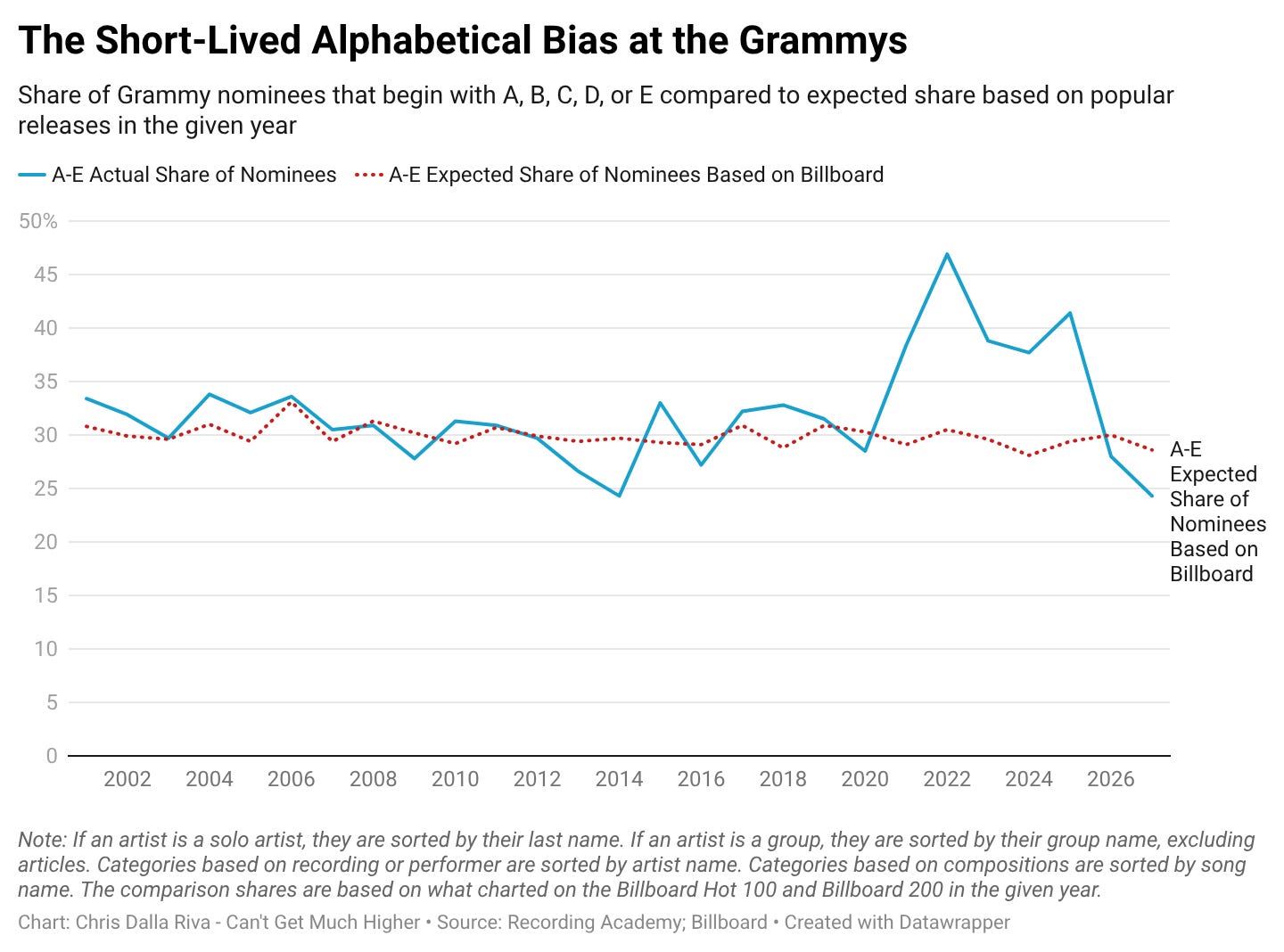
And there was! For a quick check, I decided to look at the percentage of nominees that began with the letters A, B, C, D, or E. The blue line in the chart above represents the percentage of nominees that fall into that group. Between 2001 and 2020, the median year saw 31.1% of nominees begin with those letters.
Then in 2021 the rate shoots up dramatically. From 2021 to 2025, the median year saw 38.8% of nominees begin with those letters, peaking at a massive 46.9% in 2022. But that’s not all. The trend reverses in the last two years. In 2026, 28.0% of nominees begin with A, B, C, D, or E. In 2027—the current year—24.3% do.
That’s bizarre. But it follows the pattern alleged in the tweet. Still, that blue line alone doesn’t tell us enough. What if in 2021 there was an unexpected influx in artists whose names began with the letter D? We would expect there to be more D-nominees.
We can check this, though. For each year, I looked at the Billboard 200 album chart and Hot 100 singles chart to try to get a base rate for comparison. That’s what the dotted red line represents.
When those lines are close, it means there is no bias toward the first five letters of the alphabet. When the blue line shoots high above the red line—as it did between 2021 and 2025—it means those nominees are benefiting from their names being atop the list. This additional data only reinforces our point.
But why would there only be a bias from 2021 to 2025? The original post suggests that the return to normalcy in 2026 and 2027 is because the Grammys switched to randomized ballots. But alphabetizing nominees goes back a long way. Why did the Recording Academy suddenly start loving the letter A and then kick it to the curb? Let’s dig a little deeper.
So, That’s Why They Didn’t Give Warren Zevon a Grammy Until He Was Dead
Let’s pull back the curtain a bit more and specify how the actual Grammy nomination process works. Recording Academy members first submit items about six months before the ceremony. Eligibility is then confirmed for those items while making sure they are placed in the proper categories.
Then comes a preliminary round of voting. Academy members leaf through hundreds of entrants to place their votes. Once those votes are tabulated, you get down to the handful of nominations per category. Then there is a second round of voting to determine the winners.
Simple enough. But in the 1990s, voters were not happy with how this process was working. Though hip-hop and alternative rock dominated popular culture, the first six winners of Album of the Year in the 20th century’s final decade were Bonnie Raitt, Quincy Jones, Natalie Cole, Eric Clapton, Whitney Houston, and Tony Bennett. Where were Nirvana and Dr. Dre?
As pushback mounted, the Recording Academy decided to double down on a change they’d been experimenting with in the jazz and classical categories over the last few years: They would have a committee of experts finalize the nominees. In other words, nominations wouldn’t be a pure popularity contest.
“The idea behind that in the beginning,” Billboard noted, “was to make the final nominations more progressive; more musically adventurous.” They went on: “The committee was also established to counter a tendency of rank-and-file voters to nominate their favorite artists year after year.” In the first year after the committee layer was added to the general categories (1996), Alanis Morissette, Mariah Carey, Michael Jackson, Joan Osborne, and Pearl Jam all got Album of the Year nods.
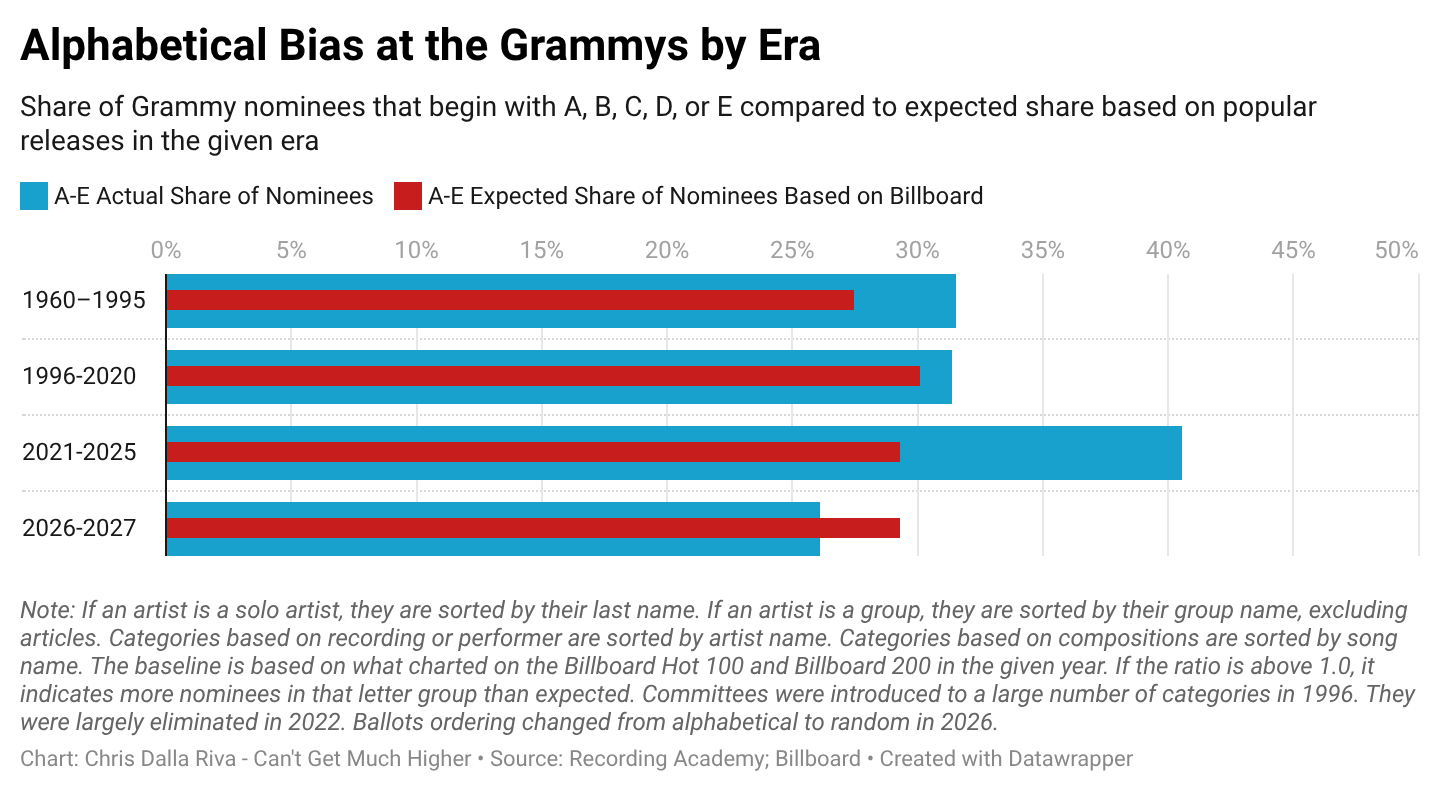
As these committees were rolled out to more categories, we started to see a decrease in alphabetical bias. In the pre-committee era between 1960 and 1995, 31.6% of nominees came from the first five letters of the alphabet when we would only expect 27.5% to. Between 1996 and 2020—with a growing number of committees involved—31.4% of nominees came from the first five letters of the alphabet compared to the expected 30.1%. Why would this be the case?
The alphabetical bias likely emerged during that first round of voting. Say you could pick five albums for Album of the Year. You’ve already selected four. You’re not sure what should get your last selection. You see Tony Bennett’s name near the top of the list. “Sure,” you think to yourself. “I liked that MTV Unplugged album he did.” You check the box and move on. In other words, because the first round of voting involves large, alphabetized lists, an advantage could be conferred to the items near the top.
But then artists and industry folks started to get wary of this committee system, especially as conversations around racial and gender representation became prevalent during the 2010s. After much debate, the committees were largely scrapped for the 2022 ceremonies.
With a snap, the first round of the nomination process became a pure popularity contest again. And alphabetical bias returned with a vengeance. From 2021 to 2025, 40.6% of nominees came from the first five letters of the alphabet when we’d only expect 29.3% to. It seems that many people were actually rounding out their ballots with whatever was listed first.
We’ve still got a problem, though. The Recording Academy got rid of the committees in 2022. If you look at the first chart in this piece, you’ll find that the spike in alphabetical bias began in 2021. There’s one more piece to this puzzle.
The Recording Academy started to expand membership greatly at the end of the 2010s to increase diversity. Before the 2021 ceremony, for example, the Recording Academy invited 2,321 new members—nearly double the previous year. This influx of new members, many of whom were likely less familiar with voting procedures, seems to have contributed to the alphabetical bias.
But then the bias went away with one simple trick—no sketchy committees needed. As noted earlier, in 2026 the Recording Academy randomized the order of potential nominees rather than showing them alphabetically. Ruby Marchand, chief awards and global industry officer for the Recording Academy, told Billboard, “This ballot update brings our process in line with standard voting best practices … and further ensures the process is fair and equitable for all entries.”
If you can’t keep track of all of this, here is a brief timeline of how this situation has evolved over the decades.
1960–1988: Voters submit paper ballots during the nomination process. No formalized committee system. Small amounts of alphabetical bias are prevalent in nominations.
1989-1990: Committee system is adopted for classical and jazz.
1996: Committee system added for major awards after the ceremony spends years ignoring the most popular genres. Alphabetical bias is mitigated.
2018: Voting goes online as the Recording Academy attempts to expand membership of historically underrepresented communities.
2021: The largest class of new voting members is added to the Recording Academy. Alphabetical bias reemerges.
2022: The committee system is mostly eliminated, opting for straight popularity throughout the nomination process. Older members are also forced to re-qualify for membership as the number of genre categories a member can vote on is shrunk from 15 to 10. Alphabetical bias is cemented.
2026: Alphabetical order is scrapped and ballots now use a randomized order. Alphabetical bias seems to have disappeared.
At this point, I think the only thing the Recording Academy has left to do is to apologize to The Weeknd.
Recommended Reading
Investigating Fraud at the Grammys

There was a longstanding rumor about one particular LA-based label executive who oversaw the nominating committees. Allegedly, this executive would freely adjust the nomination lists to better reflect which people were in his favor each year. I don’t know if this story is true, but people in the business certainly believed it was true and therefore treated the whole enterprise as sort of a joke.
Is the Grammy for Best New Artist Cursed?

Last week, when I wrote about who musicians thank at the Grammys, I came across a theory that those who are named Best New Artist are cursed, never to replicate their early success. In order to see if this year’s nominees - namely, Gracie Abrams, Fred Again, Ice Spice, Jelly Roll, Coco Jones, Noah Kahan, Victoria Monét, and The War and Treaty - should be concerned about winning, I decided to see how real this curse is.
Chris, thanks!