


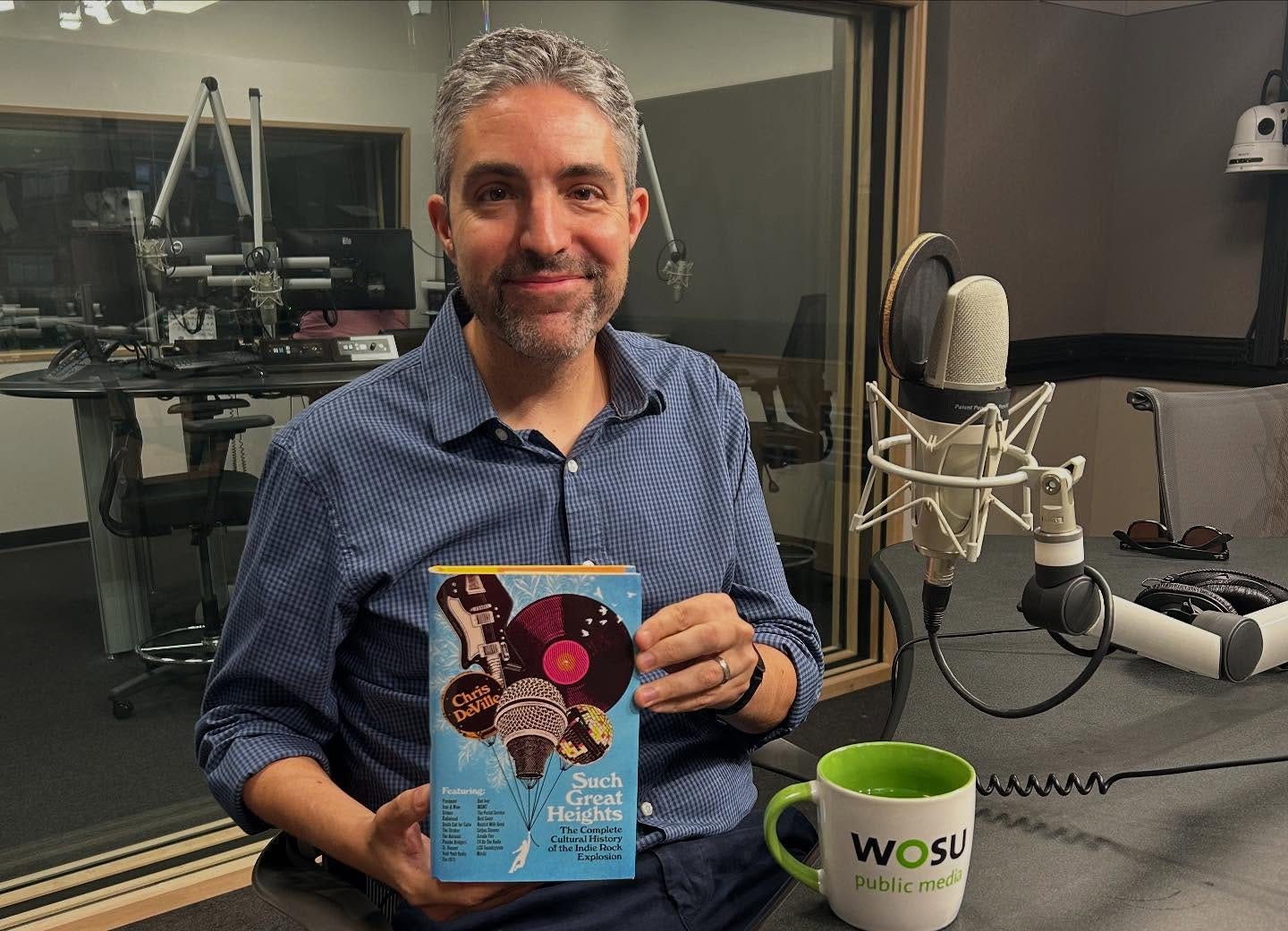
About a year ago, my friend Walter Hickey told me that I really needed to interview Chris DeVille. DeVille, a longtime writer for Stereogum, had a new book out, Such Great Heights: The Complete Cultural History of the Indie Rock Explosion. As a lover of all things indie rock, the book looked like it was written just for me. Then I got distracted. And forgot about it.
But a year later, I have finally heeded Walt’s advice. I not only picked up a copy of DeVille’s incredible book but got him to sit down with me to talk about it for an hour. My favorite thing about this book was how much wider the scope was than I was expecting. Yes, you get the inside scoop on all your favorite indie rock of the last 25 years from a genuine expert. But you also get to understand how these indie artists came to impact the mainstream in both big and small ways. If you enjoy our conversation, I implore you to pick up a copy of DeVille’s book.
There’s often a narrative that popular culture, and especially music, has stagnated. I won’t claim that the changes over the last 25 years have been as radical as those between, say, 1955 and 1980. But your book tracks some pretty significant shifts in popular music over the last few decades. Do you agree that music has kept evolving?
I do, especially in terms of pop music. I think about what’s happening in popular music almost like an Overton window. The way we define pop music is based on what’s getting played on the radio, what’s going up the charts, or what’s in the zeitgeist. The content of that has changed a lot. There’s always turnover and new trends coming in. Think about the DJ Mustard–style production that was everywhere around 2013 and 2014. You don’t really hear that now.
The genres themselves have also evolved a lot, partly from merging together and influencing each other. Country music is pretty dominant on the pop charts right now, and you hear a lot of hip-hop and classic rock influence in it. If anything is stagnant, it’s the distribution of new music. The way new hits and new stars get made feels really stagnant. But the evolution of the music itself is still happening, and it definitely happened within indie rock, which was the subject of my book.
Given the title, I naturally expected a 21st century indie rock history from your book. But it encompasses so many other styles and sounds. I was not expecting to read so much about Kanye West, for example. Did you know the book would be this expansive when you set out to write it?
Yes. My original subtitle for the book was “How Indie Rock Went Pop,” and I meant that in a few different senses. I meant it in the sense of indie blowing up and having more of a mainstream presence. But I also meant it in the sense of indie morphing into a kind of pop music. In the late 2000s and early 2010s, the trends were moving in a poptimist direction. Many indie bands were moving away from the guitar-rock band formation toward synths, hip-hop, R&B, and mysterious electronic music. It felt like the zeitgeist was anything except rock.
I joined the staff of Stereogum in 2013, but before that I was just an observer of the indie media sphere. I saw Pitchfork, Stereogum, and the rest moving toward a celebration of big pop stars. It became very cool within the indie realm to be into Justin Timberlake or Beyoncé. Your average Joe who wasn’t tapped into trendy music probably had no idea. So, I wanted to write a book that showed how indie rock interacted with mainstream pop culture.
That was part of the selling point for the publisher. There are so many entry points. The target audience is probably a religious Pitchfork reader from the last 20 to 25 years, but you don’t have to be that person to get into the book. If you remember American Apparel or Garden State or MySpace or the rise of the iPod and those iPod ads, there’s something here for you. My hope was to write a book that anyone who lived through those years could relate to in some way, and I feel like I achieved that to some extent.
A lot of those cultural moments are vivid memories for me, but some were just before my time. I had no idea how important The O.C. was in bringing indie rock to a wider audience.
In 2003, I was a fairly new listener compared to the OGs who’d been into indie rock since the 1980s and 1990s, but I felt like a veteran at the time. Then all of a sudden there’s this hit primetime soap opera where one of the main characters is name-checking Death Cab for Cutie, The Shins, and Bright Eyes all the time. It was like the meme of Leonardo DiCaprio pointing at the TV, even though it predates that meme. It really felt like a big deal.
In the book, I quote Britt Daniel from Spoon saying that, more than anything else, he hears from people that they discovered Spoon through The O.C. I think it turned on a lot of listeners who didn’t previously have a pathway into underground rock music. It created that pathway, even if it was mostly serving up the poppiest, most accessible version of it.
A lot of this story is told through how Pitchfork shaped the discourse around indie rock for well over a decade. You even include album scores in the book. Is it possible to overstate Pitchfork’s influence on this scene?
Its influence was pretty large. It’s probably possible to overstate it in the sense that I’m largely writing from my own perspective. I was loading up Pitchfork every day and reading the reviews for 15 years or so. It was extremely influential on me and was my personal entry point into a lot of this music. But I’m not a unique story. When you read quotes from people talking about how a positive review basically gave them a career or a negative review destroyed their career, the influence was profound.
Then there was the festival. Anything that could get booked at Pitchfork Music Festival felt like it fell under the indie umbrella, even if it had nothing to do with indie music. Kendrick Lamar performed at Pitchfork Music Festival. Nobody would call him an indie rock artist, but he was part of the assortment of artists your typical indie listener was almost certainly into. Pitchfork wasn’t the only publication contributing to that broadening of horizons, but it played a huge role.
Maybe I could have cited them a little less often in the book. Somebody pointed out early on how many times I referenced them. But Pitchfork was the baseline for my understanding of this culture, and especially of its expansion to a broader audience.
Pitchfork’s own journey—from an independent publication run by one guy out of a basement to being part of Condé Nast—feels like a meta illustration of the music it covered expanding into the mainstream.
That’s a fair point. Pitchfork’s own journey kind of mirrors the journey a lot of the music took.
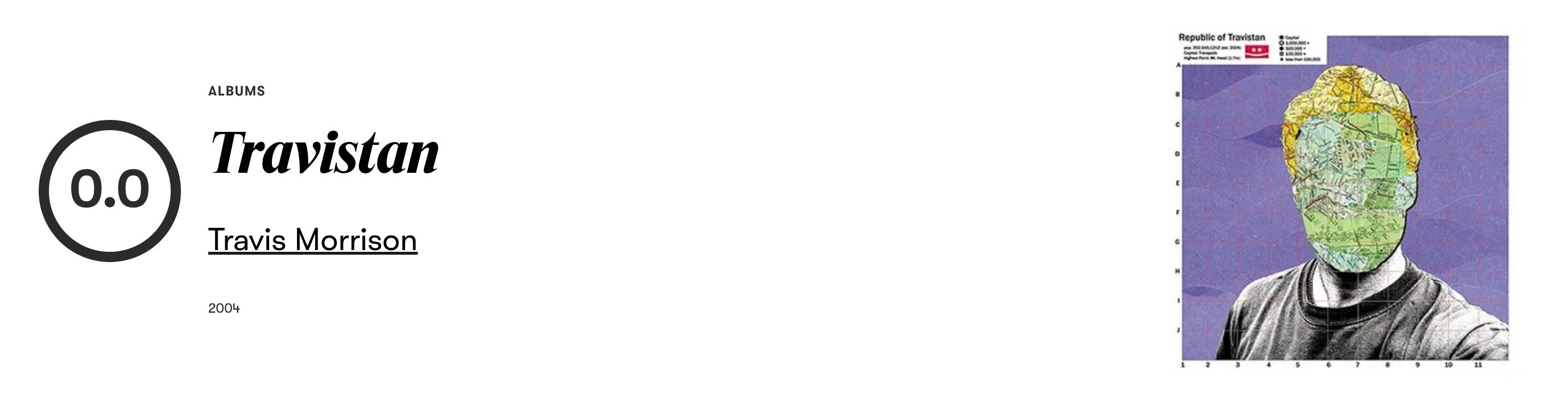
Since Pitchfork’s early days were before my time, it’s hard for me to fathom that one bad review could sink a career. The quintessential example is Travis Morrison’s Travistan. He’s basically said that review destroyed his solo career.
It really was the case. That was 2004, and Pitchfork was really picking up steam. But Travistan is a unique example. Travis Morrison was coming from The Dismemberment Plan, a band Pitchfork had heartily endorsed. They were one of Pitchfork’s flag-plant bands. When an institution that’s been giving you a significant boost turns on you, you’re in a uniquely vulnerable position.
I’m the biggest Dismemberment Plan fan you’ll find, so I’m not saying Pitchfork made them. But I think they would acknowledge the role Pitchfork played in bringing their music to a broader audience. They were extra dependent on the indie media sphere that Pitchfork was at the center of.
One of my favorite passages comes about two-thirds of the way through the book:
In terms of subjective cultural impact, indie rock wasn’t quite grunge or nu metal. It was difficult for rock, even increasingly poppy rock, to have that kind of sustained reach at a time when MTV was no longer a taste-making behemoth, putting the rockers and the pop stars in the same programming blocks.
How much of the success of earlier waves of alternative music came down to tastemakers like MTV putting it right next to what was popular?