


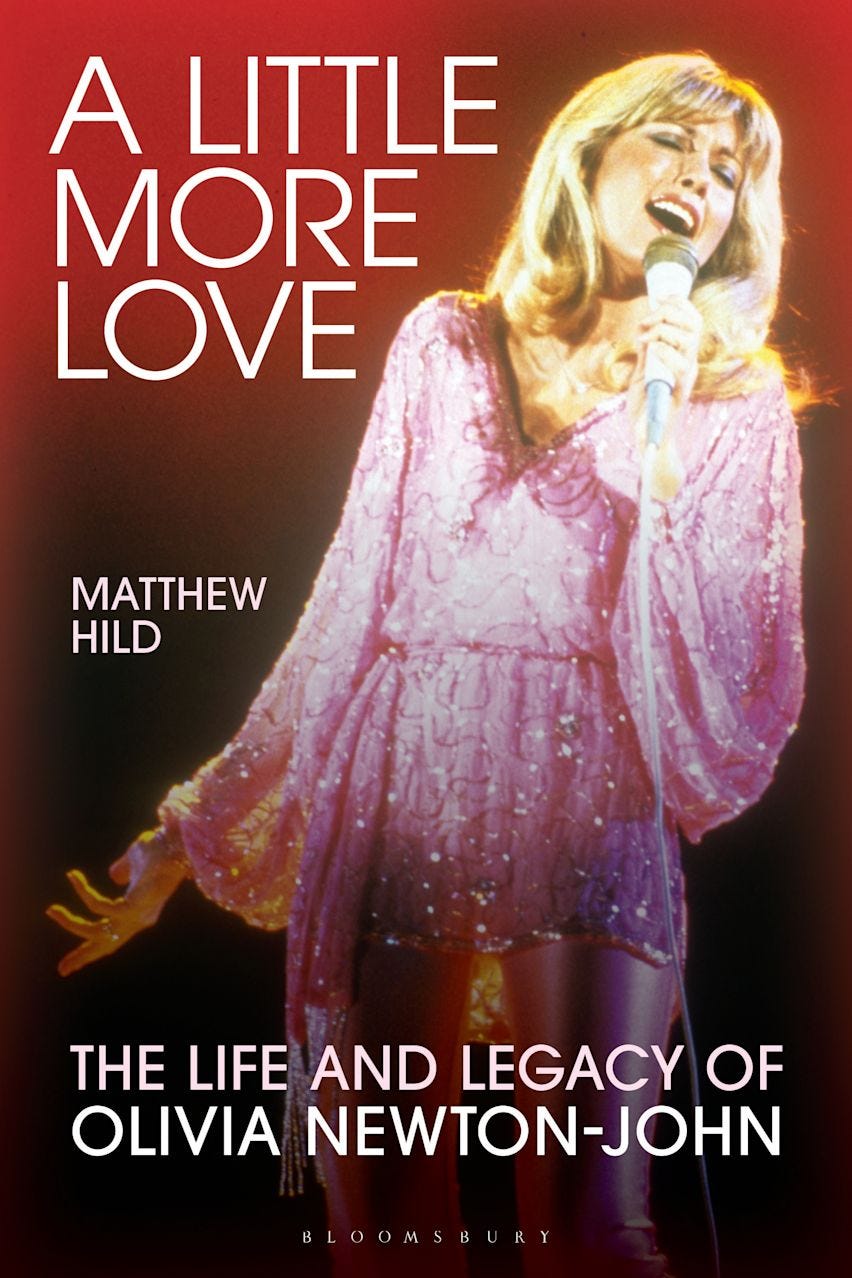
Beyond her big hits, I know next to nothing about Olivia Newton-John. That’s why I was intrigued when I heard about Matthew Hild’s new biography A Little More Love: The Life and Legacy of Olivia Newton-John. Was Newton-John compelling enough for an in depth biography? I quickly learned the answer to that question was “Yes!”
Last week, Hild—a Georgia Tech-trained historian—stopped by to talk about all things Olivia Newton-John. We touched on the unexpected evolution of her sound (i.e., country → pop), how she paved the way for a generation of female pop stars, why nobody has a bad word to say about her, and so much more. If you are a fan of Olivia Newton-John or late-20th century popular culture, this book is a must read. Grab your copy at the link below.
What drew you to writing about Olivia Newton-John? Of course, she was a huge pop star, but she was never someone that struck me as a deeply interesting character.
She was huge. People of all ages remember “Physical” and Grease. I mean who hasn’t seen Grease? But even some stuff of hers that initially bombed, like Xanadu and Two of a Kind, have achieved a cult status.
Before I wrote this book, I wrote a biography of Andy Gibb. Many of the people that I spoke to for that book also knew Olivia. Plus, the last true biography of Olivia came out in 2008. And most stuff written about her stops at her big hits. I thought she deserved a biography that looked at her entire life and impact. And I think she had a bigger musical impact than most people acknowledge. Plus, there’s the other side to her focused on humanitarian and environmental efforts, along with her cancer advocacy. Most pop stars don’t branch into so many fields.
Were you a big fan of hers beforehand? Or did you come to appreciate her more as you wrote the book?
Of course, I knew her. I was a kid when big hits like “Hopelessly Devoted to You” and “Physical” came out. I wasn’t a huge fan of hers back then, though. I was into heavier rock. But I came to appreciate her music more as I worked on the book. There’s a lot of stuff of hers that holds up really well.
Were there any particular less known tracks that you came to appreciate during your research?
I think many of the songs she wrote or cowrote after her commercial heyday are underrated. Those songs spoke to her life experiences more than much of her earlier work that she didn’t have a hand in writing. Some that come to mind are “Not Gonna Give Into It” and “Stronger Than Before.”
Let’s jump back to the beginning of her career. Olivia Newton-John is often associated with early MTV, especially because of how provocative the video for “Physical” was, but it strikes me that image was always part of her appeal. Much of her early career is littered with talent contests and television specials. Were visuals always important to her?
It would be foolish to deny that her image was important to her success. Everyone had a crush on Olivia Newton-John. She was beautiful. By the time she got famous, she resented this to some degree. Most of her early promotion was just about how she looked. In fact, the label only focused on how she looked when promoting her first single, a cover of Bob Dylan’s “If Not For You.” One MCA Records ad read, “Olivia Newton-John lives in the country in England and sings for the country in America and is as pretty as her newest single.”
By the mid-1970s, she acknowledged that people commenting on her looks was both a compliment and not a compliment. It implied that she was only successful because of how she looked. That’s a dynamic that’s played out for women in the pop world forever.
Even so, there was always a visual element to her career. And she changed those visuals often. You had the girl-next-door look during her country era in the mid-70s. You had the black leather Sandy look during Grease. You also had the spandex-and-headbands look during the Physical era and her “Physical” video in particular. And I think Olivia, along with people like Jane Fonda, helped launch the fitness craze in the 1980s.
One thing I found most fascinating about her life is how many unexpected characters she crossed paths with. You write extensively about her early career was shaped by the British rock star Cliff Richard.
Olivia met Cliff Richard in England in 1966 while she was working with her Australian duet partner and friend Pat Carroll. Cliff was a regular on British television in those days, and he gave Olivia a lot of TV exposure. It was through Cliff that Olivia met his band member Bruce Welch. Bruce and Olivia became romantically involved, and he co-produced and played on many of her early records. The co-producer was John Farrar, an Australian songwriter and guitarist who married Pat in 1969 and became Olivia’s longtime collaborator. He produced her on his own after Olivia split with Bruce. John wrote many of her songs. He also played on most of her records. As one of Olivia’s band members told me, John was like George Martin as a producer, John Lennon and Paul McCartney as her songwriter, and George Harrison as her guitarist all wrapped up in one for her.
But Cliff Richard and Bruce Welch were both important in getting Olivia’s career off the ground. Olivia never forgot how Cliff helped her along. Cliff was huge in England but not so much in the US. Because he helped get her career going in England, she eventually duetted with him on an American TV special and the Xanadu soundtrack after she became big. They looked out for each other.
The idea of her lending a hand to Cliff Richard highlights this idea that comes up a lot in the book: Olivia Newton-John was very nice. It seems like you couldn’t even find a person to say something bad about her.
Many people I spoke with would have to specify that some things that sounded too good to be true about her were actually real. Many of them were adamant that I not say anything bad about Olivia in the book. And I didn’t. She really was that kind.
There is a man named Greg Mathieson who played with Olivia during the 1970s. They lost touch, but when he heard she was sick near the end of her life he reached out via email. He told me that they just had the nicest email exchanges. Since he was a session player, he met lots of stars over the years. And he was clear that there was really nobody nicer.
As you noted, Olivia Newton-John’s career is so interesting because she transformed her sound a few times. Was she actively involved in those sonic switches, or were they pushed on her by the label?