


Welcome back to Can’t Get Much Higher, the internet’s favorite place for music and data. If you enjoy this newsletter, check out my book Uncharted Territory: What Numbers Tell Us about the Biggest Hit Songs and Ourselves. It’s a data-driven history of popular music that I wrote as I spent years listening to every number one hit in history. Now, let’s talk radio.
When Radio Died
By Chris Dalla Riva
When I tell people that Sheriff’s “When I’m With You” is the strangest song to ever top the Billboard Hot 100, I’m often met with a confused look. Released in early 1983, “When I’m With You” sounds like a quintessential power ballad of the 1980s. It’s got the quiet keyboard intro, the slow building melody, the soaring chorus vocal, the gear shift key change, etc. It doesn’t seem like there’s much strange about “When I’m With You.”
Musically, there isn’t. It does indeed have the sound of a quintessential 1980s power ballad. But what it lacks in musical strangeness, it makes up for in the strange route it took to the top of the charts.
As noted, “When I’m With You” was released in early 1983. Later that year, it peaked at number 61 on the Billboard Hot 100. Sheriff didn’t last much longer than their small hit. They broke up in 1985 with some members continuing on as a duo called Frozen Ghost. Sheriff and “When I’m With You” were destined for musical obscurity.
Then something unexpected happened. In the fall of 1988, a DJ in Phoenix started spinning the five-year-old song as if it were new. Listeners liked it. Other DJs soon followed suit. By February, a song that had neither a group to promote it on the road nor a music video to do so on MTV was at number one—a near impossibility in the 1980s.
Of course, while the specific details of Sheriff’s journey to the top of the charts are unique, the general contours are not. For decades, radio would break hits. A station would start playing a local band. Listeners would call in to request to hear it again. Those requests would spread to other stations. Those additional radio spins would lead to sales. And, voilà, you were famous.
But this hit song trajectory seems to be from the distant past. I can name tons of songs from the last decade that first broke on TikTok. I can’t name one that did so on radio. Maybe Marconi’s miraculous invention is dead.
Can the Radio Still Make a Hit?
My main data source in this newsletter—and my first book, for that matter—is the Billboard Hot 100. The Hot 100’s goal is to aggregate every possible listening source in order to figure out what the true most popular song in America is. Back in the 1950s, that involved looking at physical sales, jukebox plays, and radio spins. These days, sales and radio still play a role, but streaming is also in the mix.
Along with this all-encompassing chart, Billboard also publishes component charts. For example, since the 1980s, they’ve had a Radio Songs chart, which ranks the songs getting played most on radio. Since the 2000s, they’ve had a digital downloads chart, which ranks the songs selling the most copies on internet music stores. And, of course, since the 2010s, they’ve had a streaming chart, which ranks the songs being played the most on Spotify, Apple Music, and the like. We can use these charts to understand where a hit first gains traction.
Let’s use “Kryptonite” by 3 Doors Down as an example. The song was originally released as a demo to the group’s local Mississippi radio station in late 1999. By May 2000, it had cracked into the top 50 of Billboard’s radio chart. There wasn’t enough sales interest to make it into the top half of the Hot 100 for another 7 weeks. In short, radio helped break “Kryptonite.”
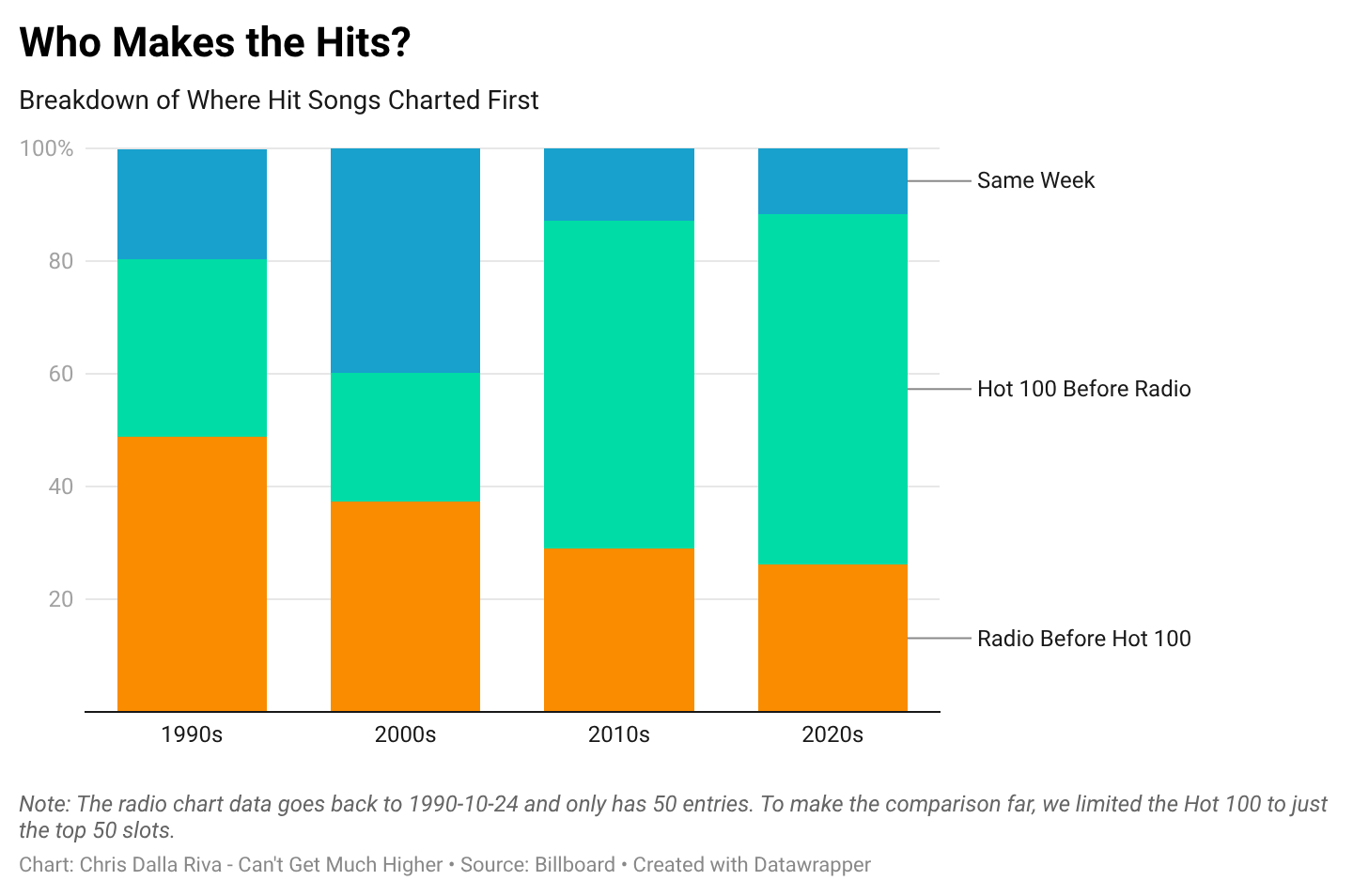
By looking at how often a song is on Billboard’s radio chart before the Hot 100, we can gauge how often the airwaves are instrumental in making a song a hit. In the 1990s, 48.9% of songs made the radio chart at least a week before the Hot 100. Over the last three decades, that rate has fallen to 26.2%. In other words, radio is no longer setting trends. It is following them.
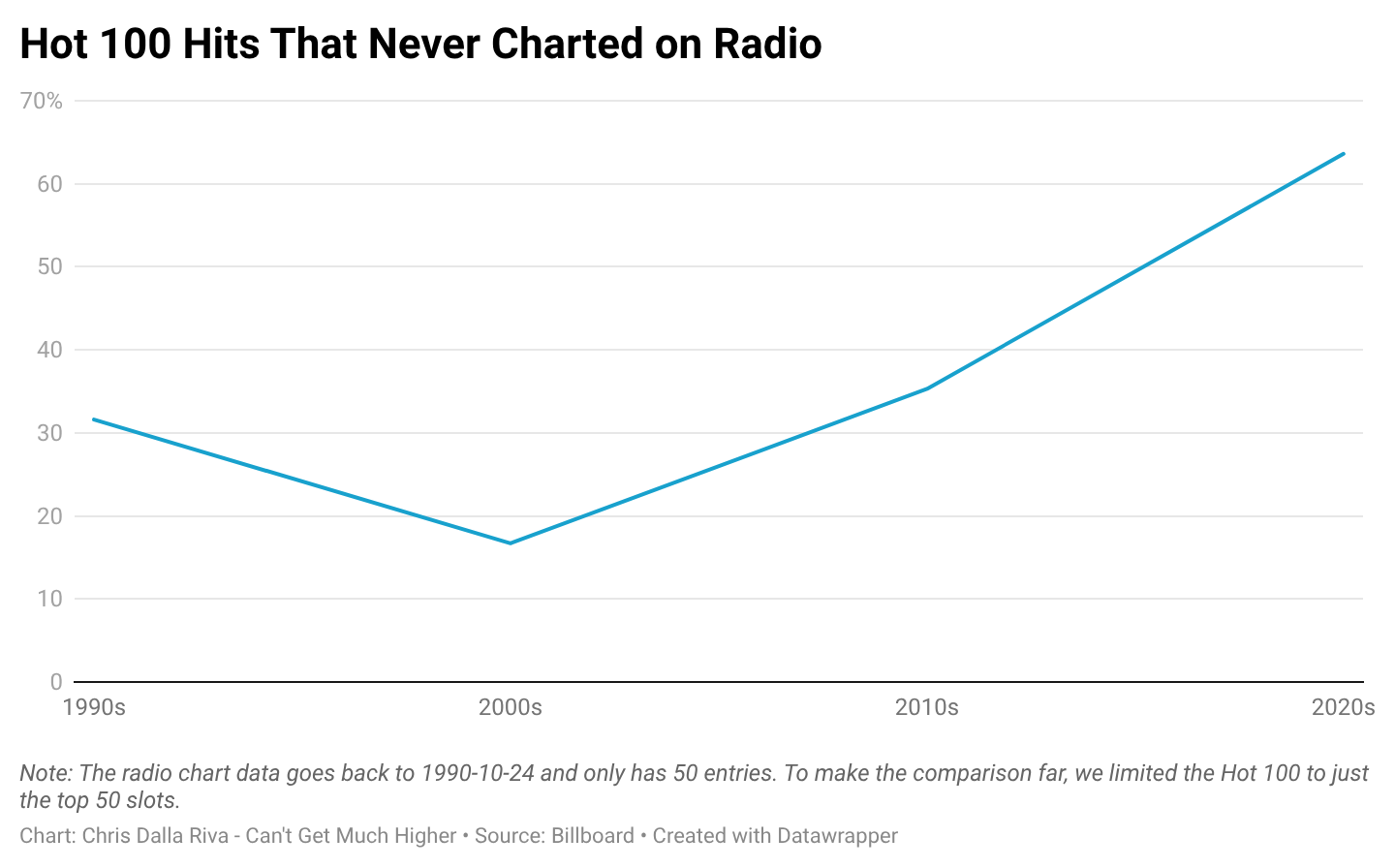
This is only part of the story, though. That last graph is looking at songs that charted on both the radio chart and the Hot 100. It’s possible to chart on one and not the other. For example, Madison Beer’s “Make You Mine” got to number 37 on the radio chart without ever cracking the Hot 100. Relatedly, Kanye West’s “Can’t Tell Me Nothing” got to number 41 on the Hot 100 without ever cracking the radio chart.
We are now seeing songs climb into the top half of the Hot 100 without even making the radio chart more frequently than ever before. In the 1990s, 32% of songs made the Hot 100 without charting on radio. In the 2020s, 64% of songs did.
Is Streaming Just the Radio?
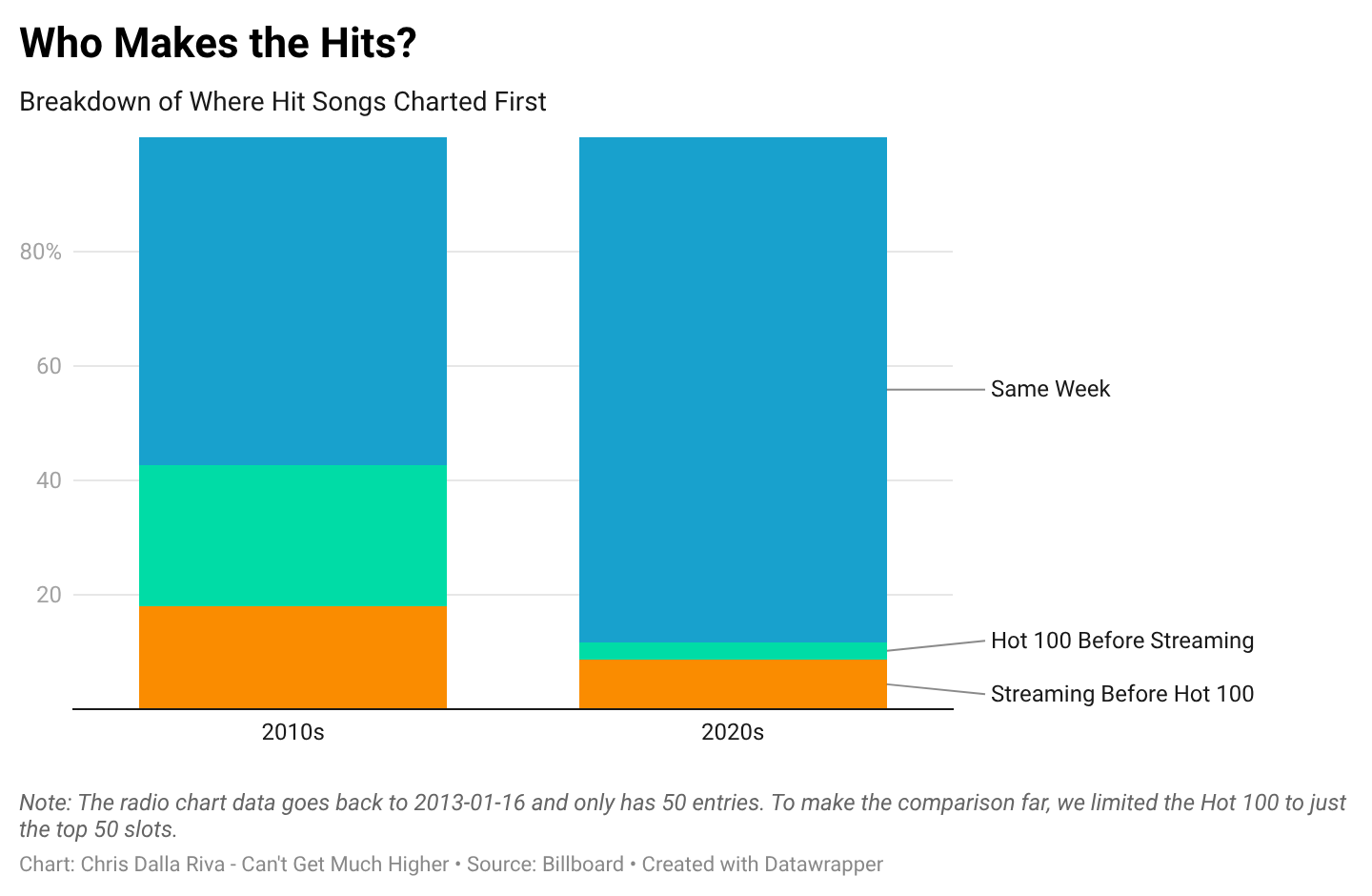
If radio is a follower rather than a leader, then what really drives something up the charts? Is there a different early indicator? In one sense, it is streaming. During the 2020s, only 9% of songs have made the top half of the Hot 100 without charting on streaming.
But streaming isn’t an indicator in the same way that radio was. Streaming is all consuming. When something moves on streaming, it usually moves on the Hot 100. Streaming is just such a large component of that chart. In fact, so far this decade, 88.2% of songs that chart on streaming are on that Hot 100 in the same week.
If you want to find hits early, you’ve got to turn to social media. Billboard has tried this a few different times. In the 2010s, they tracked songs trending on Twitter. In the 2020s, they did the same for TikTok. These charts are usually short-lived, though. You’ve sadly got to have your nose in social apps rather than your ear to the radio if you want to find the next big thing.
Is TikTok Just the Radio?
It would be remiss not to mention that the reason that some songs charted on radio before the Hot 100 back in the day was because sometimes songs would be released only to radio first. The thinking was twofold. First, if a song got a good reception on radio, then it was worth a wide release, a much riskier proposition in the age of physical media. Second, if a song was already climbing the radio charts, then when the physical release came out, the pent up demand would push the song very high up the Hot 100 in its debut week.
This strategy doesn’t exist anymore. Now, Beyoncé—or your favorite pop star— pushes their music out everywhere at once. Radio stations, digital stores, and streaming services all have access together. The old world is dead.

 Tiktok failed to load.
Enable 3rd party cookies or use another browser
Kind of. Last year, sombr told the folks at Switched on Pop that he often doesn’t finish songs. He starts posting his ideas to TikTok and then chases whatever people respond to. If fans are begging for the full song, then it also bodes well for the song’s first-week chart performance.
In short, though we live in a very different world, the incentives remain the same. This makes it such that new tools are used in a similar way to how they were used decades ago. But it’s important to remember that all of this is secondary. You may get people to care about a song that isn’t good for a short time, but if you want to stick around, good music and lyrics are still the best way to go.
Radio still exists?
I’m only half joking.
My favorite “broken by radio” story is “Hanky Panky” by Tommy James & the Shondells. Recorded for a small label in 1964, dies, plucked out of a bin by a Pittsburgh DJ, picked up by Roulette, James has to find a new Shondells because the old one didn’t exist anymore, goes to No. 1.
But that’s when radio stations were truly independent and not all owned by three companies - and weren’t competing against streaming and everything else.
I don’t envy new artists these days. I guess there’s always Bandcamp.
I love this deep dive on the changing relationship between radio and top hits.
I remember hearing that Sheriff song in the Sirius Top 40 80s countdown recently, and they told the story about how it appeared so many years earlier which is fascinating.
I just ordered and received your Uncharted Territory book, and I’m looking forward to exploring more musical info!