
Why Don't Songs Fade Out Anymore? Mailbag
This month we dive into questions about micro-genres, expensive albums, common song titles, and so much more
If you enjoy this newsletter, consider ordering a copy of my debut book, Uncharted Territory: What Numbers Tell Us about the Biggest Hit Songs and Ourselves. It’s a data-driven history of popular music covering 1958 to 2025.
Today’s newsletter is another mailbag edition of Can’t Get Much Higher, or the newsletter where I answer reader questions. This month we cover questions about album titles, The Beatles, collecting records, and so much more.
What is the most common song and album title? - Abby
This is rare data that I have for both the US and the UK. The most common song title to chart on the Hot 100 in US history is “Hold On.” For the UK’s pop chart, it is “Stay.” For those same countries, the titles shift if we just look at them since 2000. In the US, it is “Home.” In the UK, it is “Beautiful.”
I only have album names in the US, but I can tell you that album names are recycled less frequently. Here are all of the album names that have charted twice on the Billboard 200 between 1963 and 2024:
Music: Carole King & Madonna
4: Foreigner & Beyonce
Faith: George Michael & Pop Smoke
Unplugged: Eric Clapton & Alicia Keys
Now: Maxwell & Shania Twain
Believe: Disturbed & Justin Bieber
Kamikaze: Twista & Eminem
Chapter V: Staind & Trey Songz
21: Omarion & Adele
Epiphany: T-Pain & Chrisette Michele
Revival: Selena Gomez & Eminem
American Dream: LCD Soundsystem & 21 Savage
Shout out to Eminem for being so lazy with album names that he ended up on here twice. Also, shout out to Zach Schonfeld, whom I once interviewed, for a great piece from 2023 where he ranked every album named The Album.
Have music collectables, like albums or singles, enjoyed a run up in value like baseball cards? - Jeff
Not really. In the long run, collectible markets are largely governed by supply-and-demand. Among music made by popular artists, the supply is so massive that you can always find a cheap copy of the most celebrated albums. Even an original pressing of a famous album, like Abbey Road, isn’t going to break the bank.
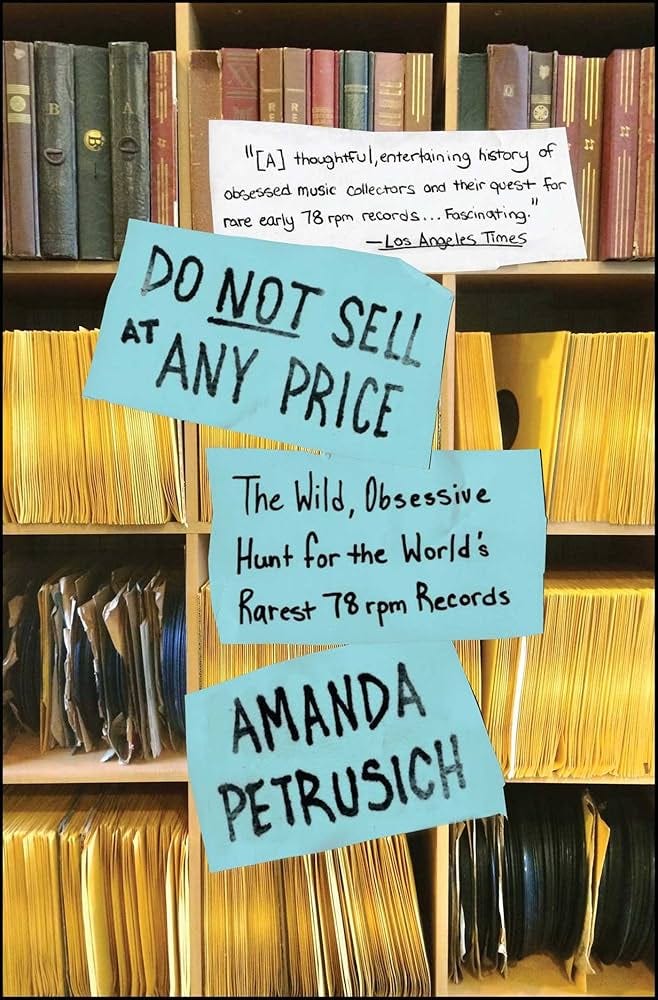
Prices only begin to rise when supply is truly limited. In 2021, for example a one-off recording of Bob Dylan’s “Blowin’ in the Wind” went for nearly $2 million. In 2009, a very rare single by soul singer Frank Wilson was purchased for about $40,000. If you are curious about this topic, journalist Amanda Petrusich wrote an interesting book called Do Not Sell At Any Price: The Wild, Obsessive Hunt for the World’s Rarest 78rpm Records back in 2015.
This is only tangentially related to your question, but in recent years, music as a financial asset, rather than physical good, has seen a run-up in value. You may have seen the catalogs of artists like Bob Dylan, Stevie Nicks, and Bruce Springsteen being purchased for eye-popping sums. There is more investment interest in this space as the music business has become more financialized.
When I listen to oldies radio, lots of songs end with a fade out. I can’t think of a single hit from recent decades that ends by just getting gradually quieter. Did this change happen abruptly at some point in the past or did it (AHEM!) fade out? - Benjamin
I write about this in Chapter 2 of my book, but your intuition is correct. Fade outs used to be much more popular. They were a function of the limits of vinyl records and popular radio formats. Longer cuts were left for the albums. When formats and radio began to change, the fade out—in your words—faded out.
There was a small resurgence in the 2010s, but that was likely a biased sample given that I was only looking at number one hits. Still, I’ll give you some of those modern fade outs just to prove that I’m not lying:
“positions” by Ariana Grande
“WAIT 4 U” by Future ft. Drake
“All Too Well (10 Minute Version)” by Taylor Swift
“Leave the Door Open” by Silk Sonic.
Though it didn’t chart in the US, my favorite fade out in the last decade is heard on Lorde’s “Supercut.” The song slowly grinds to a close for a glorious minute-and-a-half.
As a long-time listener to American Top 40, Casey Kasem mentioned how he felt the single most impressive chart feat in history was when the Beatles held the top five spots on the Billboard Hot 100 in April of 1964. Nowadays, it happens occasionally, if not routinely. Of course, it’s like comparing apples to oranges when talking about the Hot 100 today versus 60 years ago. You’ve studied the charts. Was Casey correct or totally off base? - John
You are indeed correct that this now happens somewhat routinely. Just two weeks ago, Taylor Swift held the first 12 positions of the Hot 100 after she released her latest record, The Life of a Showgirl. How is this possible?
As you noted, the Hot 100 may be the same in name, but it is very different in practice. Back in the 1960s, the chart mostly counted physical sales. Now, it is counting streams. This means it went from tracking purchasing behavior to listening behavior. In 1975, once you walked out of the store with your record, Billboard had no idea if you ever played it. Now, the marginal cost of listening to something is close to zero. As you note, comparing the chart across the decades is really “apples to oranges.”
But let’s just focus on when Kasem was on the radio to make things simpler. By the end of the 1970s, The Beatles feat was still very impressive. To command the entire top 5 on the Hot 100, you had to have fans willing to go out to buy 5 of your records at the same time.
In the 1,118 weeks between the launch of the Hot 100 and 1980, 92.5% of the time the top 10 contained 10 songs by 10 different artists. The only time a group held 5 positions in the top 10 was The Beatles during the back-to-back weeks of April 4 and April 11, 1964. The only time a group held 4 positions in the top 10 was also The Beatles around the same time. And other than The Beatles, the only group to hold 3 positions in the top 10 was the Bee Gees during the weeks of February 25, 1978, and March 4, 1978. In short, Kasem was correct.
It is worth noting why The Beatles could pull this off, though. Popularity was only part of the reason. Typically, a label wouldn’t release so many singles at once. They wanted listeners focused on specific tracks. But before Capitol Records decided to put out “I Want to Hold Your Hand” in the United States, some other small labels had put out Beatles’ records.
These pre-Beatlemania releases did not fly off the shelves. But once “I Want to Hold Your Hand” started selling like hot cakes, those other labels’ releases were also in high demand. In other words, part of the reason they could control the entire top 5 was because of a weird situation where multiple labels were releasing their music at the same time.
Has the popularity of micro-genre labels (e.g., synthwave, bedroom pop, nightcore) increased with the streaming age, or were hyper-specific genre labels always used?Thanks, love your work! - Tia
These labels have certainly become more popular in the internet age. A long, long time ago, genre mostly denoted the form or function of the music. Beethoven’s “Moonlight Sonata” was a composition of the sonata form. Parlour music was applied to songs that were played in the home.
If we shorten the timescale a bit—say, to the last hundred years—genre was mostly a tool created by labels, radio, and magazines for marketing. And, as I write about in Chapters 2 and 6 of my book, many of these genre labels (e.g., R&B, country), were just thinly-veiled ways to categorize the race of the artist or the race of the listeners the music was being marketed towards.
That’s not to say that the genres we applied to radio stations, for example, had no use. But radio and magazines had to appeal to a wide enough audience in order to generate advertising spend. Micro-labels weren’t as useful when you wanted to reach the most eyeballs. In short, these formats were scaled to humans. Humans could not maintain 1,000 genre charts for Billboard magazine.
Enter, the internet. The internet is not at human scale. The information super-highway has more stuff than anybody could consume or categorize in 100 lifetimes. Because of that, we need more granular ways to refer to things. In addition, the internet makes finding those granular categorizations quite easy. Spotify, for example, has thousands of genres, and you can browse them all!
Thanks for reading. If you enjoy my work, please consider ordering a copy of my forthcoming book Uncharted Territory: What Numbers Tell Us about the Biggest Hit Songs and Ourselves. It’s a data-driven history of popular music that follows my journey listening to every number one hit from 1958 to 2025.


"Among music made by popular artists, the supply is so massive that you can always find a cheap copy of the most celebrated albums."
Having sold things on Discogs, I can tell you this is wrong. There are rare pressings of popular albums that people search for. I never knew what "dead wax" was until I got on there.
Since you mentioned Dark Side of the Moon, here is one offered for $1,500:
https://www.discogs.com/sell/item/3869985484
Why? It's still sealed, and it MIGHT be Winchester press, whatever that is.
although the notes say:
Original, Still Sealed, Purple Hype, 1973, SMAS-11163, identifier for Winchester press is purple hype later USA