


Chris here. Between my wedding, honeymoon, and all related matters, I will be pretty busy throughout this month. Because of that, some friends have volunteered to take over this newsletter while I’m away. Today’s piece comes from Ian Temple, the composer and writer behind Soundfly Weekly, a newsletter focused on creativity.
Ian actually reached out to me a few weeks back to comment on a new series he was working on about how to make epic pop music. After weighing in on his questions, I thought to myself, “Hey! I’m about to be very busy getting hitched. I should reprint one of the articles in this series. Thankfully, Ian obliged. If you enjoy today’s piece, you should check out the rest of the series and subscribe to his newsletter.
On Pop Music Breaking the Mold
By Ian Temple
Can pop music be epic?
To most people, the answer to this question is probably obvious: “Mamma mia, mamma mia, mamma mia, let me go!”
Queen’s “Bohemian Rhapsody” hit number 9 in the charts in 1976 and then number 2 in 1992 after the release of the film Wayne’s World, categorically proving the answer is “Yes!” That was certainly Chris Dalla Riva’s answer when I asked him:
The quintessential example would have to be “Bohemian Rhapsody” by Queen. That’s like quintessential epicness. It’s longer. It has a tremendous amount of dynamic range. There’s the whole operatic section in the middle. You got the big old guitar solo. You got the ballad. If I’m thinking just epicness, especially in the pop sphere, that would be the song I would go to immediately.
So, yes. The answer is yes. There is nothing more needed here. There is definitely no need to call up experts, to chat about it with everyone I know, or to spend a couple dozen hours listening to every pop hit since 1965 just to make sure.
Right? Riiiiight?
OK, here’s the thing: I wasn’t convinced.
My background lies more in epic music than pop. My idea of a good time is listening to an Icelandic band bowing a distorted guitar behind a wailing falsetto, ideally with an orchestra behind them. Give me 24 hours straight of drone music or an opera with a counter-tenor wailing over an ostinato for four hours. I want hard-won emotional peaks that crack you wide open, and to experience the results of human endeavor taken far beyond what’s reasonable.
From this vantage point, pop music seems a little anti-epic. At the risk of oversimplifying things:
Epic music is long. Pop music is short.
Epic music often complex. Pop music is often simple.
Epic music often has slow builds and rewards patience. Pop music needs to grab your attention in the first couple seconds.
Epic music often isn’t commercially viable. Pop is all about the money.
Epic music offers a grand sweeping narrative arc. Pop music often has slightly nonsensical lyrics, like five good-looking dudes singing “I want it that way” without anyone anywhere including themselves or the person who wrote the song having any idea which way they’re talking about.
But … is any of that actually true?
Welcome to Episode 3 of How to Make Epic Music, my series exploring artists and music that take things too far. In episode one, we talked about the insistence focus of Chopin. In episode two, we dissected the surprising discipline of the jam band Phish. And today, we’re talking about pop music, at least the epic parts of it. Let’s dive in.
Once again, I bit off more than I can chew so this will be a two-parter. This is Part 1: the grand sweep of epic pop music through history. Part 2 will follow.
Is Pop Music Anti-Epic?
Pop is such a difficult word to define, right? Because at any one moment it can be a genre or sound. It can be the thing which is at the top of the charts. It can be just in the popular zeitgeist. There are a lot of songs that are enormous in conversation and culture that actually don’t achieve huge commercial success.
That’s Charlie Harding, the co-host of the amazing, long-running podcast Switched on Pop and also a professor of songwriting at NYU and Berklee. I needed help with this topic, and Charlie has literally written the book on pop music. At the start of our conversation, he did validate my question a bit:
Harding: I like to think about pop music going back to one of the great songwriters of pop music Irving Berlin.
Irving Berlin, one of the great American songwriters of all time. Wrote some 1,250 songs in the first half of the 20th century, including dozens of hits, standards, and classics, like “God Bless America,” “Cheek to Cheek,” and “White Christmas.”
Harding: He had a set of rules for songwriting published in a magazine, and he basically says to write a great pop song you have to write something that everybody can sing. Part of pop music is an intention more than it is a genre. It is: Do you want this song to be sung by many people?
Irving Berlin says, in order for it to be sung by many people, there are some particular rules to follow, like the words have to be sonorous. Some words don’t sing well. My favorite example is a 30 Rock episode in which Jenna Maroney’s character is in a film called The Rural Juror. The joke of the episode is nobody can understand what she’s saying “cause rural is a mouthy word and doesn’t sing well.”
Some of the other rules in Berlin’s list:
The melody should be within the range of an average singer.
The title should appear frequently in the lyrics so it’s more memorable.
Songs should be sexless, available to men or women, and should deal with ideas, emotions, or objects familiar to everyone.
They also need to contain “heart interest,” should be simple, and should endeavor to be original.
Basically, make songs that are singable, accessible, and marketable.
Harding: If you think about the rules of Irving Berlin, in some ways they are kind of anti-epic. They’re very populist, and I think they very much still apply to songs by Max Martin and all the great Swedish pop songwriters. There’s a preference for singable words, even over the intelligibility of the lyric, repeatable melodies that people can sing, not too many giant leaps, etc. If your song is too acrobatic, people can’t sing along with you.
So pop music is meant to be sung by the populace. In that way, its epicness might be more about its reach than in every part of its melodic structure.
This is an important anchoring thought: Perhaps more than anything else, pop music is an intention—the intention to be popular, to reach what Irving Berlin calls “the crowd.”
And this often dictates the choices that go into the music. It pushes certain aspects of the songwriting away from anything too weird or surprising that could turn people off and toward things that most people will find accessible. An anti-epic pressure, if you will.
But Berlin also hints at competing pressures, like the pressure to stand out, to be memorable, and to move people emotionally. If we focus on that side of the equation, I expect that’s where we might find the more epic pop music.
After all, can’t epic music also be popular?
Digging For Pop Epics
The logical next step was to go to the archives, to go panning for epic music among the pop pantheon greats. Luckily, the website The Pudding has created this great visualizer of every top 5 pop song on the US Billboard charts from the 1950s to 2015. That seemed like a good subset to start with. If there are epic songs among the hits, then that could help us learn more.
Using The Pudding’s data, I began listening to as many songs as I could, mostly number ones, gathering the ones I thought were epic-ish, and rating them according to a rubric I made up. Specifically, I graded every song I listened to according to how it performed along five parameters on a scale from 1 to 5:
Scale: Does it feel big and expansive?
Journey: Does it give the sense of a grand narrative with a massive build, strong contrasts, or multiple movements?
Stakes: Does it feel like it matters, like something important is happening or being expressed?
Commitment: Does the artist go all in, further than expected?
Pay Off: Does it drive compellingly toward a big resolution and nail the landing?
I then averaged out the scores for each category to give each song an epic grade. A song with a 5 on each parameter is a perfect 5 in epicness. Here are the results.
In the first hour of listening, this seemed like a great idea. By hour 10, I was convinced every pop song was in fact epic. By hour 30, I decided none of them were. And by hour 60, my corporeal form had dissipated and slipped out of space and time.
What I Learned about Epic Pop
The most obvious conclusion is that there has in fact been a lot of epic pop music at the top of the charts. I included almost 300 songs on my list, and I’m sure there are lots of others that slipped through my fingers.
Of those, 231 reached number one on the charts. If we estimate that there were around 900 total number one hits in that time frame, then we can say that about a quarter of all number one songs are at least somewhat epic. This is fairly subjective—but that’s not a bad haul!
There are so many undeniably epic moments in here. The chord punches that kick off “Eye of the Tiger.” The driving, desperate intensity of “Lose Yourself.” The orchestral intro to K-Ci and JoJo’s “All My Life.” Are those actual cannon shots in Bonnie Tyler’s “Total Eclipse of the Heart”? (Sadly, no, but not for lack of trying from the songwriter Jim Steinman). How did I even question this?
Then, there are the divas. In almost any era, there’s one epic music formula that finds its way onto the charts: a diva with an orchestra singing a power ballad. Whitney Houston, Celine Dion, Mariah Carey, Barbra Streisand, Adele, Diana Ross, Alicia Keys, Taylor Swift, etc. Almost 20% of the songs on the list could be categorized as some version of this.
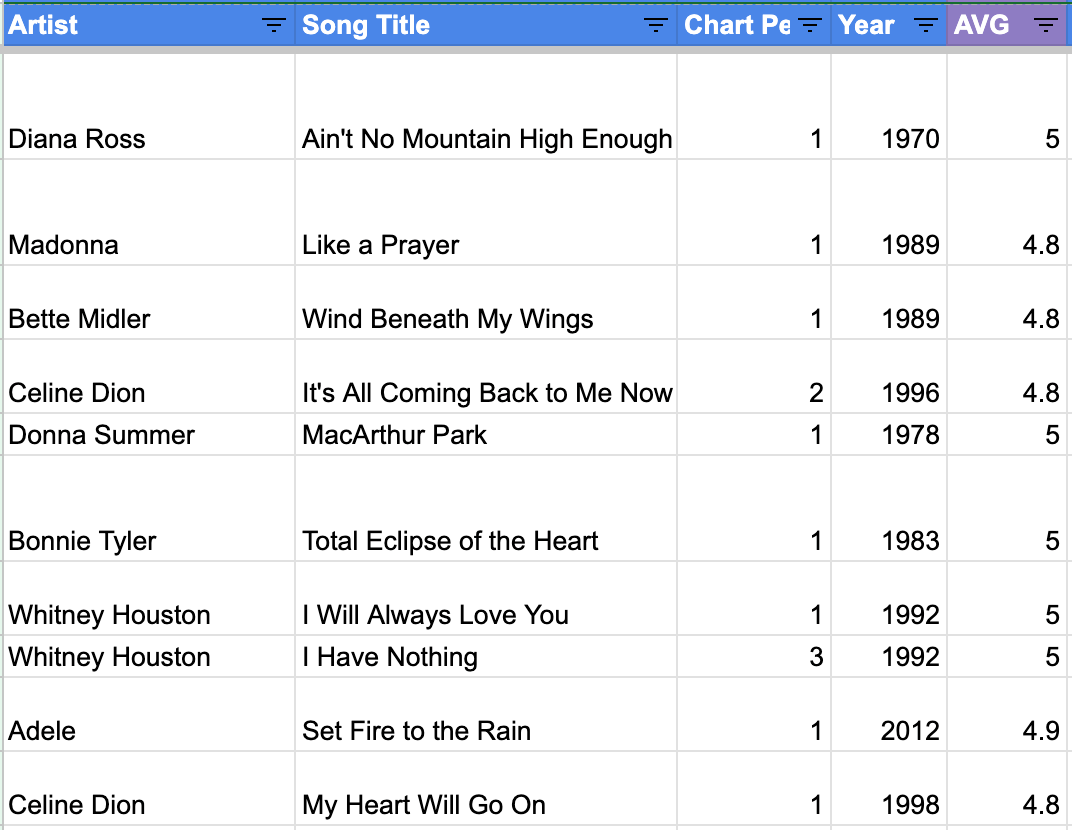
This formula produced so many number ones it made me wonder if epic songs aren’t actually the most successful type of pop song in history.
American Idol clearly seemed to think so. When the show first aired in 2002, tasked with finding and launching new chart-topping pop stars, what did the big money producers bet on? What did the audiences vote for? You guessed it. Divas singing over orchestras. Kelly Clarkson, Fantasia, Carrie Underwood, even Clay Aiken and Taylor Hicks—all had hits with power ballads and orchestras.
Another thing that jumped out to me was how many of the epic hits were tied to films in some way. About 13% of the songs on my list were tied to a movie or TV show in some way—themes like the “Chariots of Fire” or a bizarre disco version of the “Star Wars Theme” that somehow hit number one in 1977, as well as soundtrack songs, like “My Heart Will Go On” from Titanic and “I Don’t Want to Miss a Thing” from Armageddon. It makes sense: Movie music tends to be more dramatic by default, and being in a movie or TV show is a great way for a song to filter through the culture.
A great example of this happening recently is Kate Bush’s epic tune “Running Up That Hill (A Deal With God)” which peaked at number 30 when it was first released, but hit number 3 a couple years ago when it was used in the TV series Stranger Things.
So we’ve got some good rules of thumb to start with: If you want to make an epic song and have it be a hit, get yourself a diva, an orchestra, and a hit film.
Where the “Epicness” Comes From
While listening, I tried my best to figure out where in each song the “epicness” was coming from. For instance, if a song swells to a massive orchestral build, then I’d give it a mark for having an epic arrangement. If it lasted 8 minutes with multiple distinct movements, I gave it a mark for having an epic structure. That sort of thing. Here’s what I found:
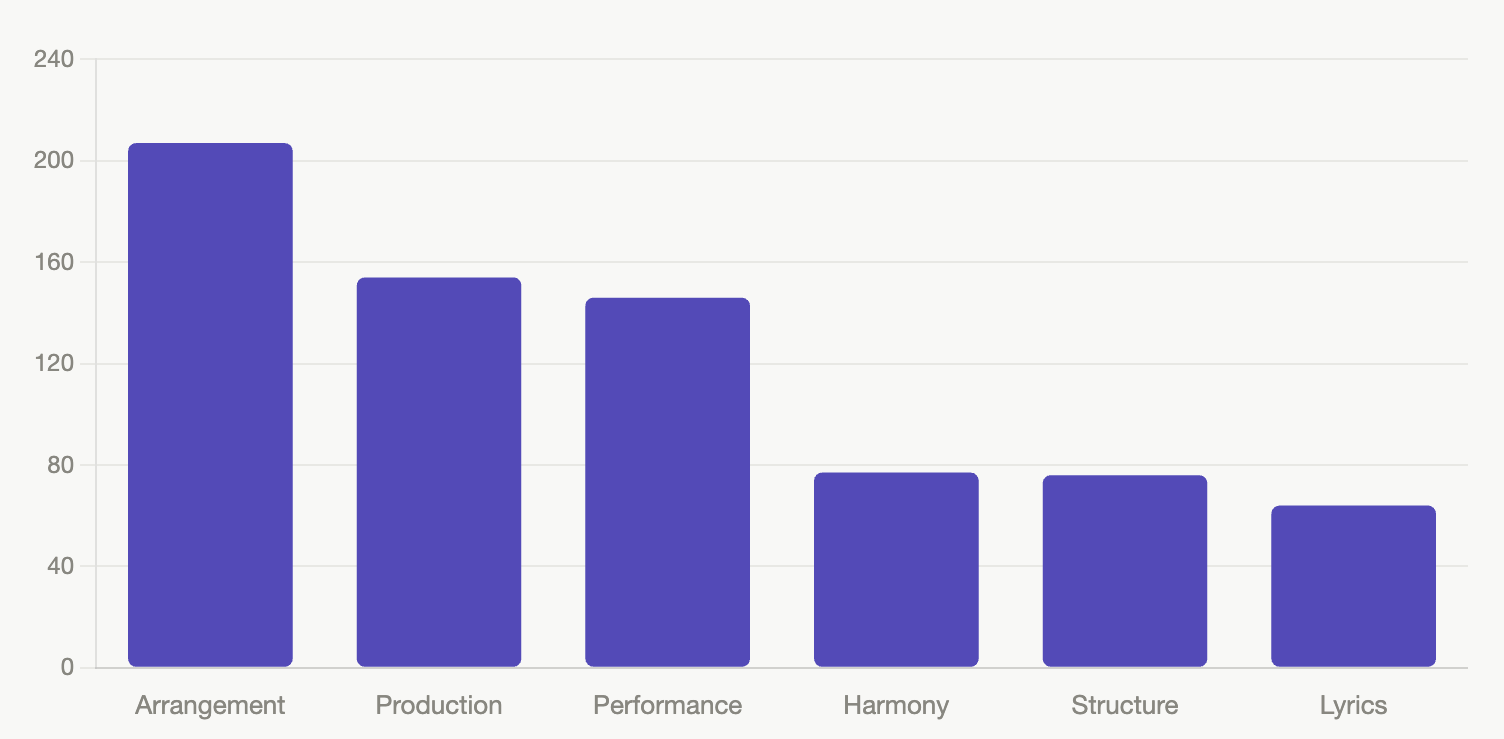
Basically, it’s more common to make a song sound epic through the arrangement, the production, and the performance than through the harmony, structure, and lyrics. That makes sense, since the arrangement, production, and performance are all elements that can be made epic within common pop structures and chord progressions.
Let’s talk more about the arrangements for a second. There are a few ways we see epicness play out in arrangements: big dynamic contrasts between highs and lows, lots of voices, melodies, or complexity, and of course the use of orchestras and choirs to expand the sense of scale and depth.
Take Diana Ross’s version of “Ain’t No Mountain High Enough.” The verse is so quiet that she’s practically whispering it in your ear, but the chorus is absolutely soaring, especially at the end with the punchy rhythms, howling vocals, and orchestral climax. She basically took a nice, mellow R&B number and made it something you roar at your enemies as you trample them underfoot. I gave it a 5.
Or “All You Need Is Love” by the Beatles (4.8 rating), a seemingly simple song with the weirdest arrangement imaginable. Why are there so many horns playing fanfares? And why is everyone playing a different song underneath the actual song at the end? How many people are actually on this song? (Apparently, around 35, including a 13-piece orchestra, Mick Jagger, Eric Clapton, and a few others).
It’s notable that almost a third of the epic songs on the charts that I tracked had an orchestra in them. A choir is arguably even more epic. A good example might be Madonna’s “Like a Prayer” (4.8), one of my favorite epic songs on the list.
Fun fact #1: The choir for “Like a Prayer” was arranged and conducted by Andraé Crouch, who also did the choir on Michael Jackson’s “Man in the Mirror,” another song on the list (4.6).
Fun fact #2: The guitar intro to “Like a Prayer” was played by Prince. Who knew?
Fun fact #3: My sister-in-law just told me that her college friends have a tradition of taking off their shirts whenever this song comes on, which I think undisputedly proves its epic pedigree.
Different Eras, Different Types of Epic
In general, I’ve come to believe you can learn a lot about an era by exclusively looking at its most epic songs.
In the 1960s, the epic songs were psychedelic and explored epic song structures.
The 1970s liked long, multi-movement songs influenced by prog rock, schmaltzy ballads, and disco tunes with endless beats.
The 1980s saw samples, effects, synths, and massive-sounding drums come to the fore, at least until the end of the era when hair metal-fuelled arena rock took over for a few years.
The 1990s is the heyday of diva-driven power ballads.
The ‘00s saw a proliferation of anthemic club hits designed to get fists pumping on the dance floor.
Here’s a list of the top five epic songs in each era, according to my ratings:
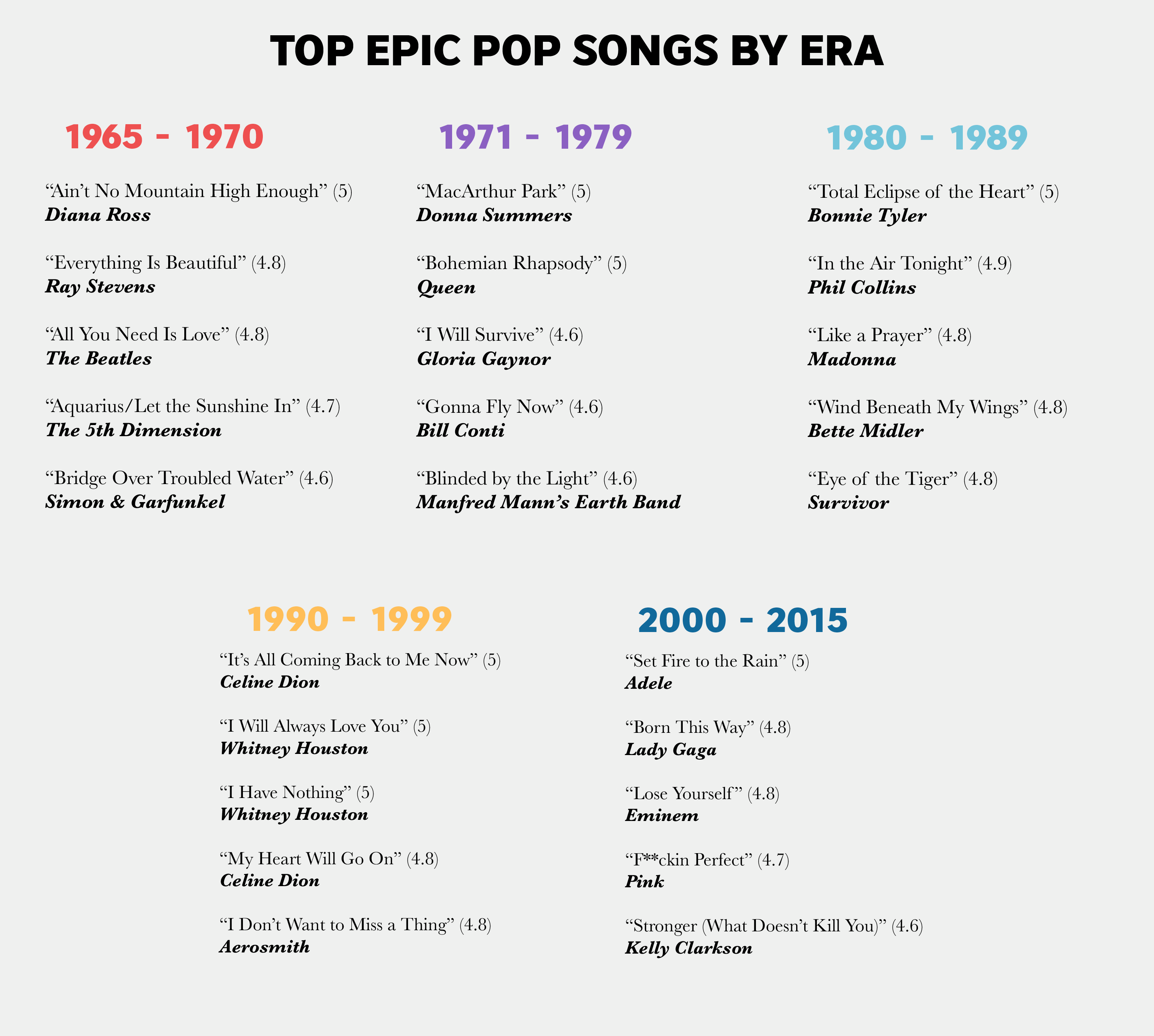
Interestingly, there are a couple specific producers and songwriters who appear on this list a few times: Giorgio Moroder, the synth and disco pioneer; Jim Steinman, the theatrical songwriter for people like Meatloaf and Bonnie Tyler; David Foster, the dramatic producer of fanfares and power ballads; and of course Dr. Luke, the anthemic pop producer in the ‘00s. These are clearly people specifically interested in a certain epic sound, and their efforts are part of the reason that epic music keeps coming back on the charts.
The Rise of Epic-Style Production
Starting in the late 1970s and early 1980s, you begin to hear a lot more epic production. Partly, that’s because you no longer needed to hire an orchestra and choir to create a massive sense of scale. You could get a similar effect through a huge synth sound and reverb, and artists absolutely did.
Take “Flashdance… What a Feeling” by Irene Cara. Listen to the layers of synth textures and melodies. There are pads that sound very similar to a string section and melodies that sound like horns, all washed in reverb and given stereo width for an extra big feel.
But that’s not all. The 1980s is also famous for its massive drum sounds, most prominently the gated reverb used on tracks like Phil Collins’ “In the Air Tonight.” Producers started dialing up the compression and reverb to the limit but then adding what’s called a gate so that the effects are only heard above a certain threshold of sound, creating this massive booming sound that then cuts off abruptly. Like it’s recorded in a cathedral but the door keeps closing after each hit.
Chris Dalla Riva agreed that the 1980s feels like an inflection point in epic pop music:
I think there’s another way that pop music can lean into epicness and that’s through melodrama. The big melodramatic ballad became very popular in the 1980s. Pop singles got a little longer throughout the 1970s and I believe they topped out in the 1980s, so I think that by the 1980s, you have a combination of these very dramatic production techniques along with slightly longer pop songs that make it possible to have these big, epic ballads.
After the 1980s, production became one of the dominant ways to add a dash of epic to a pop song. This is even more true in the 2000s when anthemic pop came to the fore, influenced by EDM and dance music. The charts start to feature a lot of songs with big synth textures, driving beats, and choruses designed for pumping your fist on the dance floor. I think of Kelly Clarkson’s “Stronger” with its driving, rhythmic synths and soaring chorus, Katy Perry’s “Teenage Dream” with its driving, rhythmic synths and soaring chorus, or Lady Gaga’s “Born This Way” with its driving, rhythmic synths and soaring chorus.
What about Structure?
There aren’t a ton of structurally epic pop hits on the list. There are definitely some exceptions, like Paul & Linda McCartney’s slapdash ditty “Uncle Albert / Admiral Halsey” or The Temptations’ “Papa Was a Rolling Stone,” which is built on one long unchanging bassline for 7 minutes. But to a large degree, most of the songs on our list adhere to the generally accepted pop music formula of verse, pre-chorus, chorus, bridge, etc. The interesting thing is how much epicness you can still generate within that structure.
I put this to Charlie Harding, and he made a very good point: Maybe there’s actually something inherently epic about the structure of pop music.
Most pop songs follow a sort of epic-like structure. They often begin small, with an intro that will grab your attention. They build through the verse and pre-chorus, indicating change. The chorus is a moment of catharsis. And then you go through that entire process all over again, except the next chorus is going to be even bigger than it was before.
Then, you’ll go through the development phase. A great bridge or even a down chorus in the sort of final act of a song, its job is to say: “Whoa, things have changed. Things are different. You’re gonna see the chorus in a new perspective.” And when you arrive at the final chorus, it’s the most epic moment of the song.
So you have gone through this journey from a very small insular world in the intro to the third chorus, by which time you should be experiencing the most overwhelming emotions and catharsis and joy or sadness, or whatever emotion you’re supposed to be feeling in its biggest way.
So, maybe in some ways pop music is inherently epic, at least in the way it allows us to experience an emotional journey in the most concise and affecting way.
Epic Music Stays With Us
Let’s end with a pop saga, an epic pop story if you will about how epic music can echo down the decades.
The year was 1967. The Summer of Love. Hundreds of thousands of people descended on San Francisco’s Haight-Ashbury. The Beatles released Sgt. Pepper’s, Hendrix lit a guitar on fire on stage at the Monterey Pop Festival, and a sunshine pop band with a few number one hits called the Association needed a new song.
The Association was a little bit of an unusual pop band, the sort you can only find in the 1960s. Eccentric, counter-culture, a little psychedelic, with ornate vocal harmonies and somewhat baroque-ish arrangements. They have a “Requiem for the Masses” that I’d classify as cathedral pop. Their hit song “Windy” from 1967 is a great early example of an epic pop song (I gave it a 4 on my scale). It’s happy but also psychedelic, with a harpsichord, flute, and intricate backing vocals.
Their new producer asked a budding songwriter named Jimmy Webb to write them a pop song with classical elements in it, a reliable path to epicness. Webb wrote a “cantata,” an operatic multi-movement piece sung over symphonic orchestration and choir, called “MacArthur Park.” The Association declined it, so it was instead recorded by a prestigious actor named Richard Harris, fresh off his epic musical film Camelot and looking to kickstart his singing career.
Released in 1968, this 7-minute piece of puffed up baroque melodrama actually hit number 2 in the charts at a time when most radio hits were 3 minutes long. It was a weird pop hit. It’s dramatic and through-composed, more like a film score. It feels romantic, conservative, and saccharine, at a time when that was not the hip thing to do. Discordantly, the song below it on the charts in June 1968 contained the lyrics “Yummy, yummy, yummy / I got love in my tummy.”
“MacArthur Park” was mostly forgotten about, an epic little footnote in the history of pop, until a synth-obsessed producer also interested in making epic music named Giorgio Moroder heard it while driving in Los Angeles and thought it would make the perfect cover for a new disco artist he was working with named Donna Summer.
Moroder and Summer decided this long, slightly absurd ballad could be longer, more absurd, and a dance hit. They took the slow intro and slowed it down even more. They added a choir to the beginning, except it’s actually just Moroder’s voice recorded to tape, layered, and pitched. They added a maniacal cackle as Summer breaks out into a fast-paced disco beat.
It retains all the orchestral lushness, but adds some weird synths, congas, a pulsing bass, stuttered horns, and a catchy synth lead. Then they released the whole thing as a 17-minute medley, with a shorter single version that hit number one on the charts.
In my survey of epic pop music, there are only a couple songs that get a 5—the perfect epic score. “MacArthur Park” is one of them. But then twenty years later there’s another.
The story of this song starts in the late 1980s with an over-the-top songwriter named Jim Steinman and a larger-than-life artist named Meatloaf, whose theatrical album Bat Out of Hell from 1977 had remained on the UK best-selling album charts for almost a decade. In the late 1980s, they were working on the follow up album Bat Out of Hell II.
But there was one song that Steinman had written that he was adamant Meatloaf couldn’t have, a song inspired by Emily Brontë’s gothic romance novel Wuthering Heights. In fact, Steinman was so determined he sued Meatloaf to stop him using it.
That’s because Steinman wanted this song to have a female lead. A few years later, he found that female singer, the French-Canadian mega-diva Celine Dion.
And so Celine recorded and released “It’s All Coming Back to Me Now” in 1996. More than 7 minutes long, it’s dazzlingly overwrought. It starts out with haunting wind and thunder sound effects behind pretty piano and verbed out electric guitar. It builds from there, tumbling in and out of multiple romance-drenched movements, through sleighbells, choir voices, and what sounds like more cannon shots. And then, of course, there’s this moment:
Remember what Irving Berlin said at the beginning? A good pop song needs to be singable by anyone?
I’m not sure anyone’s able to do what Celine does here. And yet, that hasn’t stopped us from trying. A pop song is for the populace, and that includes me occasionally mangling Celine in the shower. Haven’t we all?
I’m telling this story both because I think it’s a good insight into a few of the most epic songs on my list—and also there’s a way in which epic music echoes down the years, maybe even more than other songs, inspiring us to ever greater heights. The drama, the theatricality, the exuberance.
“MacArthur Park” recently made a bit of a comeback when the Donna Summer version was used by Olympic figure skater Alysa Liu for her gold medal performance. It was also performed live in 2011 by Donna Summer at a concert arranged and produced by David Foster, the legendary producer behind another 5 on epic pop scale: Whitney Houston’s “I Will Always Love You.” And so the tradition continues.
Epic music makes us feel big things. So does pop music.
One of the reasons I struggled to get my head around epic pop music at the outset of this project is because there’s a way in which epic music self-consciously breaks the mold, while I assumed pop music was the opposite.
And yet, it’s more complex than that. Pop music is in dialogue with the mold, playing with an audience’s expectations to reach people and move them. I can’t imagine two songs that demonstrate that more clearly and ambitiously than “MacArthur Park” and “It’s All Coming Back to Me Now” in every way.
Pop music is just a matter of: Where do you want it to be heard? Do you want it to be heard on the radio or do you want it to be heard in a rarefied institution, in a museum?
Charlie Harding again. He points out that modern pop music isn’t usually intended to promote nationalism and grandeur, like Wagner or Tchaikovsky. Instead, it’s a reflection of our times, where the journey is personal, where artists are sharing what they’re going through in ways that the rest of us can relate to.
Pop music can make us feel big, epic feelings. Or it can make us feel quiet, small plaintive feelings. When I look at a great work that is considered epic, there’s a feeling of awe, and I think awe can be experienced in a enormous vista with the most beautiful sunset or staring into a raindrop on a leaf. Musically, I think we can experience the feeling of epicness in all kinds of modes of expression.
Pop songs give us the ability to experience those emotions as individuals in a fuller way.
Ultimately, epic music is just music that makes us feel part of something bigger than ourselves, like our emotions are tied into the endless tide of history and humanity before and after us.
Sometimes the music that does that goes under the radar. But other times, it’s exactly the song that everyone else is also listening to right now.
And when we all feel connected like that, it’s a beautiful, and I’d argue epic, thing.
Want more writing like this? Subscribe to Ian Temple’s Soundfly Weekly to keep up with his epic series about epic pop music.
Want more from Chris Dalla Riva? Get a copy of his debut book, Uncharted Territory: What Numbers Tell Us about the Biggest Hit Songs and Ourselves.

Fun article! Great job defining what makes a song epic. Here are a few more I'd add to the list:
Band on the Run - Paul McCartney & Wings
Scenes from an Italian Restaurant - Billy Joel
Baker Street - Gerry Rafferty
Paradise By the Dashboard Light - Meat Loaf
You Oughta Know - Alanis Morissette
Ray of Light - Madonna
Livin' La Vida Loca - Ricky Martin
Smooth - Santana/Rob Thomas
Not sure how Beach Boys Good Vibrations didn’t make the list in even the Google doc.