


If you enjoy this newsletter, consider ordering a copy of my debut book, Uncharted Territory: What Numbers Tell Us about the Biggest Hit Songs and Ourselves. It’s a data-driven history of popular music covering 1958 to 2025. Though that book is mostly focused on popular music, today we are going to talk about something different: classic rock.
Classic Rock is Changing
By Chris Dalla Riva
Though I grew up in the 2000s, my gateway to becoming obsessed with music had nothing to do with pop punk, southern rap, boy bands, or any other genre that dominated the airwaves at the time. My gateway was classic rock.
Looking back, this was both funny and odd. “Funny” because at 8-years-old I talked about popular music like someone who was 58. “Odd” because nobody was forcing this music upon me.
Often when I encounter someone quite young who has musical tastes that are quite old, I’ll find that there is someone in their life—often a parent—who is pushing those tastes on them. Most tweens are not stumbling on Bringing It All Back Home and Hunky Dory. Though my parents have recommended many great songs to me over the years, my conversion into an old head was largely self-driven.
As the years have gone on, I continue to have a soft spot for classic rock even if I don’t listen to it much. There are only so many times you can listen to “Hotel California” and “R.O.C.K. in the USA” without wondering if there is something else out there.
If I do listen to songs of that ilk these days, it’s almost certainly because I am in the car and have tuned to Q104.3, my local classic rock station. When I was at my parents for Thanksgiving, I flipped over to the Q as I was running some errands. I heard mostly what I was expecting. AC/DC. Def Leppard. Queen.
But then something weird happened. After a commercial break, Green Day’s “Boulevard of Broken Dreams” started playing. “What?” I thought to myself. “How is this classic rock? It came out in 2004.” Classic rock, it seemed, was changing. I wanted to find out how.
The New Classics
Since 2001, Q104.3 has counted down the greatest classic rock songs of all-time each Thanksgiving weekend. Initially, the list was only 104 songs long, but in 2004 they decided to expand to a massive 1,043-song list. Scanning these lists is a great way to see how people’s perception of the genre has changed over time.
And perceptions matter. There are some sonic and temporal qualities that unite the classic rock canon. The songs usually involve electric guitar, bass, and drums. And they were typically released in the second half of the 20th century. But these aren’t hard and fast rules.
Prince, for example, is not part of the classic rock canon. Across the last 20 years, he’s only made the Q104.3 list one time when his “1999” came in as the 815th greatest classic rock song in 2013.
This is kind of strange. If you were to institute some objective standard of what qualified as a classic rock song, Prince would have some that fit (e.g., “Let’s Go Crazy”). The man can out-shred most classic rockers. But listeners don’t perceive him as part of the canon.
By contrast, Elton John has had 25 songs make the lists over the last two decades. Similarly, Elton John does have songs that would surely qualify as classic rock by any sense of the definition (e.g., “Saturday Night’s Alright For Fighting”). But he also has songs that make the list nearly every year that don’t strike my ear as rock songs (e.g., “Monas Lisas and Mad Hatters”).
As I talk about in my book, some of our perceptions of what qualifies as a certain genre are tied up in the race and gender of people performing the songs. It’s undeniable that the classic rock canon is largely dominated by White men. But even with that in mind, the bounds of genre are fuzzy.
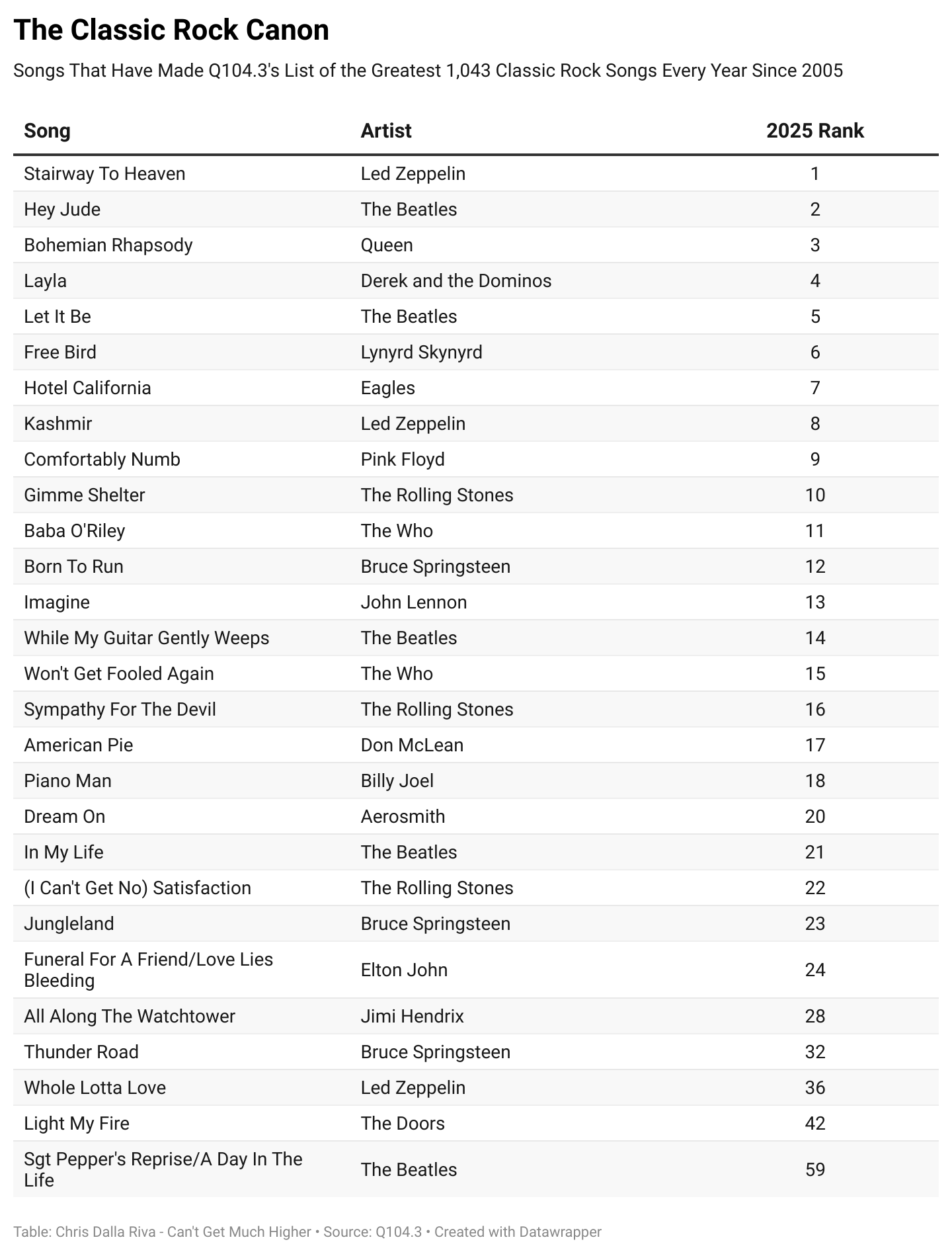
Let’s start with some key facts, though. Across the history of Q104.3’s the list, there have been 1,985 songs included as performed by 376 artists. The median song was released in 1977. And some songs have been quite consistent.
Led Zeppelin’s “Stairway to Heaven,” for example, has been voted the best classic rock song every year Q104.3 has run the poll. 340 songs have been somewhere on the list each year since 2005. 28 songs were in the top 100 each year in that same period. In 2005, The Beatles led the pack with 58 songs on the list. 20 years later, they still bested everyone else, except they now have 60 songs on the list.
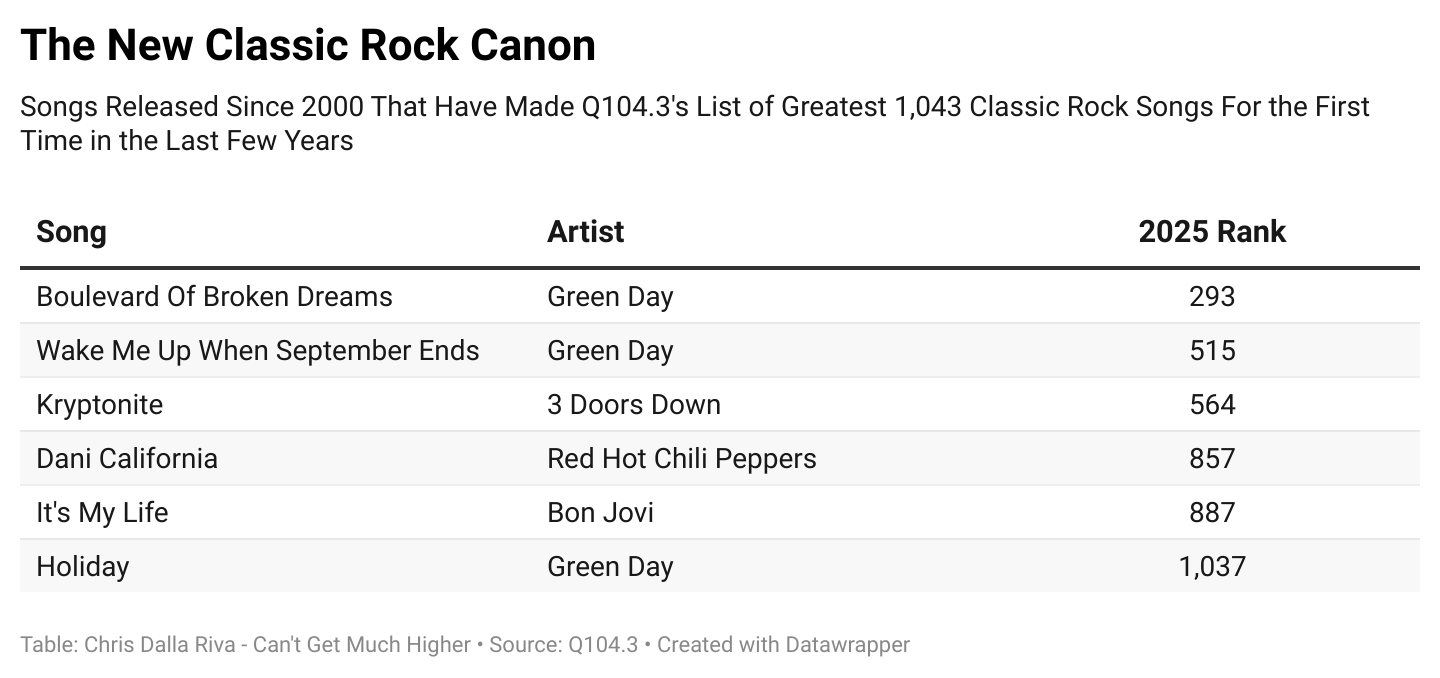
But, as noted, things are also changing. We can look for songs that weren’t regularly on the list from 2005 to 2009 but are now consistently included. If we just focus on songs released after 2000, we can see which compositions are entering the classic rock canon, like “Dani California” by Red Hot Chili Peppers and “Kryptonite” by 3 Doors Down.”
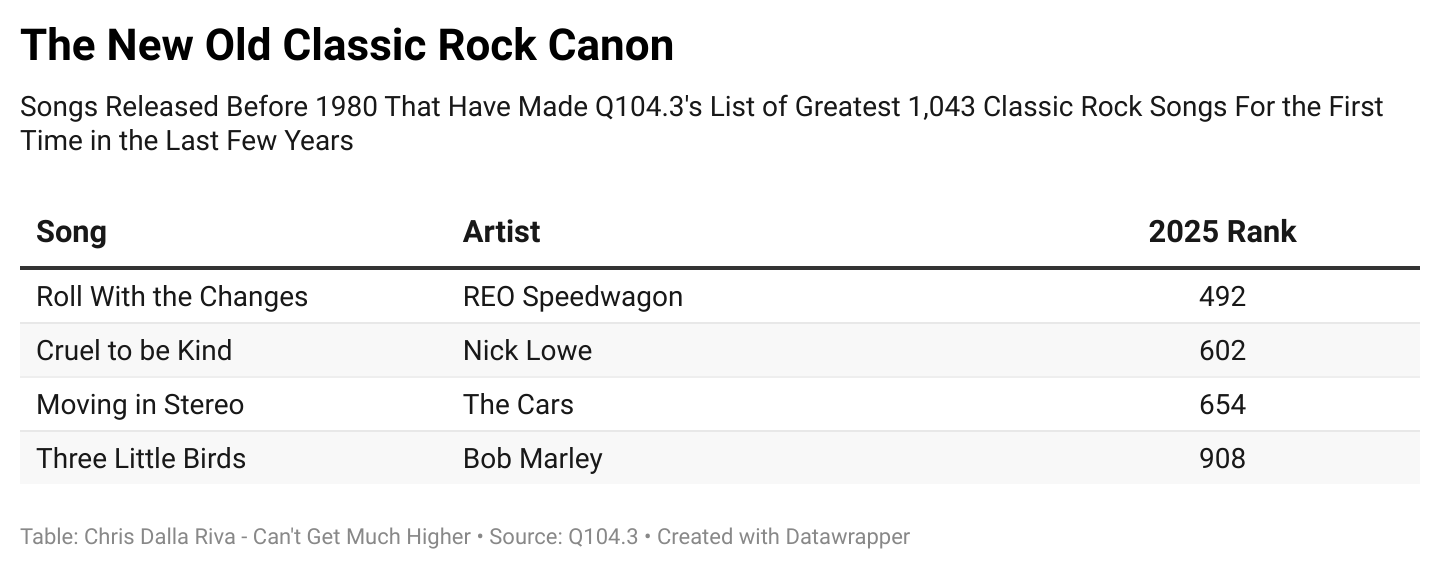
Older songs can also enter the canon too. If we use the same methodology but focus on songs released before 1980, we see that songs like “Cruel to be Kind” by Nick Lowe and “Moving in Stereo” by The Cars weren’t considered classic rock two decades ago. Now they are.
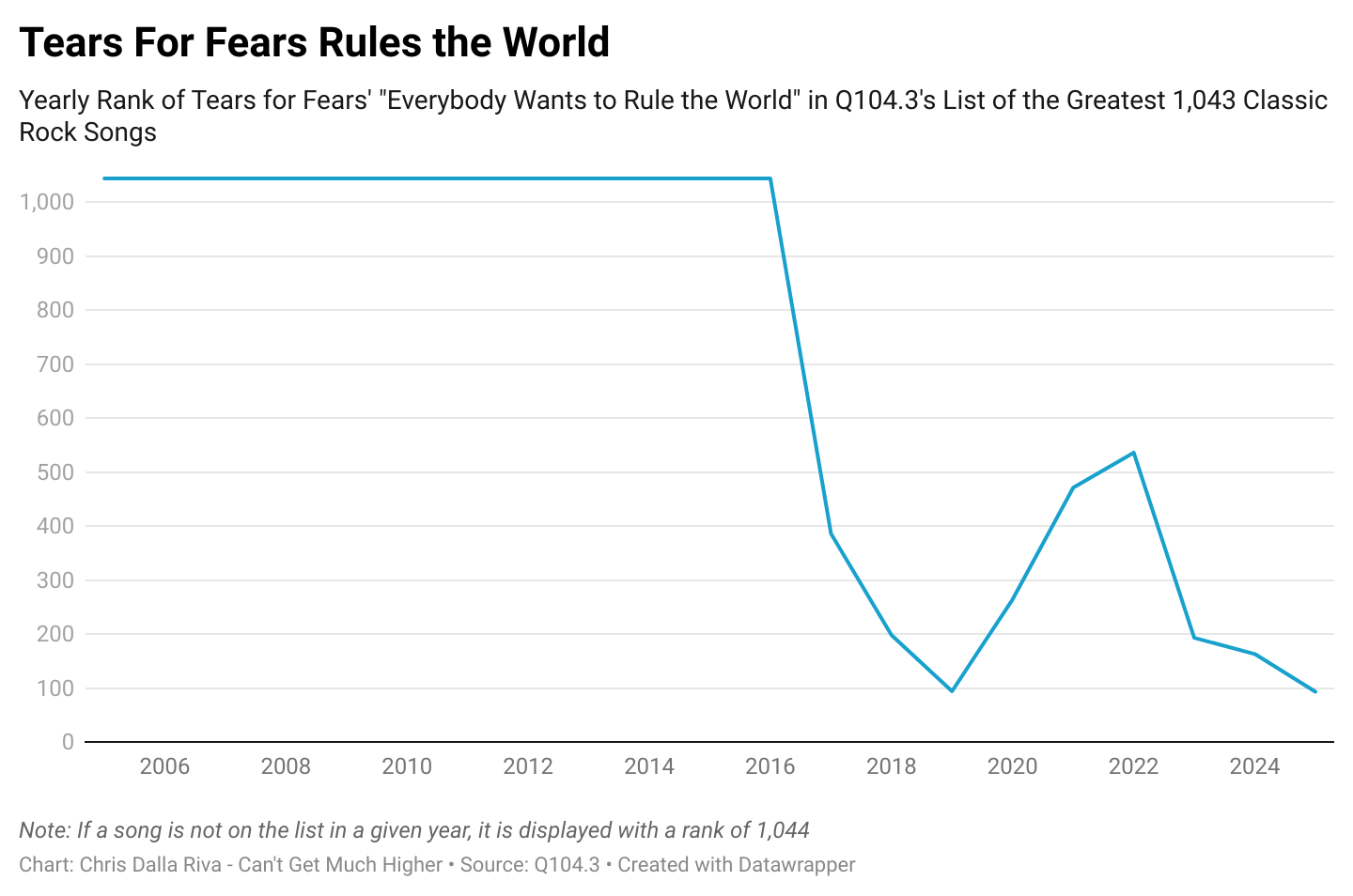
To be clear, many of these songs are in the lower reaches of the list. But we also see songs—both new and old—only gain more acclaim as time has gone on. Tears for Fears’ “Everybody Wants to Rule the World” wasn’t even on the list in 2005, but over the years it began to inch up. In 2025, it was voted one of the top 100 greatest classic rock songs.
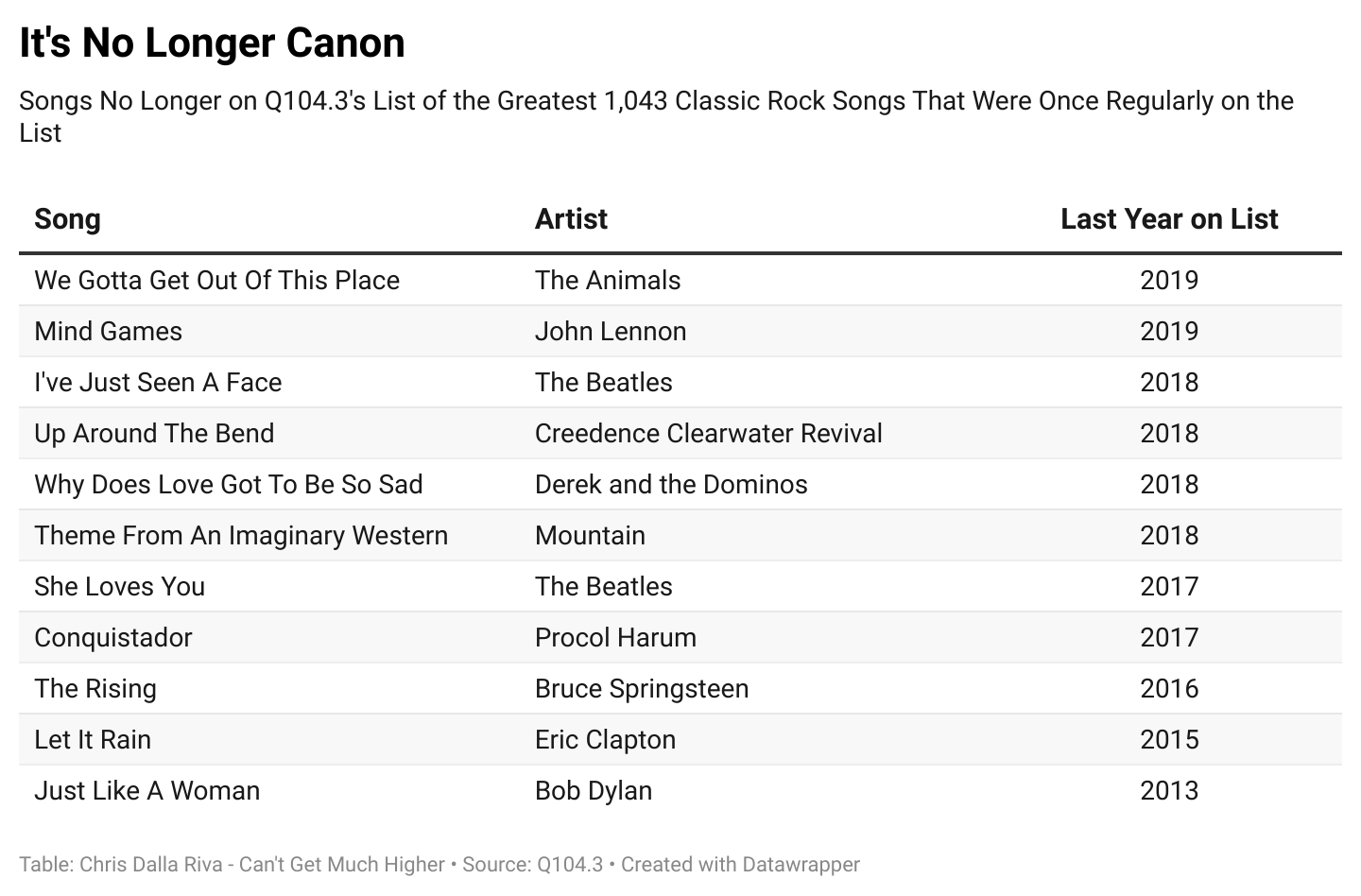
Songs can also lose their classic rock status. For example, from 2005 to 2009 both The Beatles’ “She Loves You” and Creedence Clearwater Revival’s “Up Around the Bend” were on the list in each year. Neither song has been included since before 2020.
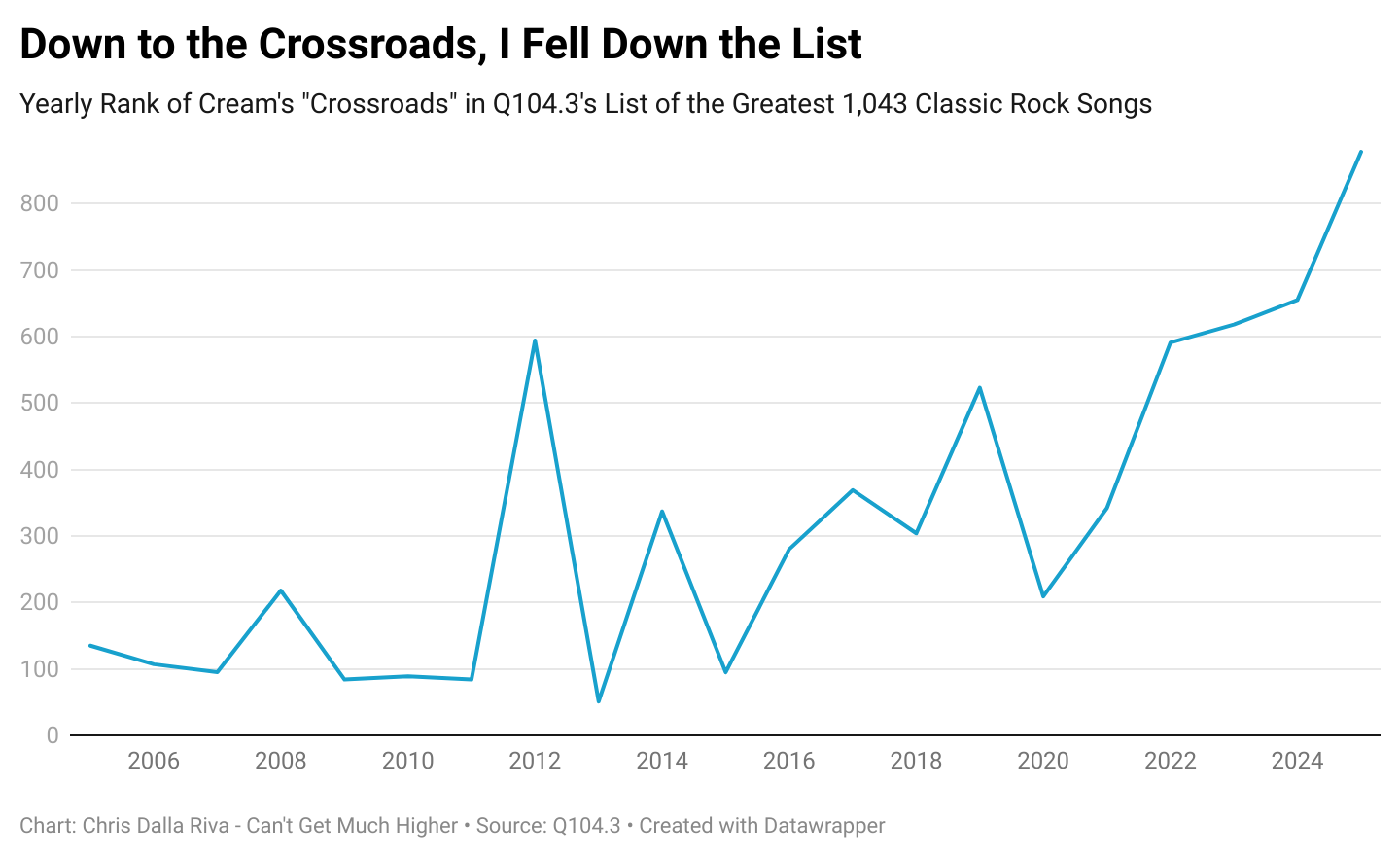
And just as “Everybody Wants to Rule the World” has seen a dramatic ascent, other songs can see a precipitous fall. Cream’s “Crossroads,” for example, would sit around the top 100 two decades ago. Now, it’s lucky if it makes the top 500.
The Journey to Rock Canon
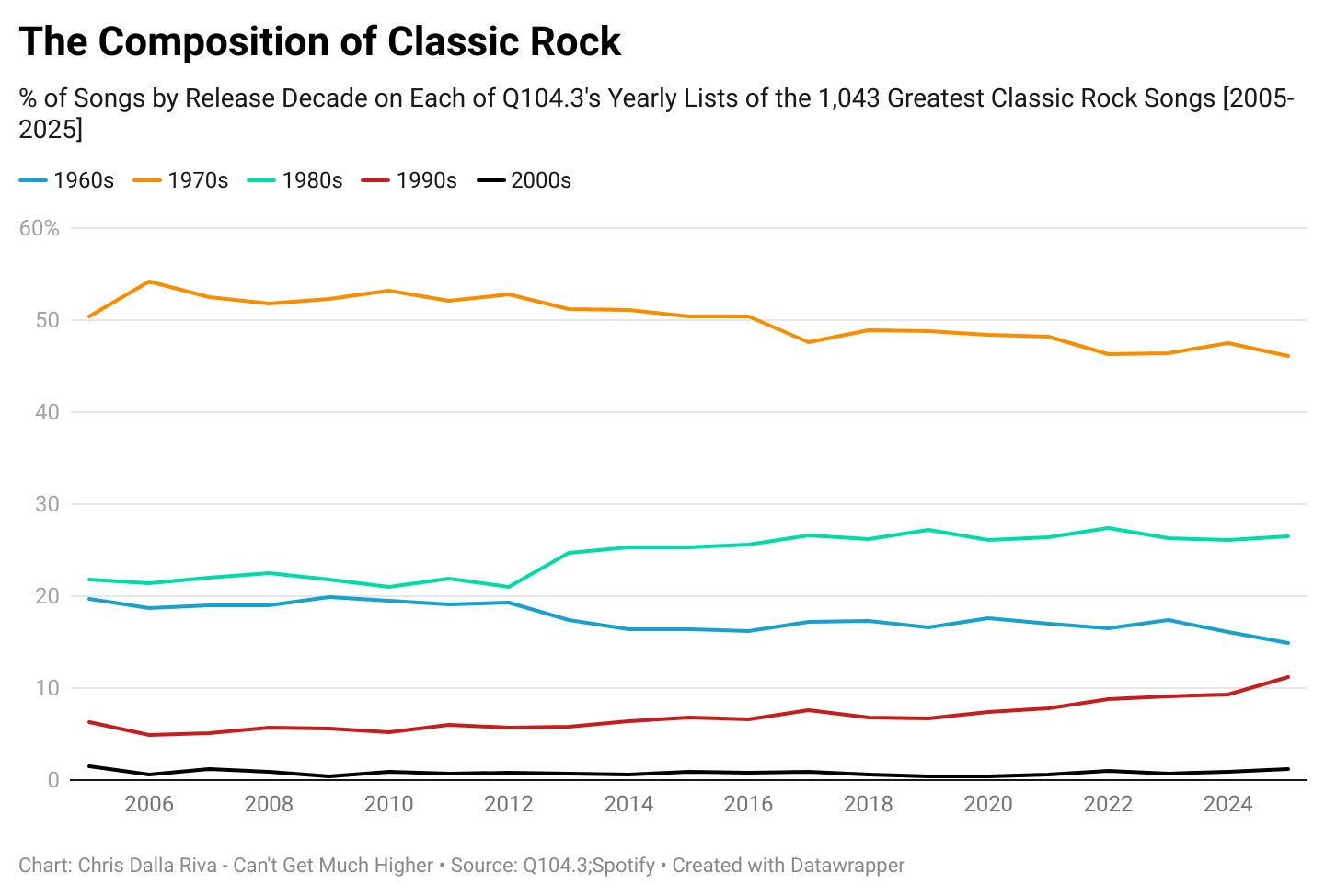
So, clearly the face of classic rock is shifting slowly over time. The simplest way it shifts is that we start to integrate newer songs into the canon. You can see this by looking at the composition of song release years for each Q104.3 list.
In 2005, 19.7% of songs on the list were released in the 1960s and 50.4% were released in the 1970s. In 2025, those percentages had fallen to 14.9% and 46.1%, respectively. By contrast, songs released in the 1980s grew from 21.8% to 26.5%. Songs released in the 1990s grew from 6.3% to 11.2%.
If classic rock is always creeping forward in time, how long does it take for a song to enter the canon? We can measure this. If we look at every song released after 1990 that has made any of Q104.3’s lists, we see that it takes about 20 years on average for a song to enter the classic rock canon.
Assorted Observations on Classic Rock
In one sense, the crux of this piece is pretty simple. First, our conception of what constitutes a genre changes over time. Musical categories are not static. Second, this conception is not just influenced by new music coming out but our changing view of the past.
When it’s laid out as I’ve done here, I don’t think you’re that shocked. But I think these ideas cut against our intuitive notions of how we think about music. You might think that since “Hey Jude” is a classic rock staple today that it will always be. That isn’t necessarily the case. The past is alive, and we are constantly wrestling with it.
To close, I wanted to list out some stray observations. When you put together an analysis like this, you often come across interesting things that don’t fit into your thesis. Rather than leave them jumbling around in my brain, I figured I’d share them with you.
I Know Nothing About Genesis: The Q104.3 dataset only listed songs, not artists. Because of that, I had to scroll through the list and add artist names. 99% of the time that I saw a song name and didn’t know the artist, it was by Genesis.
Eric Clapton is the King of Classic Rock: Slowhand does not have the most songs in the history of the list, but he is unique in how his work is spread across so many different groups. Along with his solo career, Clapton’s work has entered the classic rock canon via the Yardbirds, Blind Faith, Cream, Derek and the Dominos, The Beatles (i.e., “While My Guitar Gently Weeps), and The Band (i.e., “Further On Up the Road”).
Eric Clapton’s Legacy is Diminishing: In 2005, Clapton had 25 songs on the Q104.3 list across all the groups he’s been involved with. In 2025, he had 17 songs, down 32%. I won’t claim that Clapton is on the road to being forgotten—“Layla” has been in the top 10 every year—but he is a bit less revered than a few decades ago.
The 1990s and 2000s Have Entered the Chat: In 2025, songs by 12 artists from the last two decades made the Q104.3 list for the first time: “Loser” by Beck, “Low” by Cracker, “Higher” by Creed, “Bring Me to Life” by Evanescence, “Santa Monica” by Everclear, “Hey Jealousy” by Gin Blossoms, “Numb” by Linkin Park, “Wonderwall” by Oasis, “All I Wanna Do” by Sheryl Crow, “What I Got” by Sublime, “The Sweater Song” by Weezer, and “Seven Nation Army” by The White Stripes. If you grew up enjoying those songs, you’re officially old.
Van Roth > Van Hagar: Across the decades, 30 songs by Van Halen have made Q104.3’s list. 21 of those songs featured David Lee Roth behind the microphone. 9 featured Sammy Hagar.
David Lee Roth = Sammy Hagar: In terms of their solo careers, both Roth and Hagar have had two respective songs make the list over the years. “Just Like Paradise” and “Yankee Rose” for David Lee Roth. “I Can’t Drive 55” and “There’s Only One Way to Rock” for Sammy Hagar.
Rock Singers Like Singing about “Rock”: 1.6% of songs voted onto the Q104.3 list since 2005 contain the word “rock” in the title. I don’t think any genre self-mythologizes itself more.
Rock Artists are Dreamers: Speaking of self-mythologizing, the most common song title across the list is “Dreams.” Three distinct songs with that title have joined the pantheon of classic rock over the decades: “Dreams” by Fleetwood Mac, “Dreams” by Van Halen, and “Dreams” by Allman Brothers Band.
A New One
"Hello Operator/Til I Collapse" by Jack White & Eminem
2025 - Classic Rock/Rap
Detroit native Jack White played the half-time show at the Lions Thanksgiving Day football game. In the middle of performing The White Stripes classic “Hello Operator,” White brought out fellow Detroiter Eminem to rap a verse of his classic “Til I Collapse.” The songs worked remarkably well together. Given that Jack White was recently inducted into the Rock & Roll Hall of Fame and had his first song included on a Q104.3 list, maybe Eminem will join the classic rock canon next.
An Old One
"I Don’t Want to Go Home" by Southside Johnny & the Asbury Jukes
1976 - Rock ‘n’ Soul
I guess I have to recommend something in the classic rock canon here. This cuts against my notion of recommending things that you probably haven’t heard before. But I’ll give you something from one of the lists that there’s a least some chance might be new to you: “I Don’t Want to Go Home” by Southside Johnny and the Asbury Jukes.
Part of the extended E Street Band universe, “I Don’t Want to Go Home” was written by Steven Van Zandt. It fits firmly within the rock ‘n’ soul scene that proliferated at the Jersey Shore during the 1970s. Lucky for a New Jersey native like me, remnants of that scene still exist at many of the seaside bars of the state.
If you enjoyed this piece, consider ordering my book Uncharted Territory: What Numbers Tell Us about the Biggest Hit Songs and Ourselves. The book chronicles how I listened to every number one hit in history and used what I learned during the journey to write a data-driven history of popular music from 1958 through today.
Besides the three Dreams songs, there’s also These Dreams by Heart and of course Dream On by Aerosmith, but surprisingly not Dream Police by Cheap Trick.
"There are only so many times you can listen to “Hotel California” and “R.O.C.K. in the USA” without wondering if there is something else out there."
Are you sure about that?
Seriously though, I think of Classic Rock as being the genre I know the best, but out of that list of the top songs there were only a few I really, really like. Most were just what I would classify as good, not great. There's at least one I can't stand, and a couple I don't think I know. (Odds are I would recognize them if I listened to them.) And then there's Stairway to Heaven.
Every year when I was in high school ('85-'89), there would be a group of kids who would strongly lobby for Stairway to Heaven to be the theme song for the senior prom. It never was, because the kids who were lobbying for it were not the kind of students who would actually get organized and be responsible for planning the senior prom. Or anything, really. And that's locked in as my mental association with Stairway to Heaven: it's the stoner's song. (Which is not to say it's a bad song. I like it, but it's not #1 in my rating.)
Finally, if you think Rock music mythologizes itself the most, I can tell you haven't listened to much Country music.