
How TV Shaped Music: A Conversation with Mark Malkoff
The author of the new book "Love Johnny Carson," Mark Malkoff stops by to talk about the important relationship between music and TV
If you enjoy this newsletter, consider ordering a copy of my debut book, Uncharted Territory: What Numbers Tell Us about the Biggest Hit Songs and Ourselves. It’s a data-driven history of popular music covering 1958 to 2025.
Today, I’m speaking with Mark Malkoff. A couple months ago, Malkoff offered to send me a copy of his forthcoming book, Love Johnny Carson: One Obsessive Fan’s Journey to Find the Genius Behind the Legend. It initially felt like a weird fit for this newsletter, but I absolutely fell in love with the book, especially since Johnny Carson’s life had major overlap with some of the great music stars of the 20th century. Over an hour, Malkoff and I spoke about The Beatles’ calamitous appearance on The Tonight Show, why Johnny Carson loved Tony Bennett, and the artists he hated having on. If you enjoy our conversation, consider picking up a copy of his book.
I want to start talking about the arc of music on television. For decades, television was really a place to discover music. Most late-night shows not only had house bands, but they featured up-and-coming artists. Now, many late-night programs don’t feature music at all. Can you give me a short overview of how music has been featured on variety shows over the decades?
Back in the day, since there were only three networks, getting on a television show would literally change your life. Johnny Carson, Ed Sullivan, and some other shows were regularly putting up singers. If you were talented, and they believed in you, they would give you a spot on your show. Every talent scout, manager, and agent watched those shows back then. If you performed well, you were probably getting signed. That’s not the case anymore.
I’m a big Frank Sinatra fan, and I know that his initial big break was winning a talent contest on the radio.
I spoke to over 400 people for my book and podcast. You hear that story constantly. You got on Johnny Carson or some other show, and it changed the trajectory of your career.
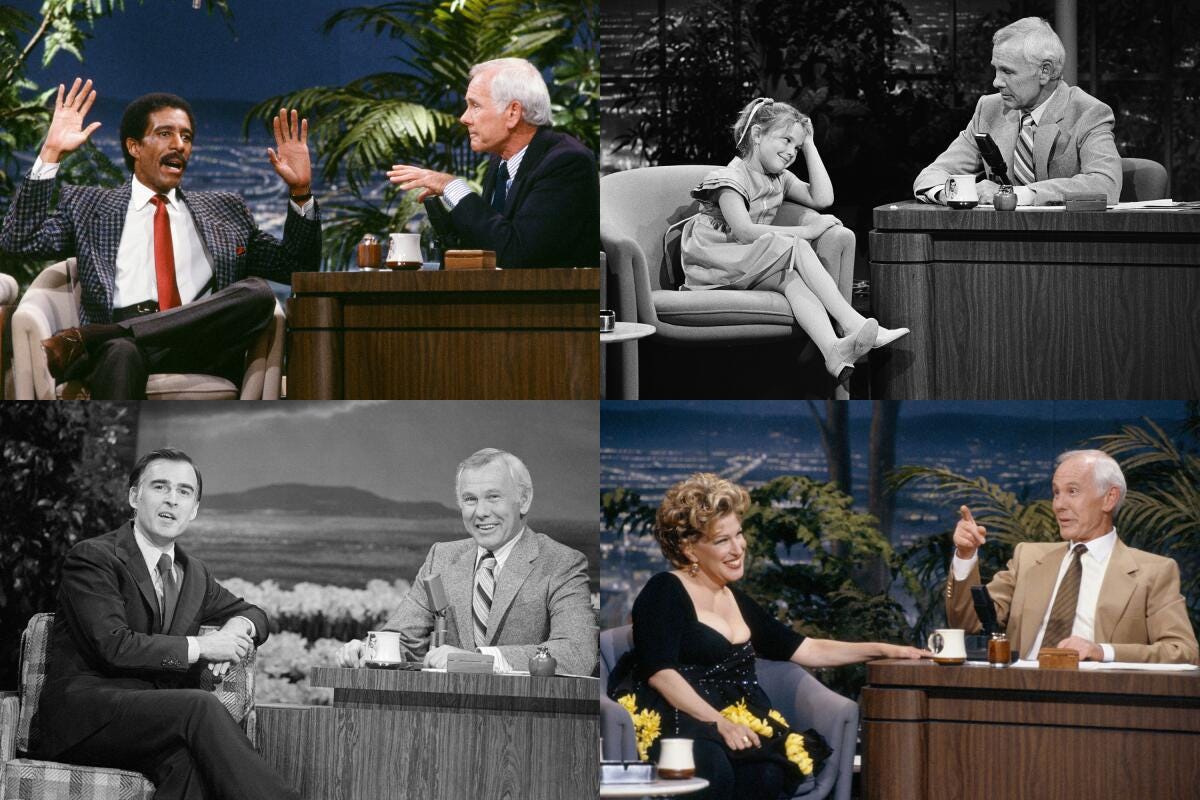
As you’d imagine, it was hard to get on those shows. They would all have scouts scouring clubs for talented people. If you got an audition, you’d get called up to the seventh floor of NBC and sing for one person in a conference room. Johnny had very little to do with choosing guests. But if he walked by and liked what he heard, he would have you on the next day.
Let’s talk specifically about Johnny Carson and his relationship to music. As you note in the book, “Though music comes with the territory, it was a particularly strong interest of Johnny’s.” Throughout the book, you highlight many of Johnny’s favorite artists. Can you highlight some of them and speculate on why he was drawn to them?
He loved Buddy Rich. Johnny was an amateur drummer. He got to perform with him at some point and was like a little kid with his hero. When Buddy Rich died, it was one of the first times that Johnny lost it in front of the studio audience. He was devastated. He canceled all the shows for a week.
He also loved Joe Williams, Steve Lawrence, and Tony Bennett. Tony Bennett was actually on his very first show. Johnny also liked to sing. He would sometimes say he was a “frustrated singer.” He tried to sing in front of an audience in Vegas, and they started laughing. They thought it was a bit. They couldn’t accept him as anything other than comedian. A couple of months later, when he sang on the show, he had to explain to the audience that it was for real.
More modernly, he loved k.d. lang. He couldn’t get enough of her. When they did the Johnny Carson tribute show on Jay Leno, k.d. lang was there with Bob Newhart and Don Rickles. That’s how highly he thought of her. And if he liked an artist, he would keep booking them no matter what kind of music they made. The Oakridge Boys did 40 shows. The Pointer Sisters did 20.
He’d also let musicians guest host regularly even if they weren’t used to a national audience. Roy Clark guest hosted. So did John Denver and Bobby Darin and Cass Elliot. If Johnny liked you, he would take a chance. You didn’t have to be a superstar.
This world doesn’t really exist anymore. It seems like you need to have already built an audience if you want a record or to be on a late-night show.
That’s true. Johnny launched so many careers. I can’t think of the last time a late-night show truly launched someone. Maybe Jimmy Fallon with Nate Bargatze? Letterman launched Ray Romano and Jim Gaffigan. But those are so long ago.
As a point of contrast, Carson had Bette Midler on and she exploded as a result. Then he had her opening for him in Vegas, and the audience just didn’t get it. But Johnny kept her in rotation because he liked her. She was actually the last guest on Carson’s version of The Tonight Show. She did a song at the desk, and it was magic. I think she won an Emmy for it.
Were there any musicians that Johnny Carson didn’t want to have on his show?
He had his fair share of grudges, but he generally didn’t want artists who were too over-the-top or stimulating because it was so late at night. One time Billy Preston got a standing ovation on the show, but Johnny said to never book him again. He thought it was too much for people drifting to sleep. There were some exceptions. James Brown would appear every once in a while. If you were as big as Tina Turner, he’d make an exception. But it was rare.
He would make exceptions if there was a good gag, though. He had ZZ Top on in the 1980s. They were playing loud rock music. But he just wanted them, so they could do a cutaway afterwards to Johnny and Doc Severinsen dressed in ZZ Top beards.
One of my favorite tales from your book was when The Beatles made an ill-fated appearance on The Tonight Show. Can you tell me about that?
The Tonight Show couldn’t believe when they heard from The Beatles’ manager that John Lennon and Paul McCartney wanted to come on the show. They were going to come on to announce the launch of Apple Corps. Naturally, Lennon and McCartney thought Johnny would be hosting. He was off, though. The host was baseball star Joe Garagiola.
When Lennon and McCartney showed up, they were upset. They never would have agreed to do the show if Carson wasn’t there. They had no idea who Joe Garagiola was. And Garagiola really didn’t know how famous they were. Tallulah Bankead was also a guest. She was six months from dying and was not in good shape. The whole thing was a train wreck.
Tony Bennett’s son Danny was there that night. He was supposed to meet John and Paul. When I spoke to him, he told me that there was all this craziness trying to get them in and out of the studio, and Tallulah Bankead thought everyone was waiting for her.
McCartney finally returned to The Tonight Show in 1984, but he refused to play any music. Now, when you get him on television, he won’t stop playing. They had a guitar for him, but he had no interest.
Your book also brought to my attention that nearly the whole first decade of Carson’s Tonight Show is lost, including that Beatles’ appearance.
There are bits and pieces of that decade preserved on kinescope. I think you can see parts of the Lennon-McCartney train wreck on YouTube. But, yes, so much was lost. It’s a real shame. So many incredible acts appeared or guest hosted during that decade. Jimi Hendrix. Nina Simone. The Beach Boys. It’s almost all gone.
It’s insane that they didn’t preserve that.
Johnny was furious when he found out. NBC didn’t see the point in keeping it. When he moved the show from New York to Burbank after ten years, he wanted to do an anniversary show and found out almost all the clips had been erased or taped over. He had a few that he kept on kinescope, like him and Pearl Bailey singing together in 1964. But, yup, it’s almost all gone. It’s such a shame. Barbra Streisand made four or five appearances in 1962 and 1963. They’re basically all lost.
I think the way you put this book together is almost as interesting as the book itself. You were a huge Johnny Carson fan growing up. Then, a few years ago, you started The Carson Podcast, where I think you spoke with every living person involved with the show. In short, you became an expert on Johnny Carson and The Tonight Show. Can you tell me what about Johnny Carson appeals to you and why you wanted to preserve his memory?
I’ve always been attracted to late-night television. I was a teenager ditching high school to drive up to see Dave Letterman’s show at NBC. I loved seeing the music acts, and Carson was my introduction to a lot of old school show business. But there was just something so likable about him.
I know that people my age at that point were way more into Letterman, who had a little bit more of an edge. But Johnny was just so likable. I discovered endless music, comedy, and people from him. Plus, everyone watched the show. Carson was born in Nebraska, and he played to the Midwest, but he also played to the cities. He could talk to an A-list actor and a farmer from Idaho that had never been on an airplane on the same episode.
I think Seinfeld said back in the day that watching Johnny at 11:30 and Dave at 12:30 were events. It was a big deal to stay up and watch those shows. I’ve talked to people that would go through their TV Guides and highlight if there was a certain music act or person they wanted to see that week, so they would stay up to watch.
How long did you run the podcast?
I started recording in 2013, launched in February 2014, and did it for eight years. I was convinced that I would get to talk to like five people. I had no idea that all of these iconic people would want to speak to me. I think it was because those Tonight Show experiences were some of the best of those people’s lives, and almost nobody ever asked about them.
I did an episode with Jimmy Buffett, and his team told me how excited he was beforehand. I was like, “Why is Jimmy Buffett excited to talk to Mark Malkoff?” The answer was that Johnny Carson was vital for Buffett’s career and no one ever talked about it. Johnny booked him early. Some people, like Joan Rivers, portrayed Johnny as this cold, aloof person, but almost everyone I spoke to described him as very warm and friendly.
Who were the biggest celebrities you spoke to?
I did an episode with Paul Anka. And that was long before Zoom, so I went to his house. It was crazy seeing all of the gold records. I talked to Chevy Chase in New York. Carl Reiner. Bob Einstein. Kevin Nealon. Regis Philbin. Dave Coulier. Cybill Shepard. Paula Poundstone. I couldn’t believe these people wanted to invite me into their homes and speak to me. I guess I just found the right subject.
Which guest did you find the most unexpectedly insightful?
The most insightful were the staff members that were not famous. Most people who ever wrote into me about the podcast would say that. Johnny’s producer Peter Lassally was very good. Comedy nerds loved when I spoke with him because he produced everyone from Carson and Letterman to Arthur Godfrey and Craig Ferguson. Talking to all of these people really helped dispel a lot of myths about Johnny Carson because, for someone that was on television for decades, he was a bit mysterious.
I feel like throughout the book you interrogate and disprove the notion that Johnny Carson was some recluse off camera, especially after he retired.
People who Johnny felt safe around would tell me that he was pretty close to his Tonight Show personality in every day life. But he wasn’t like that with most other people because he had to protect himself. He was constantly getting death threats. After Mark David Chapman killed John Lennon, they found a list of other people he thought about killing. Carson was on that list. People were sometimes getting through NBC security with knives.

Even if it was less dangerous, people were always grabbing him on the street. They wanted photos or for him to say hello to someone. Everyone thought Johnny was their friend because they watched him on TV. And you have to remember how much television that he was filming. He had to protect his energy. He was doing an hour-and-forty-five minutes of television every day for years. He would have never survived if he didn’t try to protect himself.
You would think hosting a television show isn’t much work. But being on every day must wear on you.
Oh, absolutely. Dick Cavett said it was like going to 200 cocktail parties in a row and having to be the life of every single one. One of Carson’s competitors said it’s more exhausting than shoveling snow for eight hours every day.
I know privately that the current hosts of late-night shows will say how tiring it is. They do about 180 hours of television a year. Johnny did 404 hours in his first year. That would be unheard of today.
I want to close by talking about Johnny Carson as a unifying figure. Part of the reason that people like him was that he put on a great show. But another reason is that, as you noted earlier, there weren’t many alternatives. There are pros and cons to have a media ecosystem like that. The cons are that you need to go through gatekeepers to do a lot of things. The pros are that culture is unified. I think that’s healthy for society. What is your perspective on this? Have you experienced the fractured nature of media while promoting this book?
I think it’s great that more musicians and creators can make a living because of website like YouTube. But it’s also harder. There’s so much noise. To get a level of success that meets people’s expectations, to get to the point of acclaim you’d get for one appearance on The Tonight Show, basically doesn’t exist anymore. Nobody goes to late-night to discover bands.
I think having few choices did make those shows more exciting, though. I’ve spoken to many people who worked at Saturday Night Live, and it was a similar phenomenon over there. They would book musicians who weren’t always household names. It would change their lives. Those days are long gone.
To finish up, can you let everyone here know what you will be up to over the next couple of months?
The book comes out on October 21. Johnny would have turned 100 on October 23. I’m going to be doing a book singing at Book Culture on 112th in New York City to celebrate. I’m also headed out to Johnny’s hometown in Norfolk, Nebraska for an event. Then I’ll be in Chicago. I’m hoping to do as many in-person events as possible.
Want more from Mark Malkoff? Consider picking up a copy of his book Love Johnny Carson or going out to his release event on October 23 in New York City.
Want more from Chris Dalla Riva? Consider pre-ordering a copy of his book Uncharted Territory: What Numbers Tell Us about the Biggest Hit Songs and Ourselves.


