


If you enjoy this newsletter, consider pre-ordering a copy of my debut book, Uncharted Territory: What Numbers Tell Us about the Biggest Hit Songs and Ourselves. It’s a data-driven history of popular music covering 1958 to 2025, and it is OUT THIS THURSDAY!
Today’s newsletter is link drop, meaning our monthly series for paid subscribers where I discuss art, news, and stories that have gotten me thinking and laughing in the last 30 days. This month, we talk about new Spotify features, AI licensing deals, the greatness of “Thong Song,” Bruce Springsteen lying, and so much more.
Is Hip-Hop Dead?
Earlier this month, an article from Billboard caught fire when Andrew Unterberger reported that for the first time in 35 years, there were no hip-hop songs in the top 40. This piece set off endless discourse online about why this was happening. Were people not interested in hip-hop anymore? Was the music just worse? Was a new genre on the rise? The truth was a bit more complicated.
First, Billboard recently changed their rules so that older songs would no longer qualify to chart. According to Billboard, the goal was to keep the chart fresh as certain songs had begun to stick around for months at a time. This change led to Kendrick Lamar’s “luther,” the only hip-hop song currently in the top 40, being removed from the chart. In short, part of this was just a change in accounting.
At the same time, hip-hop was already holding on for dear life in the top 40. Lamar’s “luther” was the only hip-hop track above that threshold. (Note: I think “luther” is more of an R&B track, but Billboard declared it hip-hop.) So, a chart change is not enough to account for the dearth of hip-hop on the chart.
I think people are underrating the fact that there was at least one hip-hop track in the top 40 for each week of the last 35 years! That’s an incredible run. That means that hip-hop has been a major cultural force since the George H.W. Bush administration. I legitimately think that hip-hop has become a bit less popular. And that’s okay! In my wise old age of 30, I’ve come to believe that trying to preserve genres in amber is bigger sign of cultural decline than letting culture move on.
Nevertheless, in the same way that rock music isn’t dead, hip-hop isn’t going to disappear overnight. Not only will other genres continue to integrate elements of the style, but classic examples of the genre will likely still find success on the charts. I mean literally two weeks after that article was published, Megan Thee Stallion rapped her way into the top 40.
News from Inside the Music World
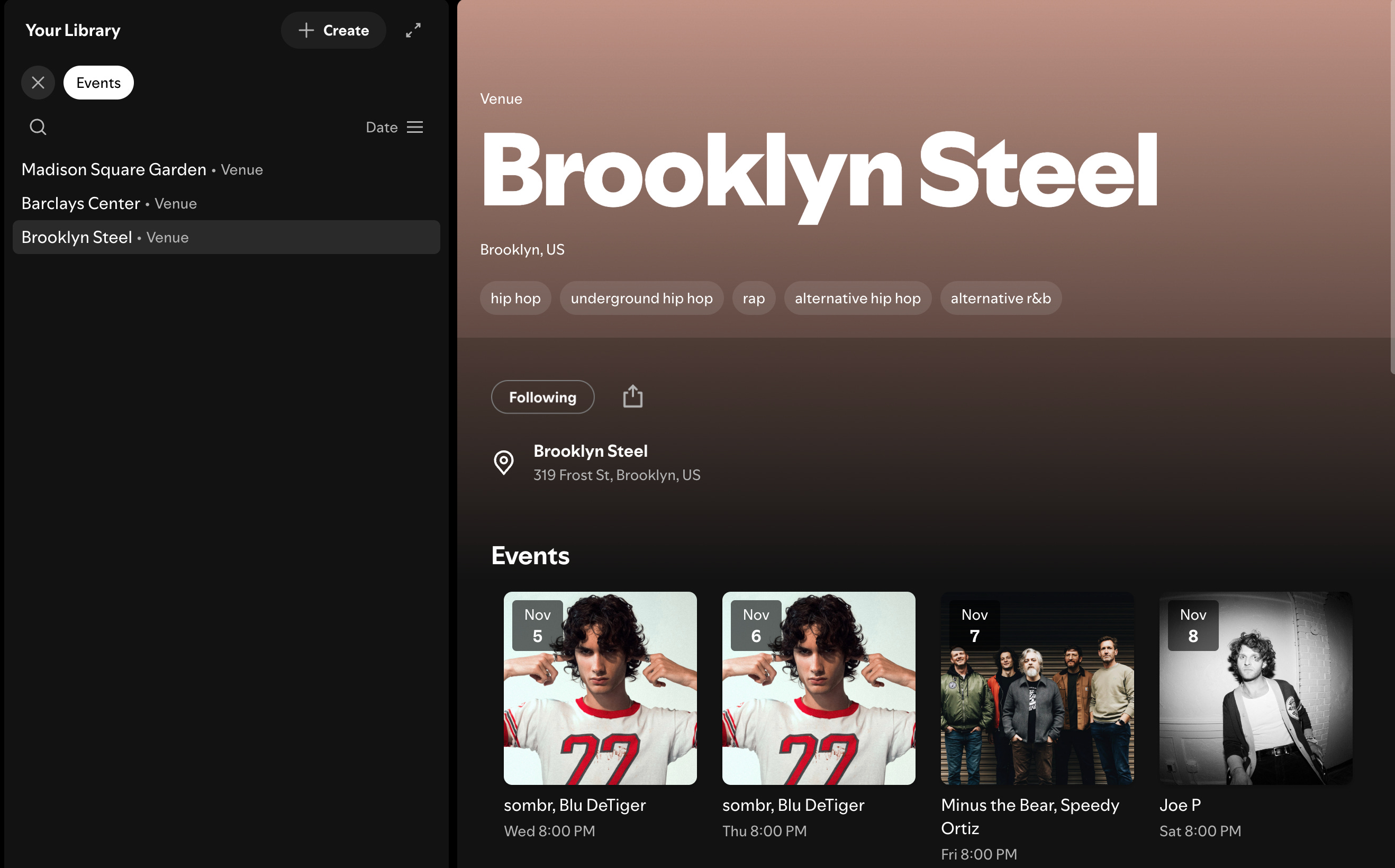
“Spotify users can now follow their favourite music venues” by Liberty Dunworth (NME)
Over the last few years, Spotify has rolled out some interesting live music features. Artists can connect touring info to the profiles. You can see personalized playlists of artists you like who are soon to be in your area. Now, you can follow venues. This function adds a new “Events” tab to your library that allows you to quickly browse who is playing at your local venues.
“Audiomack’s ‘Tastemakers’ curators are getting their own analytics” by Stuart Dredge (MusicAlly)
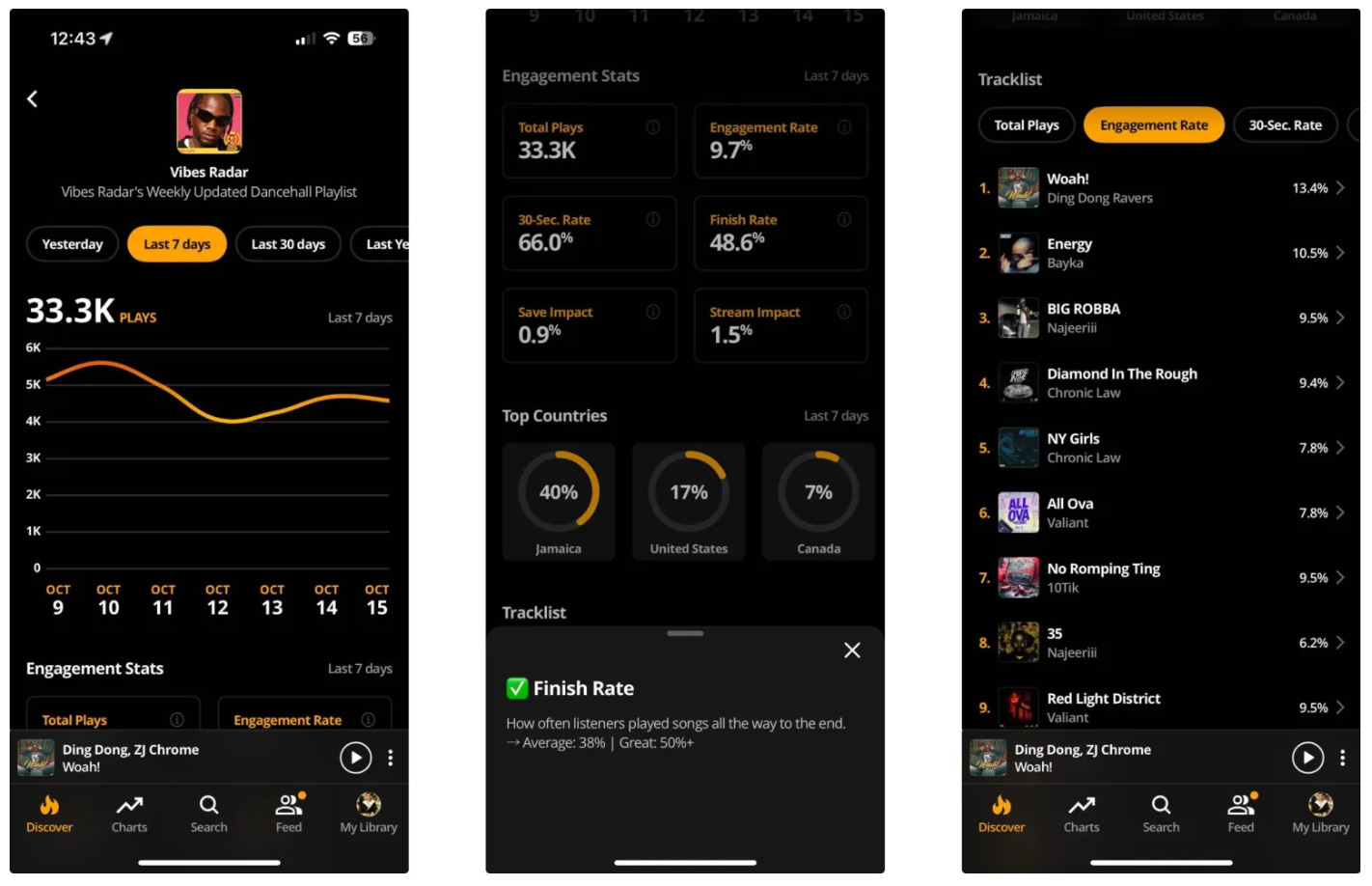
If you don’t know, I work for the music streaming service Audiomack. I’ve been heavily involved in our curator program over the last year. Last week, we announced a cool new feature for curators that allows them to see granular stats on how their playlists perform. Here’s how I described it on LinkedIn:
Though playlist curators are part of the lifeblood of streaming platforms, they’ve often been second-class citizens when placed next to artists, labels, and listeners. Over the last year at Audiomack, we’ve been looking to elevate the status of tastemakers.
First, we made it possible for anyone to apply for a tastemaker badge. That badge conferred tons of advantages, including higher ranking in search, playlist chart eligibility, and the power to message all of your followers. Now, we’ve added the most robust fleet of curation stats in the business. Along with topline plays and likes, you can see completion rates and engagement rates for every song on your playlists, along with a bunch of other stuff.
Our goal is to have the best playlists in the industry because great playlists lead to happy artists and listeners. More to come!
“UMG and Udio Reach Agreement for ‘New Licensed AI Music Creation Platform’” by Kristin Robinson (Billboard)
There has been so much AI-related news in the last month that it’s been hard to keep up. The most startling was that UMG, the world’s largest label, signed a licensing agreement with Udio, a generative-AI music platform. This is a first-of-its-kind agreement and an about face from the fact that UMG sued Udio earlier this year.
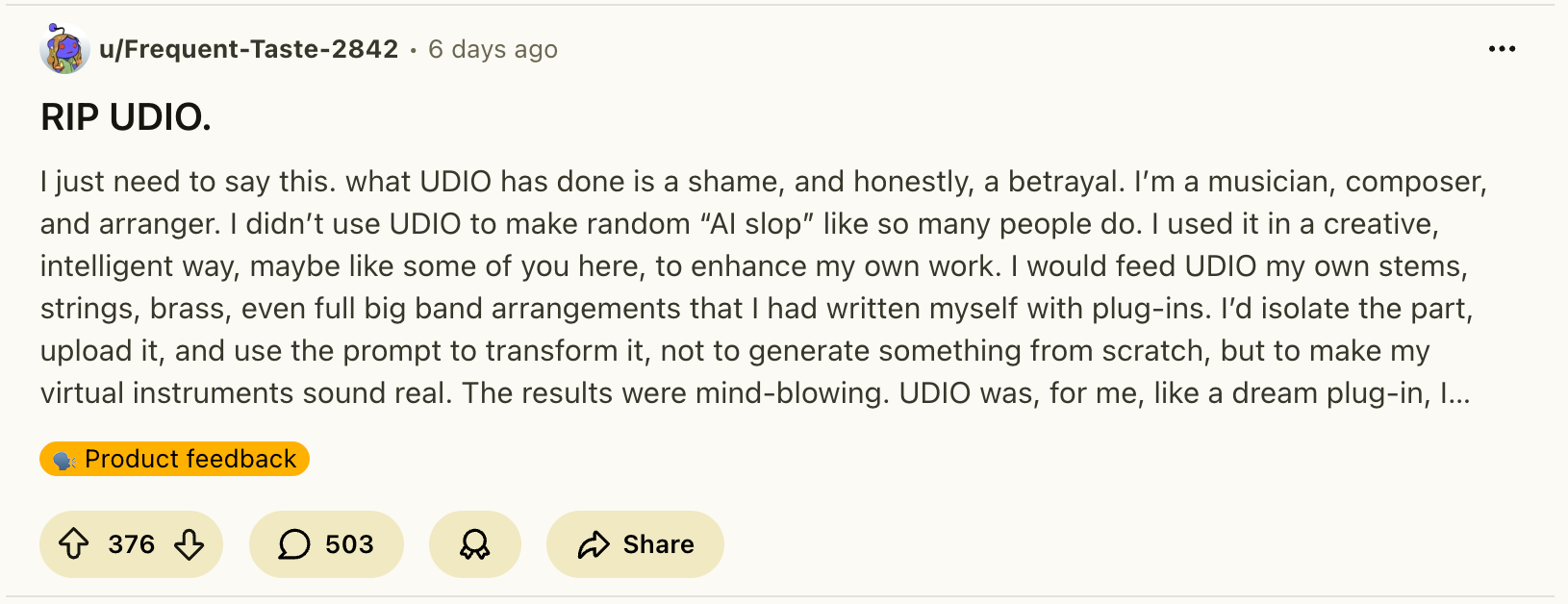
In short, Udio users will now be able to generate music based on content in the UMG catalog. The catch? They can no longer export the music. They can just enjoy it within the platform. Udio users were not happy about this. In fact, the product’s subreddit has just been flooded with negative comments.
My friend Darren Hemmings has been covering this topic more closely than I have. The reaction from across the industry to this deal has been odd. Naturally, UMG announced it as a huge win. Legendary label executive Irving Azoff, by contrast, expressed disdain for the deal:
We’ve seen this before – everyone talks about ‘partnership,’ but artists end up on the sidelines with scraps. Artists must have creative control, fair compensation and clarity about deals being done based on their catalogs.
I’m still trying to make sense of all of this, but I don’t see these issues become clearer even as licensing deals are inevitably signed. I’m curious to how reactions will shift as Spotify rolls out (what will presumably be) an AI-powered remix tool officially licensed by the major labels.
Music History to Write Home About
Ace Frehley and D’Angelo respectively died in the last month. To mourn Space Ace, I urge you to put on any of Kiss’s hits. Many of those songs have an energy that still feels vital today.
Of course, you can spin any of D’Angelo’s records in his memory, but I implore you listen to him cover The Beatles’ “She Came in Through the Bathroom Window” at Bonnaroo music festival. Not only is it a reminder of how skilled he was as an interpreter but how groovy that Beatles’ deep cut is.
As I spent years listening to every number one hit for my book, I came to realize that sometimes even the silliest songs were creative with great musical skill. This short documentary about Sisqó’s “Thong Song” is testament to that.
You might think that a song about female undergarments was just a cash grab, recorded in a few minutes as a joke. But this documentary demonstrates how even music that seems childish can come from a place of great passion. I know this sounds like an insane statement when talking about “Thong Song,” but I implore you to watch the documentary.
A Bruce Springsteen biopic—Springsteen: Deliver Me from Nowhere—debuted in theaters a few weeks ago. Reviews have been mixed, but I enjoyed the dreary film. Independent of your take, the film generated one of the greatest pieces of internet sleuthing I’ve witnessed in my 25 years on the web.
In short, there is a very short scene in the film where Springsteen tells a child that he puts mustard on his hot dogs. A Twitter account called “GenZBruceFan” claimed that this wasn’t true. Springsteen hates mustard. And they had the receipts to prove it. There is concert footage of The Boss going on an anti-mustard tirade:
Don’t give me no fuckin’ Grey Poupon! I don’t like any mustard! I don’t like it on my hot dogs, I don’t like it on my sandwiches, no.
I cannot imagine sitting in the theater knowing that you had this clip ready to go. A truly incredible find.
Online Posts That Gave Me Life



 Tiktok failed to load.
Enable 3rd party cookies or use another browser
If you enjoyed this piece, consider ordering my book Uncharted Territory: What Numbers Tell Us about the Biggest Hit Songs and Ourselves. The book chronicles how I listened to every number one hit in history and used what I learned during the journey to write a data-driven history of popular music from 1958 through today.
It seems there’s a lot of rap influenced country and pop crossover stuff now that doesn’t get classified as hip-hop.
It’s probably more about the death of genres than any specific genre.
Would have luv to have taken your class as an elective.
97 grad