


Each month, I collect the most important stories in music for my paid subscribers. As it’s the end of the year, I decided to make this month’s free. If you enjoy it, consider taking out a paid subscription to this newsletter. Subscribers get access to four additional newsletters each month, and subscriptions are HALF OFF until January 1.
Is Stealing Music Good?
Anna’s Archive is an open-source search engine that allows you to search through pirated materials from across the web. Though it’s typically focused on text-based content, the site is slowly making the entirety of Spotify free to download, including every song and associated piece of metadata.
Why are they doing this? They claim that despite the fact that “music is already fairly well preserved … This Spotify scrape is our humble attempt to start such a ‘preservation archive’ for music.”
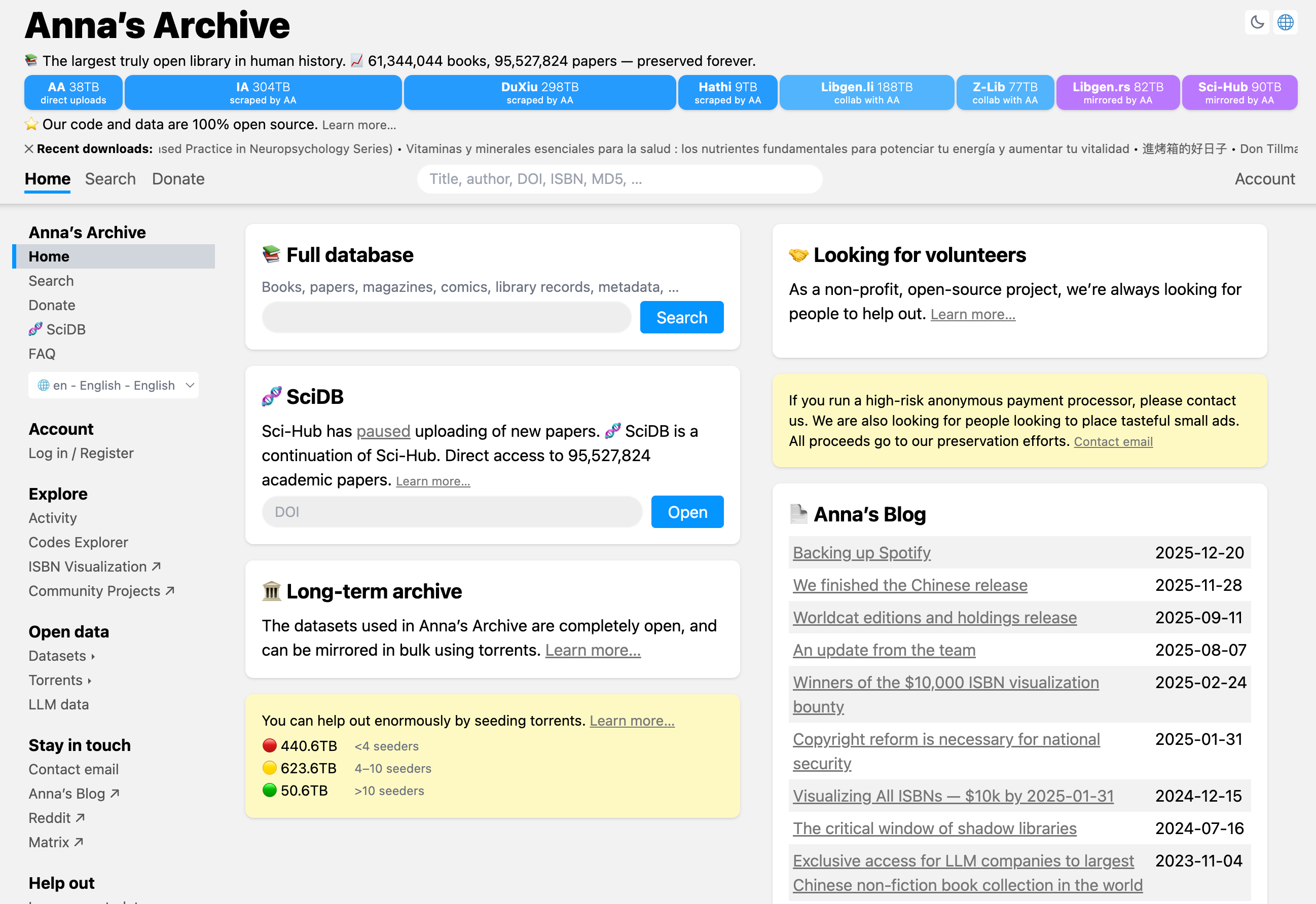
This seems altruistic, especially when you recall stuff like the 2008 fire that destroyed over 100,000 master tapes owned by Universal, but you can color me a skeptic. While preservation is important, music is quite well-preserved. The New York City-based ARChive of Contemporary Music, for example, has over two million physical items. That’s well short of the hundreds of millions in Spotify’s archive, but it’s quite significant.
In addition, I can’t support preservation efforts that also require mass copyright infringement. I’ve spent significant time writing about how copyright terms are too long and streaming payouts could be adjusted, but I am an avid supporter of intellectual property rights. There’s almost no doubt that people will use this data scrape to train AI models and listen without compensation. I don’t think preservation efforts should trump clearly defined intellectual property rights.
Rather than scraping Spotify, you could purchase nearly all of these files from, say, iTunes. It would be expensive, but according to Anna’s Archive, nearly 70% of songs on Spotify had fewer than 1,000 streams. If you only archived those that met some low stream threshold, it would be a cost that someone could stomach. In short, we should preserve music, but we should also compensate the relevant rightsholders if need be.
News from Inside the Music World
“Gene Simmons Says Artists Treated ‘Worse Than Slaves’ Because Radio Doesn’t Pay Them” by Jon Blistein (Rolling Stone)
Let me give you a little context for this headline. When you listen to a song almost anywhere, both the people who own the recording and the underlying composition get paid a royalty. I say “almost” because this isn’t the case on terrestrial radio (AM/FM) in the United States.
When “I’m a Believer” by The Monkees gets played on your favorite oldies station, Neil Diamond—the songwriter—gets paid, but whoever owns the recording—either the artist or label—is not getting paid. This is not the case if the song were played on Spotify, SiriusXM, or terrestrial radio outside the US. In each of those cases, both parties are getting paid.
Gene Simmons and a consortium of artists are now pushing Congress to make terrestrial radio stations pay royalties on recordings in the US. Radio will likely push back arguing that it will damage an already flagging industry. It’s difficult for me to feel that bad given that (a) it is ethically wrong and (b) every other country pays for recordings played on the radio.
So, why doesn’t terrestrial radio pay for recordings? I couldn’t pin down the reason precisely, but I suspect that it is because you couldn’t copyright a sound recording until the 1970s. Up to that point, only the underlying composition could be copyrighted. When sound recordings were finally copyrightable, I suspect radio negotiated not having to pay.
“A change to YouTube’s inclusion on the U.S. Billboard charts” by Lyor Cohen (YouTube)
YouTube claims that streams on their platform will no longer count toward the Billboard charts after January 16. YouTube’s reason for opting out is that Billboard counts streams on ad-supported platforms less than those on subscription-based platforms. In practice, this means that 10 streams of a song on Apple Music count more than 10 streams of a song on YouTube.
As someone who works for a popular ad-supported music streaming platform, I agree with YouTube. I have a hunch that Billboard will update their rules at some point in the next year. The chart loses a ton of power without YouTube.
“ASCAP Faces $123 Million Radio Royalties Lawsuit from Production Music Owners: ‘ASCAP Severely Underpays Its Non-Feature Music Members for the Utilization of Their Works’” by Dylan Smith (Digital Music News)
More radio news. When a song is played on the radio, some money is supposed to be set aside for performers on the song. A group of plaintiffs claim that ASCAP, one of the biggest performance rights organizations in the US, is not paying out these royalties properly. I suspect that this will get settled before going to trial.
Three Artist Profiles
Though The New Yorker has some immensely talented critics (e.g., Amanda Petrusich, Hanif Abdurraqib, Alex Ross), it’s not the first place that I go for music coverage. That said, in the last month, they had three profiles of musicians that I really enjoyed.
The first focused on pioneering rapper Kurtis Blow and his preparation for the Legends of Hip-Hop tour, which featured other progenitors of the genre, like Big Daddy Kane, Melle Mel, and Doug E. Fresh.
The second captured burgeoning artist Audrey Hobert and her confessional songwriting. I am admittedly confused by the appeal of Hobert, but Dan Green keyed me on why some people are connecting with her.
The final (and longest) of these pieces was Alex Abramovich’s deep dive into the world of the roving, nonagenarian legend Willie Nelson. A Bob Dylan quote from the profile about the “On the Road Again” songwriter has come across my social media feeds a million times already:
It’s hard to talk about Willie without saying something stupid or irrelevant, he is so much of everything. How can you make sense of him? How would you define the indefinable or the unfathomable? What is there to say? Ancient Viking Soul? Master Builder of the Impossible? Patron poet of people who never quite fit in and don’t much care to? Moonshine Philosopher? Tumbleweed singer with a PhD? Red Bandana troubadour, braids like twin ropes lassoing eternity? What do you say about a guy who plays an old, battered guitar that he treats like it’s the last loyal dog in the universe? Cowboy apparition, writes songs with holes that you can crawl through to escape from something. Voice like a warm porchlight left on for wanderers who kissed goodbye too soon or stayed too long. I guess you can say all that. But it really doesn’t tell you a lot or explain anything about Willie. Personally speaking I’ve always known him to be kind, generous, tolerant and understanding of human feebleness, a benefactor, a father and a friend. He’s like the invisible air. He’s high and low. He’s in harmony with nature. And that’s what makes him Willie.
Music History to Write Home About
As I noted in this newsletter a few weeks ago, Jack White played during the half time show of the Detroit Lions Thanksgiving Day game. He shocked everyone when he brought out fellow Detroit native Eminem in the middle of “Hello, Operator” to spit a verse of his classic “Til I Collapse.”
The entire performance was incredible and a good reminder of how talented Jack White is. Here is how critic Steven Hyden described it on Twitter: “Fascinating to me how Jack White decides to flip the ‘generational rock star’ switch every now and then on national television, and then go back to running his label or building some furniture.”
Here’s a collaboration that only makes partial sense. At the 2006 Grammys, Jay-Z and Linkin Park mashed up the former’s “Encore” and the latter’s “Numb.” This made sense. They had just released a popular collaborative EP, Collision Course.
But then something weird happens at around 2 minutes and 40 seconds. Paul McCartney walks out and starts singing “Yesterday.” It’s mostly a disaster, though not because of McCartney. Linkin Park’s Chester Bennington cannot find the right pitch to harmonize with the former Beatle, and in between the pitchiness, Jay-Z is ad-libbing “uh-huhs” and “yeahs.”
The only reason that I can think that McCartney was trotted out for this is because Jay-Z’s “Encore” is based around a sample of John Holt’s “I Will.” “I Will,” in turn, was written by John Lennon and Paul McCartney. That’s not the song McCartney was singing, though. I guess he was already at the ceremony for a few nominations, so they figured they’d give it a shot. I’m glad it happened despite never wanting to listen to it again.
It was recently brought to my attention that right-wing provocateur Tucker Carlson was on Dancing with the Stars in 2006. He came in last place. The past, as I saw someone observe online, is a foreign land.
Assorted Mergers and Acquisitions
“Bending Spoons agrees to buy Eventbrite for $500M to revive stalled brand” by Marina Temkin (TechCrunch)
Bending Spoons is an Italian technology conglomerate that focuses on investing in established brands for the long-term. The group recently added the live event platform Eventbrite to their growing portfolio, which already includes Vimeo, AOL, Evernote, and many others. I’m usually skeptical of private equity, especially in media, but Bending Spoons seems set on improving and holding onto brands. Maybe it will do Eventbrite some good.
“Spotify acquires music database WhoSampled” by Sarah Perez (TechCrunch)
WhoSampled is a crowd-sourced repository of samples, interpolations, and covers. It’s one of the few places left on the web that I can still get lost. As an example, WhoSampled allows me to see that The Beatles’ “Eleanor Rigby” has been sampled in 47 songs, including in B.o.B.’s “Lonely People.”
Spotify recently purchased the site. Though they claim they will maintain a degree of independence, Spotify will likely use the WhoSampled data to improve their search, recommendation, and related music features. Internet users were kind of upset about this, but I’m bullish on the merger.
“Radio streamer TuneIn acquired for $175M” by Sarah Perez (TechCrunch)
An early entrant into the online music space, TuneIn was recently acquired by a private equity firm for $175 million, well below its previous $500 million valuation. In recent years, TuneIn has struggled to compete in the crowded audio space, which includes satellite radio, streaming, and physical media.
An Endless Stream of AI News
The music industry’s relationship with AI continued to evolve over the last month. Warner Music Group signed a licensing deal with Suno, the AI-powered music platform. Now, users can make songs based around music by Warner artists. This is similar to the deals Universal signed with Udio and Disney signed with OpenAI: Creators can opt out, there are limitations with how the music can be used, and artists are compensated in some way.
At the same time, The Recording Academy announced that songs created with AI will be eligible for Grammys in certain cases:
Something can still be nominated in a performance category [if] AI created [it] or wrote the music and a human sang it. Using AI does not make your entry ineligible. It just makes you have to choose the right categories to be considered in ... If you’re doing something illegal or something that affects an artist in a way that is protected, there are things that we can do to avoid that. But all that is starting to look really blurry and needs clarification more now than ever.
And people are certainly using this technology. Charlie Harding, a friend of the newsletter and host of Switched on Pop, recently reported on how AI is beginning to dominate the demo-creation process in Nashville.
None of this is cut-and-dry, though. Last month, an artist named HAVEN went viral on TikTok with a song called “I Run.” It was revealed that the vocal was created using AI. It was then removed from streaming platforms when singer Jorga Smith noted how similar it sounded to her voice. HAVEN then re-recorded the song with a different human singer. People on TikTok said the version with the human vocal was worse.
Online Posts That Gave Me Life


If you want more content like this every month, consider taking out a paid subscription to this newsletter. Typically these link round-ups only going out to paying subscribers. Until January 1, subscriptions are 50% off.
I get the joke, but Enrico Caruso was orders of magnitude bigger than Jolson in the first quarter of the 20th century. I think you can make a case that Vernon Dalhart was bigger than Jolson by 1925, but we all know how the industry didn’t want people to notice their hillbilly and blues artists during that era.
I suspect another reason that radio was able to not pay artists was that it could argue that just playing the song provided value to the artists. If a song didn't get played on the radio, no one would hear it and want to go buy the album. The more a song was played, the better it was for sales (unless the song was overplayed and everyone got sick of it). That's not true anymore.