


Before we talk about one of the most worrisome trends in popular music, I wanted to introduce you to my friend, Caileigh Nerney. If you’ve read this newsletter over the last few months, you’ll know that I have a book coming out. It’s a data-driven history of popular music called Uncharted Territory: What Numbers Tell Us about the Biggest Hit Songs and Ourselves.
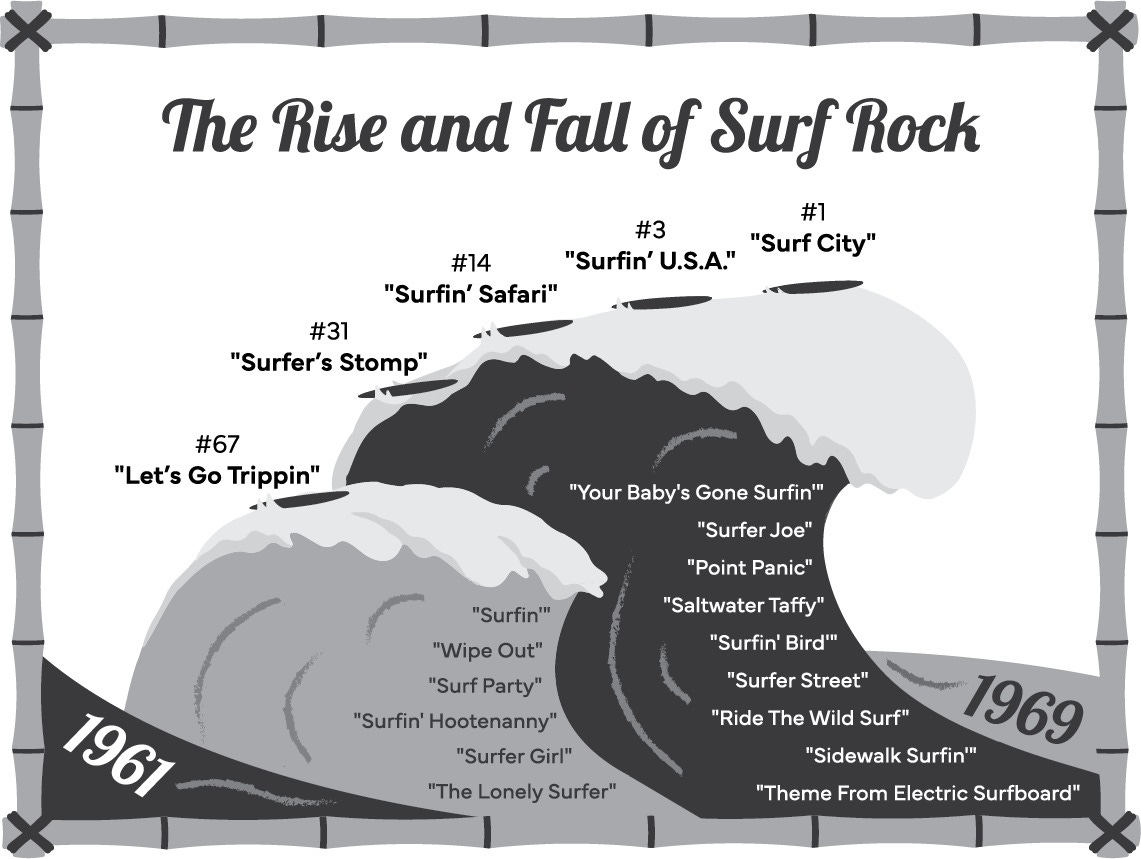
That book is filled with cool visualizations, like the one you see above. They were all made by my friend aforementioned Caileigh. If you have any graphic design needs, you should reach out to her. She’s superb. Now, let’s talk about anonymization.
The Anonymous Pop Star
By Chris Dalla Riva
Stephen Foster had a problem. He’d written not just the most popular song of the year but maybe the most popular song in American history, but he wasn’t making money. In fact, he’d only made a few thousand dollars from his creation. Like any idealistic musician, Foster was not deterred. He decided to pursue a career as a songwriter.
Tradition states that Stephen Foster — often dubbed “the father of American music” — was the first American to become a full-time, professional songwriter. The aforementioned song that set him off on that path was “Oh! Susanna.”
When Foster released “Oh! Susanna” in 1848, recording had not been invented, so songs were spread via sheet music and word of mouth. And “Oh! Susanna” spread far and wide. Numbers are hard to verify, but some sources indicate that up to that point, the best-selling piece of American sheet music only sold a few thousand copies. “Oh! Susanna” sold hundreds of thousands.
Foster’s problem was that copyright laws were not strictly enforced at the time, especially for music. Because of that, every music publisher put out a version of the song and paid Foster nothing. Stephen Foster, whose life ended in ruin on multiple levels, was thus a superstar but completely anonymous. And that was common for that era.
When Thomas Edison patented the phonograph in 1878, 14 years after Foster’s death, the age of anonymity was to come to end. Now, fixed recordings of songs could be associated with specific artists. You no longer had to travel to Italy to hear Enrico Caruso’s voice. You could hear it in your home as many times as you wanted for a nominal fee.
This was also a boon for songwriters. Of course, there were songwriters who would write a hit or two and never gain any level of recognizability. But there were others that became household names. Artists, like Ella Fitzgerald, would record entire albums singing George Gershwin. Others would turn to the oeuvre of Irving Berlin. In other words, by the middle of the 20th century, the success of a song often meant those that wrote and performed it became well known. Stephen Foster, it seems, was a century too early.
All that said, I’ve noticed that the age of Foster has been returning over the last few years, anonymity creeping in from the shadows. Let me give you an example. One of the most popular songs in the history of TikTok is “Love You So” by King Khan & BBQ Show. It’s been used in over 30 million posts.
If you have ever used TikTok for at least 10 minutes, I can almost guarantee that you’ve heard this song. I can also guarantee that you probably had no idea who the artist was. In fact, I would go so far to venture that almost every person under the age of 30 knows this song but has no idea who performs it.
That’s odd. Even if you were a one-hit wonder in, say, 1985, people would still have some familiarity with you. Sure, you might not know any Toni Basil music beyond the stomping hit “Mickey,” but you do know that she’s the woman in the music video dancing to the song in a cheerleading outfit. Her music is associated with her. That’s not the case anymore. Many of the ways we discover music today decontextualize the music from the people performing it.
TikTok is a great example of this, but it’s also possible to experience music in this fashion through streaming services too. Let’s say you open Spotify and click shuffle on the first playlist that’s served to you. You listen for two hours while you work. It’s possible you become familiar with scores of songs without any idea who is performing them. In fact, it’s possible some of those songs you’ve heard have millions of streams while the performers remain 21st century Stephen Fosters, under-compensated and anonymous.
While I find this trend worrisome in general — in fact, I write about it in the last chapter of my book — I find it doubly worrisome because this could all be exacerbated by the AI-generated music that has begun to flood streaming services. If you didn’t know who was singing the songs that soundtracked your day when it was made by humans, why would you notice if those songs were replaced by those made completely with artificial intelligence?
To be clear, there is no ironclad law that states that music streaming services and social media necessarily make us experience music in this way. At Audiomack, for example, we’ve been working on building out a first-of-its-kind tastemaker program, along with scores of free tools for artists, including the ability to directly message all of your followers. These are tools that allow artists and listeners to forge connections. Hopefully, they can help us avoid reinventing the world that Stephen Foster lived in.
A New One
"a good man with a broken heart" by LoVibe.
2025 - Lofi Beats
Here’s a good example of online anonymity. A year ago, a Ukrainian producer named LoVibe. cooked up an off-kilter beat and put the vocal from a Kendrick Lamar song over it. It did nothing. Then a couple of months ago, it popped off on TikTok when people starting using the beat to soundtrack edits of the 2015 Ryan Coogler movie Creed.
The beat is hypnotic. It’s also one of the most popular pieces of music on TikTok right now, which is especially astounding given that it is an instrumental. Still, LoVibe. remains obscure even as his song goes to the moon. Hopefully, he can avoid a Fosterian fate and turn it into something bigger.
An Old One
"Mother We Can’t Get Enough" by New Radicals
1998 - Rock
brendan varan, a friend of the newsletter and the man behind Good Stuff, recently told me that I had to listen to the entire album that contained the New Radicals late-1990s hit “You Get What You Give.” While I love that song, I was a skeptic. I thought they were just a one-hit wonder. I was wrong.
This New Radicals album absolutely rips. While clearly inspired by the rock music of the 1970s, I’d stand “Mother We Can’t Get Enough,” the first track from the album, up against anything from that decade. Great riffs. Killer vocal. Immaculate vibe. Listen to this record.
If you enjoyed this piece, consider ordering my book Uncharted Territory: What Numbers Tell Us about the Biggest Hit Songs and Ourselves. The book chronicles how I listened to every number one hit in history and used what I learned during the journey to write a data-driven history of popular music from 1958 through today.
New Radicals Hive stand up.
Fun fact I also just found out that Gregg Alexander wrote "Murder on the Dancefloor" for New Radicals before giving it to Sophie Ellis-Bextor, and they reunited in the studio last year for the first time in 26 years to record a cover of it.
Speaking as a huge fan of King Khan who knows nothing of TikTok, this is utterly baffling - but I hope he's made a lot of money from it.
Now I'd better go and see if I can dig up that New Radicals CD.