


Earlier this week, I had the pleasure of being featured in Anastasiya Kuznetsova’s wonderful newsletter BI Bites. Kuznetsova broke down some of the cool visualizations that you will find in my forthcoming book, Uncharted Territory: What Numbers Tell Us about the Biggest Hit Songs and Ourselves. Here’s one of them that you’ll find in Chapter Two.

For all my data nerds out there, BI Bites is a great place to learn about best practices in data visualization and analysis. I found their pieces on data visualization 101 and transforming time series data particularly enlightening if you are trying to improve your skills. Now, let’s turn to another data quandary: What’s the most underrated song of the 1980s?
The Most Underrated 1980s Song
By Chris Dalla Riva
Though I’ve always been particularly infatuated with the music of Billy Joel, that infatuation has grown to new heights since the release of the Joel-sanctioned documentary And So It Goes. Seriously, if you haven’t watched this thing, you should. (My friend Mike Pesca and I also had a long conversation about it last week if you still need more to sate your Joel fix.)
As I watched, I began to have an internal debate about what the most underrated Billy Joel song is. Naturally, I tried to figure this out with some data. I posted the results on TikTok, with the “Sleeping with the Television On” and “Miami 2017 (Seen the Lights Go Out on Broadway,” coming in as his most underrated recordings.
 Tiktok failed to load.
Enable 3rd party cookies or use another browser
These results were particularly satisfying given that those are two of my favorite songs by the Long Island tunesmith. But the process of figuring this out got me thinking about underrated-ness more broadly. For me, a song is underrated if it isn’t well known despite being very good. Let me give you an example.
One of my favorite bands of all time is The Replacements. The Replacements were never that popular. That said, they are awesome. By the time the band released their third record, I actually think they were quite sophisticated, songs like “Swingin’ Party” and “Can’t Hardly Wait” worthy of the best artists of the 1980s. In other words, many songs by The Replacements are underrated.
We can actually operationalize this process of finding underrated songs. Basically, we just need a way to measure how good a song is and compare it to how popular it is. For the sake of brevity, we will just stick with songs released in the 1980s for this newsletter.
To measure the “good-ness” of a song, I aggregated 7 critical lists of the best songs of the 1980s. According to Rolling Stone, for example, the best song of that ten-year stretch was Prince’s “Kiss.” According to NME, it was New Order’s “Blue Monday.” For VH1, it was Bon Jovi’s “Livin’ on a Prayer.” By looking across these lists, we can try to gauge the best songs of the decade.
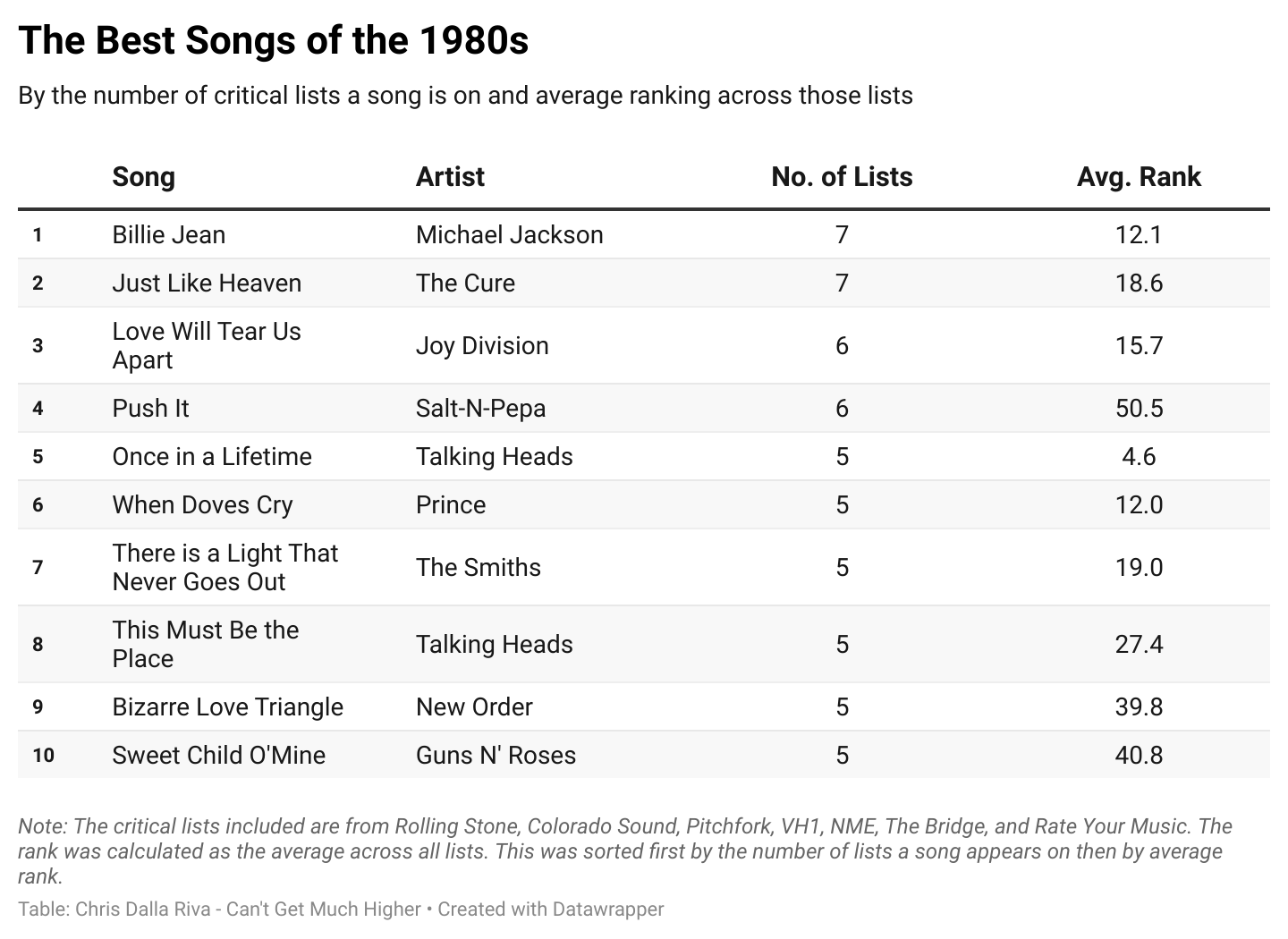
As a first pass, I sorted songs by the number of critical lists they were on and then by their average rank across those lists. By this methodology, Michael Jackson’s “Billie Jean” came out on top. Certainly a great song, but something felt wrong with this.
Should a song really be at a disadvantage because it was on 6 of 7 lists rather than all 7? By that idea, if there were only one song on every list, but it was ranked 100 on all of those lists, it would be considered the best song of the decade. Of course, I wouldn’t want to declare a song the greatest if it only topped one list, but maybe we shouldn’t be so stringent.
With this in mind, I updated my methodology to just sort songs by their average ranking if they were on at least three lists. Thus, we still get some critical consensus, but don’t penalize a song because they were missing from one list.
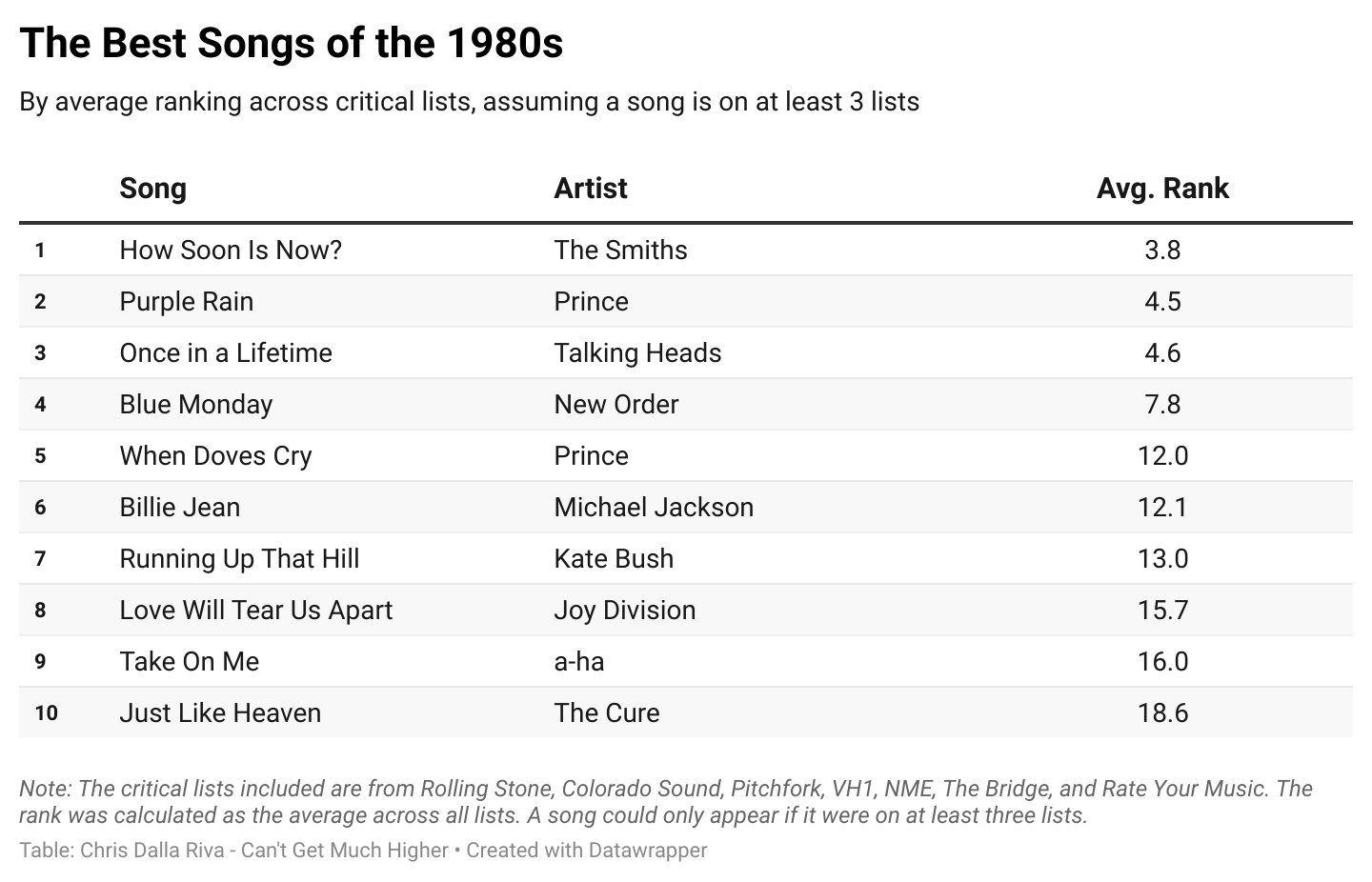
By this methodology, our list shifts a bit. “Billie Jean” falls from number 1 to number 6. By contrast, The Smiths’ “How Soon Is Now?” jumps from 15 to 1. It didn’t rank as high before because it was only on 4 of the 7 lists. But the 4 it was on all ranked it near the top. Because of that, this methodology feels a bit fairer.
Since we now have a way to measure the “good-ness” of a song, we also need a way to measure its popularity. There are two basic options here: the RIAA’s count of sales or Spotify’s count of streams.
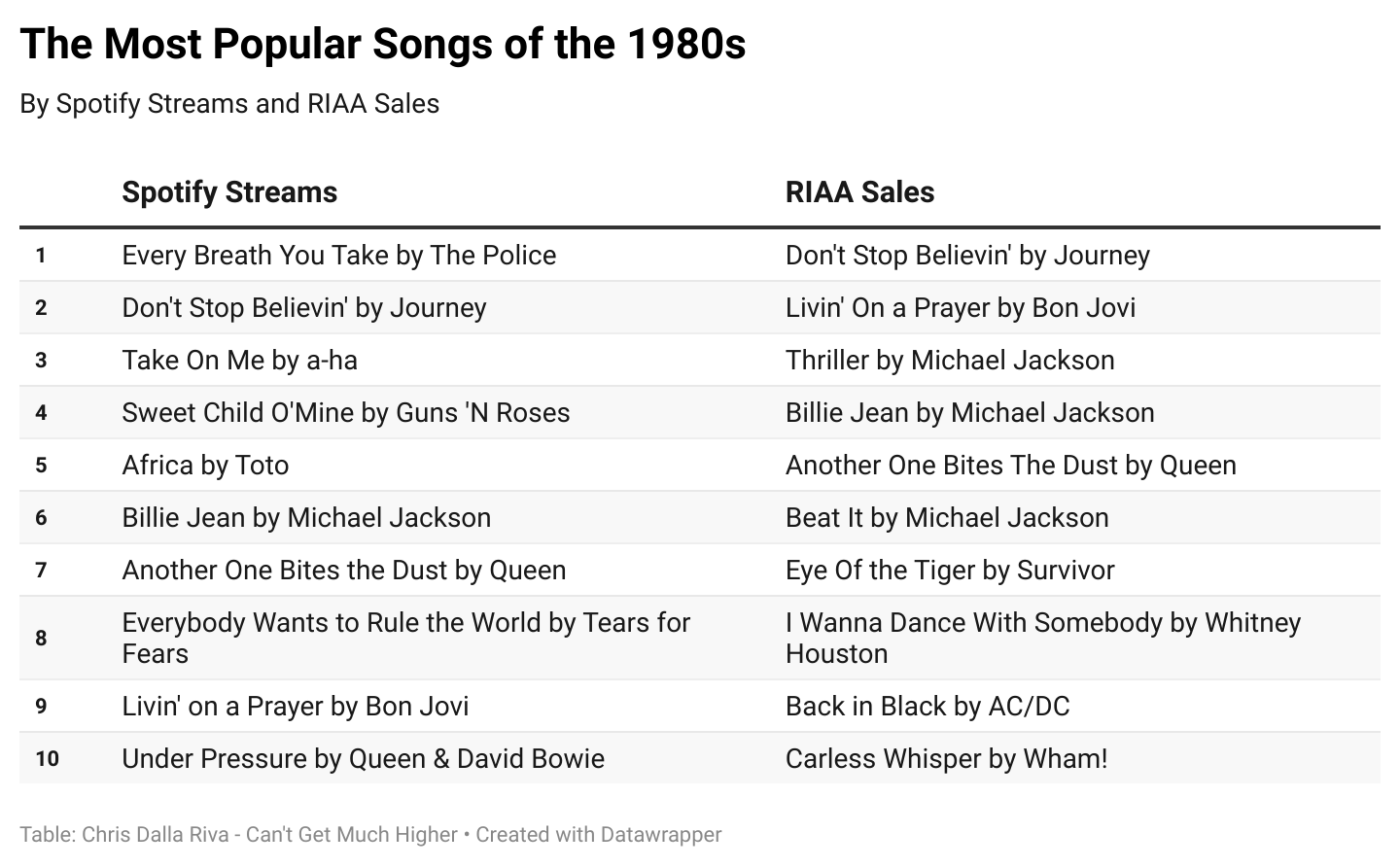
While these lists aren’t dramatically different — 4 of the 10 songs are the same — I think they illustrate distinct phenomenon. RIAA sales capture all-time popularity. Spotify streams capture the last decade-ish of listening. Even though it’s a shorter time frame, I actually think the latter is closer to what we are after. We want to know what is popular recently. We don’t care if a track sold 10 million copies in 1985 and has scarcely been played since.
With these measures of goodness and popularity in mind, we can now try to hunt down the most underrated songs of the 1980s. By my original definition, “a song is underrated if it isn’t well known despite being very good.” Thus, we need to find songs whose rank on the goodness scale is much higher than their rank on the popularity scale. To do this, we’ll take the ratio of the rank on each list.
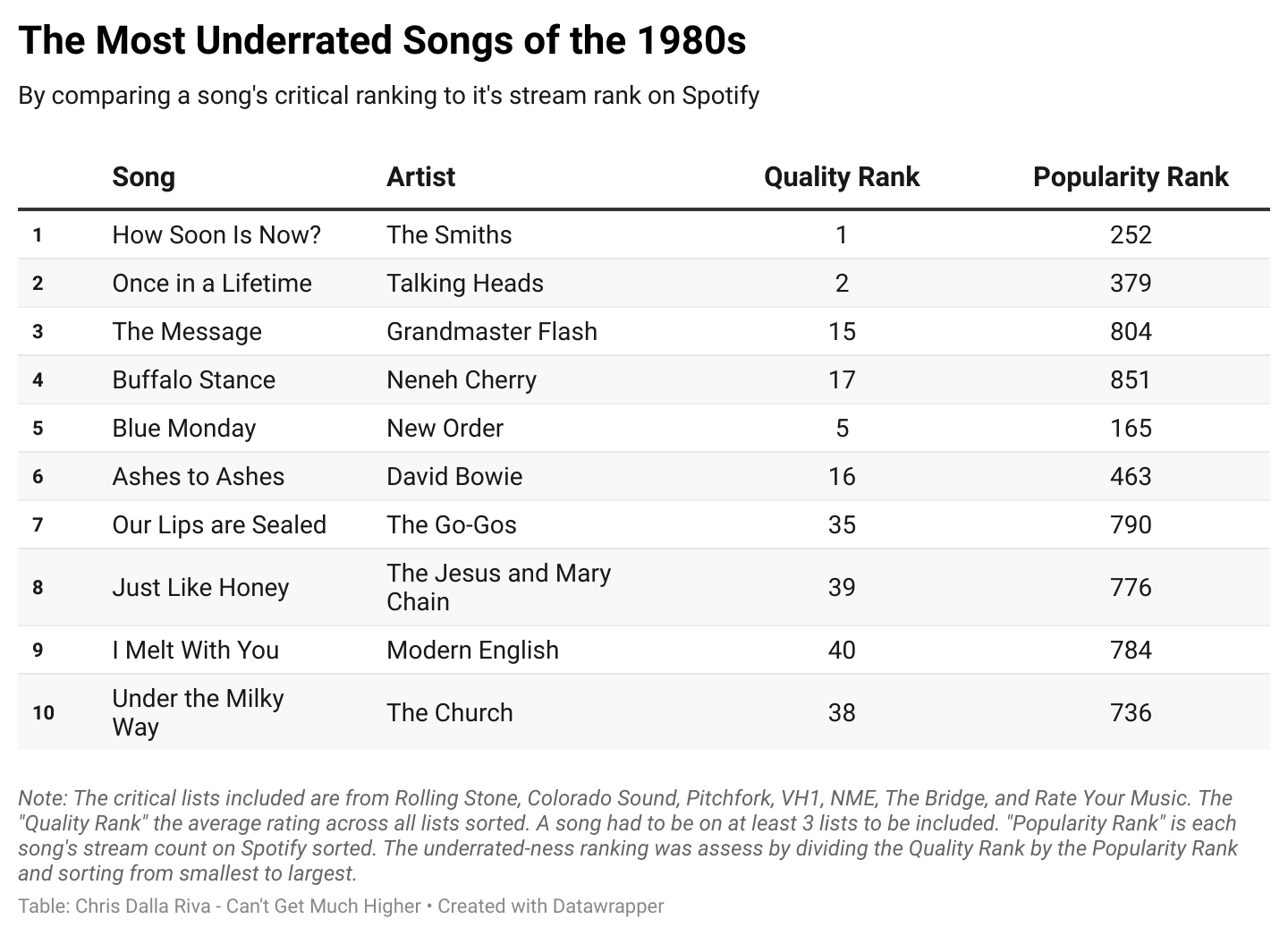
By using this methodology, the most underrated song of the 1980s is The Smiths’ “How Soon Is Now?”, which was also the highest rated song of the decade. On the surface, this may seem a bit odd. How can the best song also be the most underrated? But it makes sense when you think about how we define “underrated.”
While “How Soon Is Now?” is far from an unknown song, it isn’t that popular in the grand scheme of the decade. In fact, it’s only The Smith’s 7th most popular song. Thus, it’s critically acclaimed across many sources while not being that popular among listeners at large.
While aggregating this list of underrated songs, a few other odds and ends jumped out at me.
Critical lists from this decade are heavily biased toward rock music generally and a moody form of rock music more specifically (e.g., The Smiths, New Order).
Prince and The Cure are critically beloved. They were the only artists with 10 songs across all critical lists.
During the 1980s, there was a pop rivalry between Prince and Michael Jackson. When I averaged the song rankings for the two across all critical lists, Prince’s 10 songs came out to 35.8. Jackson’s 6 came out at 27.8. The King of Pop thus retains the crown.
There were also a few times during this exercise that I found out a song was from the 1980s that I didn’t realize was released in the 1980s. For example, despite being a huge Springsteen fan, I never realized The River was released in 1980. In my head, it came out in 1979.
This faux pas got me searching for other songs that came out in the 1980s that aren’t associated with the decade. Maybe there was some widespread musical blind spot of the Reagan years. That might also indicate that a song was underrated, not because there was a gap between critical and popular perceptions, but because people didn’t realize that song was from the 1980s.
Then I realized that was the case. Toss all the data aside. The most underrated song of the 1980s is Frank Sinatra’s “New York, New York.”
This may shock you — it left my jaw agape — but Frank Sinatra’s “New York, New York” was indeed released in 1980. Though it sounds like it was written for a musical from decades earlier, the Sinatra classic was actually composed for Martin Scorsese’s 1977 film New York, New York. Performed by Liza Minnelli in the film, Sinatra recorded it for his sprawling album Trilogy: Past Present Future at the encouragement of his long time associate Frank Military.
“New York, New York” is undoubtedly a classic. Despite being in his fourth decade as a performer, The Chairman’s vocal power and control are still something to marvel at. That said, I have never seen the song appear on a list of the great works of the 1980s. In fact, I’ve never even heard it mentioned in relation to the decade, even though it was nominated for Record of the Year at the Grammys in 1981. (It lost to Christopher Cross’s “Sailing.”)
No, I don’t think the data led us far astray. Saying The Smiths released the most underrated song of the 1980s would probably lead to a ton of agreement. But the next time I’m arguing about the decade defined by Madonna and Prince and Michael Jackson, I’m making sure we don’t forget Sinatra’s final classic.
A New One
"Waste More Thyme" by Max Rauch
2025 - Indie Rock
When Max Rauch releases a song, I’m all ears. The New Jersey rocker spends most of his time producing and mixing some of the best music in the region, he still finds energy to release his own music. “Waste More Thyme” is quintessential Rauch. Built around a circular, arpeggiating guitar, the song captures the vicissitudes of life, lyrics like, “I always waste more time doing what I say I won’t do” butting up against others like, “Everyday above ground is a good day.” It’s in this contradiction that Rauch shines.
An Old One
"In a Big Country" by Big Country
1983 - New Wave
Though it didn’t crack the top ten, one of the most underrated songs of this era, according to my data, was Big Country’s “In a Big Country.” When I clicked play, I was surprised that the song not only sounded familiar, but I knew the words. Then I realized that I had been listening to a cover of the song by the band moe. for years. I think I’m the only person in existence who discovered this song via moe. rather than the original hit single. Regardless, it’s a great song.
If you enjoyed this piece, consider ordering my book Uncharted Territory: What Numbers Tell Us about the Biggest Hit Songs and Ourselves. The book chronicles how I listened to every number one hit in history and used what I learned during the journey to write a data-driven history of popular music from 1958 through today.
Gonna need a future post about "New York New York effect" songs from other decades
“In a Big Country” is such a fantastic, epic, even grandiose power pop song. It’s like “Chariots of Fire” or “Man In Motion/St. Elmo’s Fire” by John Parr.