


Publishers Weekly just wrote a really great review of my forthcoming book Uncharted Territory: What Numbers Tell Us about the Biggest Hit Songs and Ourselves: “Dalla Riva mixes data analysis with music criticism in this scrupulous debut analysis of popular music trends from the 1950s to the present ... Data-minded music fans will relish this deep dive.” I’ve been doing some cool promotion too:
Polityka: I did an interview with a prominent Polish magazine about the book
Tedium: My friend Ernie Smith ran a short excerpt about drum machines from the book
SiriusXM: I did a short interview about the book on Eric Alper’s SiriusXM show Canada Talks
The Power of Musical Thinking: I did a fascinating interview about how music affects our lives on The Power of Musical Thinking
One Hit Thunder: I talked about the weird legacy of the “Harlem Shake” on one of my favorite podcasts
Chartmetric: I did a short interview about the book with the folks at Chartmetric, one of the world’s premier music analytics platforms
If you are interested in interviewing me about my book or my career in the music industry, do not hesitate to reach out via this form. Now that we have that covered, let’s talk about the ongoing musical revolutionary war.
Last year, when I saw a preview for the forthcoming film Better Man, I was intrigued. A movie about fictional pop star who’s a chimpanzee? Sign me up. Most music-related movies are kind of cheesy. This would at least be unique.
I soon realized that this movie was not fictional. It was a biopic. Of course, there has never been a chimpanzee pop star, but this animated chimp was playing Robbie Williams. This left me scratching my head in chimp-like fashion. Who is Robbie Williams?
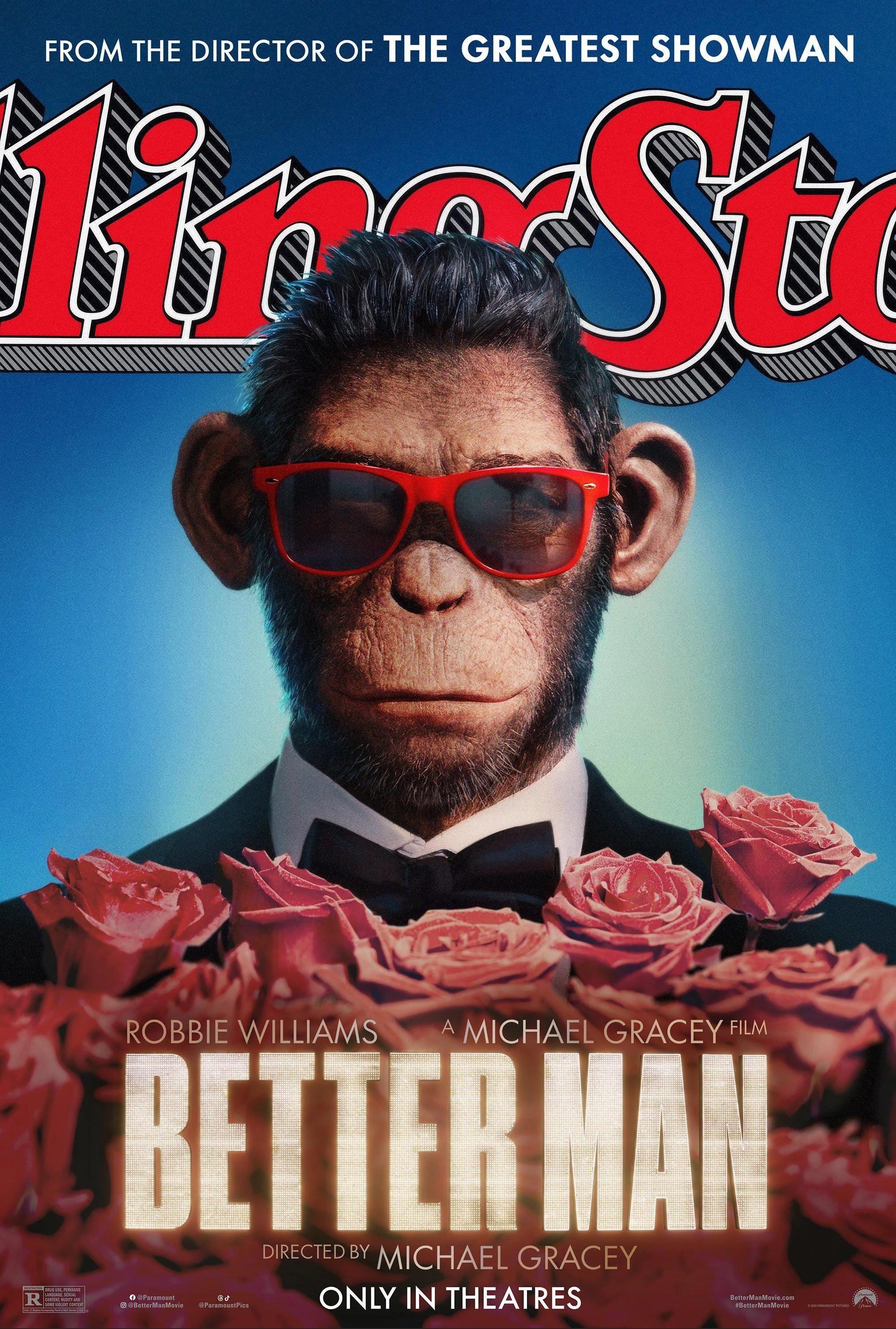
A quick search told me that Mr. Williams was one of the biggest British pop stars of the last few decades. How could I not know who he was? Part of my schtick is being in touch with pop music. This oversight was a good reminder that despite tremendous crossover, there are pieces of the British and American music scenes that remain sequestered from one another. It got me wondering which British stars outside of Robbie Williams never made it in America and vice versa.
On the surface, this seemed like a pretty simple task. Grab the British charts and the American charts. Count up the top 40 singles for each artist. Then compare that count in each country. I already had the chart data. This was going to be easy! Sadly, nothing in this newsletter ever is.
Artist name data is shockingly messy. Some artists were referred to by different names throughout their career (e.g., John Cougar, John Mellencamp, John “Cougar” Mellencamp). Some artists had different names in the US and UK (e.g., The Spinners, The Detroit Spinners). Some artists had many of their chart hits as featured artists (e.g., T.I., Lil Wayne). Furthermore, sometimes the charts just spelled names differently (e.g., Simon & Garfunkel, Simon and Garfunkel).
After a few very late nights dealing with all of this madness, I finally got the data in good shape. (As they say, 99% of data analytics is data cleaning.) Once that was the case, I grabbed the decade’s biggest artists in each country. In this case, “biggest” meant the most top 40 hits as either a lead or featured artist.
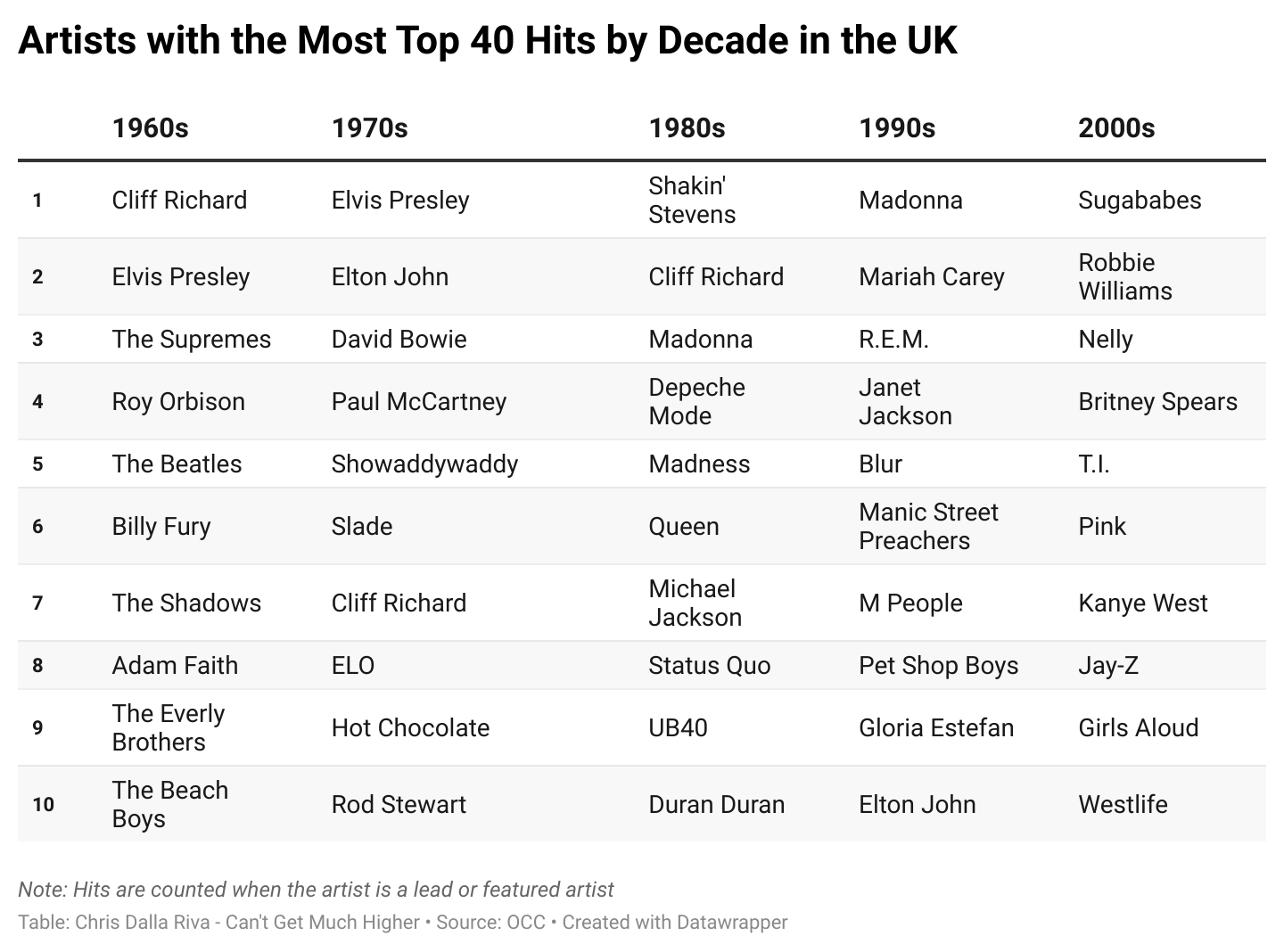
Above you can see, the biggest UK artists by decade. You’ll probably notice a few things.
First, why aren’t The Beatles the biggest artist of the 1960s if they outsold everybody? Like I said, bigness is based on unique top 40 singles per decade. Some other artists had more top 40 singles in the UK than the Fab Four.
Second, did the Brits really like Cliff Richard that much? They did! He is in the top ten in the 1960s, 1970s, and 1980s.
Third, did homo sapien Robbie Williams make the cut? Yup. He’s number two in the 2000s, just behind Sugababes.
Now, let’s turn to the US. It’s worth noting that the American pop charts as tabulated by Billboard are a bit different than the British pop charts as tabulated by the Official Charts Company. The former accounts for sales, streams, and radio play. The latter includes the same stuff excluding radio.
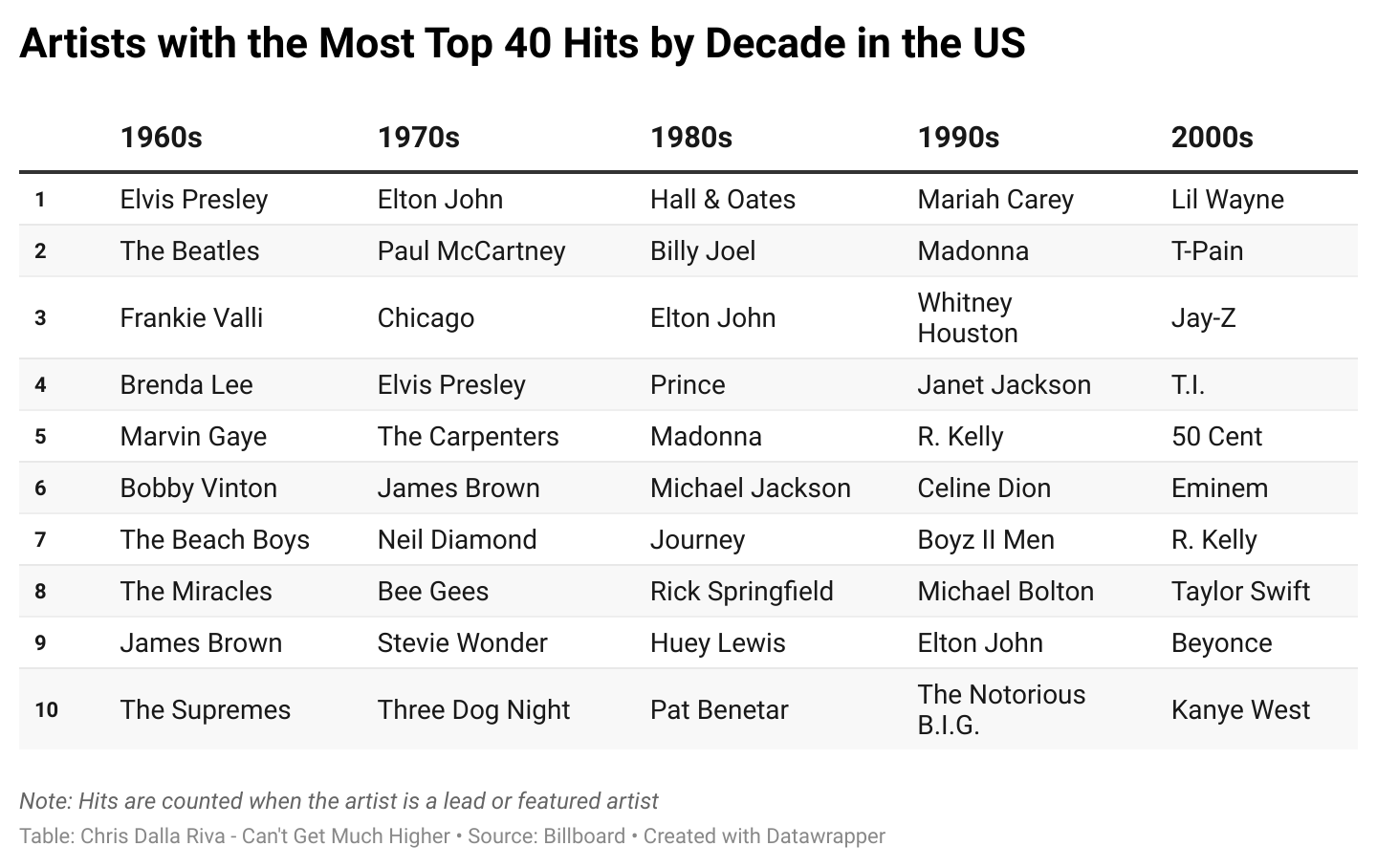
Regardless of these statistical differences, I think we can agree that both of these lists contain artists that were quite popular and relevant. That said, many were popular in both. Elton John, for example, found massive success in both the US and UK in the 1970s. So was Paul McCartney. But we aren’t interested in the Elton Johns and Paul McCartneys of the world. We are interested in artists like Robbie Williams.
To find Williams’ cousins, I went on the hunt for artists that had at least a handful of hits in one of these countries but close to none in the other. Below you can see the results for popular artists in the UK that never truly crossed over in the US.
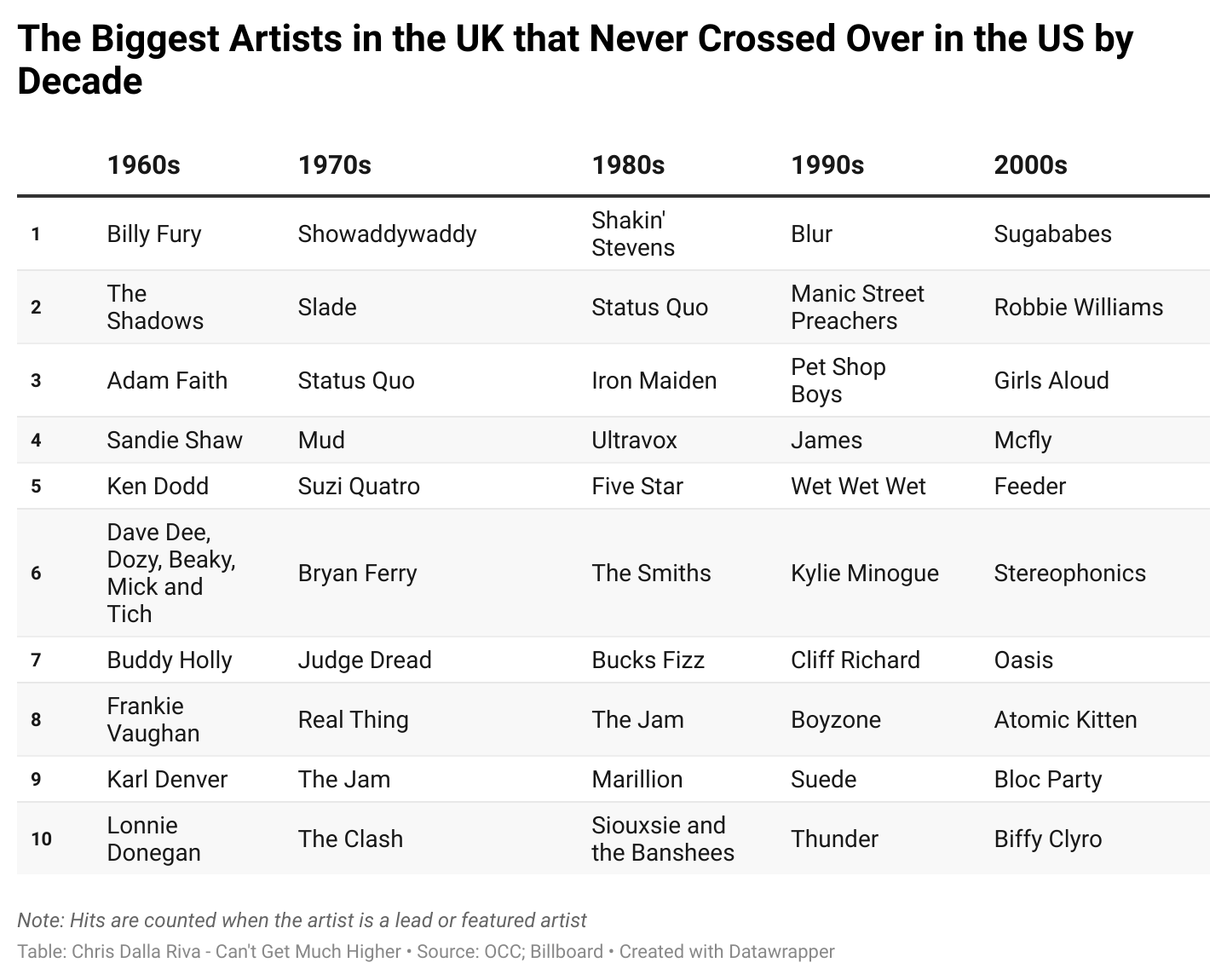
I know that this methodology worked because, as an American, I am not familiar with more than a few of these acts. Let me point out some other things:
The British people love both moody rock music (e.g., The Smiths) much more than Americans
The British people also love their hard rock music (e.g., Iron Maiden) much more than Americans
Some acts that were popular in both countries in one decade (e.g., Oasis in the 1990s) only had their success continue in one of those countries in the next decade (e.g., Oasis in the 2000s)
Dave Dee, Dozy, Beaky, Mick & Tich might be the worst band name of all time
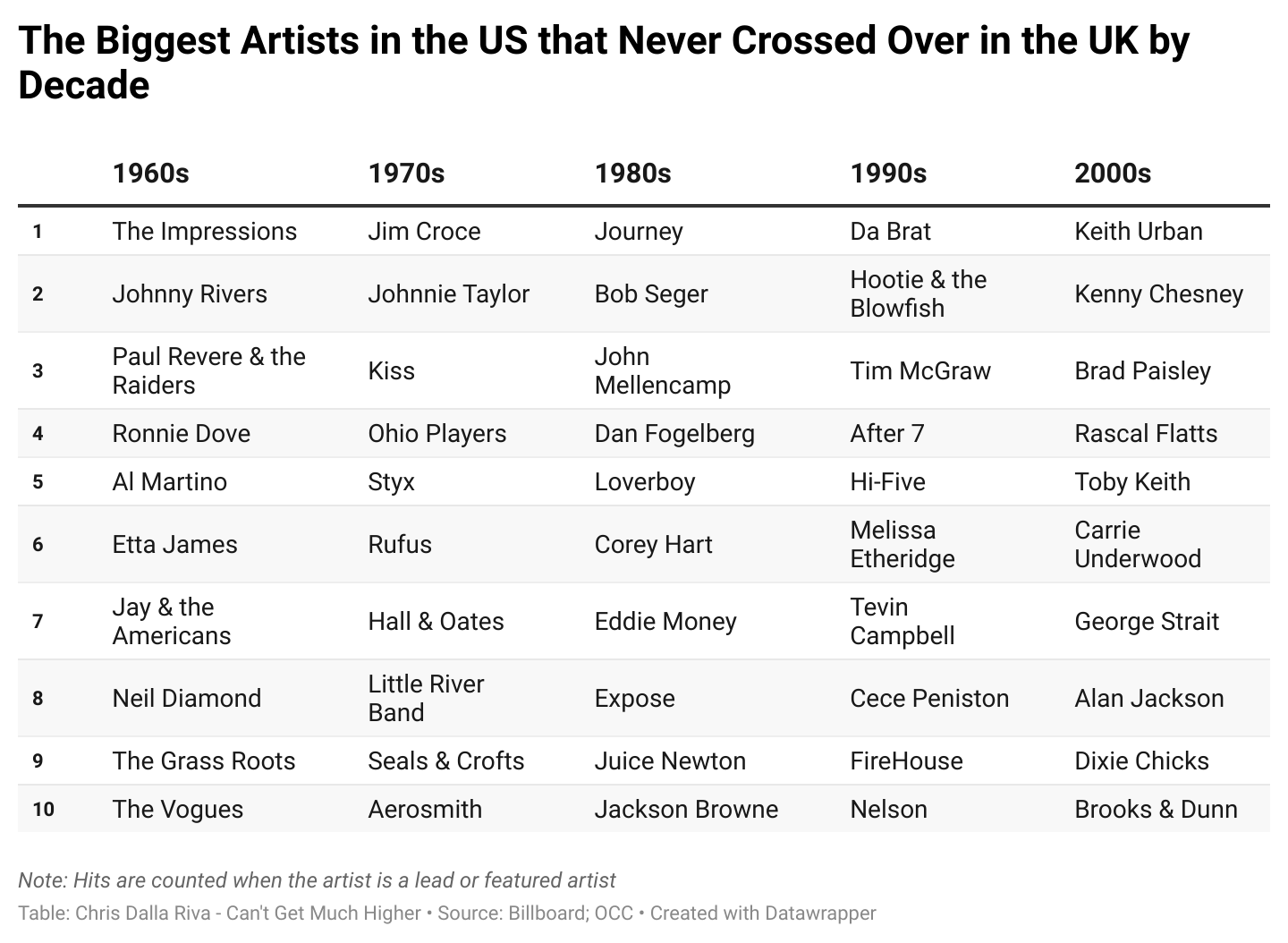
I also computed the opposite, namely artists who had more than a handful of hits in America but never made it in the UK. Likewise, let me point out a few things here:
Some acts that were popular in one country in one decade (e.g., Neil Diamond in the 1960s) only broke through in the other country in the next decade (e.g., Neil Diamond in the 1970s)
In the same way that the Brits like their moody rock, Americans love their hip-hop
American country music of the 2000s (e.g., Kenny Chesney, Alan Jackson) gets no love in the UK
Many 1980s American hitmakers that my dad loves (e.g., Journey, John Mellencamp, Jackson Browne) have very little presence in the UK
I could go on about all of these lists. They each fascinate me in their own way. But, again, they are a good reminder that the US and the UK have their own distinct musical cultures, despite many artists finding success in both places.
A New One
"David’s Brother" by The Favors
2025 - Indie Rock
I did not have particularly high hopes for this new album by The Favors, a duo composed of Finneas O’Connell — the brother-producer of Billie Eilish — and Ashe. The two had previously worked on Ashe’s hit “Moral of the Story,” a song that I detest. But I’m glad that I did not ignore this album despite my distaste for their earlier collaborations. The album is tremendous.
Though the songwriting is very strong across the entirety of The Dream, I continue returning to “David’s Brother,” a track on the back half of the record. It’s the perfect balance of groove and melody.
An Old One
"Zabadak!" by Dave Dee, Dozy, Beaky, Mick & Tich
1968 - Psychedelic Rock
Given that the new song that I recommended was by an American duo, I figured I should give the British people some representation for the old song. It felt doubly appropriate that I would turn to Dave Dee, Dozy, Beaky, Mick & Tich, the grouped that I slagged — see, I used British slang — for their ridiculous name.
Dave Dee and company were one of the few British Invasion acts who failed to land in the US. Sure, it might have to do with the unmarketable name, but it also might have to do with the fact that their music was weird. “Zabadak!” is a perfect example of that. It combines rhythms of the world with nonsensical lyrics and some psychedelic flair that you’d only find in 1960s Britain.
Thanks for reading. If you enjoy my work, please consider ordering a copy of my forthcoming book Uncharted Territory: What Numbers Tell Us about the Biggest Hit Songs and Ourselves. It’s a data-driven history of popular music that follows my journey listening to every number one hit from 1958 to 2025.
In the mid-60s WLS in Chicago (with practically a nationwide signal) had a Sunday night show where they played the top hits in England that week. IIRC a deejay from there (Radio Caroline?) was involved, but I could be hallucinating. I remember being struck by the number of songs that were big there but not here. Keep on Running by the Spencer Davis Group comes to mind. I went out of my way to special-order that one. Took weeks for my local record store to get it. And so much Cliff Richard! And how could one forget Dave Dee, Dozy, Beaky, Mick, & Tich? I certainly haven't.....
In the ‘70s and early ‘80s, my brother and I used to xerox (word used deliberately) the Hot 100 at our library so we could get ahead of AT40 and Casey Kasem when it aired in our market. While doing so, I noticed Showaddywaddy at the top of the Billboard UK charts. I asked a British friend of mine who they were and he just rolled his eyes.
Similarly, I ran across Slade and Mud in Joseph Murrells’ “Book of Golden Discs” and had no idea what they sounded like until college because it’s not like you could easily get their records in the US. Same for the Move, though they had the ELO/Jeff Lynne connection.
Fascinating stuff!