


In late 2024, Darius Mullin—a previous contributor to this newsletter—reached out to me with a pitch. He stumbled upon a very obscure record and wanted to research it. Could he write about it if he turned up anything interesting? “Sure,” I agreed. “Let me know what you find.”
Life then got very busy, and I forgot about this request. Like really forgot about it. I was finishing my book and beginning to plan a wedding. Then a week ago, Mullin’s name popped up in my inbox again. He had some stuff to report. I’ll let him take it from here. If you enjoyed my previous pieces about looking for evidence that Frank Sinatra really performed at my grandmother’s high school or trying to repair an ancient iPod, then you will love this piece. Strap in!
Bobby Blue, Where Are You?
By Darius Mullin
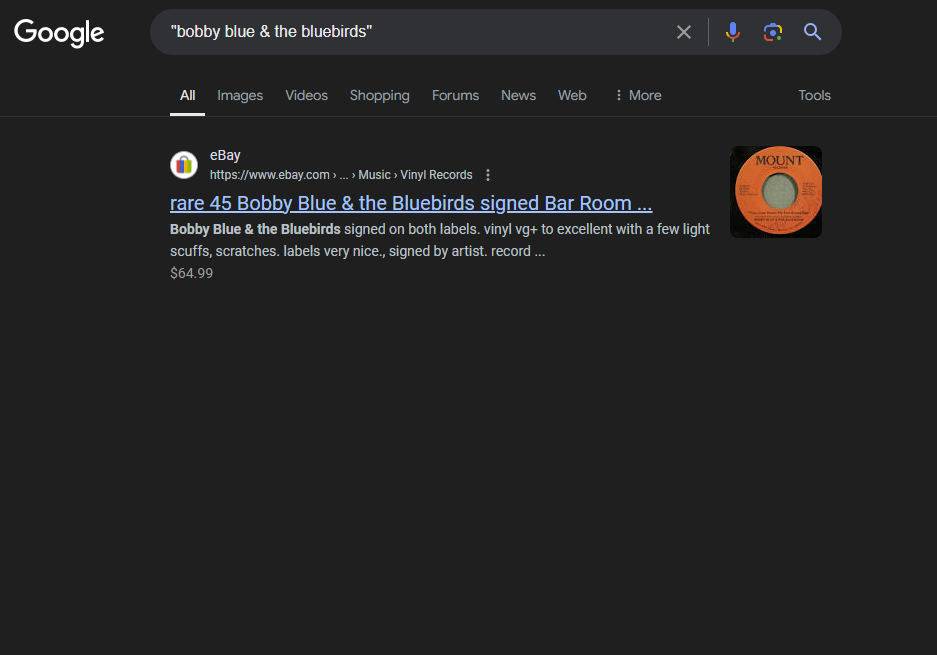
It was the summer of 2024 and I was going through my stack of 7” records when something caught my eye: a signed record I hadn’t noticed before. I don’t listen to 7” records often, and I could not remember how I acquired this one. The autograph’s presence, though, made me interested to learn more. I searched online for the artist name—“Bobby Blue & the Bluebirds”—and was confronted with exactly one result: an eBay listing for the same record I owned.
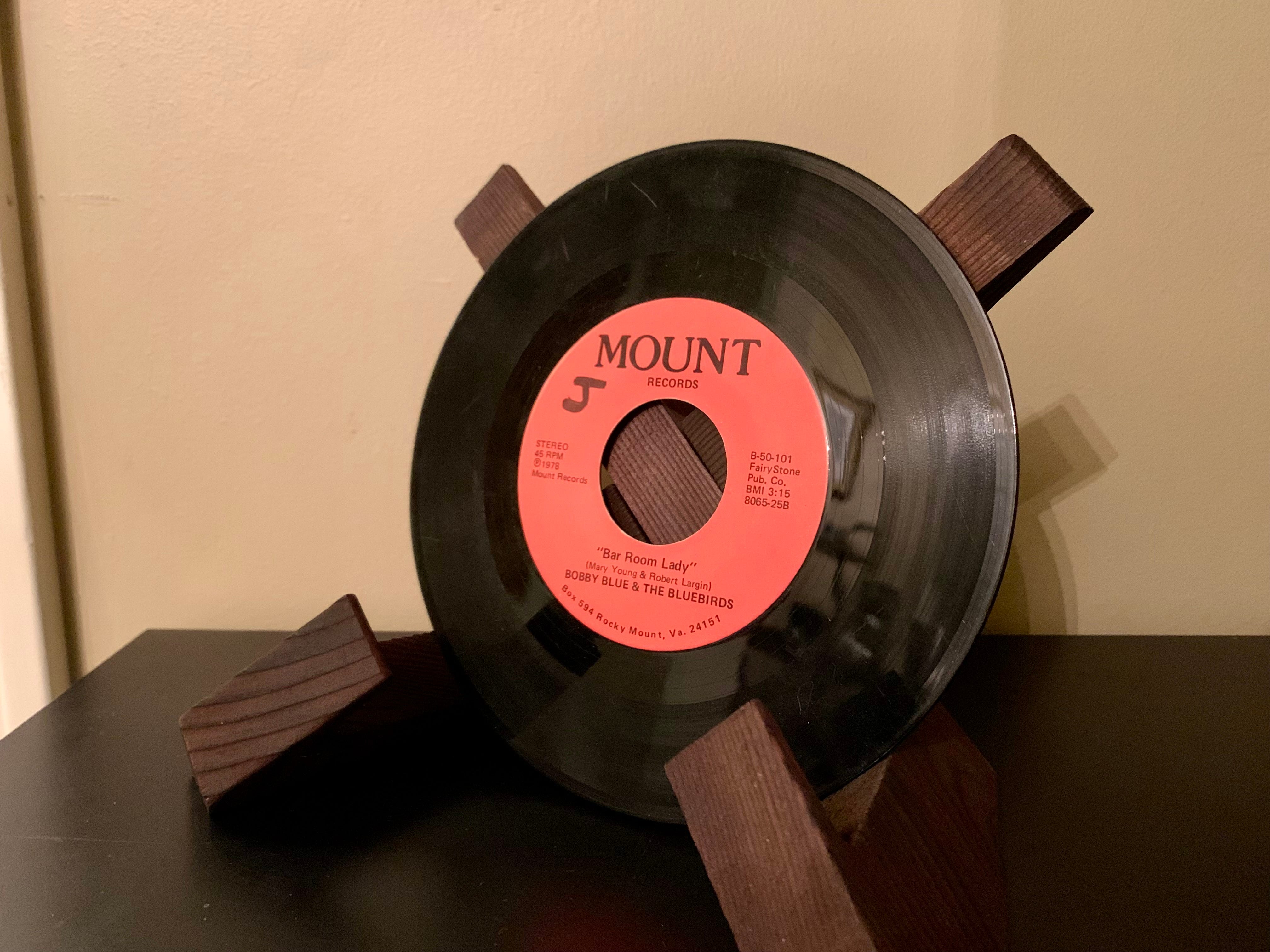
This was intriguing, so I looked a little closer at the metadata on the disc. The publisher was listed as “Fairystone Publishing Company.” Fairy Stone State Park is in Virginia near where my grandparents live, and the “fairy stone” moniker is often associated with establishments in that community.
I called up my mom and grandparents, but none of them had any recollection of this record or artist. I knew I had to find out who this mysterious “Bobby Blue” was.
December 15, 2024
I decided to start with what I already knew: the publishing info from the record I had in-hand. I had already tried searching up the song titles, but that turned up nothing useful. Nevertheless, both songs were co-written by a man named “Robert Largin.” It seemed reasonable to assume that Largin is “Bobby Blue,” so I focused my efforts towards finding information about him.
I soon came across a headstone for a “Robert Cushing Largin.” This man was born in 1913 in Dublin, Virginia, and died in 2002, in Roanoke, Virginia. It seemed possible that this could be my Bobby Blue.
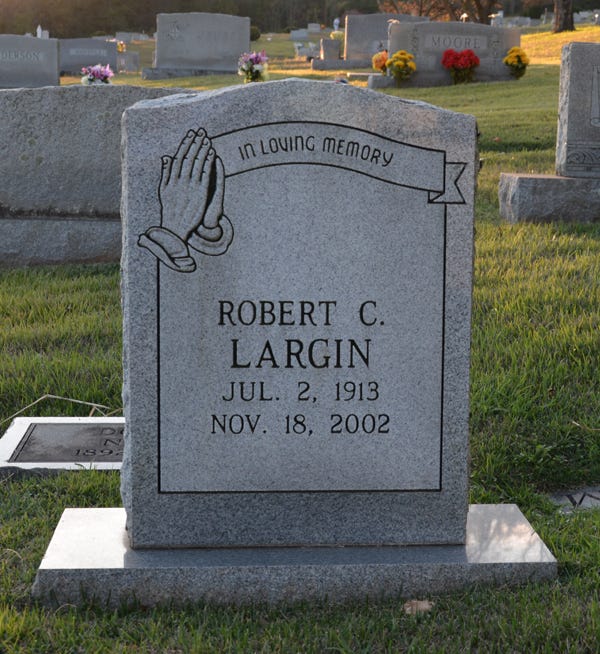
I then dug up some information about this Robert C. Largin. I couldn’t find any evidence that he was a musician. Furthermore, the record that I had was released in 1978. This Robert C. Largin would have been 65 years old in 1978. I wasn’t confident that this was the man I was looking for.
December 16, 2024
Mount Records, the label listed on my copy of Bobby Blue’s record, didn’t seem to have much of a digital footprint, so I turned to the publisher, Fairystone Publishing Company.
I found several allusions to a “Fairystone Publishing Company” online. A Discogs webpage, an Easy Song webpage, and an LP review on an e-zine called SlipCue all referenced bluegrass music from Virginia. Unfortunately, all the contact info was out of date. However, there were multiple references to two men: Rodney and Steve Shively.
December 17, 2024
Unfortunately, I quickly discovered that William Rodney “Rod” Shively had passed away in 2001. His obituary in the Martinsville Bulletin read:
A musician, Shively owned and operated several businesses connected with the music industry, including Little Music City in Rocky Mount and later Far Star Satellite with his partner and brother, Steve Shively, Outlet Recording Inc. of Rocky Mount [sic]. He also owned and operated a publishing company, Fairystone Publishing.
Outlet Recordings had a Facebook page, but its last post was from 2023 and the contact info didn’t lead anywhere. This made sense after I learned that Steve Shively, too, had passed away, in February 2024. Here’s the obituary for Steve that found on the Flora Funeral Services website:
Steve was a well-known musician and band leader. His music career spanned many years and took him to many venues. … He was partner with his brother Rod at Outlet Recording, Rocky Mount. Steve also recorded a weekly radio spot for WYTI Radio in Rocky Mount, VA.
December 19, 2024
I decided to give the Franklin County Public Library in Rocky Mount, Virginia, a call. They put me in touch with Jamie Mize, Genealogy Librarian. She didn’t recognize any of the names from the song. She agreed to look through some local history publications, though, and we subsequently struck up an email correspondence:
I checked the Yesterday and Today books and found nothing about Bobby Blue and the Bluebirds. I also checked the Franklin County Bicentennial book and found some musical stuff mentioned but it pertained to Galax, Virginia, and a few other local bands.
Checked the Family Files and the Mann Family Files for the last name you gave me, “Largin,” and no hits for that either … It seems as if most bands traveled around to West Virginia and down to North Carolina weekly, but these bands had multiple albums. It makes me think maybe they just had friends here and recorded the album for fun but lived elsewhere—either in another county or possibly just a little past the border of Virginia.
I sent a message out on one of the Facebook pages I am affiliated with (You Might be From Franklin County If You Remember)—a comment was left that a man named Ross Hunt played in the band but he passed away years ago. I got in touch with the previous genealogist and she said a lot of people ran recording studios out of their homes and had P.O. Boxes listed as their address. She seems to think that FairyStone Publishing was close to the Henry County border, which makes sense because of Fairy Stone [State] Park. This means Basset Historical Center could have some information on this group …
On top of all this, Mize provided a list of several local history groups, including contact info, and corroborated Rod Shively’s association with Fairystone Publishing. At this point I was feeling optimistic that I might be able to find something useful.
December 30, 2024
Poking around on the Rocky Mount, Virginia, official website led me to reach out to Daniel Pinard, a local official focusing on tourism and development. He pointed me toward a local record store and a local business owned by the son of Steve Shively, one of the two men behind the publishing company that released Bobby Blue’s record. I reached out to both businesses a couple times but never heard back. Another dead end.
January 3, 2025
I heard back from Linda Stanley, Managing Director of the Franklin County Historical Society:
I knew both Rod & Steve Shively and wrote many stories about them over the years. I think Mary Young recorded for Outlet. I will look at some of my old records and albums. I have put out [a] call for info on Bobby Blue … I know the Largins are from Floyd County. More to come.
Rodney was quite a songwriter himself. If he had wanted to leave home, I’m pretty sure he would’ve gone far in the business. Most of the studio’s recordings were like the vanity publishing today and a one time shot. Although some went on using Rod’s session as a calling card of sorts.
Stanley told me that she put out feelers to “every living soul I can think of” and would let me know if anything else turned up.
January 6, 2025
Upon librarian Jamie Mize’s recommendation, I emailed Pat Ross from the Bassett Historical Center. She reached out with a connection to a local record collector:
I talked with a gentleman by the name of Teddy Compton, and he knew exactly the names that you sent to me. He knew about Fairystone Publishing and the Shivelys … Nice guy with a huge [record] collection who will be happy to help.
Pat Ross’s assessment of Teddy Compton was spot-on. Compton has 30,000 records! She told me that she has been collecting for about 50 years and had indeed heard the name “Bobby Blue & the Bluebirds” mentioned before. She offered to ask around about Bobby Blue.
January 17, 2025
Pat Ross reached out to me again with an exciting piece to the puzzle:
This will make your day. You are correct that Robert Largen is indeed Bobby Blue. This comes from a nephew of Robert Largen to Wes Wells … Wes knows music and the people in the music business, and he found this out by contacts.
I had failed to consider that Largen’s name might be spelled differently in different places. Ross also included Wells’ phone number. I knew that I had to give him a call when I had a chance.
January 20, 2025
Wes Wells is a board member at Bassett Historical Center and musician who was able to get connected with a family member of Robert Largen via a local high school band director. “Robert Largen, according to the information we got from them,” Wells told me, “is still alive and lives in Atlanta.”
That was outstanding news! What’s more, Wells had a phone number for Largen. I dialed it immediately after getting off the phone. Alas, the number was out of service.
Wells told me he’d try to get a good phone number for Largen but had heard that there was a recent death in the family and didn’t want to bother them too much. In the meantime, on top of learning that Bobby Blue was still alive, I had a new geographical focus for my search: instead of central Virginia, I should be looking in northern Georgia.
July 17, 2025
While I waited to hear back from Wes Wells, I was juggling a lot of different projects, and with my search seemingly at a dead end, Bobby Blue faded from my priority list. After about a month of obsessive searching, some months would pass before I returned.
When I did, I followed up with Wells, who ended up giving my phone number to Carlton Wilkes. Wilkes is the retired high school band director who was Wells’ connection with Largin’s family. (He also, I later learned, played saxophone in Percy Sledge’s band for more than a decade.) I got a call from Wilkes one day while I was on my lunch break…
August 1, 2025
Wilkes has a resume a mile long and is chock-full of fascinating anecdotes. Pertinent to this story, he told me that he had worked with Rod Shively and Outlet Records himself as a session musician back in the day, and that his aunt used to take care of Bobby Largen when he was a child.
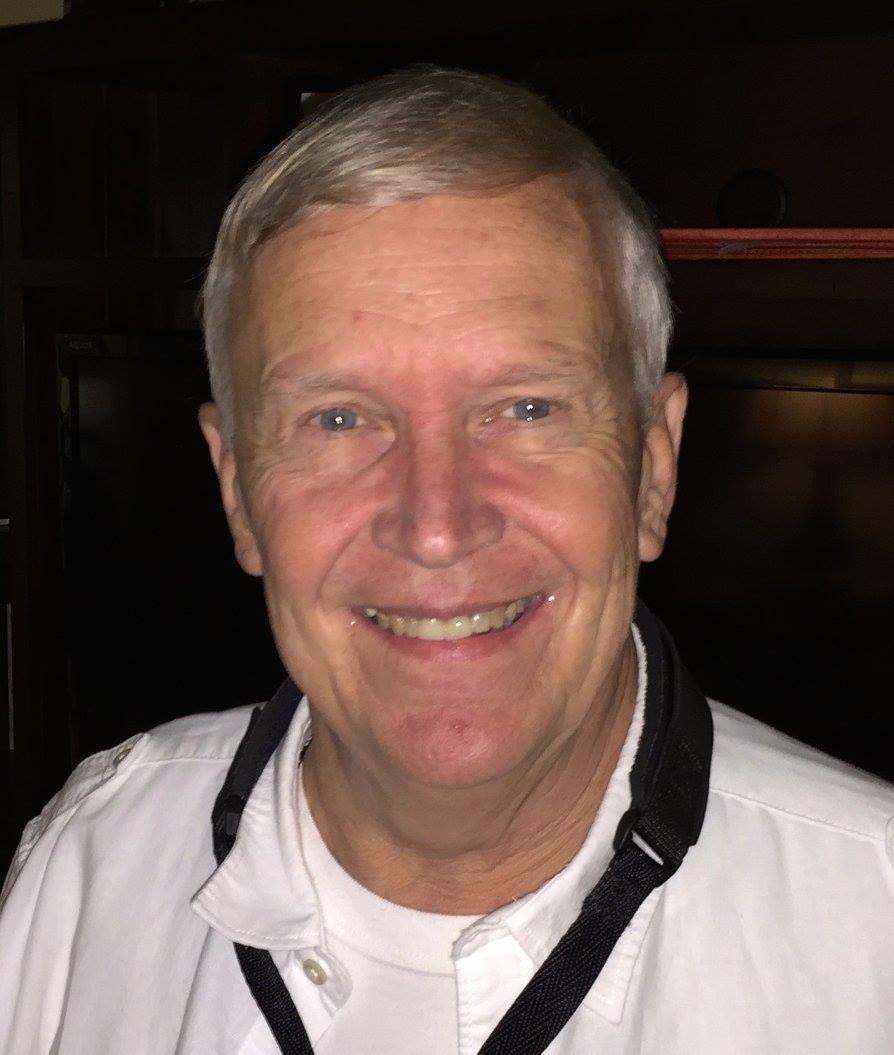
“Wes said, ‘Do you know someone named Robert Largen?’ And I said, ‘Well, yeah, I know somebody named Robert Largen!’” Wilkes had reached out to his cousin, who said that Largen lives near Six Flags Over Georgia and gave him the same phone number that Wells had given me. Apparently, they had been having a tough time getting a hold of Largen, too. Wilkes promised to follow up with his cousins and “put our heads together” to work out a way to contact their old acquaintance.
August 27, 2025
While I waited, I kept mulling over the story so far, going through my notes, and trying to think of anything I hadn’t tried yet. One day, it occurred to me to look up “Bobby Largen” via social media, rather than on Google.
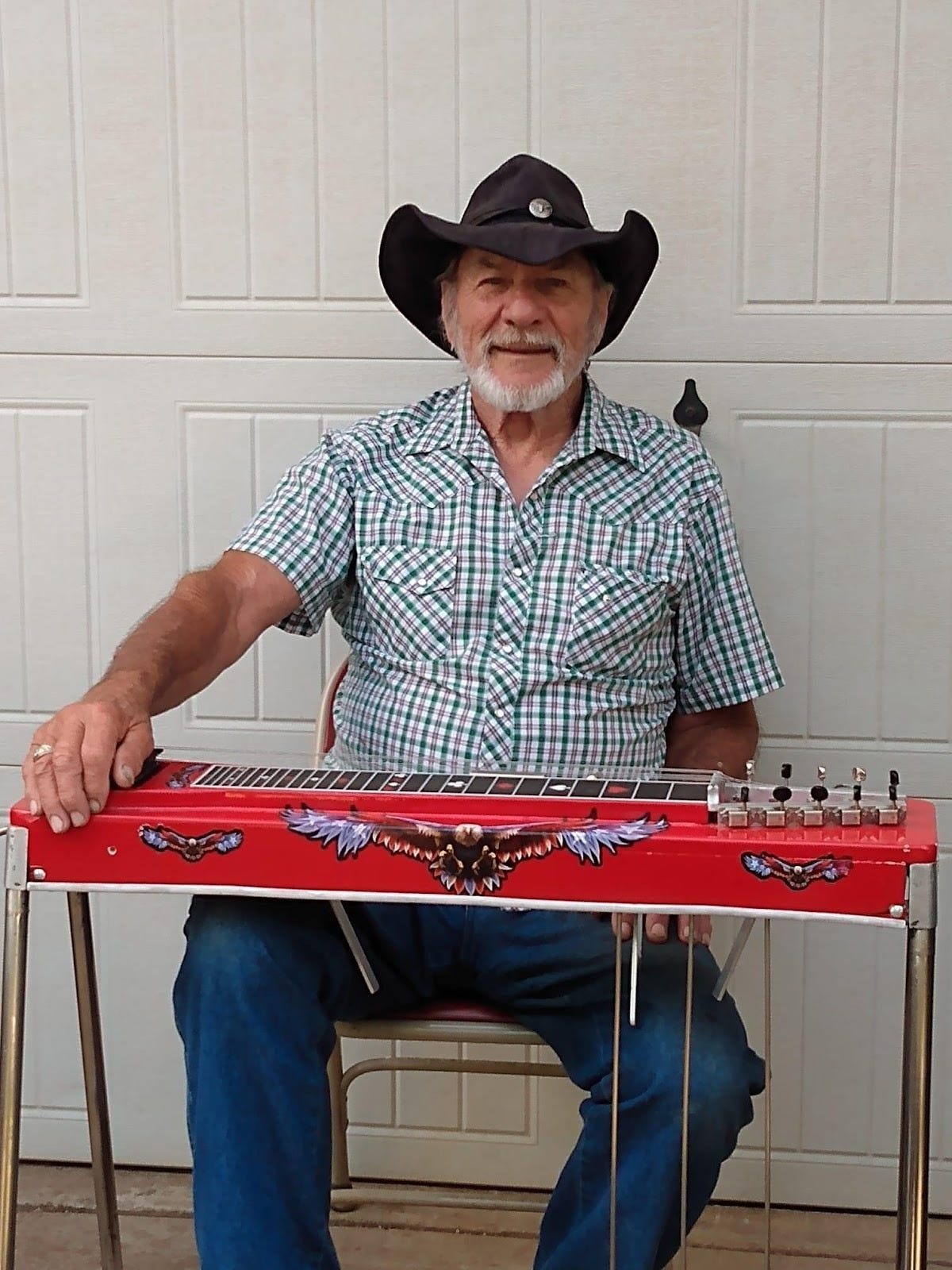
I did so on Facebook and found a sparse profile with the last name spelled as “Largin.” (I guess the original spelling that I had was correct.) The profile only had one photo. And it said that he currently lives in Georgia. His birthplace, I was happy to see, was listed as Rocky Mount, Virginia!
I ran a similar search on YouTube. A video posted by a JB Walker from 2015 purported to feature a Bobby Largin playing guitar at B3 Bar And Grill in Austell, Georgia. The man from the video appeared to be the same man from the Facebook profile.
This had to be him, right? I couldn’t send a message on Facebook, but I left a comment and every day hoped to hear back.
September 8, 2025
After days of radio silence on Facebook, I was back to making phone calls and sending emails. I tried calling the phone number on the banner from the background of the video. No luck.
The banner appears to be for Southland’s Full Throttle Magazine, a now-defunct motorcycle publication. An email to them bounced back as undeliverable, and I couldn’t find any active contact info for them.
I tried calling the bar from the video description. No luck. I tried calling the booking number for the band and got another out of service message. I also left a comment on the video, then tried the booking email for the band that posted it. I soon got what felt like my thirtieth “email undeliverable” message.
October 28, 2025
A couple hours later, I got a call back from JB Walker of JB Walker And The Cheap Whiskey Band, the guy that posted the YouTube video that seemed to feature Bobby Blue. Here’s how the conversation went:
Me: I found a video on your YouTube page from like ten years ago that says it’s Bobby Largin, and I am thinking that might be the person I’m trying to track down.
Walker: Oh yeah! I’ve known Bobby for forty years.
Me: No way!
Walker: He got me started in the music business … I have the world’s largest biker band thanks to Bobby Largin.
This was it! At first, Walker gave me the same number that Wells and Wilkes had, but a few hours later he texted me a number for Largin that was still in service. A number I could call to interview Bobby Blue himself. A year in the making, I gave Bobby Blue a call.
Robert “Bobby” Largin was born in Roanoke, Virginia, and was raised in nearby Rocky Mount. Both of his parents were musicians, and at the age of five he began playing flat-top guitar. “I learned to play, and I kept on playing and playing and doing little shows in the backyard for the neighbors, and they was liking it. And I was growing up and just kept on doing that—carrying my guitar to school and played at school, when I was in elementary school.”
At fifteen, young Largin started getting some of his first gigs. “When I got old enough to go in American Legions and everything, I started playing [there].”
“When I turned 17 years old, I joined the Army to go to Korea. And when I got in there, my lieutenant, he played. Him and I, we put a band together, and we played while we was in service. And when I got out, I still kept on playing. I’m still playing today.”
Largin and his wife moved to the Atlanta area in 1971. They were both from Franklin County, Virginia, though, and in 1977 they decided to move back. But Largin told me he didn’t like how cold it was in Virginia—especially since he was a painter. In the South, he could paint all year round, he explained. By contrast, in Virginia the snow and cold weather made business slow down. So, they moved back to Georgia only a few years later, where he has lived ever since.
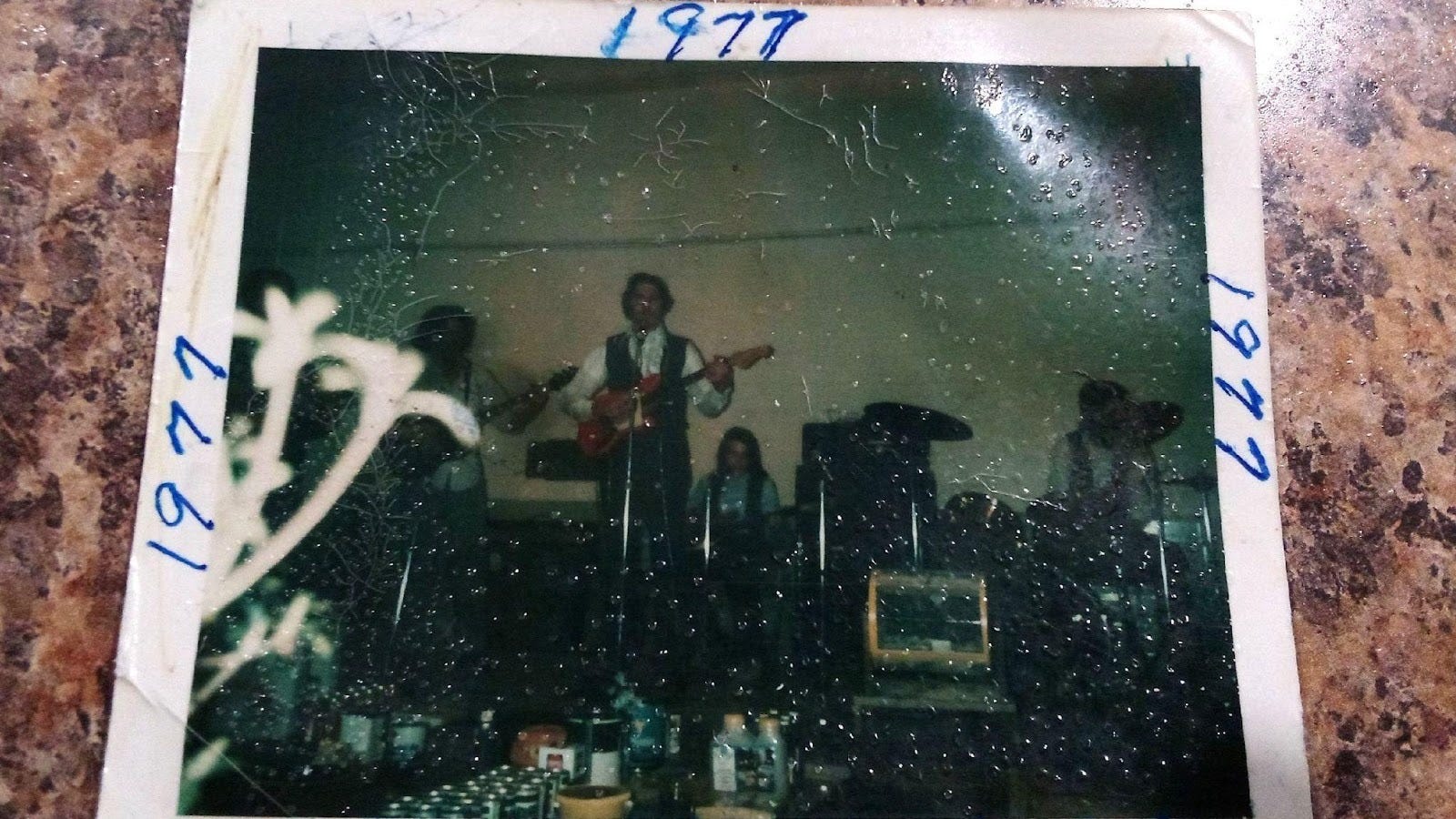
It was during this three-year stint in Rocky Mount that Largin formed the Bluebirds band. “When I became ‘Bobby Blue & the Bluebirds’ and got my band, I bought all the equipment—including the drums, the guitars, and amps.” That band played a lot of shows in the Rocky Mount/Roanoke area at establishments like American Legions, Moose Lodges, and honky-tonk joints.
I asked Largin how he came up with the name “Bobby Blue & the Bluebirds.” “Oh, boy, I don’t know that,” he said. “Uh, I’d reckon I wanted to copy Conway Twitty & the Twitty Birds.”
The Bluebirds themselves were James Young (lead guitar, steel guitar), John Sinclair (lead guitar for rock 'n' roll-style gigs), Mike Young (drums—no relation to James), and Donna Largin (bass guitar, harmony vocals). Donna is Bobby’s oldest daughter, who he taught to play bass at 7 years old. I asked about Ross Hunt—the man who a Facebook comment alleged played in Bobby’s band—and it turns out he was not a member but was a big fan that came to many of their shows.
Mary Young, who co-wrote “Bar Room Lady,” was James Young’s wife. Dorothy Ann Largin was Bobby Largin’s wife, and the two of them wrote “Your Love Makes Me Feel Brand New” together. She passed away ten years ago, he told me.
The Bluebirds band was active for about three years before Bobby Largin moved back to Georgia. It was in that window of time that they made their recordings. “Rod Shively owned the studio that cut my records. That was Mount Records.” Largin explained that he approached Shively about making the records and paid for the studio time.
Largin: I went up to the recording company and we just took one take on it. What’s on the record—we just walked in there and done it and walked out. We wouldn’t take no second or third cut … As soon as he turned the light on, we started playing; when he turned the light off, we finished playing. And that’s how quick it went.
Me: Well, y’all did a great job on your first try!
Largin: Yeah, because they had practiced! They had played and played and played and played. And they were real good musicians … They could really play good, you know.
His daughter, Donna, had bronchitis that day—and Bobby was starting to feel sick, too—but he had already paid for the session, so they forged ahead with it. She was 14 years old when they recorded, which meant she had seven years of bass-playing experience under her belt.
Largin told me that he regrets recording original songs, instead of covers. “I wish we’d never written a song and tried to put it out … I wish I went on ahead and put one of Waylon Jennings’ songs on there—one of somebody else’s songs. I think it would have went a whole lot further, you know, than just your original stuff.”
I also learned that Bobby Blue & the Bluebirds recorded a second 7” that day! One side of it was a song called “Melt & Roll,” a song about the biblical end-times. That song was sung to the tune of “Foggy Mountain Breakdown” by Earl Scruggs, which Largin said was his wife’s idea.
Largin also mentioned that the band had at least one other original song that never got recorded. Its name was “This is My Way of Saying I Love You,” written by his daughter Donna.
After making the move back to Georgia, Largin continued to be active in his local music scene. “I’ve been here since 1971, and I’ve been playing ever since I got here. I met up with a lot of people over the years.”
One notable gig he mentioned was at a big auditorium venue called “The Sports Arena,” where another band of his—still including his daughter on bass—appeared as “Bobby Larkin and the Country Larks.” The Sports Arena, which shut down in the 80s, was also host to a long list of other noteworthy acts, from Elvis Presley to Fleetwood Mac. Largin told me that his band was the last act to play the venue before it closed permanently.
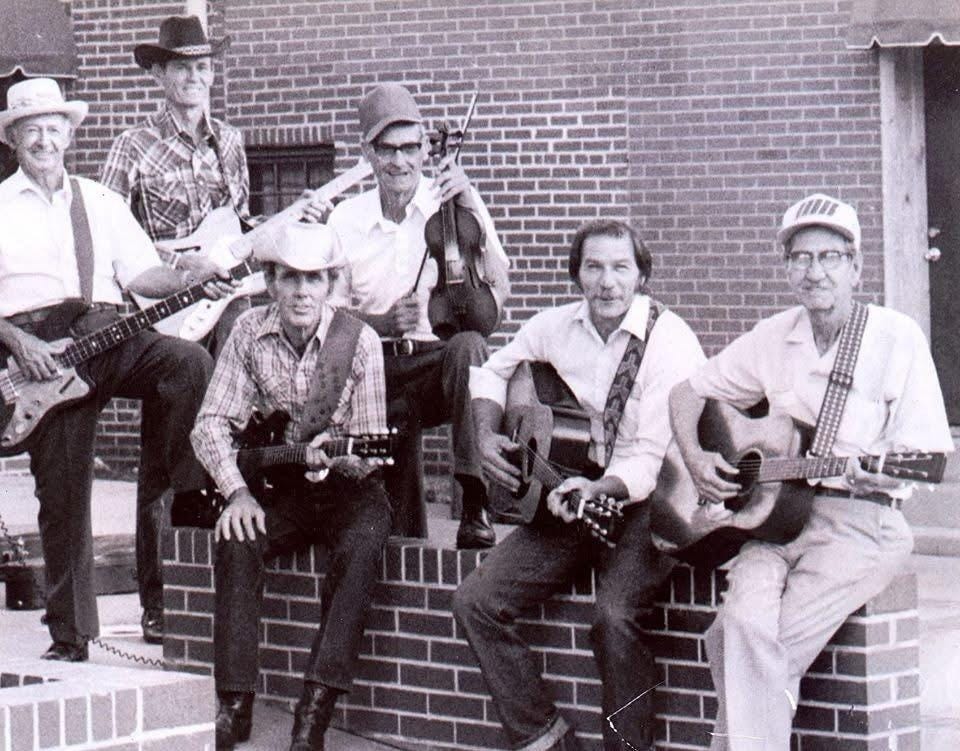
All these years of musicianship have left Bobby Largin with quite the legacy. I got the sense from talking to him and JB Walker that he is a respected and well-liked role model in his local music community. He still gets out and plays a few times each week. Speaking of Walker, it was Largin who first gave him the chance to perform:
45 years ago, I let him sing the first song out in public, and it got into his blood and been into his blood ever since … Winn-Dixie [grocery store], at that time, didn’t pack up the meats and put them out there like they do today. So, when you went to Winn-Dixie and you wanted chicken, you had them cut it up for you … And that’s where JB was. He was my meat cutter.
I said, ‘JB, do you sing anything?’ He said, ‘I sing an Elvis song. Why do you ask?’ I said, ‘I want you to come out this weekend—I’m playing this place’ … And I said, ‘I want you to shine one time.’ And he came out and I just gave him the mic and I said, ‘Do your thing!’ And the band backed him up and then it got into his blood.”
Largin’s own family, too, has continued in his footsteps. He mentioned that his daughter plays gospel piano; his grandson plays at church in South Carolina, alongside his wife; and his grandson, Eli Bryce, is a session musician.
As our conversation drew to a close, Largin wanted to give me an idea of where he’s at today, and sang me a few bars of “He Stopped Loving Her Today” by George Jones. “85 years old and still doin’ it,” he said. “And I’ll do it till God calls me home.”
I’ve only done it a handful of times, but researching niche local history is always a ton of fun. I had a blast throughout this whole process and got to talk to lots of wonderful people. I couldn’t be more pleased with the result. When I started searching for Bobby Blue & the Bluebirds, I never suspected that I would end up talking to Bobby Blue on the phone!
Aside from my own enjoyment of this project, being able to research and write this article means that Bobby Blue & the Bluebirds’ story finds a place in the public record, rather than slipping into obscurity. I am heartened to know that Bobby Largin’s story need not be a mystery to future generations of music lovers.
I am grateful to everyone who took time out of their day to assist me in my search, including Teddy Compton, Holly Kozelsky, Jamie Mize, Brian Olinger, Daniel Pinard, Pat Ross, Linda Stanley, Jodie Thomas, JB Walker, Wes Wells, and Carlton Wilkes. Thanks to my wife, Grace, for letting me use her Facebook account and for giving this article a look before I finished it. Thanks to my friend, Rob Griffith, for letting me use his turntable to digitize the 45 that started this all. And thanks to Chris Dalla Riva for giving this article a home.

I don’t know whether you’d be interested, but my Substack, “Mixed Feelings,” presents various issues from the perspective of a mixed-race person. I also am posting a bio daily about one of my family members in Notes for Black History Month. Today’s is about mid-century composer, arranger, conductor and producer Belford “Sinky” Hendricks. If you read it and like it, please restack and subscribe.
I love this, Darius. Posted one of the scattered newspaper ads that ran for this elusive group in a note since it doesn't look like comments permit pictures. Sorry for the link.
https://substack.com/@bayesianbarndance/note/c-211659757?r=1nw08&utm_source=notes-share-action&utm_medium=web