


Welcome back to Can’t Get Much Higher, the internet’s favorite place for music and data. If you enjoy this newsletter, check out my book Uncharted Territory: What Numbers Tell Us about the Biggest Hit Songs and Ourselves. It’s a data-driven history of popular music that I wrote as I spent years listening to every number one hit in history. Now, let’s talk about something making me angry.
Is Nepotism Real?
By Chris Dalla Riva
In 2009, while journalist Ian Betteridge was lambasting TechCrunch for an irresponsible headline (i.e., “Did Last.fm Just Hand Over User Listening Data To the RIAA?”), he made an observation that I think about often:
One thing though: This story is a great demonstration of my maxim that any headline which ends in a question mark can be answered by the word “no”. The reason why journalists use that style of headline is that they know the story is probably bullshit, and don’t actually have the sources and facts to back it up, but still want to run it.
Though this maxim predates Betteridge, it has come to bear his name: Betteridge’s Law of Headlines. And I’m often thinking about Betteridge and his law because this newsletter regularly uses questions in its titles (e.g., “Is the Album Dead?”). I like to think that I write with enough nuance that Betteridge would give me a pass, but I can’t be certain. Social media’s twisted incentives make us do many things we might not otherwise.
That said, I am certain that today’s inquiring headline does break his law. Nepotism—or in the words of Merriam-Webster, “favoritism … based on kinship”—is undoubtedly real. From that dolt in your high school class taking over his father’s successful plumbing company to The Los Angeles Lakers drafting the under-qualified son of LeBron James, examples of nepotism in every area of the world are easy to come by.
Something strange is going on with nepotism, though. And it doesn’t have to do with actual acts of nepotism. It’s with how we apply the word, especially in the world of music. Stella Lefty proves a good example of this.
Stella Lefty is a singer-songwriter whose rise over the last year has been nothing short of meteoric. In fact, she recently scored her first top 10 hit: “Boston,” a twangy song about falling in love hard and fast that interpolates the chorus of Noah Kahan’s “Stick Season.”
The success of “Boston” doesn’t require a ton of explanation. First, it’s got a catchy chorus. Second, it arrived at just the right time. Country music has resurged over the last five years. As I write, the genre commands half of Billboard’s top 10.
Stella Lefty has a problem, though. If you scroll through the top comments on any of her recent videos, one thing comes up again and again: nepotism. Stella Lefty—born Stella Lefkofsky—is the daughter of Eric Lefkofsky, the billionaire founder of Groupon. People are very angry about this. Her recent popularity, they claim, is just driven by the fact that she was born into a wealthy family.
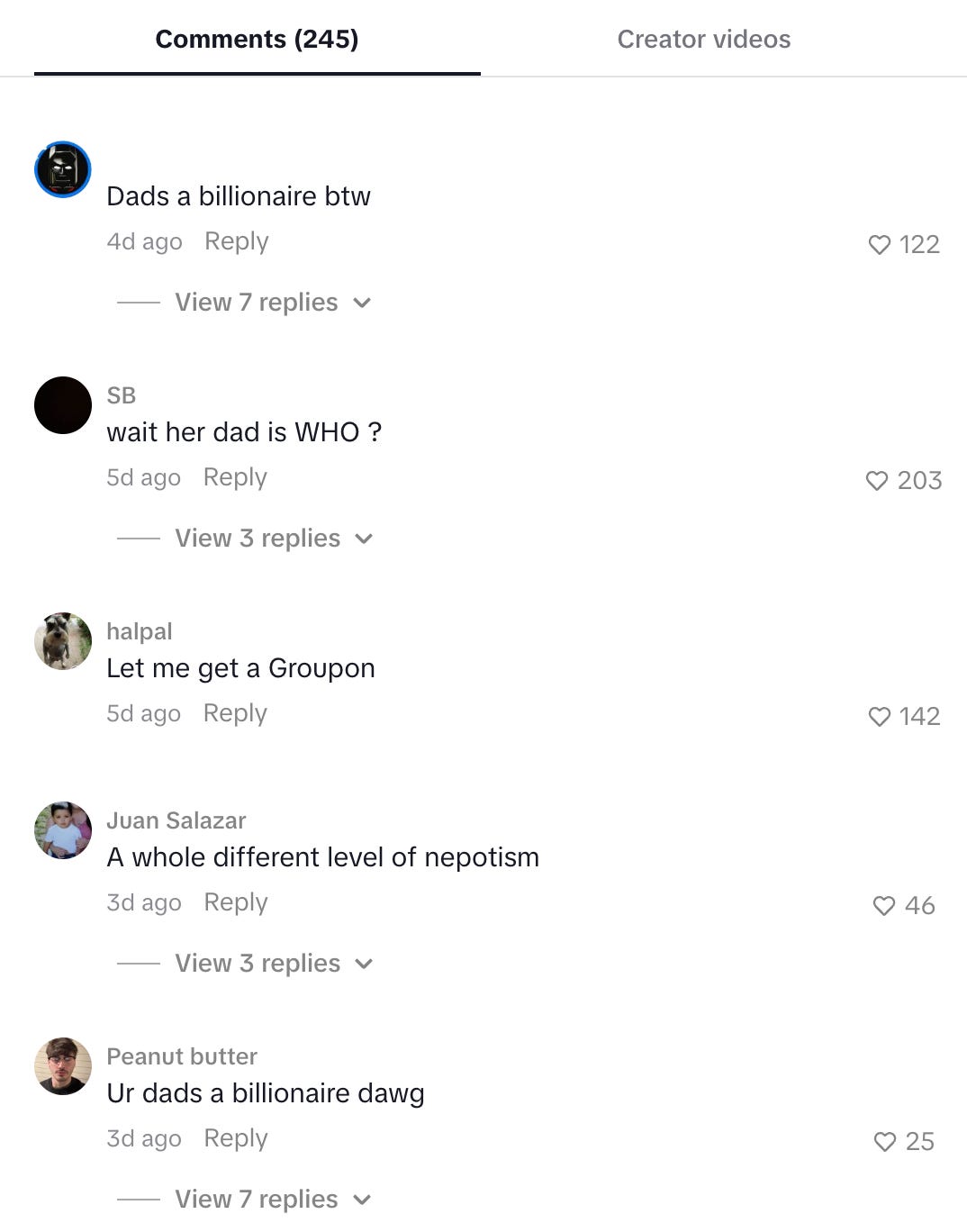
This doesn’t make much sense. First, is this really nepotism? I know this might seem pedantic, but it’s not like her father is the CEO of Atlantic Records. He made his money in e-commerce. Wealth comes with incredible resources and benefits. If Stella Lefty’s music career failed, she’d be just alright. That wouldn’t necessarily be the case had her origins been more humble. But I don’t think “nepotism” really captures her career trajectory.
Second, that career trajectory is so much more mundane than any of these comments assume. If you dig through her TikTok, you will see that she posted for years getting almost no views. Occasionally, she’d find small virality by singing a snippet of a popular song.

 Tiktok failed to load.
Enable 3rd party cookies or use another browser
Over time, people started responding positively to her voice. Then the same happened for her originals. Hundreds of views became thousands. Thousands became millions. Somewhere along the line, she picked up management and had a popular producer named J Kash reach out to her. But that’s not enough to have a career. She kept posting and eventually “Boston” went mega viral.
I would bet serious money that neither her management company nor J Kash knew who her father was when they reached out. They just saw a girl with a pretty voice building an online audience. Countless artists get record deals that way. (Albeit not related to original songs, I’ve built a large following on TikTok talking about music—no billionaires required.)
To be clear, I don’t even think “Boston” is a very good song. It’s a few lackluster verses slapped around a catchy but derivative chorus. Still, I think people significantly underrate how hard it is to score a top 10 hit. I’m not saying that wealth doesn’t confer advantages, but I suspect true nepotism is much less common in the world of popular music than people think. But to be sure, I decided to look.
The Myth of the Musical Nepo Baby
A few years ago, I wrote a piece for Business Insider that was a bit different than my normal fare: “The rise of political nepo babies.” To summarize, we looked at what percentage of each Congressional class had parents who were also in Congress. For most of the 20th century, that rate sat at or below 2.0%. By 2010, it had risen to 4.6%.
Then we took things a step further. Rather than just measuring if a member of Congress had a parent who was also in Congress, we looked for every member whose parent had a Wikipedia—excluding members whose parents only had pages because their children were famous (e.g., Bill Clinton’s mother and father). Though not strictly a measure of nepotism, we figured “if at least one of your parents was notable enough to have Wikipedia page, you likely had some advantages in your political career.”
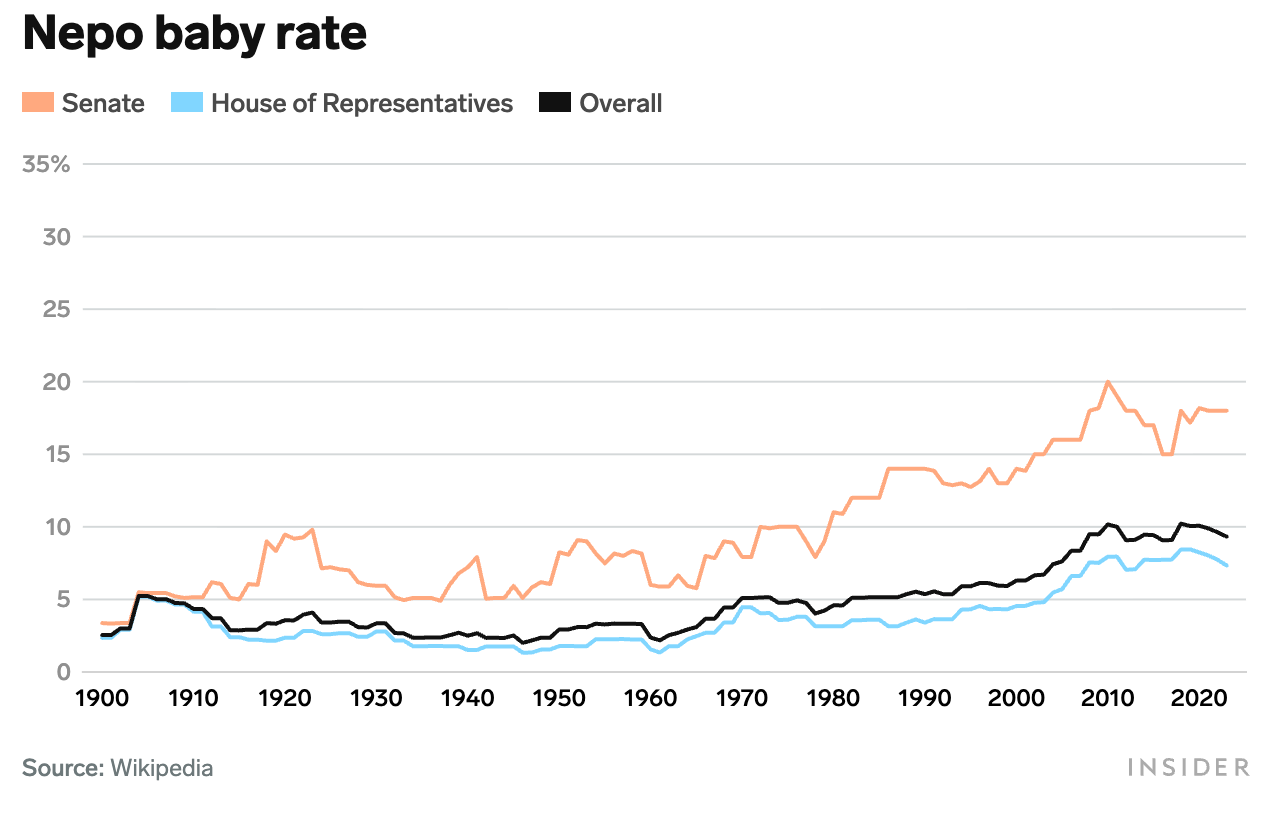
I decided to apply the same methodology to the world of music. Even though I just argued that we are misusing the term “nepotism,” I figured we wanted to be as generous as possible with our definition. Of note, this methodology would count Stella Lefty as the beneficiary of nepotism because her father has a Wikipedia page.
To track this over time, I grabbed Billboard’s year-end Hot 100 between 1960 and 2025. For each artist who performed a song, I went to their Wikipedia and noted if their parents had a Wikipedia page of their own. For bands, I used their frontman as proxy. Finally, as with politicians, I removed parents who only had a Wikipedia page because they created someone famous (e.g., John Lennon’s mother and father).
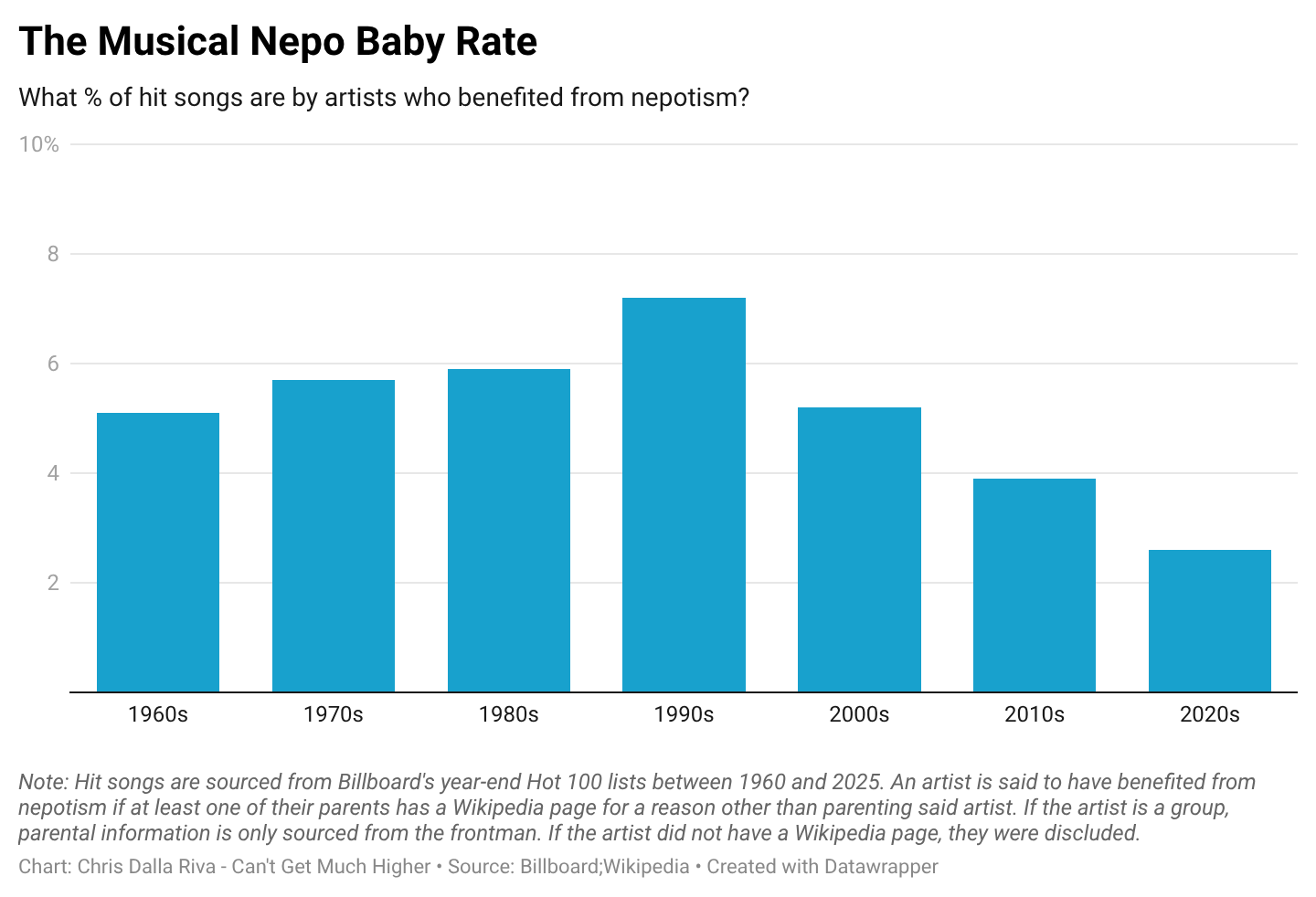
We can glean two things from our graph. First, the large majority of hits in any decade are not by artists benefiting from nepotism. In fact, the highest the nepotism rate gets is 7.2% in the 1990s because of the likes of Wilson Phillips, Bonnie Raitt, Lenny Kravitz, Tim McGraw, and Jewel.
Second, the nepotism rate is decreasing. Thus far in the 2020s, only 2.6% of hits have been by artists who benefited from nepotism, down almost five percentage points from the peak during the last decade of the 20th century. This illustrates one of the promises of the internet: democratization.
Back in the day, it was probably a lot easier for John Sebastian to get his group The Lovin’ Spoonful off the ground because his father was a notable musician and his mother was good friends with actress Vivian Vance. It’s hard to navigate the world of entertainment when information is hard to come by.
Now, connections remain vital, but information is more plentiful. Furthermore, social media and music streaming have made it easier than ever for artists of all social strata to get their music out there. (Relatedly, see the fact that you are reading a newsletter with thousands of subscribers by a guy with no connections in journalism.)
Do We Really Care about Nepotism?
At the beginning of this piece, I noted, “From that dolt in your high school class taking over his father’s successful plumbing company to The Los Angeles Lakers drafting the under-qualified son of LeBron James, examples of nepotism in every area of the world are easy to come by.” I believe the plumber-LeBron dichotomy illustrates how most humans feel about nepotism.
You likely don’t care if that guy you used to hang out with takes over his father’s plumbing business even if he didn’t inherit his father’s skills with rushing water. On the other hand, you might care that LeBron James’s son got drafted into the NBA without having the typical stat line required.
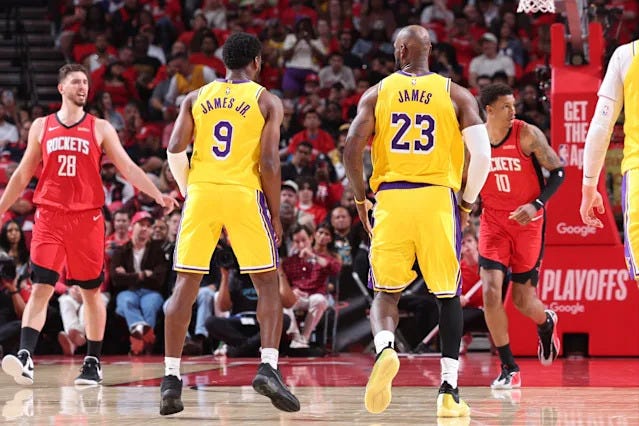
The difference is twofold. First, being a plumber doesn’t automatically lead to riches the same way being in the NBA does. Second, the world needs a lot more plumbers than NBA players. If you’d always dreamt of working with toilets and sinks, your friend’s career likely has no effect on your success or failure. Bronny James, on the other hand, likely took a spot away from someone much more qualified.
So, I get why people are mad at Stella Lefty. Being a famous musician is much closer to being an NBA player than a plumber. But at the same time, people who benefit from nepotism can still make good music. I have yet to hear someone complain that Carly Simon is the daughter of Richard L. Simon, the cofounder of Simon & Schuster. Likewise, nobody gives the spirit of David Crosby grief for being the son of an Academy Award-winning cinematographer.
I, too, would like to live in a more equitable world, the most talented rising to the top. But your efforts would probably be better spent fighting for progressive tax reform than yelling at singer-songwriters on the internet for the parents they had no choice in being born to. Plus, if those singer-songwriters end up writing better songs, you probably won’t care anymore anyway.
It’s just undeniably true, though, that there are far fewer hungry outsiders today than there were in the past, when you had the British Invasion, the Big Four of grunge— to say nothing of all the early pioneers of jazz, soul, or hip hop. In other words, working-class kids who had to try much harder, to be much better, to overcome their disadvantages.
By contrast, outside of hip hop, almost every defining artist of the 21st century, from the Strokes to Taylor Swift, is a trust fund baby, nepo baby, industry baby, or some combination thereof. This can’t be a coincidence!
I find it strange that so many people defend those who have privilege, saying, “All it does is get your foot in the door.” Like, getting your foot in the door isn’t some trivial step? A working-class kid can spend their whole life trying to do just that!
Interesting timing. I just found out that Gracie Abrams' father is the famous movie director J.J. Abrams. I wondered, too, if it helped having J.J. as her father. In a recent interview, I saw how hard she works and what it takes to be at her level. I applaud her and others who do the work despite their upbringing.