


Though this newsletter largely focuses on pop music, I try to touch on as many genres as I can. This week we are headed down south to a genre that has been absent from the pages for some time: country music. The last time we spoke about country was August 2023, when we used data from Wikipedia to figure out how “country” country artists really are. Today, we’re going to talk about how you just cannot kill country music.
If you enjoy the stuff that I do here, consider purchasing a copy of my book Uncharted Territory: What Numbers Tell Us about the Biggest Hit Songs and Ourselves. It’s a data-driven history of popular music that I wrote as I spent years listening to every number one hit in history.
Country Music Always Comes Back
By Chris Dalla Riva
Ella Langley is in rarefied company. As of the publication of this newsletter, she is one of six artists to top the Billboard Hot 100 this year. Langley’s name might not be familiar to you, but the names of the other chart-topping artists from this year will be: Mariah Carey, Taylor Swift, Bruno Mars, Harry Styles, and Bad Bunny.
Langley got to number one with “Choosin’ Texas,” a twangy tale of lost love cowritten with country stalwart Miranda Lambert. “Choosin’ Texas” is assuredly a country song. And a country song topping the charts isn’t that strange these days. Along with Nashville fixtures like Morgan Wallen, every pop star from Beyoncé to Post Malone has turned to the genre.
Country music’s relationship with pop music is strange, though. For most of the last 60 or 70 years, country has existed in its own universe, so much so that there are big country stars who the general public would know little about. Ella Langley’s crossover success is therefore a rarity.
Kind of. The American public has a love-hate relationship with country music. The genre will spend years sequestered off by itself, a secret of the south, and then suddenly burst into the mainstream. Langley and her ilk are the fourth iteration of a country crossover in recent memory. Let’s talk about those crossovers.
1950s: Country Gets Slick
After the Great Depression, country music was largely associated with the “honky-tonk sound.” This style differed from earlier iterations of the genre in that it was more rhythmic—often built around a clip-clopping feel—and was built around guitar, pedal steel, and stand-up bass. Lyrical themes were often a bit grittier too.
In the 1950s, producers like Chet Atkins and Steve Sholes began to smooth out the roughness of the honky-tonking style. The nasally tone of Hank Williams was replaced by the crooning of Jim Reeves. Riffing fiddles were traded for orchestral arrangements.
Artists like Patsy Cline, Brenda Lee, and even Elvis Presley began to have bona fide pop success with this sound. The sound became so successful that it even got a name: countrypolitan. Yes, it was country music, but there was some worldly sophistication behind the twang.
1970s: Country Goes Pop
That countrypolitan style didn’t go away completely. But with deaths of Patsy Cline and Jim Reeves in the early 1960s, along with the British Invasion driving an obsession with the electric guitar, the style certainly lost favor.
But, again, country music always comes back. And it came back with a vengeance in the middle of the 1970s. Whereas there were genuine countrypolitan hits in the late 1950s and early 1960s, you probably wouldn’t call Patsy Cline a pop star. But the country artists of the 1970s were.
People like Glen Campbell, John Denver, Helen Reddy, and Dolly Parton became genuine celebrities. Much of this music was influenced by the countrypolitan style from a decade before. It was sleek and utilized pop music song structure. But it lacked the orchestral arrangements of the decade prior.
These stars would continue to find success into the 1980s. For example, Dolly Parton would top the charts with “9 to 5.” But the height of the style’s power was certainly in the 1970s. In fact, I’d argue that the 1970s had the most country songs top the Billboard Hot 100 of any decade.
1990s: Country Conquers the Stadium
In his excellent book There Was Nothing You Could Do: Bruce Springsteen’s “Born In The U.S.A.” and the End of the Heartland, Steven Hyden makes the case that Garth Brooks took up a cultural lane in the 1990s that Bruce Springsteen largely abandoned. If you want to understand Hyden’s full theory, it’s worth checking out his book. But I think the fact that he could plausibly make this argument illustrates how country music transformed in the 1990s.
From Garth Brooks to Shania Twain, country stars of the 1990s were playing bigger venues than ever before. Though how much the songs of this era borrowed from pop music depends on the artist, those songs made country choruses bigger than ever before.
2020s: Country Looks to Hip-Hop
The choruses in country songs that crossover to the pop charts these days are just as bit as they were in the 1990s. But there’s one key difference from 30 years ago. Country has internalized hip-hop.
Morgan Wallen, maybe the biggest country artist of the 2020s, is a great example of this. Here’s what I wrote about his song “Last Night” in my book:
“Last Night” not only topped the Hot 100 for 16 weeks and the country chart for 25 weeks, but it was the most popular song in 2023 according to Billboard. Country music was now pop music. But was “Last Night” even country? Sure, “Last Night” has some elements that we associate with the style. A pedal steel sobs throughout. The lyrics are filled with references to alcohol (e.g., “Last bottle of Jack, we split a fifth”). There’s even a slight drawl to Wallen’s vocal. But, to my ears, “Last Night” has as much in common with hip-hop as it does with country.
Throughout the entirety of the song, an acoustic guitar loops the same four bars. This is like how a sample might do the same throughout a hip-hop track. While Wallen is singing over that loop on the chorus (i.e., “Last night we let the liquor talk”), his cadence on the verses is akin a rapper’s flow (i.e., “Last night I kissed your lips / Make you grip the sheets with your fingertips”). Furthermore, the rhythm section on this track takes more cues from hip-hop than country. The percussion is mostly programmed, built around snaps and a faint hi-hat on the chorus. The bass is a booming synth that doubles as a kick drum.
Of course, not all country music that finds success in the pop world these days borrows from hip-hop. Crossover stars like Zach Bryan, for example, are more indebted to Johnny Cash than anyone spitting rhymes. But hip-hop production and flows have come to define contemporary pop country.
So, What’s Next for Country?
If we haven’t already reached it, we are probably nearing peak country. I took a look at each Billboard Year-End Hot 100 since the turn of the millennium, and there are more country songs crossing over to the pop world than ever before. But with pop stars donning cowboy hats and rappers hopping on country remixes, I think we are reaching saturation.
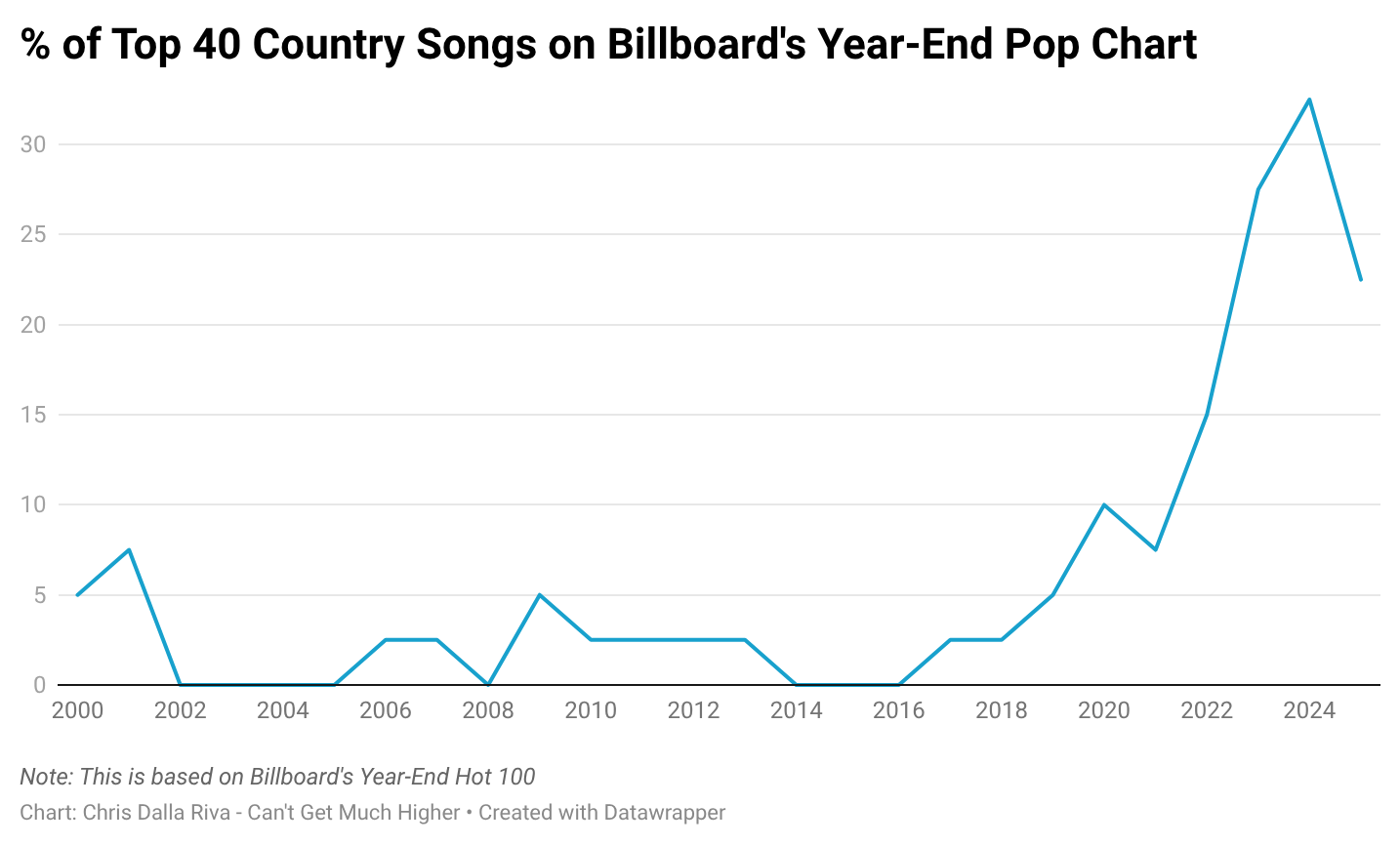
That means that country will likely recede into the background as it did for much of the 2000s, only the occasional hit reaching your general pop listener. And that’s okay. Because country always comes back. I’ll see you all in 2045.
A New One
"Livin’ In Shame" by Emily Nenni
2026 - Country
What I like most about Emily Nenni’s latest single “Livin’ In Shame” is the same thing that I love about many country stars of yore: directness. “Why am I living in shame?” she asks on the chorus, a refrain so short and to the point that Loretta Lynn might even approve.
If you read anything about Nenni online, it’s that people say you must see her live. I sadly have not had the pleasure yet—and her tour won’t be stopping in my area—but I plan to keep an eye on her and her classic country sound.
An Old One
"Fist City" by Loretta Lynn
1968 - Country
Speaking of Loretta Lynn, I figured I should recommend one of her songs. (I haven’t recommended one in three years!) Today, I will point you to “Fist City,” one of Lynn’s most famous songs. As with Emily Nenni’s aforementioned song, “Fist City” gets right to the point. Here’s how Nathan Rabin of The A.V. Club described the song in 2010:
Lynn grappled with the most important social issues facing our nation, but she did not hesitate to beat a bitch down when the situation called for it. In song and life, Lynn could be a fierce lioness when it came to fighting for her man. As chronicled in Coal Miner’s Daughter, she had her hands full trying to tame a hard-drinking womanizer who felt threatened by his wife’s incredible success. On “Fist City,” for example, Lynn deliciously taunts a silly little thing whose interest in Lynn’s husband is destined to earn her a one-way invitation to a beatdown.
Even with that description, Rabin may be underselling how to-the-point Lynn is on “Fist City.”
Shout out to the paid subscribers who allow this newsletter to exist. Along with getting access to our entire archive, subscribers unlock biweekly interviews with people driving the music industry, monthly round-ups of the most important stories in music, and priority when submitting questions for our mailbag. Consider becoming a paid subscriber today!
Recent Paid Subscriber Interviews: Pitchfork’s Editor-in-Chief • Vinyl Specialist • Spotify’s Former Data Guru • Hall of Fame Songwriter• John Legend Collaborator • Broadway Arranger • Indie Label Founder• Fender Exec
Recent Newsletters: Two-Hit Wonders • The Lostwave Story • Forgotten Artists • Album Cover Colors • Bad Ways to Die • A Frank Sinatra Mystery • Slop Problems
Want more from Chris Dalla Riva? Get a copy of his book Uncharted Territory: What Numbers Tell Us about the Biggest Hit Songs and Ourselves wherever books are sold.
There’s a much more interesting and parallel country path that comes out of the Hank Williams’ honky-tonk. The Bakersfield sound from the late fifties through the mid-sixties eschewed the syrupy strings and production of Nashville (and the late sixties and early 70’s saw the birth of Cosmic American Music and country rock with the Flying Burrito Brothers, Gram Parsons, and Poco). And that was followed by the Outlaw County movement of the 70’s (Waylon Jennings & Willie Nelson). And even the 80’s saw the establishment of such great and varied artists such as Steve Earle, Dwight Yoakam, and Lyle Lovett. Then the late 80’s and early 90’s saw the rise of cowpunk and alt-country, with the likes of Lone Justice, Uncle Tupelo, and the return of a clean and incredibly prolific Steve Earle. And this was followed by the larger genre of Americana, with the more recent likes of Colter Wall, Sturgill Simpson, Margot Price, Tyler Childers. I know a lot of these didn’t necessarily crossover into mainstream pop (with some exceptions), but it’s largely the much more interesting country music path to take. Would love to see you take a deep dive into this territory at some point.
I'm glad you included Elvis in the discussion of the countrypolitan sound. For me, he was the artist who made the best records with that sound. Polished yet gritty (there was a lot of force in some of them) and endlessly listenable.