



One of my favorite things about music is how we interact in so many places via so many different pieces of technology. I try to cover much of that in this newsletter. The CD. The radio. The iPod. The movies. The supermarket. This week, I want to take you to a very different locale, though: the piano bar.
Jesse Rifkin is a musician and writer who plays at a Washington, D.C., piano bar each week. Rifkin reached out to me a few months ago to tell me about all the weird things he’s learned by fielding piano requests for hundreds of hours each year. Though we worked on this piece together, Rifkin did the heavy lifting. I’ll let him take it away.
The Piano Bar Teaches Us What Music Lives and Dies
By Jesse Rifkin and Chris Dalla Riva
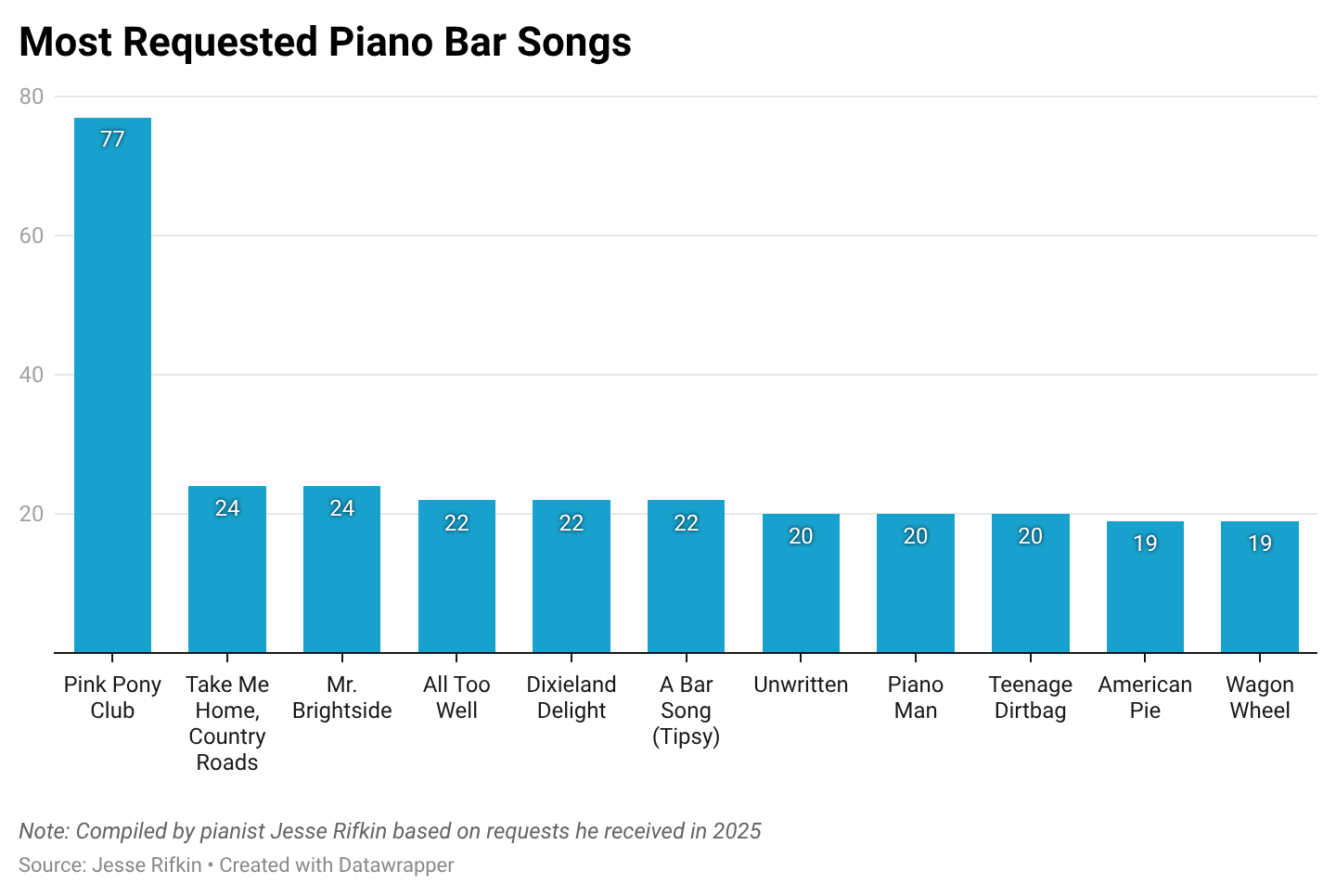
“Teenage Dirtbag,” the 2000s’ angsty, adolescent, pop-punk anthem, is now requested at piano bars as frequently as Billy Joel’s “Piano Man.” That’s according to our unprecedented dataset, which we unveil here.
One of us, Jesse Rifkin, is a Washington, D.C. piano bar performer, headlining Georgetown Piano Bar’s dueling pianos show most Friday and Saturday nights. The other one of us, Chris Dalla Riva, is a music journalist specializing in data analysis.
In December, Rifkin published a Washington Post opinion column about how “Pink Pony Club” by Chappell Roan recently dethroned “Piano Man” as the most requested song at his venue. After Rifkin’s column published, Dalla Riva said that he’d love to see a dataset of all Rifkin’s piano bar song requests.
In response, Rifkin compiled a spreadsheet of all 2,272 digital song requests made to him in 2025 via Venmo, PayPal, and CashApp. To our knowledge, this marks the first such dataset ever created.
Here were the top requested piano bar songs of 2025. You may be surprised. For example, among rock acts, there are zero songs by The Beatles, The Rolling Stones, Bruce Springsteen, or Elvis Presley. But there is one by Creed.

Naturally, this shocked us. Had Scott Stapp become John Lennon for Gen Z? We decided to dive deeper into this data to find out. Along the way, we learned a few things about what songs live on and which get forgotten.
“Pink Pony Club” Eats the World
We need to talk about the elephant in the room. Or, should we say, the pony.
Rifkin’s December Washington Post opinion column described how “Pink Pony Club” had recently become his most requested song. But even he couldn’t have imagined the margin. By our count, in 2025, it was requested more than three times as much as the next-closest song.
A piano bar colleague of his, who’s performed since the early 2000s, identified two prior songs as having achieved comparable request frequency to “Pink Pony Club” at their peaks: “Hey Ya!” by OutKast in 2003 and “Call Me Maybe” by Carly Rae Jepsen in 2012. Fast-forward to 2025, and neither even cracked our top 50.
The Piano Man is Still Doing Alright
Given the volume of requests for “Pink Pony Club,” you won’t be shocked that Chappell Roan was our most requested artist. That said, she was only pushed into the number one spot because her “Good Luck, Babe!” was also requested with great frequency.
After Roan, Billy Joel, Taylor Swift, and Elton John come up just behind her. There is then a steep drop off for ABBA, the fifth most requested artist. In fact, ABBA is requested half as frequently as Elton John, the fourth most requested artist.

Number six might be the most interesting artist on the list, though: The Beatles. Of course, The Beatles have a ton of well known songs. The legendary Liverpudlians have a record 20 Billboard Hot 100 number one hits.
People continue to request those hits today, but no individual song is overwhelmingly requested. In fact, their most requested song, “Hey Jude,” falls outside the top 50 most requested songs.
The 1960s is Dead at the Piano Bar
The piano bar where Rifkin performs is packed with young professionals. That, along with the popularity of “Pink Pony Club,” might make you think that they mostly request newer songs.
That’s not the case. In fact, most requests are over 20 years old. Some even go back very far. Both 1957’s “Great Balls of Fire” and 1964’s “Fly Me to the Moon” were two of the top 50 most requested in the last year.

Not all older decades are represented equally, though. Only two songs from the 1960s were requested. This is odd. Many consider the decade’s second half to be the greatest period in music history. These songs just don’t seem to translate to the piano bar.
Indeed, the only song released between 1965 and 1969 in our top 50 requests is Neil Diamond’s “Sweet Caroline.” Though a hitmaker, Diamond is not who we think of as a towering figure from that period, like Bob Dylan and Jimi Hendrix.
The 2010s is also relatively absent from the request list. This creates an odd effect. You have underrepresentation from a very old decade and a very recent decade. That said, both seem to have been filled with hit songs that don’t really translate well to piano.
Again, the 1960s—especially the second half—was dominated by guitar music. The 2010s was filled with electronic beats that also don’t lend themselves to interpretation on the piano. In addition, the 2010s just seem to lack the singalong-style songs that make up many piano bar requests.
The 2020s have not suffered the same fate as the 2010s, though. Again, this is a bit surprising. Many musical trends from the 2010s have remained in the 2020s. That said, the 2020s will likely suffer a similar fate to the 2010s as time goes on.
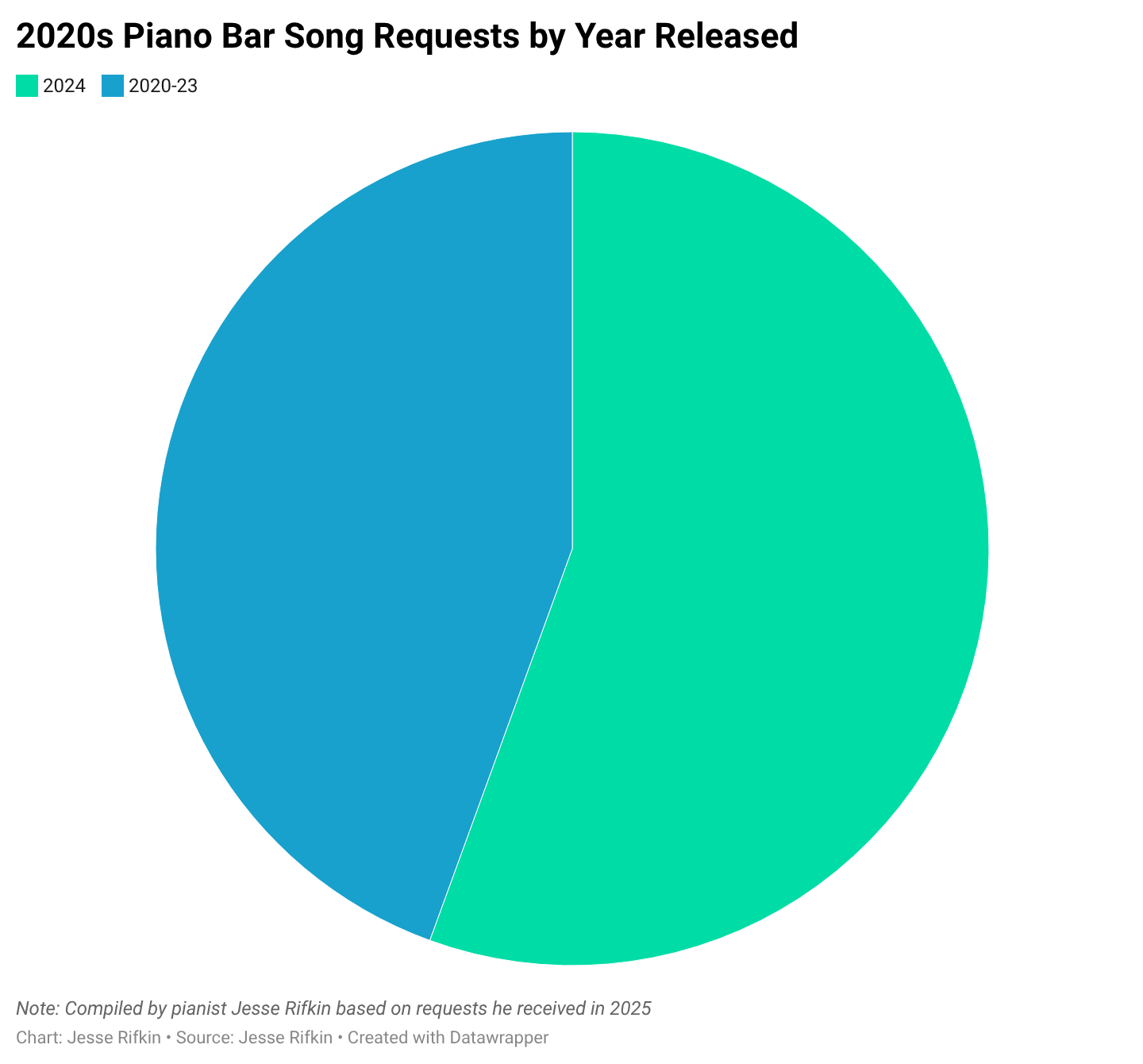
As you can see in the chart above, over 50% of requests for songs from the 2020s were from 2024. This seems to be a general pattern. Contemporary hits are always requested. But as time goes on, some of those hits are replaced by more enduring works.
So, Which Hits Will Live and Die?
Most people realize how music streaming broke down musical boundaries by geography and dismantled the old divide of major labels versus independent releases. What fewer people may realize is how music streaming also broke down temporal boundaries.
In this streaming-centric environment, all culture is concurrent in an unprecedented way. No longer are modern hit stations “separate” from oldies or classic rock stations. With the rise of “playlists” over airwaves and talk shows as the preeminent method of music discovery, older songs and artists can potentially rise with greater ease than ever before.
Take our “Pink Pony Club” as an example. Originally released to little attention in 2020, it debuted on the Billboard Hot 100 four years later in 2024. Ultimately charting for 68 weeks, its popularity was largely fueled by music from any time and place being equally accessible.
Other songs in our top 50 reveal how culture can rise due to other factors:
Politics: Toby Keith’s post-9/11 nationalistic country anthem “Courtesy of the Red, White, and Blue” includes the lyric: “We’ll put a boot in your ass, it’s the American way.” After two decades when the song wasn’t requested much, it’s truly exploded since 2024, especially since Donald Trump adopted it as one of his signature songs at campaign rallies.
Covers: Tracy Chapman’s 1988 “Fast Car,” an acoustic guitar ode to fresh starts in life, only truly exploded as a song request after country star Luke Combs’ 2023 cover.
Re-releases: Taylor Swift’s 2012 breakup ballad “All Too Well” was considered among her finest songwriting, despite having only reached #80 as an album track. It didn’t top the chart until she released an updated version of the song nine years later.
Media: 1970s one-hit-wonder Looking Glass’s “Brandy (You’re a Fine Girl),” an upbeat ode to unrequited love, surged only after its prominent feature in 2017’s Marvel blockbuster Guardians of the Galaxy Vol. 2.
Reassessments: Creed’s 2000 power anthem “Higher” was critically maligned at the time of its release. In the 2020s, though, Creed has experienced an unforeseen Gen Z renaissance.
Yet just as culture can rise, it can also fall. A few years ago, piano bar patrons often requested songs by Lizzo. After several of her backup dancers publicly accused her of creating a hostile work environment and berating them backstage, her “relatable” reputation vanished. Bar patrons, especially women, stopped requesting her songs.
These dynamics mean that the canon of piano bar songs—and popular songs, for that matter—constantly changes. Small songs from one year might go on to become classics of the present.
Will a small song from the present similarly become a classic of the future? Keep swinging by Georgetown Piano Bar, for years or decades to come. And let’s find out.
This piece was written in collaboration with Jesse Rifkin, a musician and writer. If you’d like to hear more from Rifkin, check out his newsletter Sunday Magazine or go see him perform at the Georgetown Piano Bar in Washington, D.C.
As a DC & piano bar enthusiast... this article brought me great joy! As a promoter, I found the stats super interesting... and the next time I'm in DC, I'm going to stop by for a cocktail & a tune or several. Cheers!
Is there a Spotify playlist of this list available?