


Welcome back to Can’t Get Much Higher, where music and data meet. Before we get into this week’s topic, here are some recent pieces that people have enjoyed:
If you enjoyed any of those, consider ordering a copy of my book Uncharted Territory: What Numbers Tell Us about the Biggest Hit Songs and Ourselves. It’s a data-driven history of popular music covering the period from 1958 to 2025. Now, onto a big dataset about chords.
I Analyzed the Chord Progressions of 680k Songs
By Chris Dalla Riva
Chordonomicon. I couldn’t get the word out of my head. Every syllable was just as beautiful as the last. Try saying it. Kord-oh-nom-i-con. It sounds like a mystical word. And, for me, it is. But it’s a term that didn’t exist last year.
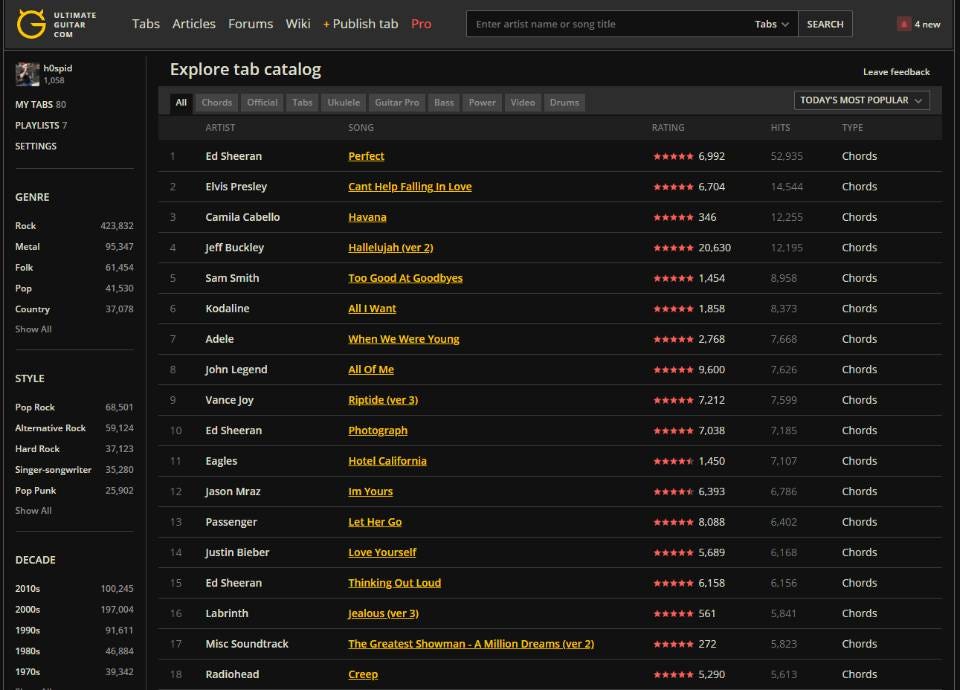
“Chordonomicon” was coined by 5 researches last October when they needed a name for a new project that they’d just completed. This project pulled together chord progressions and genres for nearly 680,000 songs from the popular music learning website Ultimate-Guitar. I knew I had to do something with the data. But what?
Typically, when I write a data-driven piece for this newsletter, my approach is somewhat scientific. First, I have a hypothesis, like “there has been an increase in music biopics over the last few years.” Then I find some data to test that hypothesis. Whether I’m correct or not, I publish the results. For example, when I looked at music biopics, I found that on an absolute basis there was a dramatic increase over the last few years, but on a relative basis, the peak was in the 1940s.
I didn’t really have a hypothesis to test with the Chordonomicon dataset, though. I just wanted to explore what was in there. There had to be something interesting among 680,000 chord progressions. And there was. But, first, we should start with a simple question: What’s a chord?
If you’re looking for in depth discussions on music theory, I’m not your guy. (You should probably turn to someone like Ethan Hein and his newsletter Ethan teaches you music.) But for this case, I think some basic definitions will help. A “note” is a single pitch. When you hit one key on the piano, for example, you are playing a note. An “interval” is a combination of two notes. A “chord” is a combination of three or more unique notes (e.g., a C major chord is comprised of the notes C, E, and G).

Above you can see a breakdown of the top 20 most common chords across the nearly 52 million chords notated in the Chordonomicon dataset. If you’ve ever played a guitar or piano, you won’t be surprised by the fact that G major and C major are at the top, accounting for 24% of all chords. These are some of the first chords you learn on those instruments. What’s interesting is that chord choices differ when you look across genre.