


My friend Ken and I decided to listen to an album every day this year. Each week is themed. At the end of each week, we rank what we listened to. To be clear, we aren’t ranking every album that fits the theme. We are only ranking what we chose to listen to during the last seven days.
This week’s theme is “1977,” meaning albums released in 1977. Why 1977? Because Ken said whenever he hears an old album that he likes, there’s a 99% that it was released in 1977. We decided to put his observation to test.
#7 Love You by The Beach Boys (April 11)
Beach Boys aficionado Ross Barkan first told me about The Beach Boys’ Love You a year or so ago. When I saw it was released in 1977, I immediately threw it on my short list. And I was excited when I picked it. I’d heard it variously described as early new wave and proto-punk. The Beach Boys making a punk record? Sign me up. I could not have been more disappointed.
Musically, there are some things to like on Love You. “Good Time” is harmonically rich. “Honkin' Down the Highway” sounds like it could please a 2010s hipster. And “The Night Was So Young” has that classic Beach Boys’ sense of longing so perfectly captured on earlier classics, like “Wouldn’t It Be Nice” and “Let’s Go Away for a While.” None of that matters, though. The lyrics on this album stink.
I never thought an album could be ruined by lyrics, especially since I like many a silly song. But from the nonsensical “Ding Dang” to the celestial ode “Solar System,” I felt like I was listening to a children’s album. Looking back, it was almost a breath of fresh air to hear a song about late night television legend Johnny Carson. I now understand why Brian Wilson tapped outside lyricists on earlier albums.
#6 Death of a Ladies' Man by Leonard Cohen (November 13)
As with any Leonard Cohen album, the lyrics on Death of Ladies' Man are as vivid as you’ll find in the popular music canon (e.g., “As the mist leaves no scar / On the dark green hill / So my body leaves no scar / On you and never will”). This record stands out for two reasons, though.
First, those lyrics are pretty horny. No, Cohen’s music is not sexless (e.g., “Chelsea Hotel #2”). But from propositioned orgies to listening to lovers through hotel walls, he seems to have ratcheted things up here.
Second, the production is a bit strange. The snare echoes on “Iodine” sound like it’s 1986. Of course, it’s not 1986. And the disco-inspired beat on “Don’t Go Home with Your Hard-On” makes sure you know that. But further confusion arrives with the country pastiche of “Fingerprints.” These weird production decisions are mostly tied to one man: Phil Spector.
Spector, as noted in my previous review of The Ronettes sole record, was both a genius and lunatic. More of the latter than the former was on display in the making of Death of a Ladies' Man. Cohen described the studio as packed with guns, liquor, and heavily-armed bodyguards. When Spector absconded with the tapes before Cohen could complete his vocals, the singer-songwriter was caught between a rock and hard place. As Cohen noted in a 2010 biography, “I had the option of hiring my own private army and fighting it out with him on Sunset Boulevard or letting it go … I let it go.”
So, no this isn’t a perfect record. But it does have some nice moments. “Memories” is a particular highlight. By the end—and I mean this as a compliment—Cohen sounds like he’s trying to capture the intensity of the best Neil Diamond vocal.
#5 Aja by Steely Dan (September 23)
The biggest disagreement that Ken and I had this week was over Aja. Despite not being a huge Steely Dan fan, I enjoyed the duo’s palatable combination of pop, rock, and jazz. Ken found most of the record “masturbatory without being interesting,” though.
I could see why he felt like that. The back-to-back “Aja” and “Deacon Blues” could be a little tedious with their seven-minute runtimes. The crisp tones on “Black Cow” and “I Got the News” were arguably staid to the point of lifeless.
But I could only see those things. I didn’t actually believe them. As noted, Aja toes the line between many styles that were bubbling on the charts in 1977. Steely Dan’s ability to pull enjoyable compositions from those styles is worth celebrating, especially when they can do it to a danceable rhythm, like on “Peg.”
#4 Bad Reputation by Thin Lizzy (September 2)
I often make the case that Thin Lizzy and Faces are the two most underrated bands in the classic rock canon. We can talk Faces another day, but Thin Lizzy’s Bad Reputation gets at why I feel this way.
The title track’s searing riff and harmonized guitar solos toe but never cross the line where they’d become too self-important for my tastes. Phil Lynott’s vocals on tracks like “Southbound” and “Killer Without a Cause” are also the perfect balance of gruff and melodious.
Thin Lizzy also stands apart because they had some pop sensibilities. “Dancing in the Moonlight” is a great example of that. Its subtle storytelling and memorable chorus illustrates the duality of the group. They could rock. But they could also write songs strong enough that your mom might be caught singing along.
#3 Lust for Life by Iggy Pop (August 29)
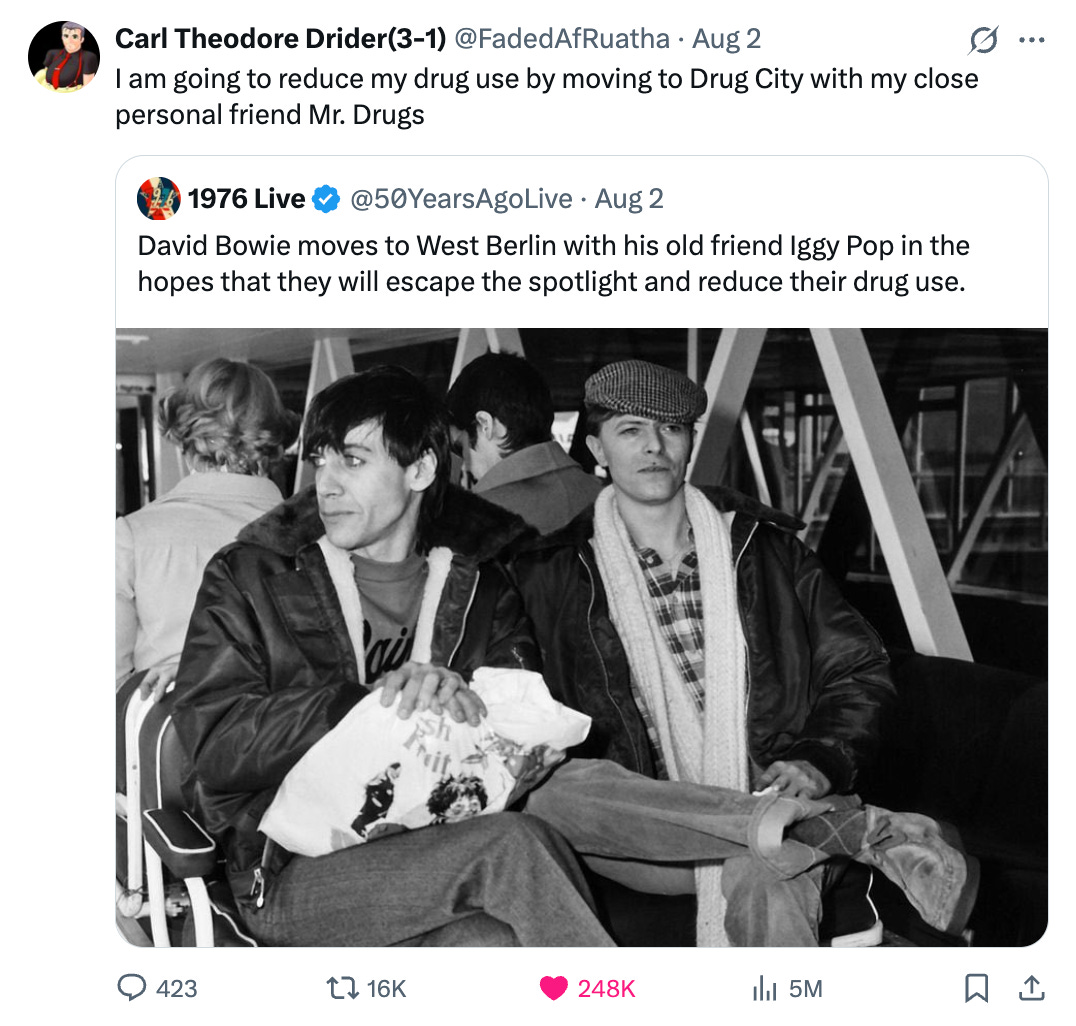
Given that I’ve never been that into Iggy Pop or The Stooges, I was surprised how much I enjoyed Lust for Life. The title track and “The Passenger” had simple yet evocative guitar work. “Success” and “Some Weird Sin” even had some compelling melodies. What was going on? Did I have Iggy Pop all wrong? Maybe. But my taste for this record probably had more to do with David Bowie.
David Bowie and Iggy Pop had some fruitful collaborations throughout the 1970s while living in Europe. Lust for Life was not only produced by Bowie, but it saw him write the music for six of the nine tracks. Given how much I enjoyed Bowie’s "Heroes" (see below), it’s no shock that I also enjoyed an album he produced just a few months before.
So, do I like Iggy Pop? I guess I’m still not sure. I’ll have to dive deeper into his discography to find out. But I do like David Bowie. And like what he did with Iggy Pop on Lust for Life. I’m also thankful for this collaboration because it inspired maybe the greatest tweet in internet history.
#2 Little Criminals by Randy Newman (September 23)
Little Criminals is surely overshadowed by “Short People,” Randy Newman’s satirical smash hit that left many listeners angry, confused, or in stitches. This reaction is standard for pre-Pixar Newman. His sardonic wit is so unique in the universe of popular music that most people don’t know what to make of it.
It would be nice if most people could get past “Short People,” though. Frankly, it doesn’t even fits this record that well. It’s much peppier than everything outside of the title track. The rest of album journeys between gut-wrenching dirges (e.g., “Texas Girl at the Funeral of Her Father”), strange scenarios (e.g., “Sigmund Freud’s Impersonation of Albert Einstein in America”), and vivid social criticism (e.g., “Baltimore”). I like “Short People,” but don’t let it distract you from what else is going on across Little Criminals.
#1 “Heroes” by David Bowie (October 14)
Structurally, "Heroes" is the most unique record we heard this week. The first half is grade-A rock music. You’ve got big riffs on songs like “Joe the Lion.” You’ve got propulsive rhythms on stuff like “Beauty and the Beast.” And, of course, you’ve got inspired vocals like on the title track.
The second half of this record lives in a different universe, though. It’s all instrumentals. While there is diversity among those instrumentals (e.g., “V-2 Schneider” rocks, “Sense of Doubt” does not), I would generally describe them as atmospheric.
I like that "Heroes" explores these two worlds. And I like that they are so clearly divided. It gives the record some Jekyll-and-Hyde mystery. The only downside is that the album’s closer, “The Secret Life of Arabia,” eschews that structure. It’s a decidedly non-instrumental piece that would have fit better on Side One. Alas, I’ll forgive you, David Bowie. The rest of your record is too good.
Shout out to the paid subscribers who allow this newsletter to exist. Along with getting access to our entire archive, subscribers unlock biweekly interviews with people driving the music industry, monthly round-ups of the most important stories in music, and priority when submitting questions for our mailbag. Consider becoming a paid subscriber today!
Recent Paid Subscriber Interviews: Pitchfork’s Editor-in-Chief • Vinyl Specialist • Spotify’s Former Data Guru • Hall of Fame Songwriter• John Legend Collaborator • Broadway Arranger • Indie Label Founder• Fender Exec
Recent Album a Day Themes: The Song is the Album is the Artist • Murdered Musicians • Random Rolling Stone • American Idol Disappointments • Butt Rock • Q but No Queens • 1990s Hip-Hop • Trading Favorites • Concept Records • Peaked at 200 • Alliterative Artists • Hip-Hop Groups • Supergroups
Want more from Chris Dalla Riva? Get a copy of his book Uncharted Territory: What Numbers Tell Us about the Biggest Hit Songs and Ourselves wherever books are sold.
Did you ever hear the beer commercial that Steely Dan recorded for Schlitz*? It's from '72 or '73, so a few years before Aja. https://youtu.be/JL0mH76XJ3A?si=V-ecedYo1lVVtbJL
*RIP