


Welcome back to Can’t Get Much Higher, the internet’s favorite place for music and data. If you enjoy this newsletter, check out my book Uncharted Territory: What Numbers Tell Us about the Biggest Hit Songs and Ourselves. It’s a data-driven history of popular music that I wrote as I spent years listening to every number one hit in history.
It’s Not All About You
By Chris Dalla Riva
I’ve been doing a lot of reading about Edgar Allan Poe and Ludwig van Beethoven. It’s for a larger project that I’m considering. But the most interesting thing I’ve come across in my research has nothing to do with my (secret) motivating question. It’s how we talk about these two 19th century giants.
You cannot read the alcohol-fueled tales of “The Black Cat” and “The Cask of Amontillado” without hearing about Poe’s struggles with drink. Likewise, no analysis of the sickly women in “Ligeia” and “Berenice” would be complete without knowing that Poe’s young wife died of tuberculosis.
Learning of Beethoven’s work is much the same. The intensity of his Third Symphony—often denoted the Eroica—is always paired with a discussion of the Heiligenstadt Testament, a despairing letter Beethoven wrote about his struggles with deafness just before completing the composition. His “Für Elise”—maybe the most famous solo piano piece in history—also holds some mystery because scholars debate who inspired it.
Although these details are interesting, my general interest is not tied to their specifics. My interest is tied to the fact that the respective artistic outputs of Edgar Allan Poe and Ludwig van Beethoven are always discussed in relation to their lives. Something happened to the American writer or the German composer, and art flowed from each of them.
On the surface, I would understand if you didn’t find this that interesting. It’s the standard way we talk about art. In a recent review of an expanded Taylor Swift album, for example, Pitchfork noted how the song “Cleveland!” is a “love song about Swift’s new husband Travis Kelce that is wholly fixated on [her] own antagonists.” Examples outside of music are just as easy to come by:
From Wheatfield with Crows to The Starry Night, most things Van Gogh painted are discussed in relation to his deteriorating mental health.
Martin Scorsese’s filmography is often interpreted through his deep, sometimes strained relationship with Catholicism.
No conversation about F. Scott Fitzgerald’s fiction is finished until you discuss his tumultuous marriage to Zelda.
Despite the ubiquity of this interpretive approach, it is historically strange. Take The Odyssey as an example. When you read about the Greek epic, you will seldom find someone thinking about how it reflects Homer’s life. How it reflects some universal truth? Sure. How it reflects Greek society? That works too. Homer—should he even exist—sits in the background.
So, when and why did this shift happen? And will we ever get back to a world where we can understand a song by Drake without needing a working knowledge of his life story? To understand, we have to go back to the time that Beethoven and Poe were doing their most famous work.
The Mirror and the Lamp
When William Wordsworth and Samuel Taylor Coleridge published the second edition of their Lyrical Ballads in 1800, Wordsworth included a brief preface that would come to reshape art:
I have said that poetry is the spontaneous overflow of powerful feelings: it takes its origin from emotion recollected in tranquillity: the emotion is contemplated till, by a species of reaction, the tranquillity gradually disappears, and an emotion, kindred to that which was before the subject of contemplation, is gradually produced, and does itself actually exist in the mind. In this mood successful composition generally begins, and in a mood similar to this it is carried on; but the emotion, of whatever kind, and in whatever degree, from various causes, is qualified by various pleasures, so that in describing any passions whatsoever, which are voluntarily described, the mind will, upon the whole, be in a state of enjoyment.
The key part of this passage is Wordsworth describing poetry as “the spontaneous overflow of powerful feelings.” When you combine that idea with his notion mentioned elsewhere in the preface that poetry should capture “common life” in “near to the real language of men,” you arrive at a novel way to understand art.
This is romanticism. And it has cast a long shadow. It is the environment that Poe and Beethoven came of age in. And it is the lens through which we continue to understand art.
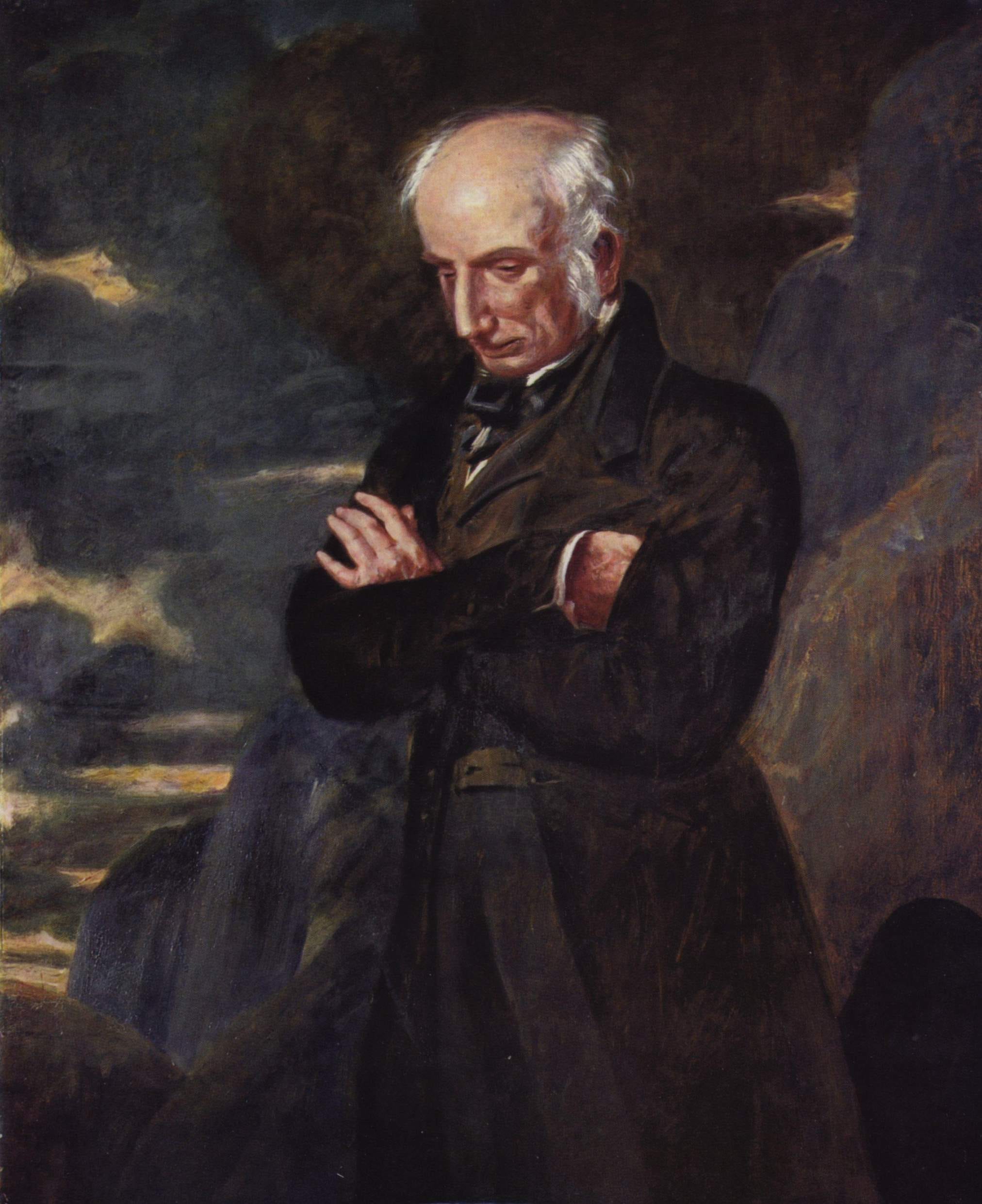
In his 1953 book The Mirror and the Lamp, influential literary critic M. H. Abrams tried to understand this shift in perspective using his titular metaphor. “The mirror” is the old way of thinking about art. The author is reflecting the real world. “The lamp” is the romantic world birthed in the 1800s and still living today. The author is spilling their soul to light the way.
Throughout his work, Abrams discusses four major ways we have come to interpret art:
Mimetic: Analyzes art by how it reflects the world (e.g., Chuck D. of Public Enemy arguing, “Rap music is the invisible TV station that black America never had.”)
Pragmatic: Analyzes art by how it impacts the audience (e.g., Nile Rodgers of Chic noting, “If people aren’t dancing, we’re not doing our job right.”)
Expressive: Analyzes art by how it reflects the artist (e.g., Joni Mitchell claiming, “The Blue album, there’s hardly a dishonest note in the vocals … I felt like a cellophane wrapper on a pack of cigarettes. I felt like I had absolutely no secrets from the world, and I couldn’t pretend, in my life, to be strong or to be happy.”)
Objective: Analyzes art by what it reflects internally independent of the artist’s intent (e.g., any artist who refuses to explain their work and let it stand on its own)
To be clear, these are critical perspectives that you can use to understand a work of art. And I would argue that our current discourse largely lives between the Pragmatic and Expressive. But these ideas have deeply shifted how artists think about their own work too. And sometimes that shift can cause problems.
When the Expressive Goes Awry
In 1977, Randy Newman found himself in hot water. His latest hit, which had climbed all the way to number two on the charts, featured a refrain about how “Short people got no reason to live.” The hateful song was not only pulled from rotation at some radio stations but also resulted in death threats for the singer-songwriter.
There was one problem, though. Randy Newman didn’t actually hate people who failed to meet a specific height.
Like some of his other compositions, “Short People” is a satire written from the perspective of a bigot. The fact that people could take it at face value illustrates both its success as a musical work and the ridiculousness of prejudice. But it’s also an example of how deeply entrenched the lamp, or the expressive lens has become. As Newman noted years later, “I had no idea … that anyone could believe that anyone was as crazy as that character.”
Of course, satire can be hard to spot, but the assumption that a work of must art reflects an artist’s actual beliefs has become pervasive. And that pervasiveness is dangerous.
Over the last decade, I’ve seen more people online criticize various forms of art for portraying flawed characters or endorsing troubling views. For example, in a 2021 episode of Netflix’s Ginny & Georgia, the titular Ginny yells at her mom, “What do you care? You go through men faster than Taylor Swift.”
Not only did Swift’s fanbase come to condemn the show, but Swift herself did too. On Twitter, she wrote, “Hey Ginny & Georgia, 2010 called and it wants its lazy, deeply sexist joke back. How about we stop degrading hard working women by defining this horse shit as FuNnY.”


Can the writers of a television show make a joke in poor taste? Sure. Can their words also reflect their inner sexism? Of course. But not everything has to reflect the artist’s inner self. It can reflect a character they have created and the world they live in.
Similar controversies bubble up constantly. A key reason is because we are living in the shadow of romanticism, looking at all art through the expressive lens. And it’s a problem. Not only is it incorrect, but it discourages artists from exploring certain material for fear of backlash.
The lamp has led to much great art and criticism over the last two centuries. But we need to remember that there are other perspectives and other ways to be creative. Not every piece of art reflects the artist nor should it.
A New One
"Jock My Style" by ggwendolyn
2026 - Indie Pop
The fun thing when I write about new music is that I usually know nothing about the artist. I can’t speculate on how their personal experience influenced their work. I can just listen to their music and tell you what I like.
ggwendolyn, a name that looks like a typo, has certainly taken cues from some of contemporary pop stars. The vocal tone across her catalog generally is reminiscent of Sabrina Carpenter. The talk-singing on “Jock My Style” specifically has hints of Olivia Rodrigo. But ggwendolyn also has a swaggering style that is uniquely her own.
An Old One
“Murders in the Rue Morgue” by Iron Maiden
1981 - Metal
As I’ve gotten deeper into Edgar Allan Poe’s work over the last few months, I’ve been surprised to learn that he’s been quite impactful on the world of music. Classical composers Claude Debussy, Sergei Rachmaninoff, and Philip Glass all wrote compositions based on his work. Stevie Nicks adapted his “Annabel Lee.” Lou Reed recounted many of Poe’s works on his 2033 concept album The Raven. Iron Maiden, too, found inspiration in Poe’s grotesque and arabesque.
The heavy metal legends never shied away from a story song. On “Alexander the Great” they recounted the life of the ancient leader. “The Trooper,” inspired by Tennyson’s “The Charge of the Light Brigade,” tells a tale from the Crimean War. Their propulsive “Murders in the Rue Morgue” does much the same but focuses on Poe’s influential work of the same name where he created the modern detective story.
Shout out to the paid subscribers who allow this newsletter to exist. Along with getting access to our entire archive, subscribers unlock biweekly interviews with people driving the music industry, monthly round-ups of the most important stories in music, and priority when submitting questions for our mailbag. Consider becoming a paid subscriber today!
Recent Paid Subscriber Interviews: Pitchfork’s Editor-in-Chief • Vinyl Specialist • Spotify’s Former Data Guru • Hall of Fame Songwriter• John Legend Collaborator • Broadway Arranger • Indie Label Founder• Fender Exec
Recent Newsletters: Two-Hit Wonders • The Lostwave Story • Forgotten Artists • Album Cover Colors • Bad Ways to Die • A Frank Sinatra Mystery • Slop Problems
Want more from Chris Dalla Riva? Get a copy of his book Uncharted Territory: What Numbers Tell Us about the Biggest Hit Songs and Ourselves wherever books are sold.
Chris, thanks!
I absolutely love this post, just love it. Your ability to think deeply has always been something noticeable about you, but as you continue to live and grow, you get more polished and proficient at the task of expressing yourself all the time. You’ve provided much food for thought today.
You said,
“The fun thing when I write about new music is that I usually know nothing about the artist. I can’t speculate on how their personal experience influenced their work. I can just listen to their music and tell you what I like.”
Despite the fact that there’s a tremendous amount of people who love to know all the details about a singer/songwriter’s life, I think people will still tend to view their work as your statements I have just quoted reflect. I often think of releasing any art as similar to the act of pulling on the string of a bow and aiming the arrow; I can take an extraordinary amount of time and effort to be a certain as I can that the arrow will hit the target, but once I have released the string, it’s going to go where it’s going to go. It might hit a branch I didn’t consider, wind might deflect the arrow, etc.
I find it as largely the same with art in that once you release the string so to speak, it is up to the person receiving it to interpret it, despite however much they may or may not know about you for your personal life.
(One particularly cringeworthy response was when I heard back from a woman who had heard one of my instrumentals, and she was quite excited about it, told me she loved it, gushed on about how it reminded her “of a Hallmark made for women movie, where the boy and the girl are reunited at last.” Listening to her say that made me feel like throwing up in my mouth.
I heard an interview with Sting a few months ago, where he referred to this very same phenomena. The interviewer described how some people thought Roxanne was a romantic love song while other people thought it was about stalking and in general a very ugly song.
He was nonchalant and took it stride, noting that (I paraphrase) people are going to respond to it how they will and that he finds it basically interesting. (I confess I was not finding that woman’s comment about my instrumental composition reminding her of a Hallmark made for women movie as interesting.)
Thank you for another superlative post, and I look forward to more of the same. Of course your pieces which center around data driven trends, and observations in music are always interesting but the ones I really look forward to are the ones where you share your personal insight and thoughts about a given subject. You have a deep mind and are equally well at expressing what is in it.