


Welcome back to Can’t Get Much Higher, the internet’s favorite place for music and data. If you enjoy this newsletter, check out my book Uncharted Territory: What Numbers Tell Us about the Biggest Hit Songs and Ourselves. It’s a data-driven history of popular music that I wrote as I spent years listening to every number one hit in history. Now, let’s talk about artists who don’t seem to understand their work.
Some Artists are Bad at Picking Singles
By Chris Dalla Riva
Back in January, Harry Styles released “Aperture,” the lead single from his fourth studio album, Kiss All the Time. Disco, Occasionally. Despite charting well in its debut week around the globe, I found it to be a strange choice. The slow burning, LCD Soundsystem-cosplay lacked the memorable hooks that have defined some of Styles other big hits.
This single choice only became more confusing when the full record came out. “Aperture” was outdone by many other tracks on the album, especially “American Girls.” In fact, I couldn’t imagine listening to this record and not thinking that “American Girls” should be the lead single. Many fans seem to agree. It’s looking like “American Girls” will soon outstrip “Aperture” in streams despite its multi-month head start.
I wouldn’t say that Harry Styles is bad at picking singles. The respective lead singles from Harry’s House (i.e., “As It Was”) and his self-titled debut (i.e., “Sign of the Times”) remain the most streamed songs off those records. But he missed with the lead single on Kiss All the Time. Disco, Occasionally. Some artists miss a lot more frequently, though.
Wait, What’s the Best Song on My Album?
Historically, the purpose of a lead single was to generate buzz for a forthcoming album. Albums were usually more lucrative than singles, so if you could get people hyped about a song, you’d likely reap a large financial reward. By this logic, you’d probably want to put out your best single first.
That’s not to say every artist follows this chain of thought. If you’re a big enough star, you can likely get away with bending the rules. The lead single from Michael Jackson’s Thriller, for example, was “The Girl Is Mine,” a cheesy ballad that I’d make the case is the worst song on the record. Similarly, Jackson kicked off the Bad album cycle with “I Just Can’t Stop Loving You,” another ballad far less memorable than classics like “The Way You Make Me Feel,” “Man in the Mirror,” and “Dirty Diana.”
Most artists aren’t Michael Jackson, though. Most artists are trying to put their best foot forward with their lead single. (I’m sure Jackson was too, but you get the point.) With some clever data manipulation, we can see which artists are the most and least skilled at picking their lead singles.
This process took a few steps. First, I grabbed the 100 best-selling artists of all-time according to the RIAA. Then I used Wikipedia to look up the studio album discography for each of those artists and the singles from each of those studio albums. That left me with a database of 1,600 albums and 5,200 singles. Finally, I used the streaming service Deezer and the listening tracking service Last.fm to source the current popularity of each single and album track. Using this data, I could see if the lead single from a record was the current most popular song.
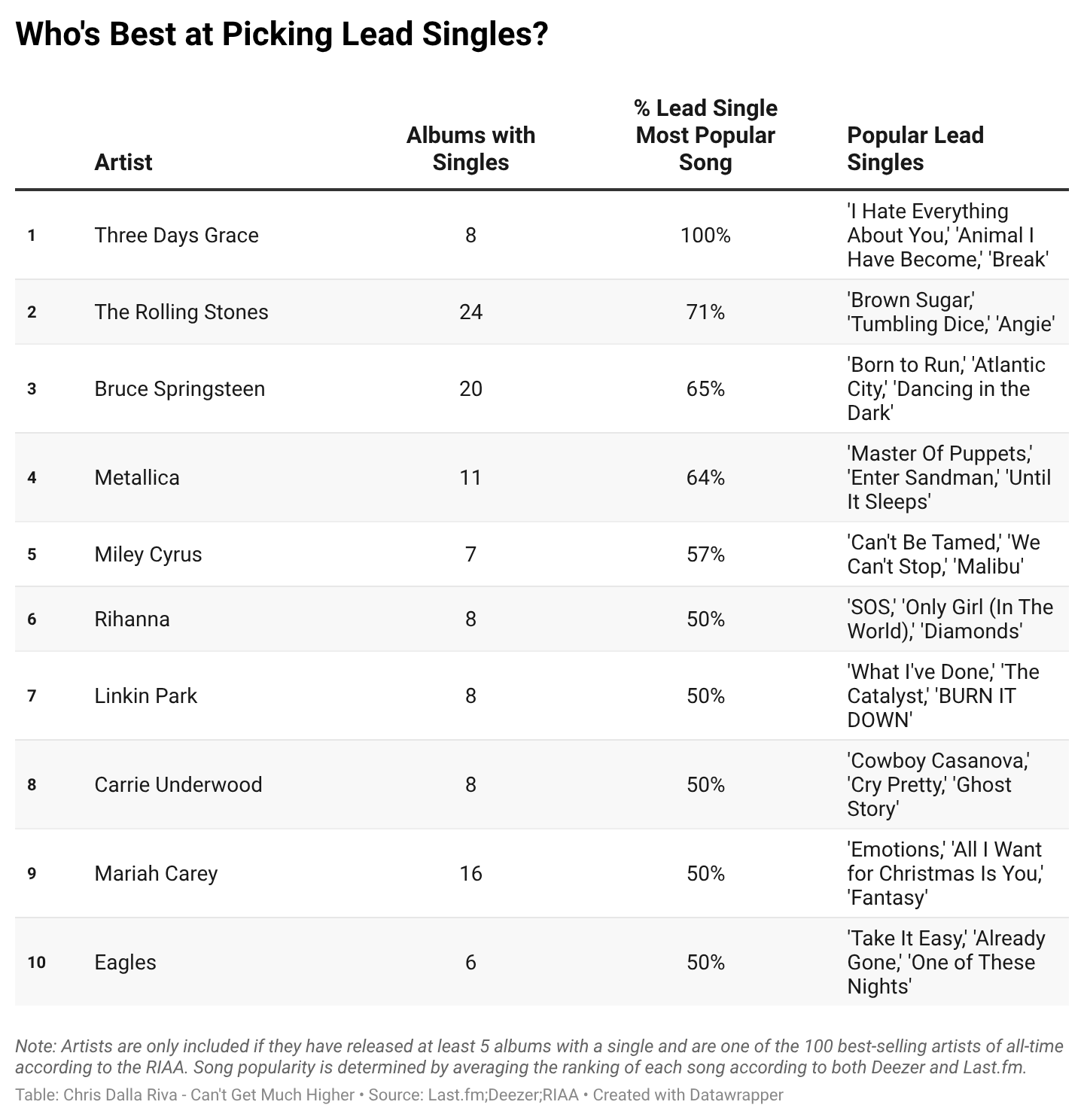
Hard rockers Three Days Grace know how to pick a single. On each of their studio albums, the lead single remains the most popular song. Nobody else with at least 5 albums is perfect, but others do quite well. Rockers, including The Rolling Stones, Bruce Springsteen, and Metallica, have hit rates above 60%. Pop stars, including Rihanna, Miley Cyrus, and Mariah Carey, cross the 50% threshold.
What may be more interesting is artists whose lead singles don’t turn out to be the most popular song on the album that often. For example, zero of the lead singles from each of Outkast’s six studio albums is that respective albums most popular track. What about “Hey Ya!” you may ask? That was (somehow) the second single from Speakerboxxx/The Love Below.
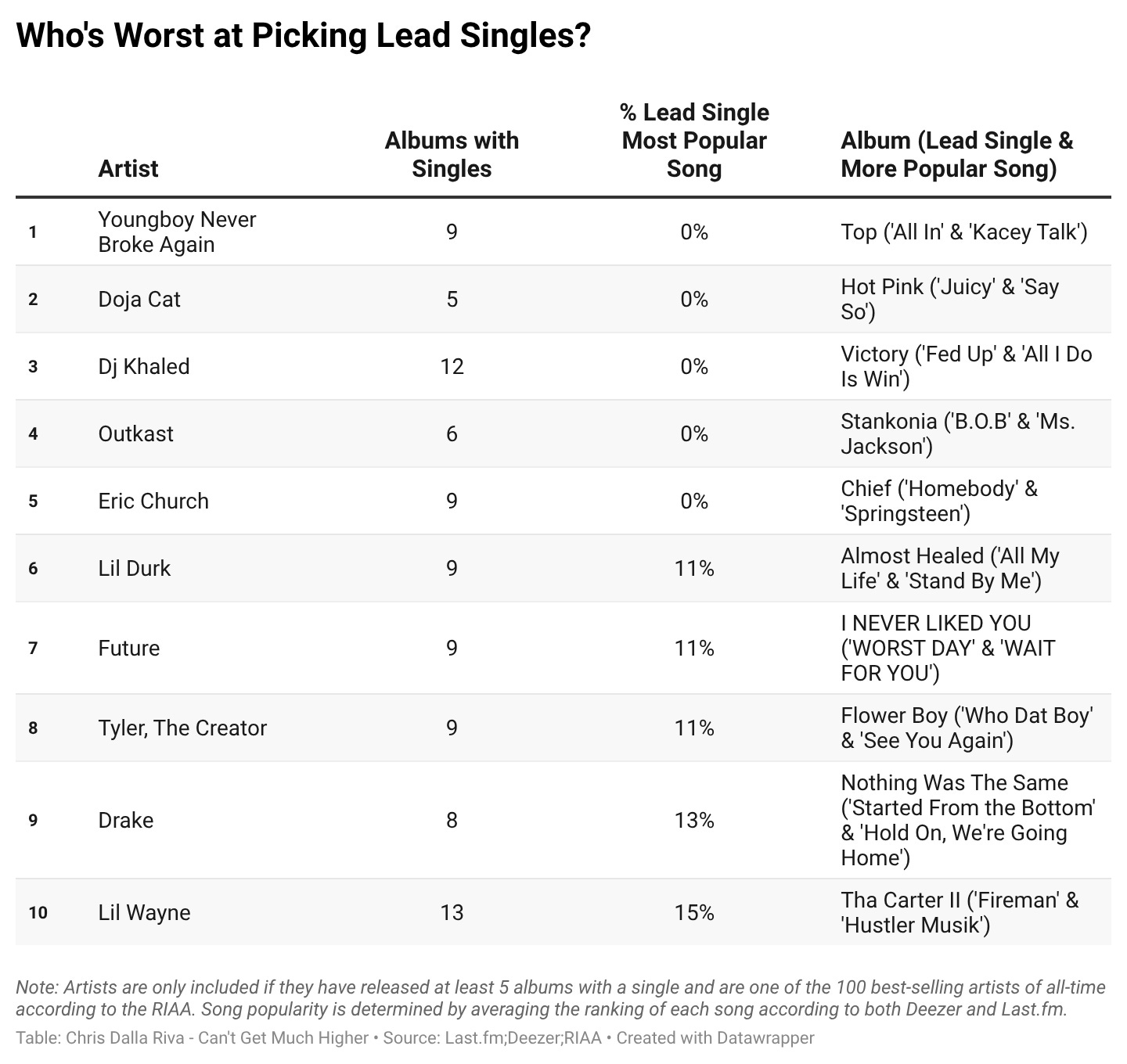
Drake, maybe the biggest star of the 2010s, also missed with his lead singles quite often. His album Scorpion is the outlier. The lead single “God’s Plan” is the only time the lead single from one of his records has remained the most popular.
That’s not to say that he is picking lead singles that end up being unpopular. The lead single from Views was “Hotline Bling,” an absolutely massive song. Drake just had the fortunate problem that “One Dance,” the second single, was even bigger. Take Care has a similar “issue.” While the lead single “Marvins Room” was popular, it was dwarfed by the follow up, “Headlines.”
Some artists do miss big with their singles, though. Arguably the worst miss in recent memory is “ME!”, the lead single from Taylor Swift’s 2019 album Lover. “ME!” is currently the 11th most popular song on the album. The song was not only absent from Swift’s massive Era’s Tour, but shortly after the release, Swift edited the recording to remove the cringy lyric “Hey kids! Spelling is fun!”
Why Don’t You Just Release the Good Songs?
It’s 1981. You’re in the band Journey. After a decade in the trenches, you’re finally starting to score some hits. You think your next album Escape is going to bring you to the next level. The album’s first track, “Don’t Stop Believin',” might be your best effort yet. Naturally, you choose it as the lead single, right? Nope. The lead single from Escape becomes “Who’s Crying Now.”
When you hear a story like this, it almost feels inexplicable. How could Journey not realize that “Don’t Stop Believin'” would be so big that it would transcend the group? This isn’t unique to Journey, though. Sometimes you just don’t know what people will connect with over time. Sometimes listeners don’t know either.
Journey released four singles for Escape: “Who’s Crying Now,” “Don’t Stop Believin’,” “Open Arms,” and “Still They Ride.” While “Don’t Stop Believin'” has outsold those other singles many times over, “Who’s Crying Now” and “Open Arms” actually charted higher on the Billboard Hot 100 upon release. “Don’t Stop Believin'” peaked at number nine. “Who’s Crying Now” got to number four and “Open Arms” made it all the way to number two.
While it’s funny to rag on Taylor Swift for picking “ME!” as a lead single when “Cruel Summer” was sitting right there or Shania Twain for going with “Love Gets Me Every Time” when “You’re Still the One” and “Man! I Feel Like a Woman!” were waiting in the wings, history suggests that the art of lead single selection is harder than it appears. No matter how it sounds in the studio, once a song is out in the wild, you never know how people will react.
Unless you’re Three Days Grace. Then you should go with your gut.
A New One
"Chance to Bleed" by Kurt Vile
2026 - Indie Rock
In the world of lead singles, I’m really digging “Chance to Bleed,” the lead single from Kurt Vile’s forthcoming record Philadelphia’s Been Good to Me. What I find fascinating about this ode to “old time, lo-fi, DIY, rock ‘n’ roll nights” is that it’s incredibly redundant. And while redundancy is often associated with boredom, Vile manages to make it hypnotic, wading deeper and deeper into the groove as the track rolls on. By the end, you feel like you’re at least four PBRs deep.
An Old One
"Summer, Highland Falls" by Billy Joel
1976 - Singer-Songwriter
Here’s something inexplicable. When Billy Joel released his 1976 album Turnstiles, he picked “James” as the lead single. “James” is almost surely the worst track on this record. The single choice is especially bizarre when a classic like “New York State of Mind” is sitting in the middle of the album.
Would that song have played well on radio in the middle of the 1970s? I’m not sure. But what I do know is that this album contains maybe the most underrated Billy Joel song: “Summer, Highland Falls.” “Summer, Highland Falls” is a wistful number that Joel has often dedicated to “all the manic depressives” when he plays it live. It’s a powerful meditation on the vicissitudes of life that deserved the lead single treatment.
Shout out to the paid subscribers who allow this newsletter to exist. Along with getting access to our entire archive, subscribers unlock biweekly interviews with people driving the music industry, monthly round-ups of the most important stories in music, and priority when submitting questions for our mailbag. Consider becoming a paid subscriber today!
Recent Paid Subscriber Interviews: Pitchfork’s Editor-in-Chief • Vinyl Specialist • Spotify’s Former Data Guru • Hall of Fame Songwriter• John Legend Collaborator • Broadway Arranger • Indie Label Founder• Fender Exec
Recent Newsletters: Two-Hit Wonders • The Lostwave Story • Forgotten Artists • Album Cover Colors • Bad Ways to Die • A Frank Sinatra Mystery • Slop Problems
Want more from Chris Dalla Riva? Get a copy of his book Uncharted Territory: What Numbers Tell Us about the Biggest Hit Songs and Ourselves wherever books are sold.
The amount of time you must have put into collating and sifting through that data - beyond impressive! I remember Warner Bros gave REM free reign to pick their lead singles. First one off Automatic For The People? Drive, off course. These days it might crop up as an album taster song just prior to the LP release. What happened to Everybody Hurts? Surely an obvious number one contender? FOURTH hit off the album in Britain, peaking at no.7 I think. Still, I always admired their wilfull ways.
Strategies for picking singles might have changed throughout the years. I don't know where I heard it, but I remember hearing way back in the 90s that the best strategy was to lead with a single that clicks with your core fans and later on release a single that might be popular among a wider audience, preferably for the third single. This would lengthen the shelf life of an album.