


Welcome back to Can’t Get Much Higher, the internet’s favorite place for music and data. If you enjoy this newsletter, check out my book Uncharted Territory: What Numbers Tell Us about the Biggest Hit Songs and Ourselves. It’s a data-driven history of popular music that I wrote as I spent years listening to every number one hit in history.
The Biggest One-Hit Wonder
By Chris Dalla Riva
Quick! Name a one-hit wonder. I’ll start: The Knack. The American power pop quartet had a single smash: “My Sharona.” Right? Well, not exactly. Though “My Sharona” was huge, its follow-up, “Good Girls Don’t,” peaked at number 11. The single after that, “Baby Talks Dirty,” cracked the top 40 too. Sure, “My Sharona” is much better known than the rest of their catalog, but it’s not really fair to call The Knack a “one-hit wonder.” They had more than one hit.
The Knack is a good example of what I have dubbed “The One-Hit Wonder Paradox.” The One-Hit Wonder Paradox captures the fact that many artists we think of as one-hit wonders actually had multiple hits.
Looking Glass: Most known for their seaside tale “Brandy (You’re a Fine Girl),” the New Jersey group got to number 33 with “Jimmy Loves Mary-Anne” a year after releasing their classic.
Simple Minds: Despite being most associated with their “Don’t You (Forget About Me),” Simple Minds scored four top 40 hits in the US. In fact, the “Don’t You (Forget About Me)” follow-up “Alive and Kicking,” got all the way to number three.
Desiigner: The New York rapper took his “Tiimmy Turner” to number 34 not long after releasing his massive trap hit “Panda.”
You get a corollary to this paradox when you state the converse: artists who had one hit that we don’t think of as one-hit wonders. Fiona Apple is a good example of this. Apple has spent decades as a celebrated singer-songwriter, yet her only hit was “Criminal,” which peaked at 21 in 1997. Thus, if “one-hit wonder” means a group or artist that had only one top 40 hit then Fiona Apple is a one-hit wonder and The Knack is not. That can’t be right.
So, what do we mean when we describe an artist as a “one-hit wonder”? Clearly, it doesn’t mean that they had one hit in the traditional sense. To unravel this paradox—and figure out who the true biggest one-hit wonders are—I decided to take a look.
I Wonder What Makes a One-Hit Wonder
As with many analyses, I started with Wikipedia. The internet’s free encyclopedia has a list of over 1,700 one-hit wonders going back to 1951. This is a good place to start not only because of the large temporal scope but because their definition is expansive. Fiona Apple and The Knack are both on the list. We need to cast a wide net before we can winnow things down to true one-hit wonders.
I then used this list to get the ten most popular songs from each artist on Spotify. This was a tremendously tedious process. Since Spotify has severely limited their API as artificial intelligence technologies have hoovered up every piece of data on the internet, I had to manually screenshot every page. I then fed those screenshots into an image extraction program to get the stream counts. (This is probably a good time to say that if you want to support me in continuing to do these insane tasks, consider taking out a paid subscription.)
After some data cleaning, I had stream counts for over 14,000 songs performed by thousands of supposed one-hit wonders. Using that information, we could try to figure out what it means to actually be a one hit-wonder.
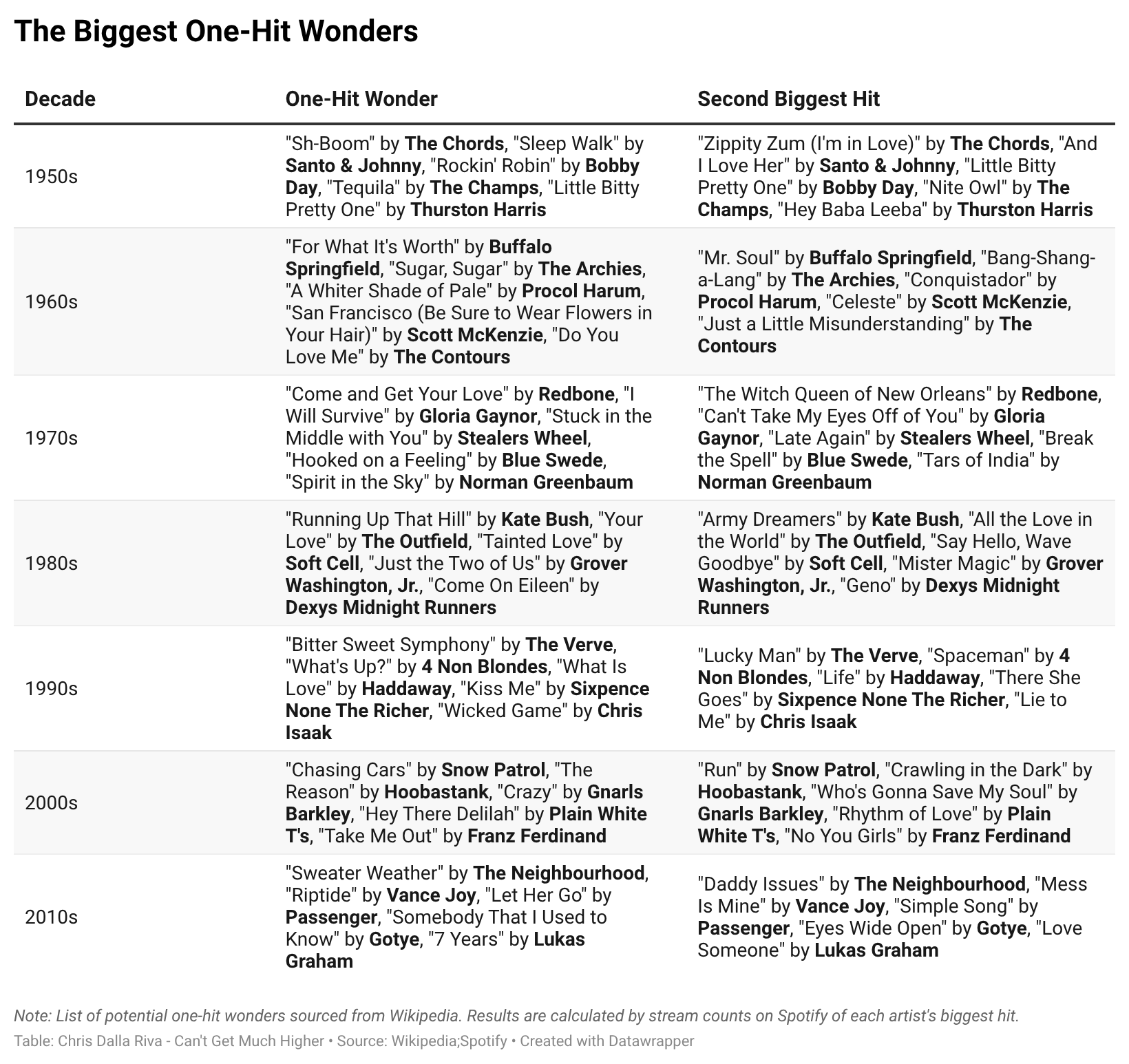
First, let’s start by sorting our potential one-hit wonders by streams of their top songs. It’s a simple methodology, but the results make a lot of sense. If I asked you to name another song by “San Francisco (Be Sure to Wear Flowers in Your Hair)” singer Scott McKenzie, you’d likely be at a loss for words. Same goes for Norman Greenbaum and 4 Non Blondes. These are artists who are genuinely only associated with a single song.
But there are some oddities here too. Take Kate Bush as an example. Though very popular in the United Kingdom, Bush’s only top 40 hit in the US was “Running Up That Hill.” That fits the very simple definition of a one-hit wonder. She had one hit. And that single hit only became bigger after being featured in Stranger Things in 2022.
That said, Kate Bush is not a one hit wonder. She is more akin to Fiona Apple, releasing decades of acclaimed music. Whereas very few people will be able to name a song by Katrina and the Waves other than “Walking on Sunshine,” scores of fans would be able to talk endlessly about the Kate Bush discography. I can tell you this because I understand Kate Bush’s place in the pantheon of popular music. But the data tells the same story.
Among their top songs, “Walking on Sunshine” accounts for 97.4% of Katrina and the Waves’ streams. “Running Up That Hill,” by contrast, only accounts for 58.6% of the streams among Kate Bush’s top ten songs. In other words, Bush has one song much more popular than the rest of her discography, but there remains interest in the rest of that discography.
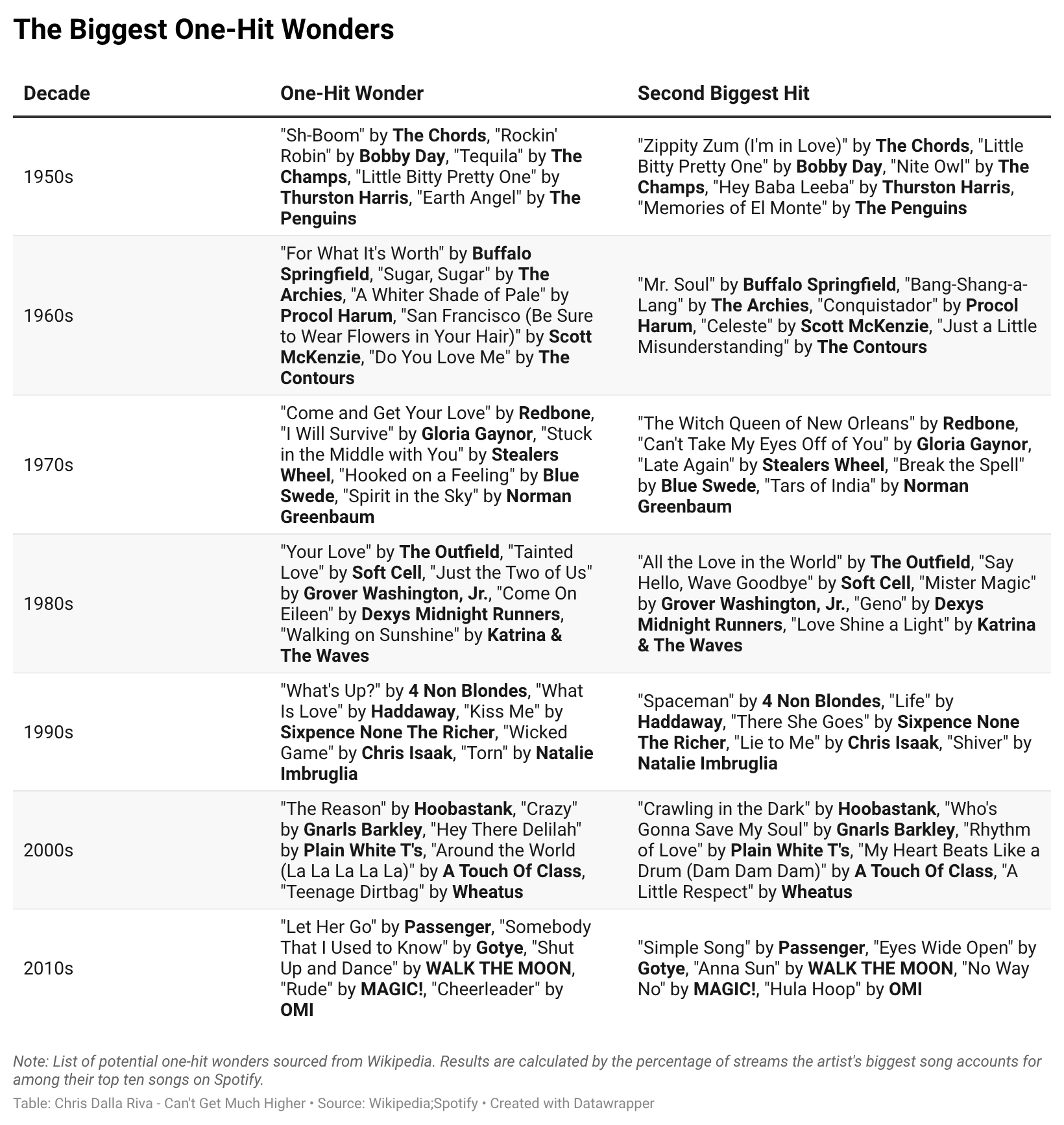
If we limit our list just to artists whose top song accounts for at least 75% of streams among their top ten and then sort by total streams, we get a slightly better list. No longer are we seeing artists with genuine fanbases, like Kate Bush and The Verve and The Neighborhood. It’s just artists with one giant hit that overshadows everything else they’ve done.
Now, let’s take this a step further. To do so, we need to turn to Rockwell, the son of Motown founder Berry Gordy that scored a hit with “Somebody’s Watching Me” mostly because Michael Jackson sang an uncredited vocal on the song. Rockwell’s top ten songs on Spotify are almost all different versions of “Somebody’s Watching Me.” If there were any symbol of one-hit-wonder-dom, this is it.
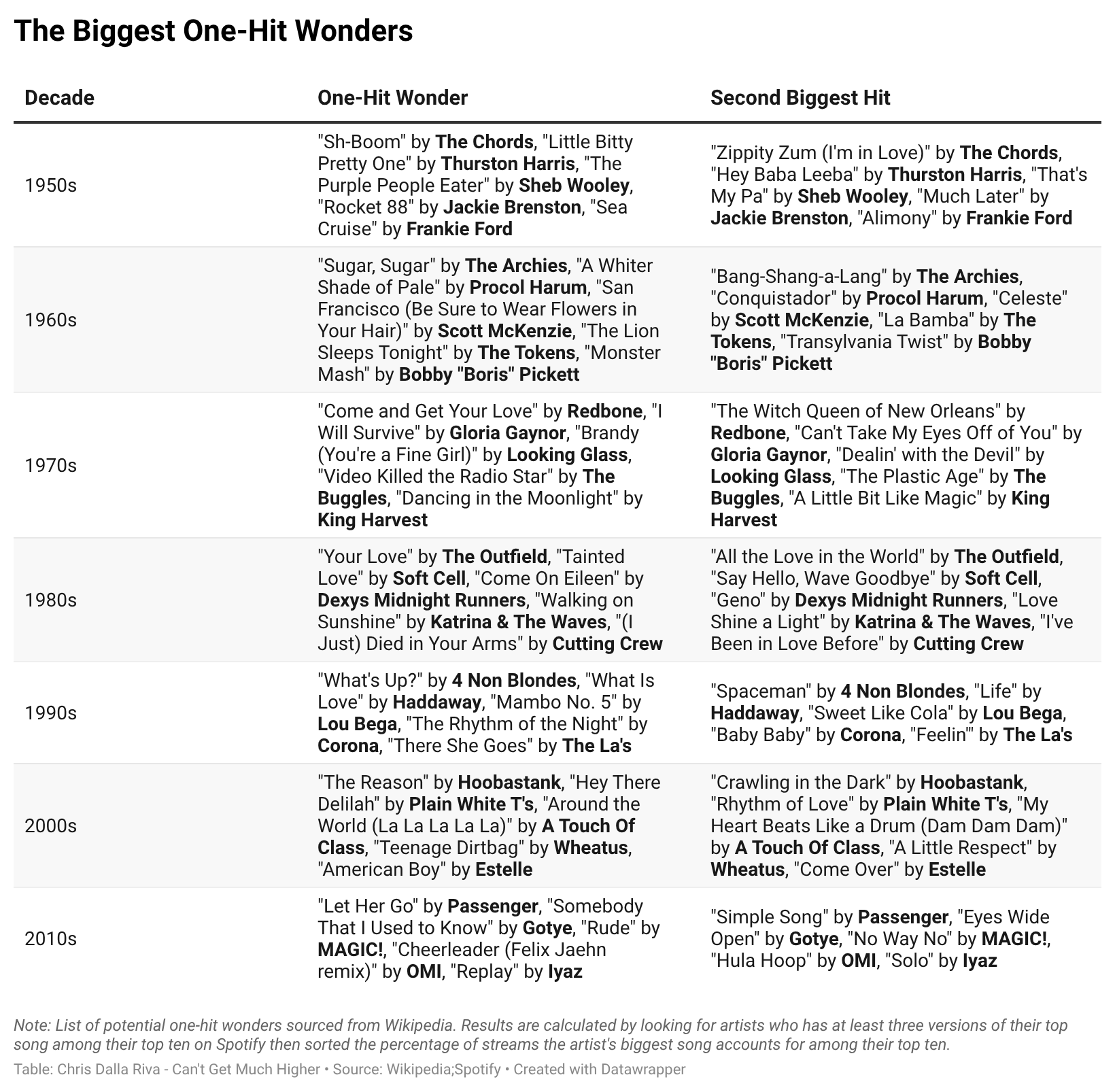
The above table is looking for artists whose top song accounts for at least 75% of streams among their top ten and at least three of those songs are different versions of the same hit. Again, we then sort by streams of the big hit.
This leaves us with what I think is the ultimate one-hit wonder list. “Sh-Boom” tops the list for the 1950s. “Sugar, Sugar” does the same for the 1960s. From there we have “Come and Get Your Love,” “Your Love,” “What’s Up?”, “The Reason,” and “Let Her Go” for the rest of the decades. Throw in some Sheb Wooley and Lou Bega, and we’ve got ourselves an immortal list of one-hit wonders.
Resolving the One-Hit Wonder Paradox
After crunching these numbers, I think a resolution to The One-Hit Wonder Paradox begins to emerge. A one-hit wonder doesn’t need to actually have a hit in the traditional sense. It can help. But nobody needs to crack the top 40 to join the one-hit wonder hall of fame. You just need to meet a few criteria.
You must have released at least an album’s worth of songs. Do I really need to call Ollie & Jerry a one-hit wonder because they only scored a hit with “Breakin’... There’s No Stopping Us” in 1984? The duo basically put out no other music. It’s no wonder they only had one hit.
The one-hit should be well known by the general public. It doesn’t feel fair, for example, to call Cathy Carr a one-hit wonder. Yes, she scored one hit with “Ivory Tower” in 1956, but nobody knows any of her music these days. She’s a zero-hit wonder, a status most musicians—myself included—have reached.
One-hit wonder status cements itself over time, usually at least a decade. Gloria Gaynor proves a good example. Though she first nabbed a hit in 1974 with “Never Can Say Goodbye,” that song’s success paled in comparison to 1978’s “I Will Survive” as time went on.
The one-hit should so thoroughly dominate an artist’s catalog that you could scarcely name another song by them. In other words, the song should be bigger than the artist themselves. This heuristic can usually be quantified by the fact that (a) that song accounts for nearly all of the artist’s plays on a given streaming platform and (b) there are multiple versions of that song scattered throughout an artist’s top songs.
By this definition, nearly anybody can become a one-hit wonder. Today, it is Soft Cell, but one day it might be someone whose catalog you consider very deep, like The Killers. “Mr. Brightside” might be just a little too popular. Watch out, Brandon Flowers.
A New One
"hey" by Artist
2026 - Alternative Emo
It feels like Sopp has been tossing off ideas as they come to him. This year, he’s released over 20 songs, most shorter than two-and-a-half minutes. Each composition is a little vignette, like a dream that fades just as it’s coming into focus. We have no idea how his career will shape up, but I will be anxiously watching and listening.
An Old One
"Turn the Beat Around" by Vicki Sue Robinson
1976 - Disco
I stumbled upon many interesting one-hit wonders during the writing of this piece. But the song that most struck me was one that I had heard before: “Turn the Beat Around” by Vickie Sue Robinson. As the name suggests, “Turn the Beat Around” is a celebration of rhythm generally and disco rhythm specifically. The rhythm section is naturally what stands out in this song. But it’s Robinson’s vocal in verse two, where she imitates various percussive sounds, that make the song a one-hit wonder worth remembering.
Shout out to the paid subscribers who allow this newsletter to exist. Along with getting access to our entire archive, subscribers unlock biweekly interviews with people driving the music industry, monthly round-ups of the most important stories in music, and priority when submitting questions for our mailbag. Consider becoming a paid subscriber today!
Recent Paid Subscriber Interviews: Pitchfork’s Editor-in-Chief • Vinyl Specialist • Spotify’s Former Data Guru • Hall of Fame Songwriter• John Legend Collaborator • Broadway Arranger • Indie Label Founder• Fender Exec
Recent Newsletters: Two-Hit Wonders • The Lostwave Story • Forgotten Artists • Album Cover Colors • Bad Ways to Die • A Frank Sinatra Mystery • Slop Problems
Want more from Chris Dalla Riva? Get a copy of his book Uncharted Territory: What Numbers Tell Us about the Biggest Hit Songs and Ourselves wherever books are sold.
Hey I rarely finish articles on substack but this was great. Love the conversational tone of your writing 😊
Black Betty got to #18 on the singles chart in 1977 and it has more than 200x the plays on spotify of Ram Jam’s second song. A classic rock staple, surely one of the purest one hit wonders.