


Welcome back to Can’t Get Much Higher, the internet’s favorite place for music and data. If you enjoy this newsletter, check out my book Uncharted Territory: What Numbers Tell Us about the Biggest Hit Songs and Ourselves. It’s a data-driven history of popular music that I wrote as I spent years listening to every number one hit in history.
A Song for Every Place
By Chris Dalla Riva
Data is usually boring. Controversial? Probably not. But I feel like I have the right to make that claim given that I write a newsletter about music and data. My right is only reaffirmed by both of my parents being accountants. I come from a long line of spreadsheet aficionados. When you spend so much of your life digging through grids of digital cells, you come to learn that 99% of the population would like to avoid that activity at all costs.
But there are people here. Each week, this newsletter—billed as “the intersection of music and data”—goes out to over 10,000 readers. On social media, my posts on similar topics have millions of views. People, it seems, like what they can glean from data even if the data itself is not that inspiring.
Because of that, I’ve always wanted to give people more ways to play with the datasets that I generate in my work. Sure, I could just post some spreadsheets. I’ve done that in the past. But almost nobody clicks on them. I’d rather give people a more interactive way to experience that data. Today, my dreams are coming true.
No One Sings About Kalamazoo Anymore

Welcome back to Can’t Get Much Higher, the internet’s favorite place for music and data. If you’ve been meaning to pick up my book, Uncharted Territory: What Numbers Tell Us about the Biggest Hit Songs and Ourselves, now is probably the time. It’s 30% off from the publisher for a limited time!
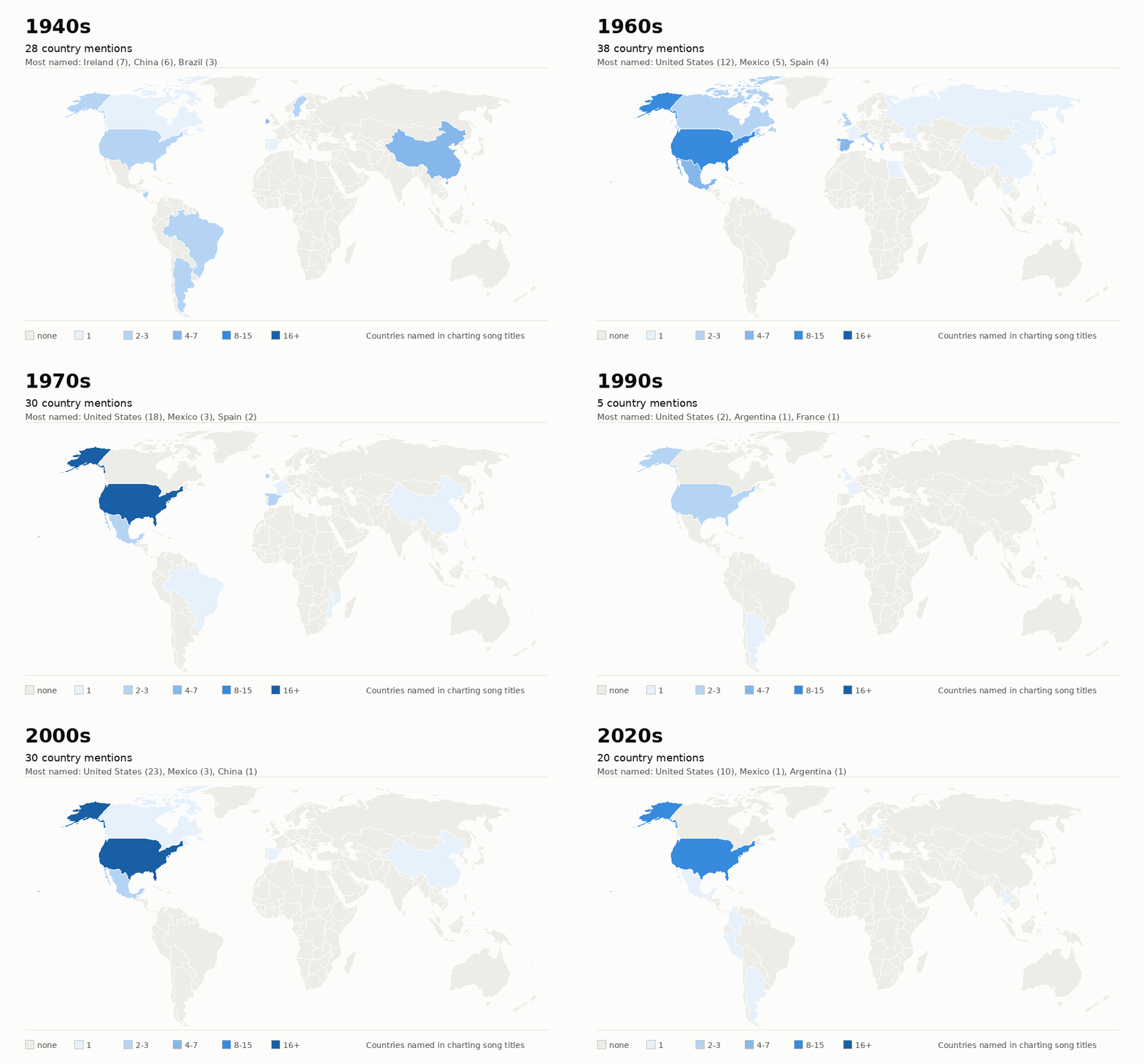
A few weeks ago, I worked on a fun piece called “No One Sings About Kalamazoo Anymore.” That involved building a dataset of hit songs that mentioned places in their titles in order to answer two questions:
Do we sing about places less frequently these days?
Among the places we do sing about today, are they more likely to be large population centers than in years past?
After I answered those questions, I kept thinking about how it would be fun to explore a map of all the songs. I had a few visuals in the piece, one of which I’ve displayed below, but I wanted something more interactive. Now, I have it. And I wanted to share it with you.
A Searchable, Scrollable Map of Songs
Before discussing some insights I’ve gained from aggregating this data, I first wanted to give you an overview of the tool. If you’re too cool for demos, you can click here to give it a try right now. For everyone else, here’s how it works.
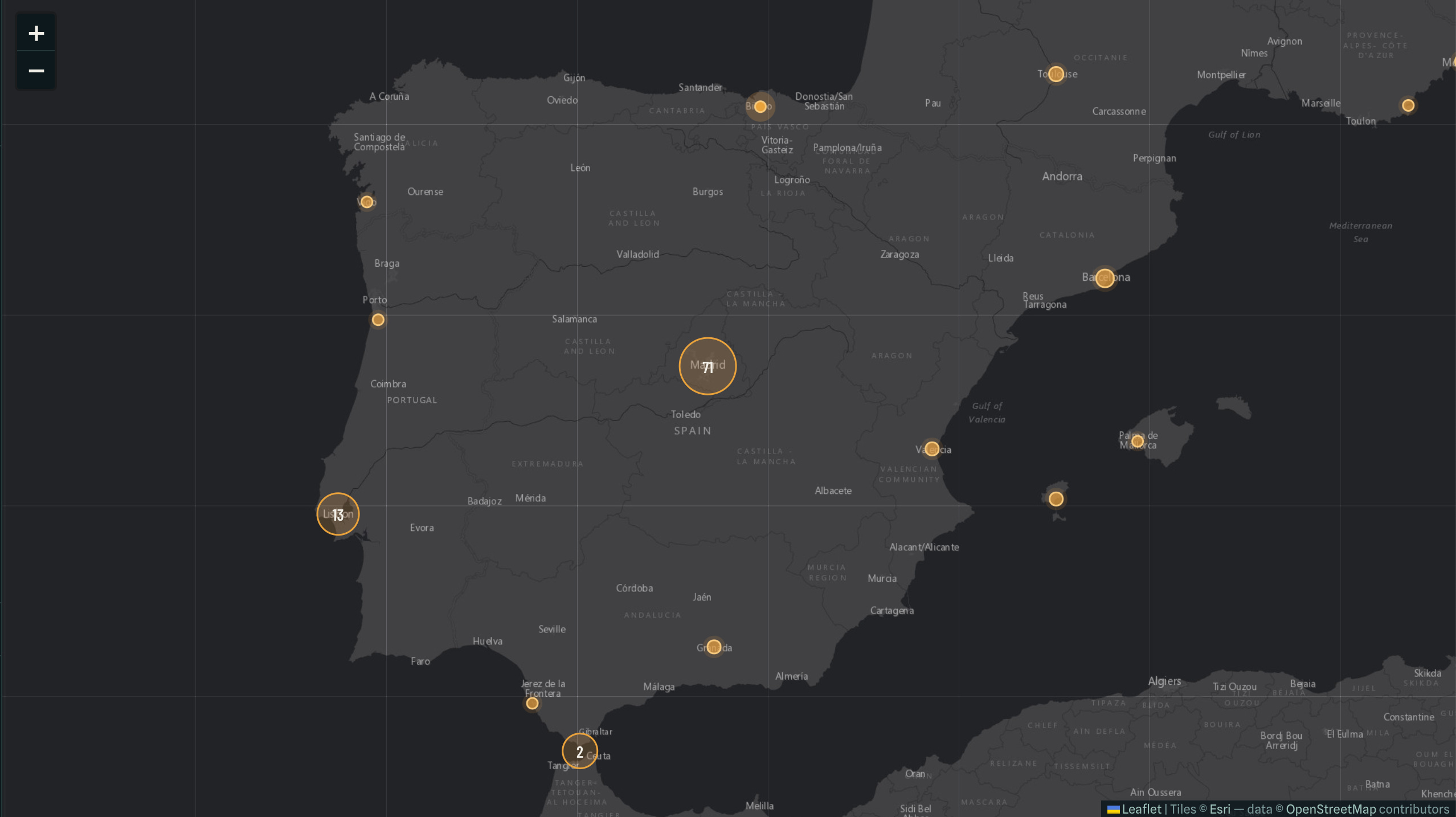
You can navigate this map in two ways: scrolling and searching. Scrolling is similar to how you might explore a map on your phone. As you move left, right, in, and out, more songs will reveal themselves.
Let’s say that I’m from Spain. I can zoom into the Iberian Peninsula on the map and see scores of songs appear. By clicking any of the bubbles, the names of the songs will display, along with some basic information, like who performed it and when it was released (e.g., “The Bilbao Song” by Andy Williams).
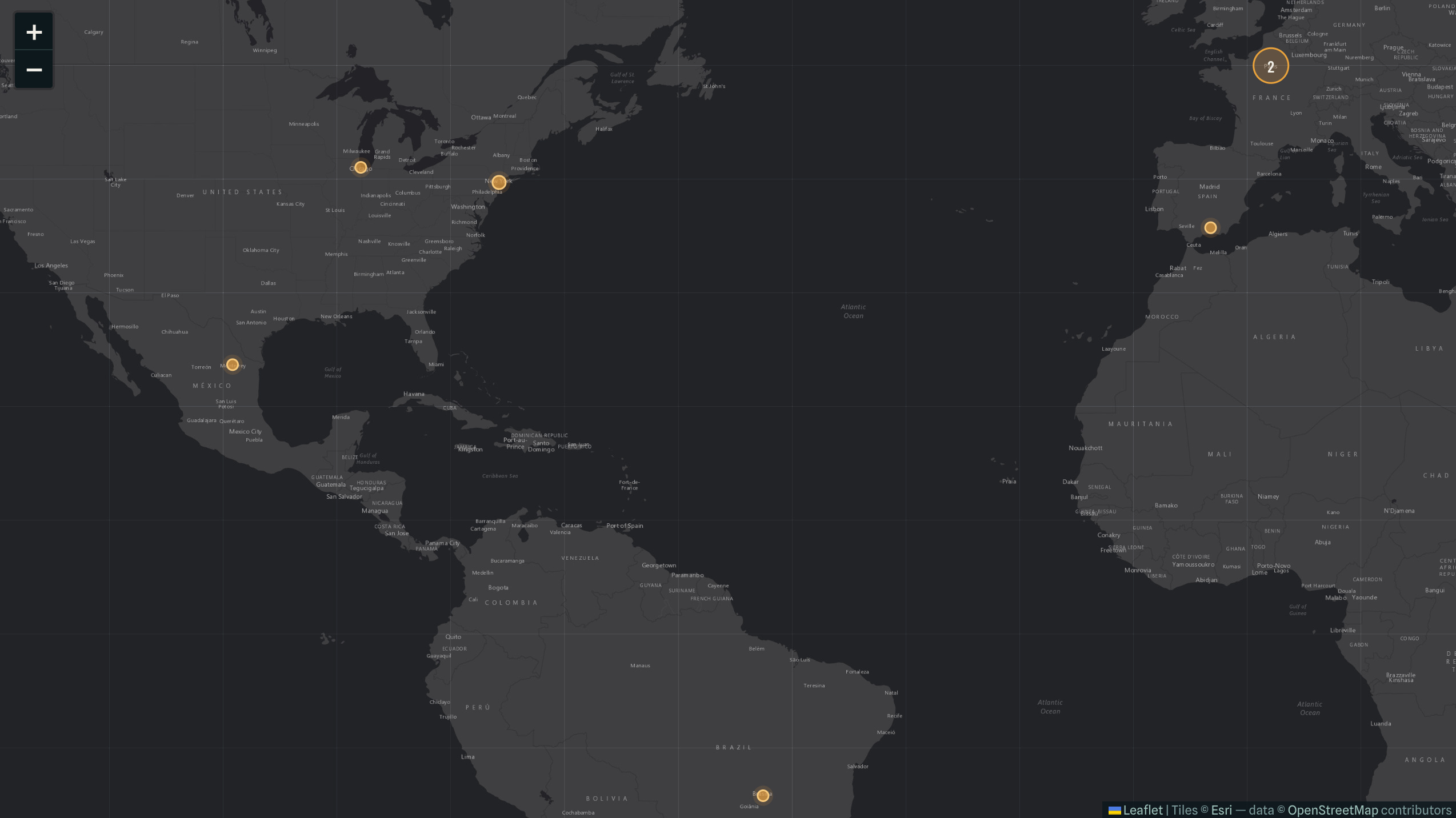
You can also find things by searching. And this search bar is very robust. You can search through artists, places, titles, and basically any other piece of metadata that I’ve attached to the song.
In the image below, I’ve searched for “Frank Sinatra.” The map then centers to include every song in the database performed by Sinatra. You’ve got “Chicago.” You’ve got “Theme from New York, New York” and “Autumn in New York.” You’ve even got the obscure “French Foreign Legion.”
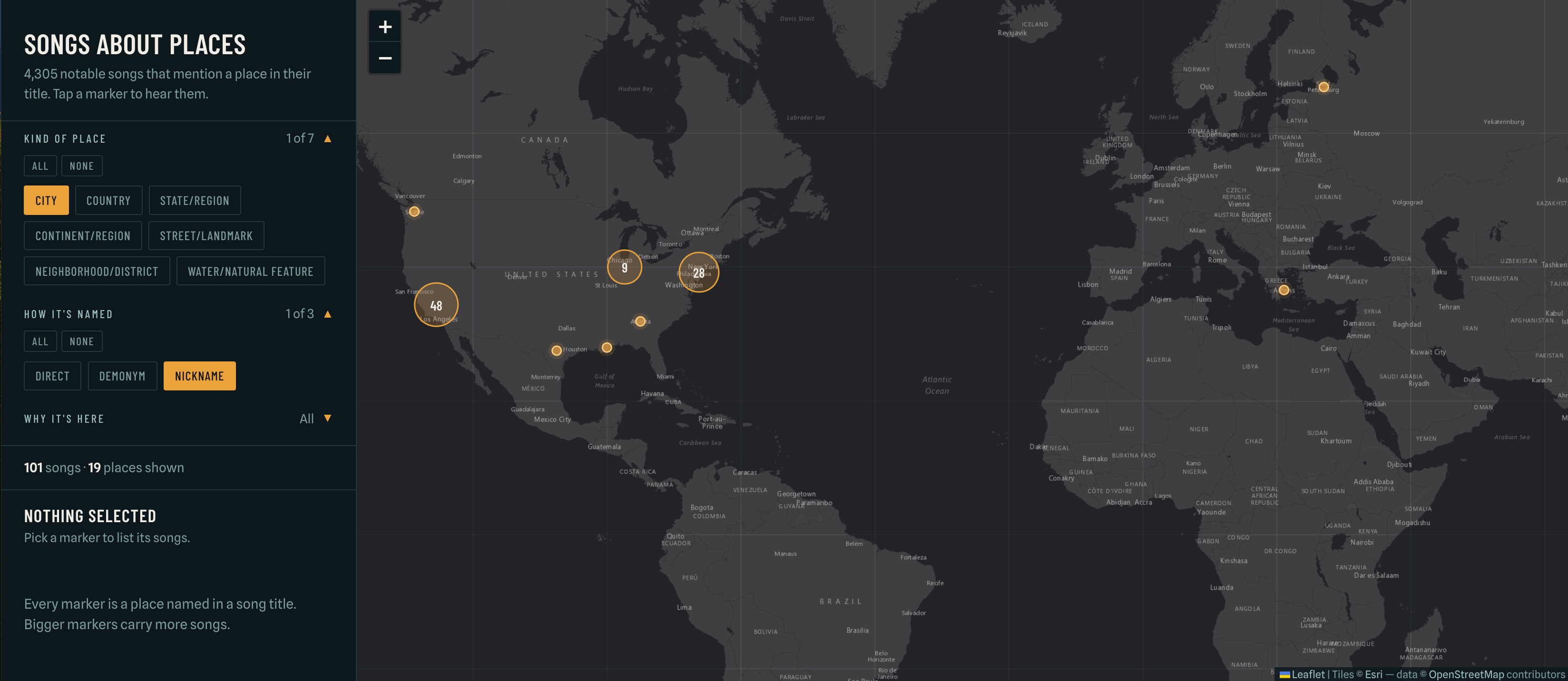
This search tool is also packed with filters. Do you want to see only songs that mention cities? Click the filter. Do you only want cities mentioned by nickname? Again, you can click the filter. Other filters allow you to limit based on when the song was released and why I’ve included it.
This last part is important. I don’t have every song. In fact, I’m only looking for songs that mention places in their titles. But even with that clarification, getting everything would be impossible. There are hundreds of thousands of songs released daily.
I wanted these songs to have some level of notability. So, I scanned pop charts going back to 1940, discographies of Rock & Roll Hall of Fame inductees, various critical lists of great songs, and a few other sources. Again, you can filter just to a specific source.
The thing I am most proud of is that you can hear any song with a click. Every song title is linked. Not only that, but you can pick your streaming service of choice, so that it brings you to where you can actually listen.
As an example, I am from New Jersey. If I search “New Jersey” and select “Spotify,” then anytime I click a song title, it will bring me to that song on Spotify. Makes it easy to listen to songs I’m unfamiliar with, like “Jersey” by Future and “Jackson” by Cymbals Eat Guitars.
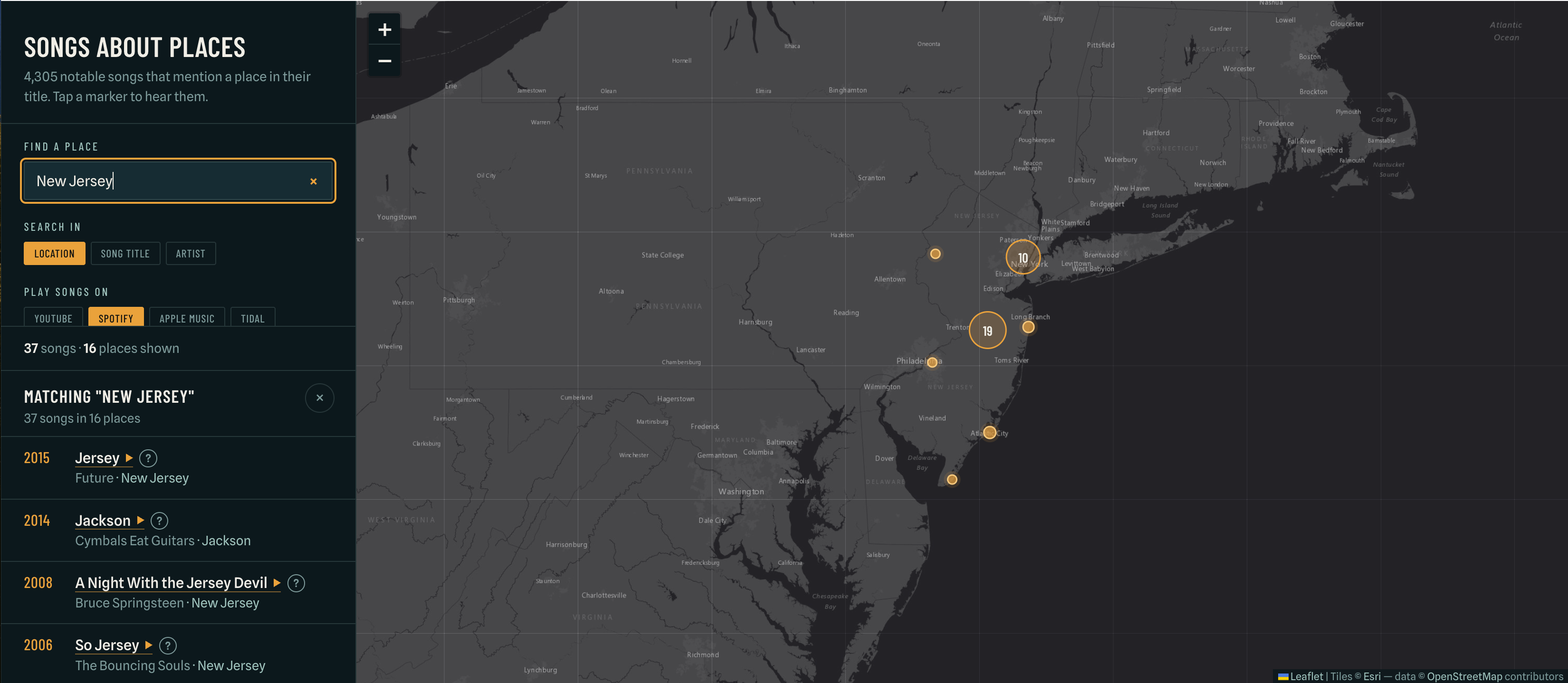
I know that when you head to this map, you will eventually search for a song or a place and find nothing. Again, I wanted songs that mentioned a place in their title and were notable in some way. But I do consider something to be “notable” if you feel compelled to tell me about. In other words, user submissions are welcomed. Just click the button on the site and tell me what I’m missing.
So, What Places are We Singing About?
This is the music and data newsletter. So, I might as well give you some insights before you take your personal tour through the map.
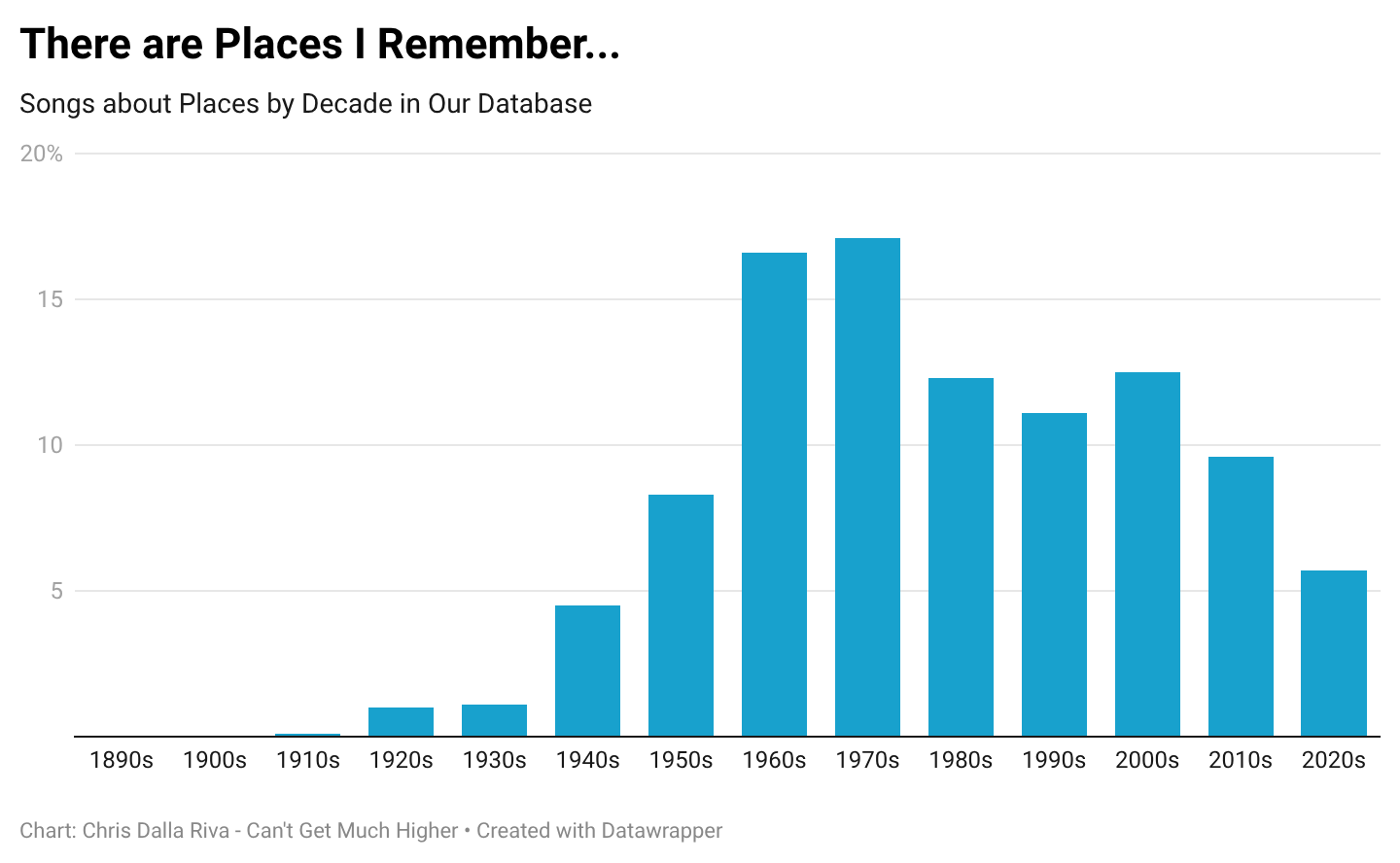
First, what years are the songs from? Given the last piece I wrote on this topic, it’s no shock that 61% of songs in the database were released before 1990. The conclusions don’t match exactly because (a) we expanded our search beyond hit songs and (b) we don’t have a base rate to compare to (i.e., there were fewer songs released in the 1940s than today).
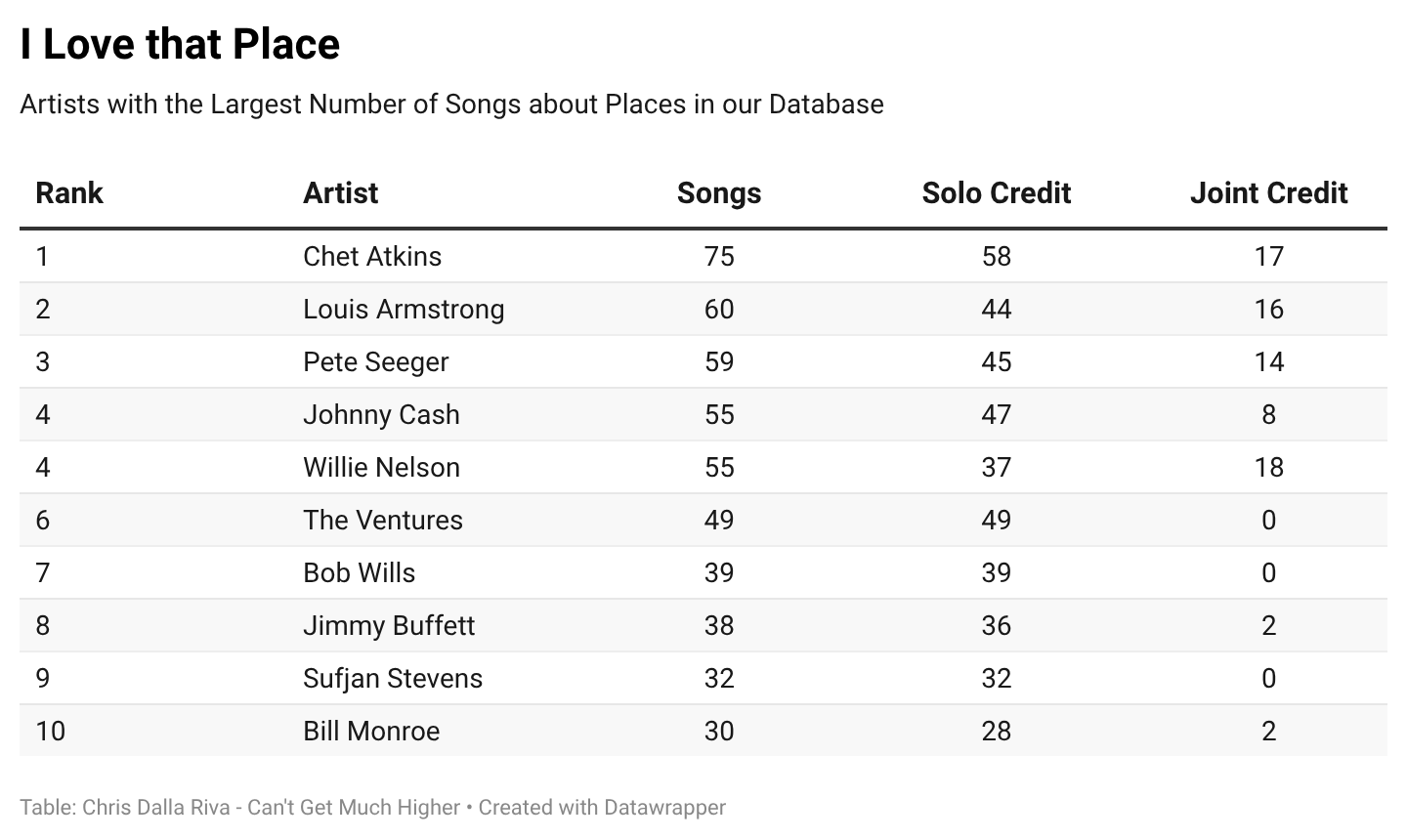
Given the preponderance of older songs in our data, it’s no shock that nearly all of the most represented artists are dead. Sufjan Stevens is the only living artist in the top ten, mostly because he’s released albums dedicated to Michigan and Illinois, respectively.
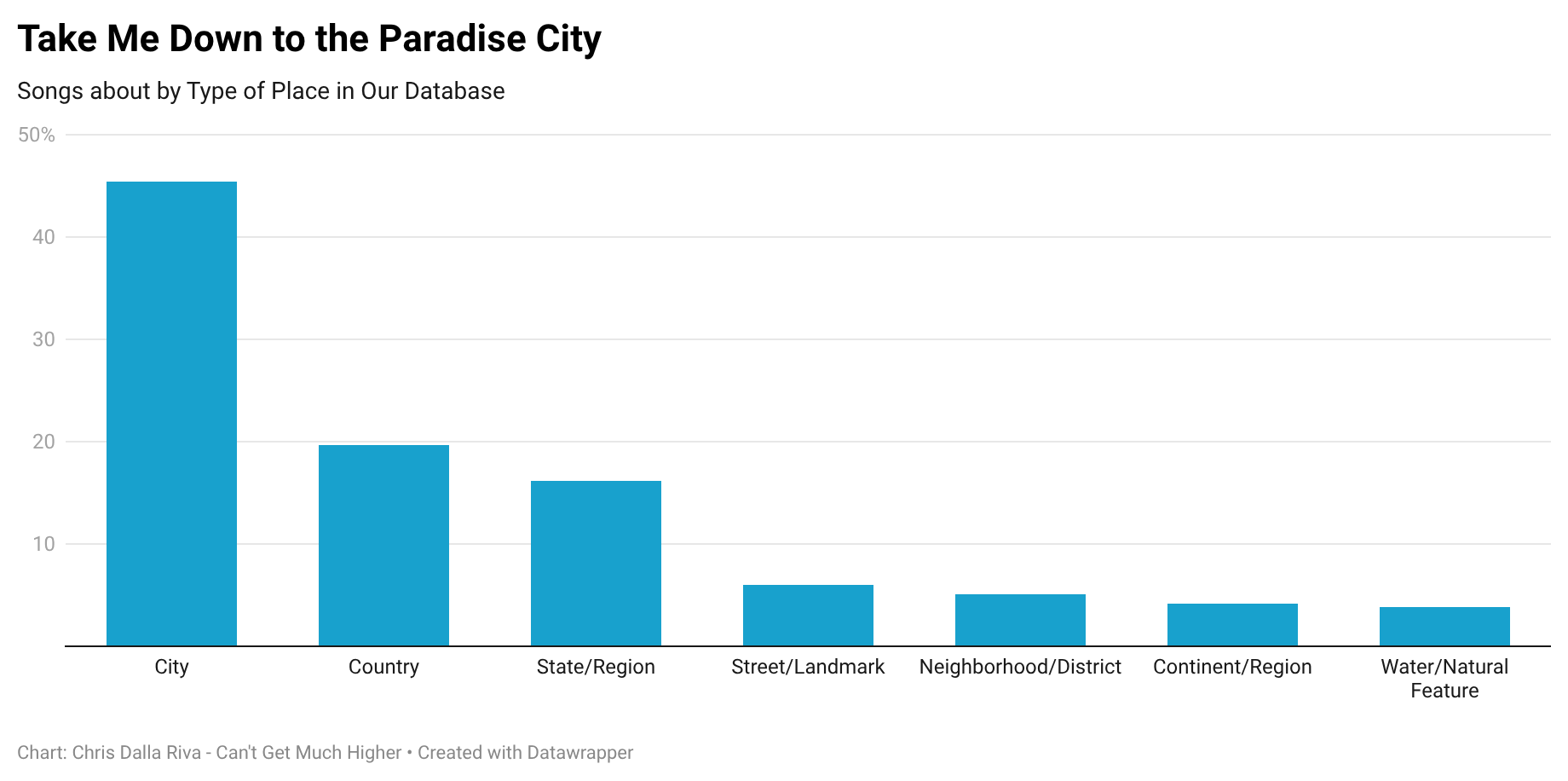
When people sing about places, they are mostly focusing on specific towns or cities. Nearly half of our database are songs of that type. The next closest is songs about countries at 19.7%. Water and natural features round out the bottom at 3.8%.
Since cities are the types of places we spend most time writing about, we might as well enumerate the top cities. It’s no surprise that New York City has a comfortable lead at number one. We’ve been singing about it non-stop for a century.
Most of the other places in the top ten aren’t a big shock either. They are large population centers. And the places that no longer rank among the largest cities in a country, like Detroit, used to be. As I noted in my other piece, we still sing about small places, but the largest continue to command much of our attention.
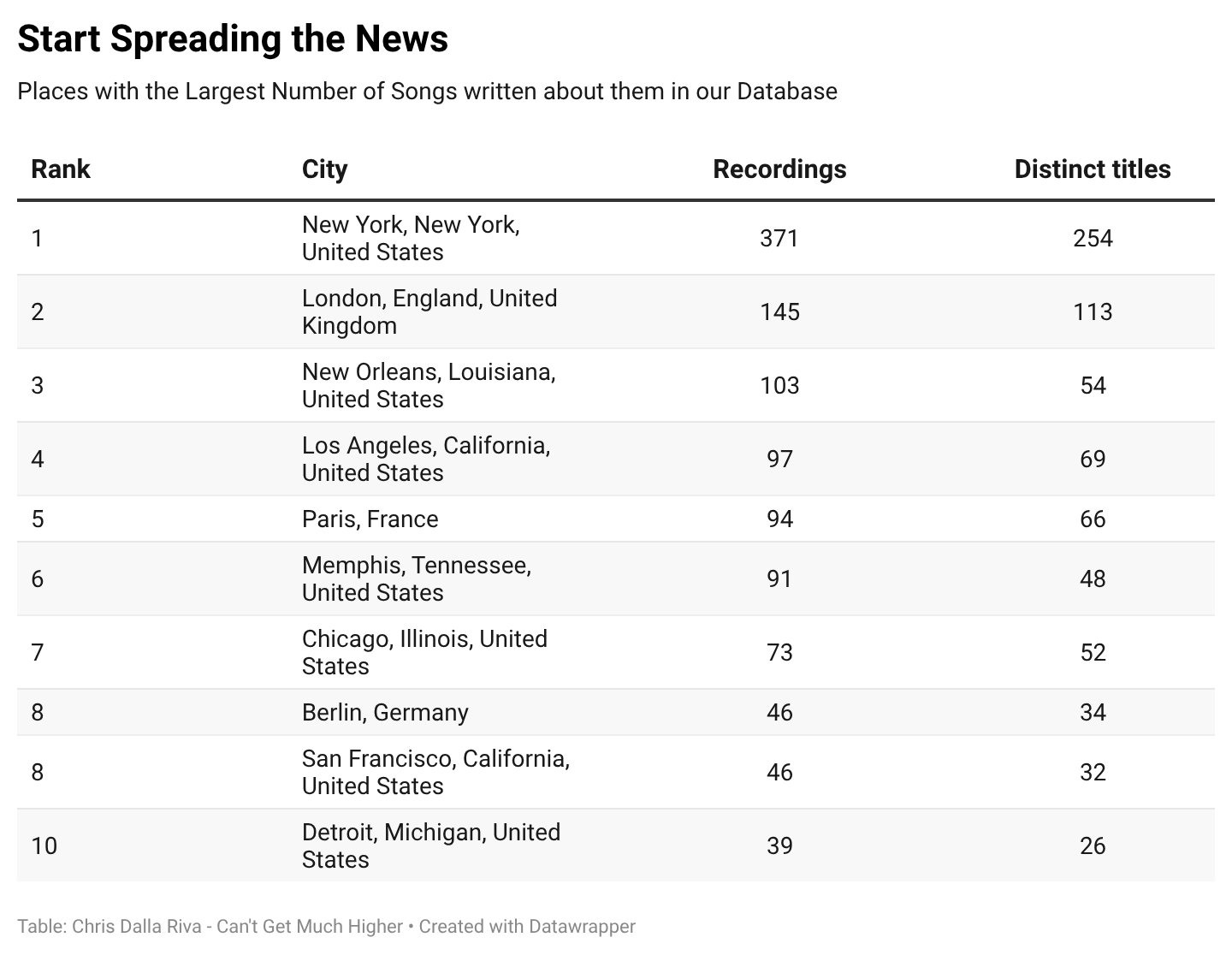
I could go on, but the point of this piece is the interactiveness of the data. I hope you enjoy clicking around. Ideally, you’ll unearth a long lost song about the place you’re from or a place you love.
A New One
"Willowbrook Mall" by Max Rauch
2026 - Pop Punk
How many songs can you write about New York City and Los Angeles? The answer is at least hundreds. But in the course of building my song map, I became more interested in the compositions that were smaller, like songs about surfing off the coast of Canada or celebrating Christmas on an aptly named Indian Ocean island.
In his recent single, Max Rauch took a big sound to a very small topic: the Willowbrook Mall. That titular shopping mall is very close to where I grew up, thus giving the song a special appeal. But Rauch’s melodies are strong enough to hold your attention even if you’ve never come within one hundred miles of the New Jersey shopping center.
An Old One
"Fall in Philadelphia" by Daryl Hall & John Oates
1972 - Soul
Before releasing their debut album Whole Oates, the future superstars Daryl Hall and John Oates had been kicking around some demos. Frankly, I find some of those demos more enjoyable than their final studio takes. “Fall in Philadelphia” is a good example of this. The studio take is just a bit too slow and polished. The demo has a looseness that really allows the vocal harmonies from the Philadelphia duo to shine.
Shout out to the paid subscribers who allow this newsletter to exist. Along with getting access to our entire archive, subscribers unlock biweekly interviews with people driving the music industry, monthly round-ups of the most important stories in music, and priority when submitting questions for our mailbag. Consider becoming a paid subscriber today!
Recent Paid Subscriber Interviews: Pitchfork’s Editor-in-Chief • Vinyl Specialist • Spotify’s Former Data Guru • Hall of Fame Songwriter• John Legend Collaborator • Broadway Arranger • Indie Label Founder• Fender Exec
Recent Newsletters: Two-Hit Wonders • The Lostwave Story • Forgotten Artists • Album Cover Colors • Bad Ways to Die • A Frank Sinatra Mystery • Slop Problems
Want more from Chris Dalla Riva? Get a copy of his book Uncharted Territory: What Numbers Tell Us about the Biggest Hit Songs and Ourselves wherever books are sold.