


Welcome back to Can’t Get Much Higher, the internet’s favorite place for music and data. If you’ve been meaning to pick up my book, Uncharted Territory: What Numbers Tell Us about the Biggest Hit Songs and Ourselves, now is probably the time. It’s 30% off from the publisher for a limited time! Please note that while the paperback and audiobook are only available for preorder, hardback and e-book will ship immediately.
No One Sings About Kalamazoo Anymore
By Chris Dalla Riva
You never know where inspiration will strike. Last week, it came from Joe Weisenthal. Weisenthal is a financial journalist at Bloomberg who hosts the popular podcast Odd Lots. Sure, I follow Weisenthal on Twitter for financial news and analysis, but his appeal is a bit wider than that. He’s genuinely curious about the world.
That brings us to the inspiration. Weisenthal recently reposted an old tweet from another financial commenter, Michael Antonelli. Antonelli’s post pondered why musicians of the 1930s and 1940s were so often singing about unexpected places, like Kalamazoo, Michigan.

Anontelli is alluding to “(I’ve Got a Gal In) Kalamazoo,” most famously performed by Glenn Miller’s Orchestra in the 1940s. And his observation feels correct. I don’t know much about music of the 1930s and 1940s, but I can easily call up scores of songs about places that (a) aren’t that large in terms of population and (b) don’t often get written about today.
Frankly, you don’t have to look further than the Glenn Miller catalog to understand this. Along with “(I’ve Got a Gal In) Kalamazoo,“ he and his orchestra had huge hits with “Chattanooga Choo Choo,” “Along The Santa Fe Trail,” “I Dreamt I Dwelt In Harlem,” and “Pennsylvania Six-Five Thousand,” among others.
So, were we actually singing about places more frequently back in the day? And were the places we were singing about more obscure than the population centers that seem to litter our songs today? I decided to look.
The Rise and Fall of the City Song
It goes without saying that people still write songs about places. Just a few weeks ago, for example, we discussed the controversy surrounding Stella Lefty’s recent hit “Boston.” But we aren’t concerned with the existence of songs about places. We are concerned with how prevalent those songs are and the cultural importance of the places immortalized in those songs.
To help investigate these concerns, I turned to Billboard magazine. Billboard has been publishing weekly music charts since 1958 and year-end charts since 1946. By supplementing that data with reconstructions of earlier charts, we can get a list of over 49,000 popular songs going back to 1940. By analyzing song titles, we can whittle that list down to 957 hit songs whose titles mention one of the following:
City/Neighborhood: 407 songs (e.g., “Kokomo, Indiana” by Vaughn Monroe, “Havana” by Camila Cabello ft. Young Thug)
Continent/Region: 45 songs (e.g. “South America, Take It Away” by Bing Crosby, “Africa” by Toto
Country: 251 songs (e.g., “Johnny Doughboy Found A Rose In Ireland” by Guy Lombardo, “Mexico Honey” Kacey Musgraves)
State/Region: 188 songs (e.g., “Tennessee Waltz” by Patti Page, “Choosin’ Texas” by Ella Langley)
Street/Landmark: 42 songs (e.g., “Penny Lane” by The Beatles, “Coney Island” by Taylor Swift)
Natural Feature: 24 songs (e.g., “Rocky Mountain High” by John Denver, “Niagara Falls” by The Weekend)
If we begin by focusing on cities and neighborhoods—the subject of the tweet—we see that (a) these songs were never that popular but (b) they used to be much more prevalent. Why?
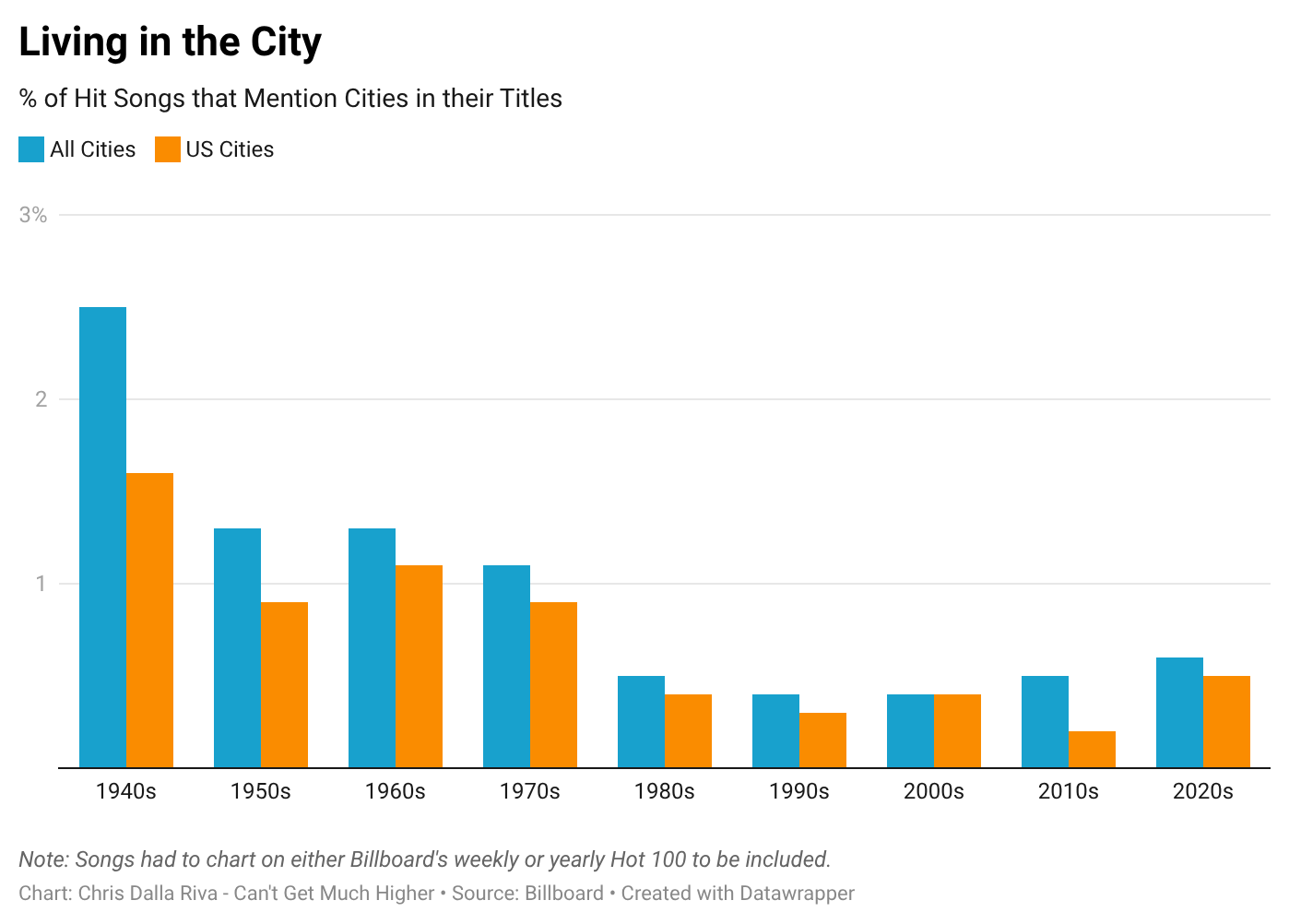
I believe this comes down to a few reasons—some musical and some political. First, as I’ve noted previously, there used to be a much deeper connection between the hit song and the musical. From South Pacific and Oklahoma! to Meet Me in St. Louis and Bing Crosby’s Road to… pictures, many of these musicals had songs about where they were set.
Second, as I detail in my book, the music industry of the 1940s was much more focused on songs rather than recordings. If a song was a hit for someone, scores of other artists might rush out versions.
For example, Johnny Mercer and Harry Warren wrote “On the Atchison, Topeka and the Santa Fe” in 1944 to be used in a film The Harvey Girls. In 1945, before the film was released, Mercer released a popular version of the song. Bing Crosby and Tommy Dorsey soon followed.
Judy Garland, the star of the film, released her version not long after. By the time people sat down in the cinema, everybody already knew the song well. Thus, one song about a place could seem even more ubiquitous because so many people were releasing it.
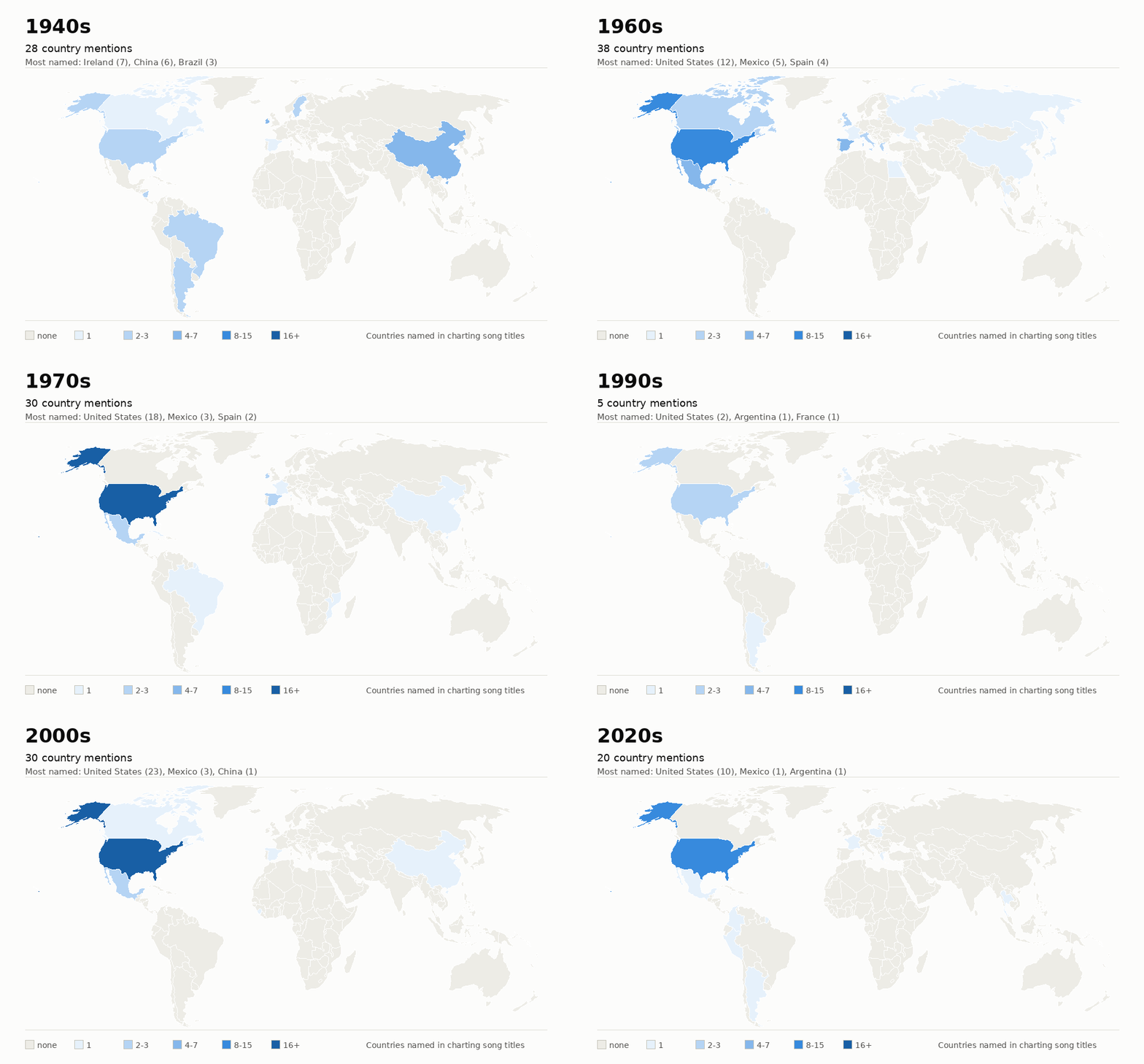
But the song about a place was not just a function of the structure of the music industry of the 1940s. The decade also saw soldiers returning home from WWII having seen faraway places. This worldliness certainly impacted the pop charts. In the animation below, you can see how global songwriting was in the 1940s. Only in later decades did country mentions become more focused on the United States.
Furthermore, the US was still expanding at this time, Alaska and Hawaii yet to join the Union. There was, for example, a whole subgenre that cropped up around Hawaiian and Pacific exoticism. Songs like “Hawaiian War Chant (Ta-Hu-Wa-Hu-Wai),” “Blue Hawaii,” “The Hawaiian Wedding Song (Ke Kali Nei Au),” and even Bing Crosby’s Christmas classic “Mele Kalikimaka” would all climb the charts before 1960.
So, yes, we used to sing about places more often. But a second question still looms: Did the places we used to sing about used to be more obscure? Or were we always singing about population centers?
The Subtle Evolution of the City Song
First, let’s generate a map of cities that we sing about in the US. We’ll compare music released over the last 25 years to music released during the first 25 years of our data, namely 1940 to 1965.
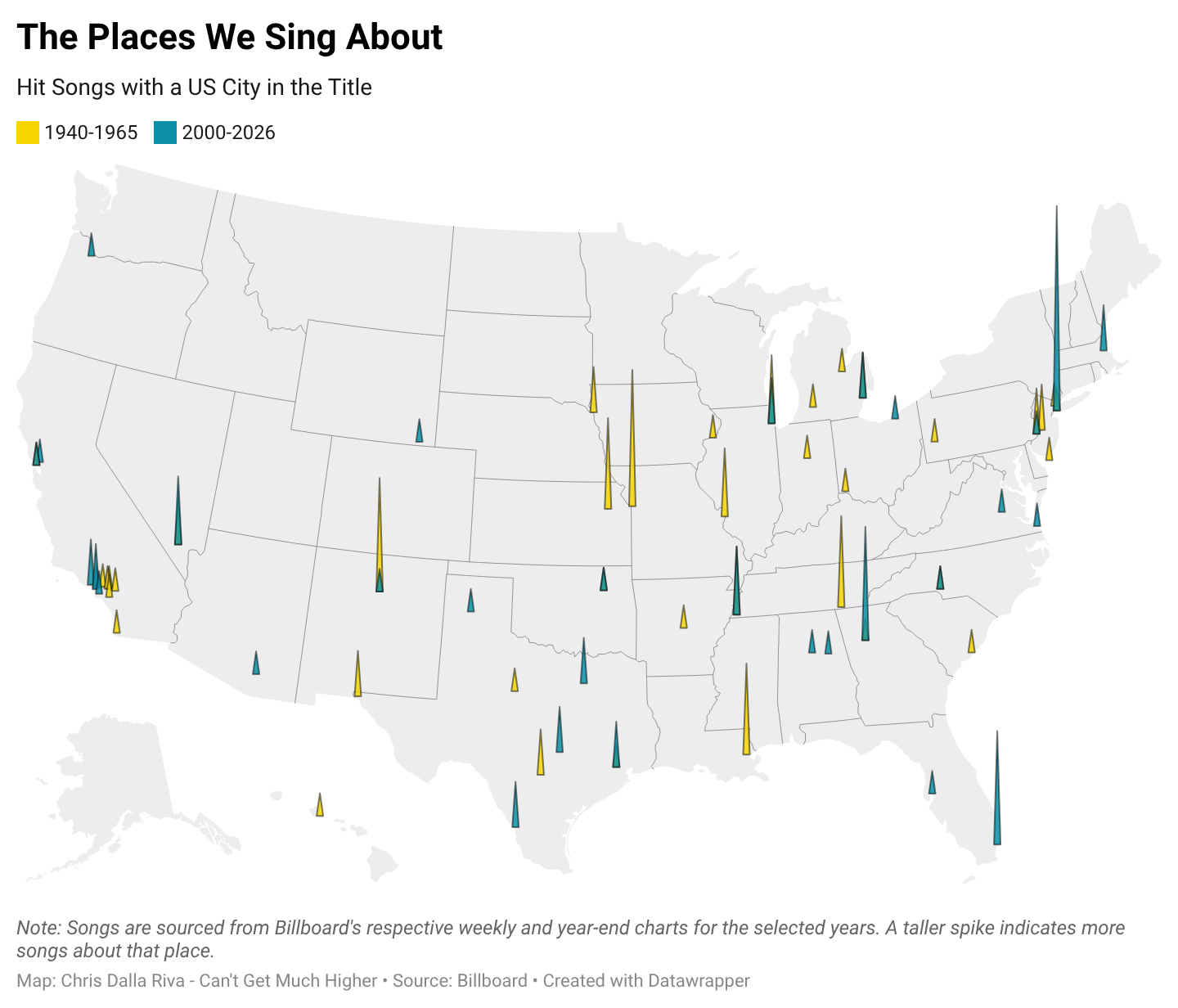
A few things jump out from this map. First, there seems to be a wider distribution of places in the 1940 to 1965 period, especially in the mid-west. The more recent period is not just focused on major cities (e.g., New York), but they do seem to represent a larger portion of musical geography. Let’s see if this visual holds up to more quantitative scrutiny.
If we look at the median population of the cities mentioned in titles as a percentage of the total US population of the time, we see something a bit more subtle. The 1940s did have a special interest in small cities, but it’s not that much smaller than other decades.
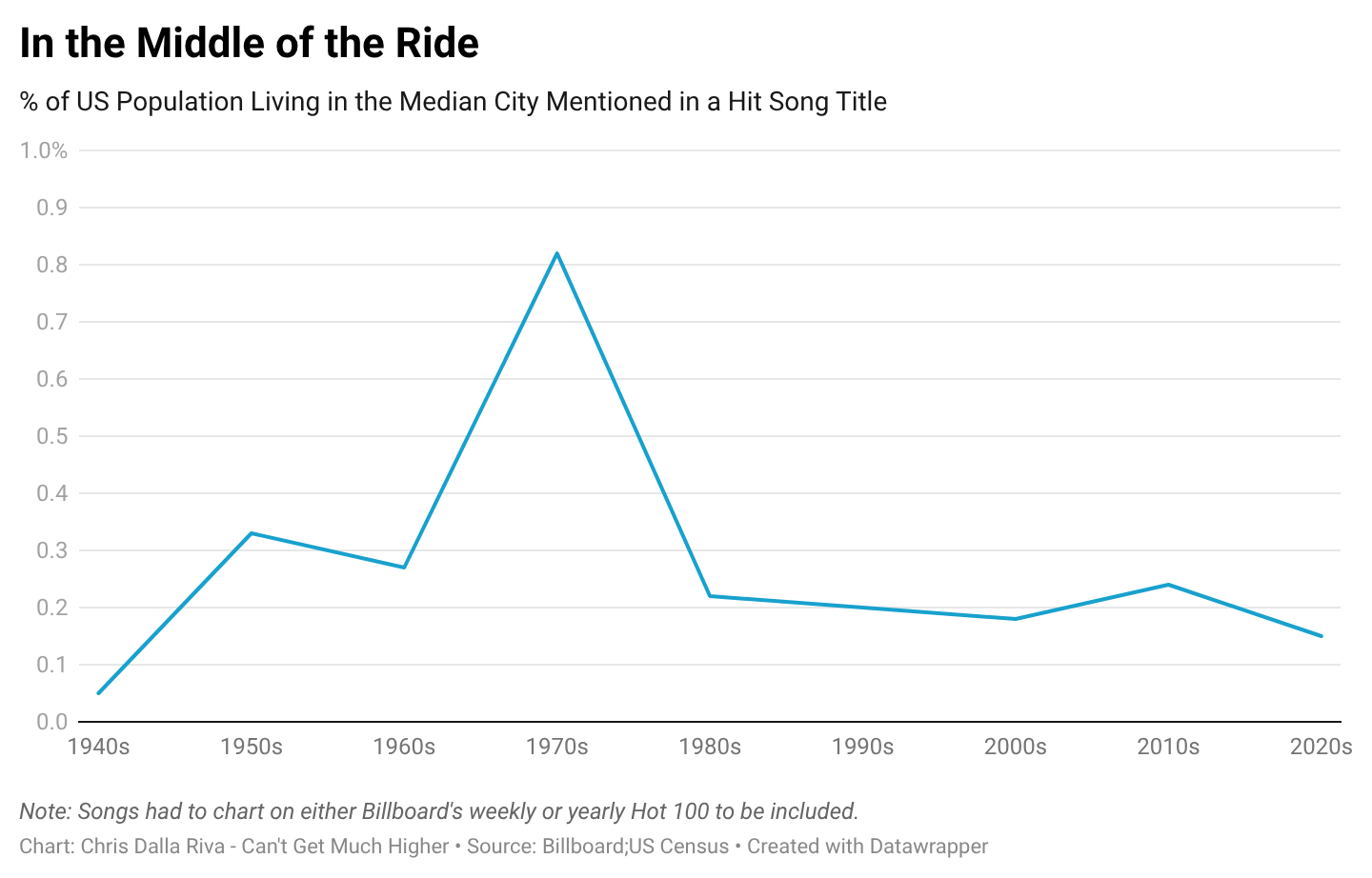
The outlier, of course, is the 1970s. The influx of hits about New York City and Los Angeles and New Orleans drove up the median population dramatically. While we aren’t often getting songs about places like Sioux City these days, there is an influx of hits about places like Laredo and Santa Fe and Calabasas that keep the median at historically expected levels.
I think it’s also important to note that when we sing about places, we don’t have to sing about cities. You can sing about mountain ranges and streets and continents too. We should check if maybe our singing about cities has just been replaced by singing about countries.
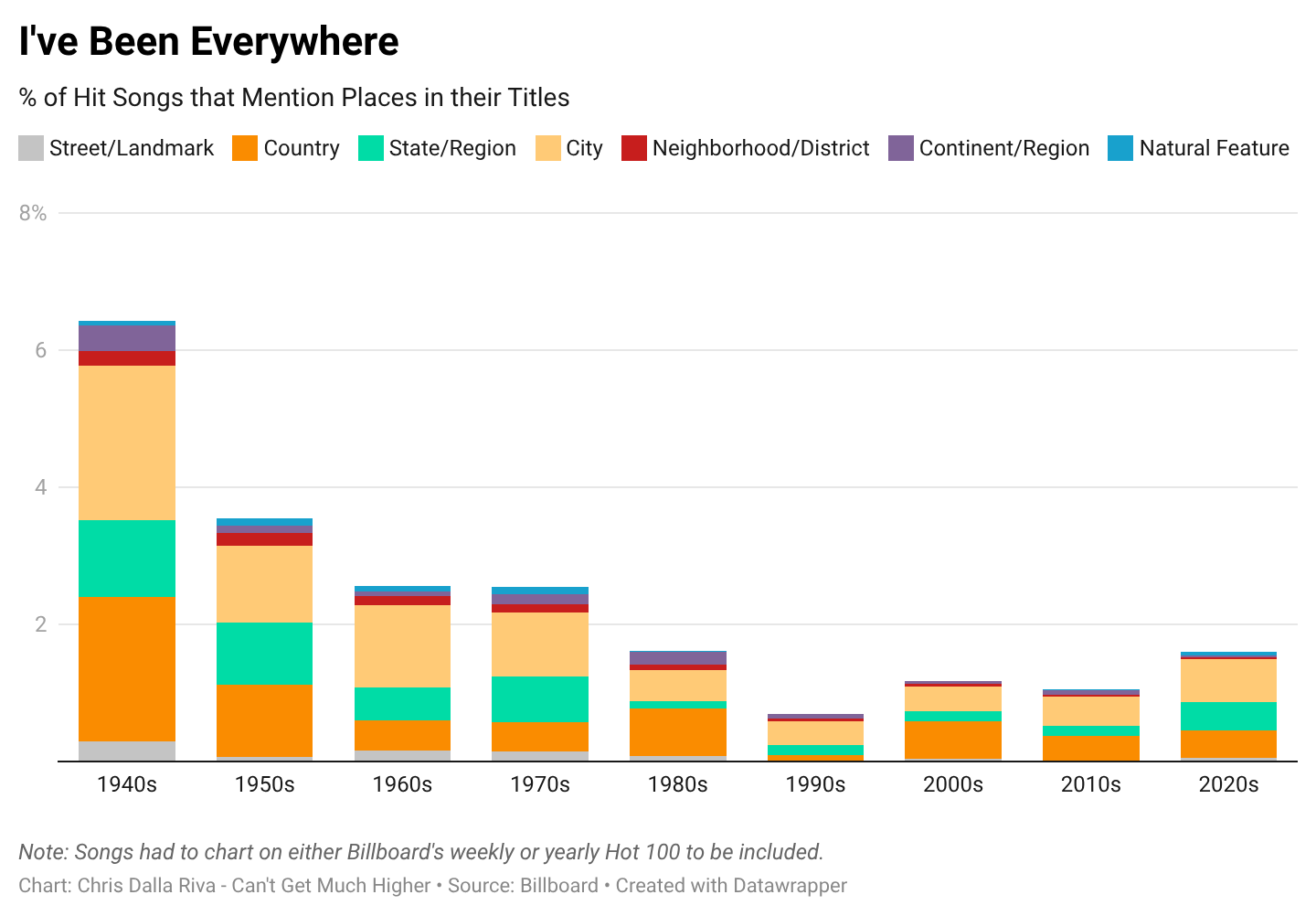
It has not. Places are sung about less frequently in every decade since the 1940s. But if we are singing about places, it is most often a city. In 7 of the last 9 decades, cities are the most common type of place to appear in a hit song title. They are only outpaced by countries in the 1980s and 2000s.
In summary, the 1940s was unique in how we immortalized place in song. Cities were more likely to appear in titles than in any other decade and those cities were also more likely to represent a smaller portion of the US population.
Not that much smaller, though. As noted, not every song is about New York and Los Angeles. Especially with the success of country music in the 2020s, we haven’t forgotten about all the small to medium-sized towns that make up America.
They Call It the Jersey Bounce
Often when I put together interesting datasets like these, I end up uncovering lots of fun facts that don’t fit into the actual narrative of my essay. As with my piece on classic rock, I decided to leave you with some of these stray observations rather than hoarding them for myself.
The hit songs to mention the smallest places are “Okolona River Bottom Band” by Bobbie Gentry (pop. 3002), “La Grange” by ZZ Top (pop. 3092), “Taos New Mexico” by R. Dean Taylor (pop. 3369), “The Anaheim, Azusa & Cucamonga Sewing Circle, Book Review And Timing Association” by Jan & Dean (Rancho Cucamonga pop. 4500), and “Wildwood Days” by Bobby Rydell (pop. 4690).
“Wildwood Days” immortalized the famed New Jersey beach town. In my book, I had a bit about trying to find songs that mention New Jersey, my home state. The piece taught me that there have actually been 6 hits to mention New Jersey or a place in New Jersey: “Jersey Bounce” by Benny Goodman, “Jersey Bounce” by Jimmy Dorsey, “Palisades Park” by Freddy Cannon, “Cherry Hill Park” by Billy Joe Royal, and “Jersey” by Future.
New Jersey is far outpaced by other states, though. California has 38 mentions. Tennessee and Georgia follow up behind with 23 and 21 respective mentions.
I mean this with no offense to residents of The Gem State, but I am shocked to report that Idaho has appeared in four titles: “Idaho” by Alvino Rey and His Orchestra, “Idaho” by Benny Goodman, “Idaho” by Frankie Valli & the Four Seasons, and “Private Idaho” by The B-52s.
Given that these are American charts, the United States is indeed the most mentioned country among our hit song titles. But number two was not a place I expected: China. Part of this is driven by a few different versions of “On A Slow Boat To China” finding success in the 1940s, but the country is still represented more than I anticipated.
That said, I think the two most unexpected countries to find their way into titles are Mozambique (i.e., “Mozambique” by Bob Dylan) and Lithuania (i.e., “Lithuania” by Big Sean ft. Travis Scott)
A New One
"Los Andes" by Hermanos Gutiérrez
2026 - Genre
Some people require pages and pages to properly evoke a place. On “Los Andes,” Alejandro and Estevan Gutiérrez don’t even need a word. The two instrumentalists’ guitar work evokes the old west with hints of Latin flair. You can almost feel yourself being chased through the famous South American mountain range as this track lumbers on.
An Old One
"My Tennessee Mountain Home" by Dolly Parton
1973 - Country
Dolly Parton died two days ago. There are scores of songs that I could recommend by her. She was one of the great songwriters of the 20th century. But to remain on theme, here is a song she wrote about a place: “My Tennessee Mountain Home.” Like nearly all of her greatest work, Parton manages to evoke vivid imagery with the simplest of language on this track. Rest in peace, Dolly.
Shout out to the paid subscribers who allow this newsletter to exist. Along with getting access to our entire archive, subscribers unlock biweekly interviews with people driving the music industry, monthly round-ups of the most important stories in music, and priority when submitting questions for our mailbag. Consider becoming a paid subscriber today!
Recent Paid Subscriber Interviews: Pitchfork’s Editor-in-Chief • Vinyl Specialist • Spotify’s Former Data Guru • Hall of Fame Songwriter• John Legend Collaborator • Broadway Arranger • Indie Label Founder• Fender Exec
Recent Newsletters: Two-Hit Wonders • The Lostwave Story • Forgotten Artists • Album Cover Colors • Bad Ways to Die • A Frank Sinatra Mystery • Slop Problems
Want more from Chris Dalla Riva? Get a copy of his book Uncharted Territory: What Numbers Tell Us about the Biggest Hit Songs and Ourselves wherever books are sold.
I've long thought that rock songs that call out cities tend to suck. Same as rock songs about rock. Therefore, there's a special place in musical hell for Starship's "We Built This City."
“In Trash City on Party Avenue/I Got a Girl From Kalamazoo.”
Joe Strummer, Trash City