


On a recent episode of her daytime talk show, Kelly Clarkson performed a cover of “Golden,” the popular song from the hit Netflix film KPop Demon Hunters. This wasn’t shocking. Kelly Clarkson is a multi-platinum singer, and viewers love the “Kellyoke” segment of her show. Additionally, “Golden” was the most requested cover in the segment’s history. What was shocking was that she was able to do the cover justice.
In KPop Demon Hunters, “Golden” is performed by HUNTR/X, a K-pop girl group who also fight demons. The otherworldly nature of the plot called for a song that was also otherworldly. Ejai, the singer-songwriter behind Rumi, one of the film’s protagonists, has repeatedly noted that they “intentionally wrote a challenging vocal line” to evoke that otherworldliness.
And this vocal line is a doozy. It requires both a three-octave range and the ability to hit pitches over and over that would give an opera singer trouble. In fact, it’s so difficult that Ejai doesn’t even sing it in the original key when she performs it live. Kelly Clarkson stuck with the original key, though.
After her gold-star performance of “Golden,” a joke resurfaced about her generational vocal talents: American Idol debuted in 2002 with the intent to find the best undiscovered vocal talent in the country and got it right on the first try. If you don’t follow, the joke is that despite running for 25 seasons, American Idol never found a better singer than Kelly Clarkson, the first season’s winner.
I agree with that sentiment. But it does undersell how many notable careers American Idol launched. Kelly Clarkson. Carrie Underwood. Jennifer Hudson. Adam Lambert. Chris Daughtry. And that ignores the contestants who never ascended to stardom but had some solid hits after the show, like Phillip Phillips and Scotty McCreery.
The fact that decades later there are that many recognizable names from a television talent competition is actually astounding, especially when you consider how the long-running Idol competitor The Voice has turned out almost none.
Inspired by this observation, Kelly Clarkson’s performance of “Golden,” and my recent listening to failed American Idol winners, I wanted to get a better sense for just how unique American Idols’ success was and when it lost its magic charm.
Every TV Singing Contest is Dead
Let’s start in the simplest place possible. We’ll look at how many top 40 hits winners from American Idol and The Voice respectively had by season. A quick glance shows us that there is no competition between these singing competitions. American Idol winners have scored 655% more top 40 hits than their The Voice counterparts. Even excluding American Idol’s season one and season four outliers (i.e., Kelly Clarkson and Carrie Underwood), Idol victors still best The Voice by almost 300%.
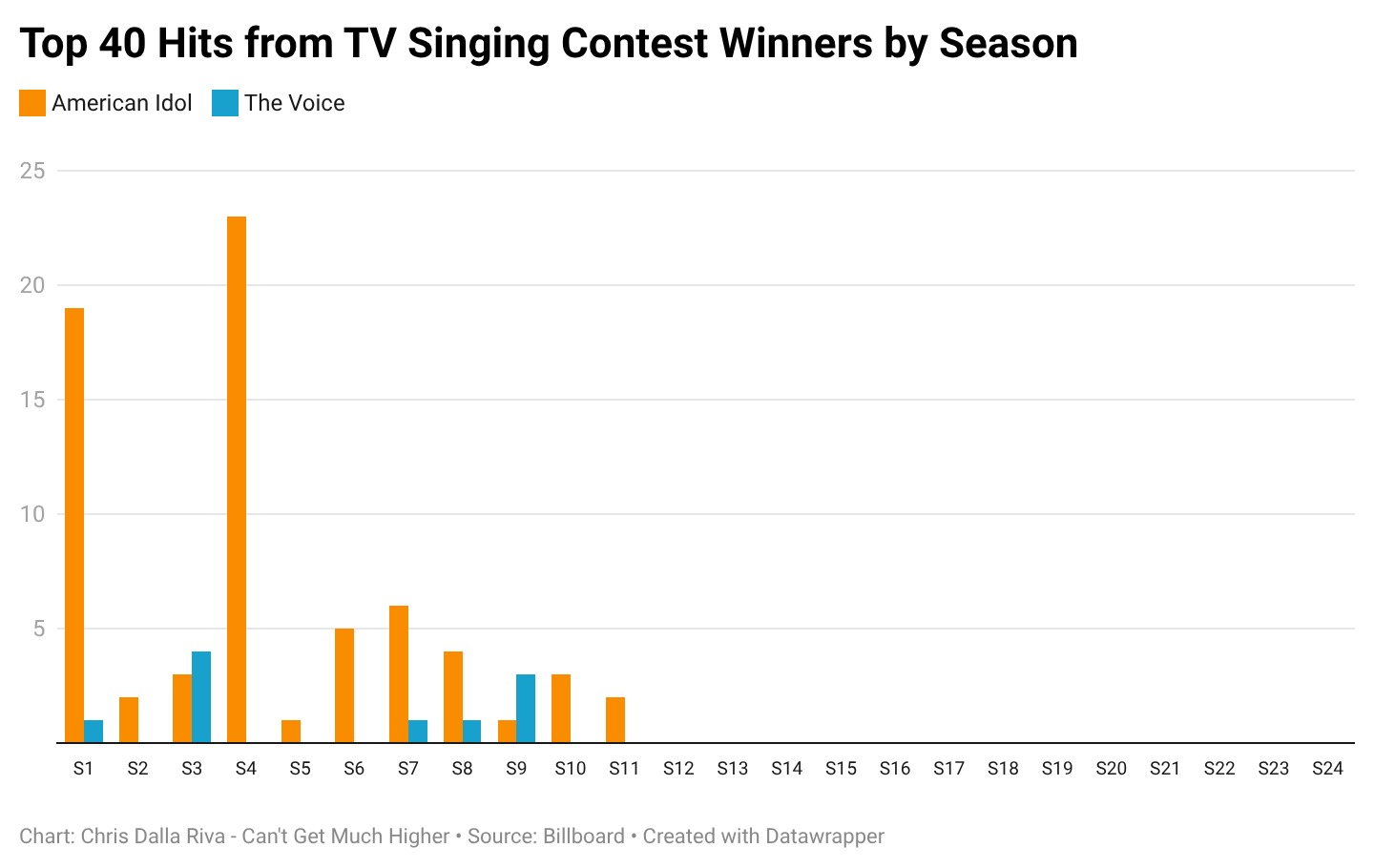
There is something missing from our discussion, though. No winner of either show has scored a top 40 hit since season eleven. That’s a long time. American Idol’s season eleven aired in 2012 with Phillip Phillips taking home the crown. The Voice’s aired in 2016 with Sundance Head winning.
These two winners are another great example of the divergent fates for winners of each show. After his victory, Phillips scored two massive hits with “Home” and “Gone, Gone, Gone,” along with the smaller “Raging Fire.” His career has been quieter since then—he appeared on the 2026 season of The Masked Singer—but it’s gone much better than Sundance Head’s. Head never scored a top 40 single. The latest news that I can find on him is that he accidentally shot himself in the stomach in 2024.
Enjoy this newsletter?
Pick up a copy of my debut book, Uncharted Territory: What
Numbers Tell Us about the Biggest Hit Songs and Ourselves.
Now, American Idol and The Voice work differently. The former has mostly a cappella auditions in front of a panel of judges. The latter uses a blind audition format where the contestant is backed by a musical ensemble. But I don’t think these divergences explain the fates of each program’s respective winners. It’s mostly timing.
American Idol began airing in 2002, and its most popular winners were in the first few years of the show. The Voice’s first season was in 2011. By then, Idol was already on its tenth season and not producing many stars. What was going on around then?
Media was becoming more fractured as websites like Facebook and Twitter began to steal eyeballs from CBS and NBC. In short, less people watched or cared about network television. A good illustration of this is American Idol’s ratings. At its peak, Idol was the number one show on television, pulling in 30 million viewers twice per week and nearly 40 million for the finale.
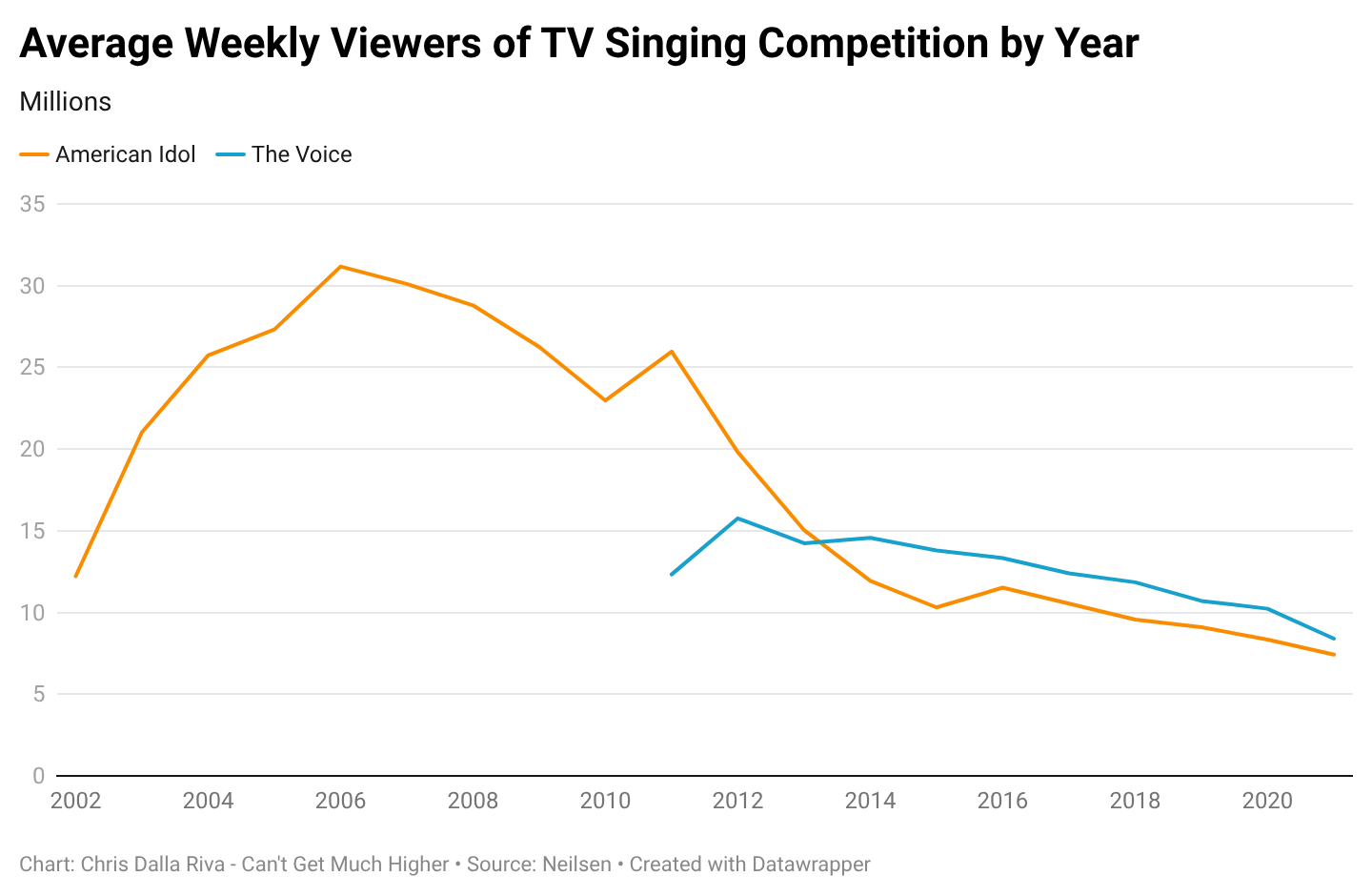
The Voice, by contrast, never averaged more than 16 million viewers per episode. It also never broke that mark for a finale. Yes, that’s still a lot of people, but it does not indicate cultural ubiquity. At its peak, an American Idol finale was reaching more than one and ten Americans. It’s much easier to launch a career when such a large portion of the population is watching.
But What about the Magic of Simon, Paula, and Randy?
If American Idol’s star-making power was really driven by timing more than some musical magic, then similar shows airing around the same time would also be able to produce stars at a near-equal rate. Lucky for us, just the show existed.
American Idol was inspired by British show called Pop Idol that functioned much the same. Pop Idol only ran for two seasons, but it was soon replaced by an even bigger British musical competition: The X Factor. Because The X Factor debuted two years after American Idol, it’s a much better comparison.
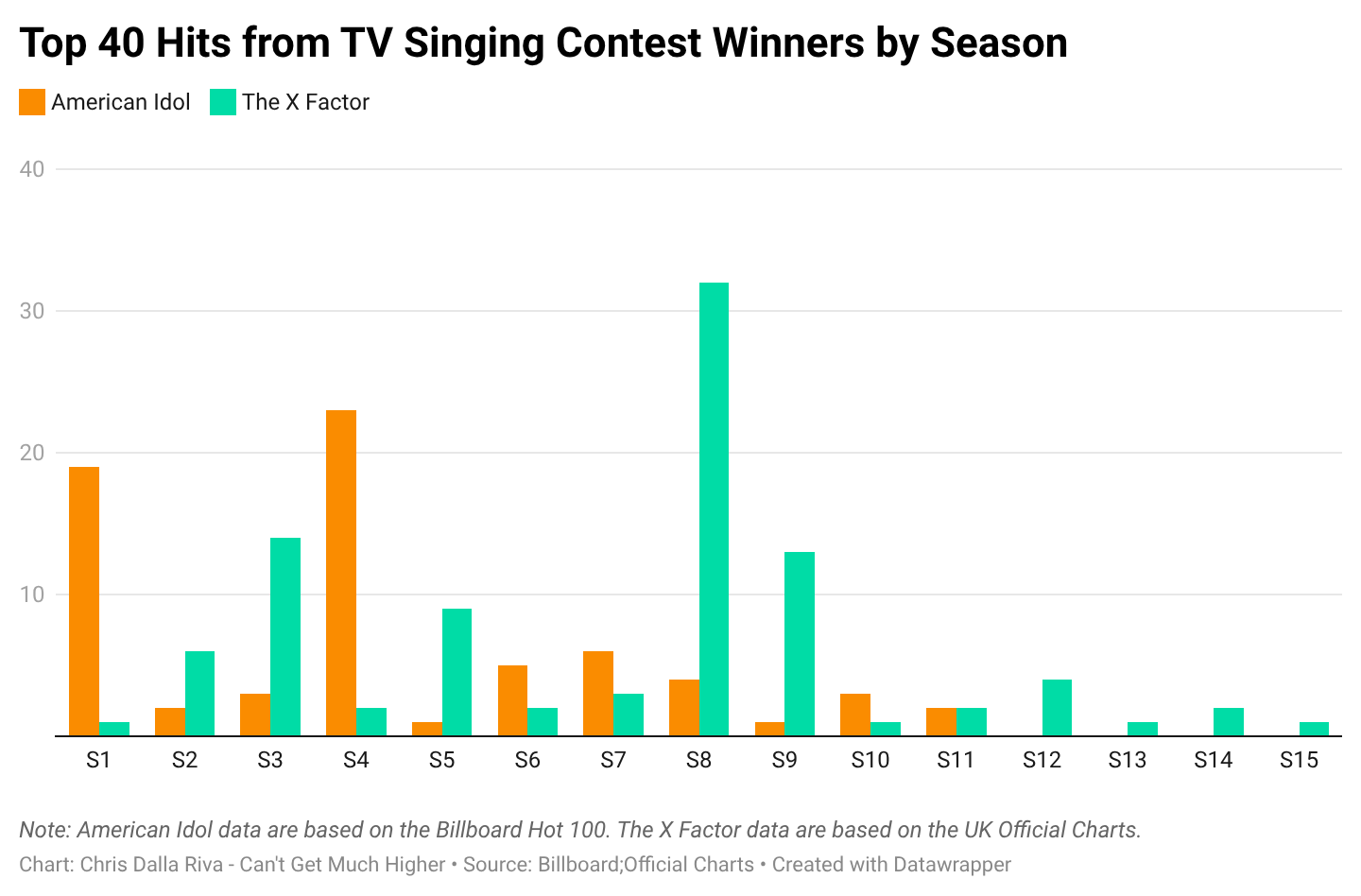
Across their respective first 15 seasons, The X Factor winners scored 35% more top 40 hits on their local chart than American Idol winners. Furthermore, The X Factor continued to generate hits after Idol’s cultural might was diminished. Little Mix, the season eight winner, is arguably the biggest act to come out of the show. Though they found effectively no success in the US, some other winners of the British show did, like James Arthur and Leona Lewis.
What’s most interesting is that even though winners of The X Factor continued to score some hits as the years went on, the show was mostly out of steam when they aired season ten in 2013. I’m sure viewer fatigue partially diminished the show’s hit-making ability, but as with Idol, a bigger factor was media fragmentation: Less people were watching the show.
So, Who’s the King of the TV Singing Contest?
Thus far, our comparisons have only looked at winners of these various singing competitions. But, as noted with American Idol, sometimes a runner-up managed to launch a big career too, like Jennifer Hudson. The same thing has happened on other shows. One Direction, for example, came in third on season seven of The X Factor. Similarly, Morgan Wallen didn’t make the podium on season six of The Voice.
To put this all together, let’s look at the careers of all finalists across the singing competition universe. This will include The X Factor and American Idol, along with the UK and US versions of The Voice. Since the shows didn’t have the same number of finalists, we’ll look at the percentage of finalists to score a top 40 hit in their home country after the conclusion of their season.
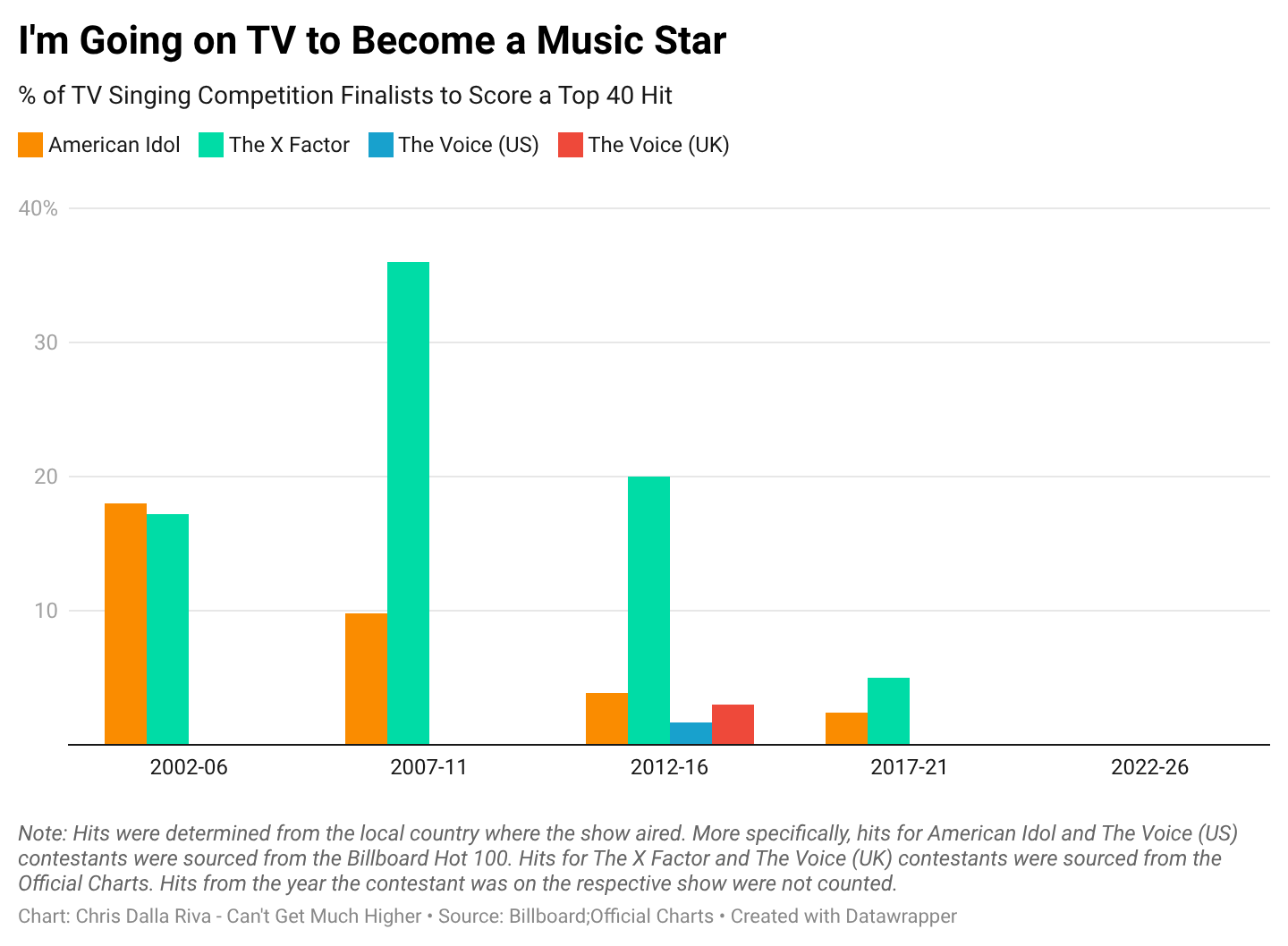
The same trends we noted earlier remain. The X Factor and American Idol were both churning out hitmakers regularly throughout the 2000s with between 15% and 35% of finalists scoring at least one top 40 hit. While The X Factor’s streak continued into the early 2010s, no show was a match for an increasingly fragmented media landscape. Both iterations of The Voice, which didn’t begin airing until after 2010, have produced close to no stars outside of Morgan Wallen (US) and Becky Hill (UK).
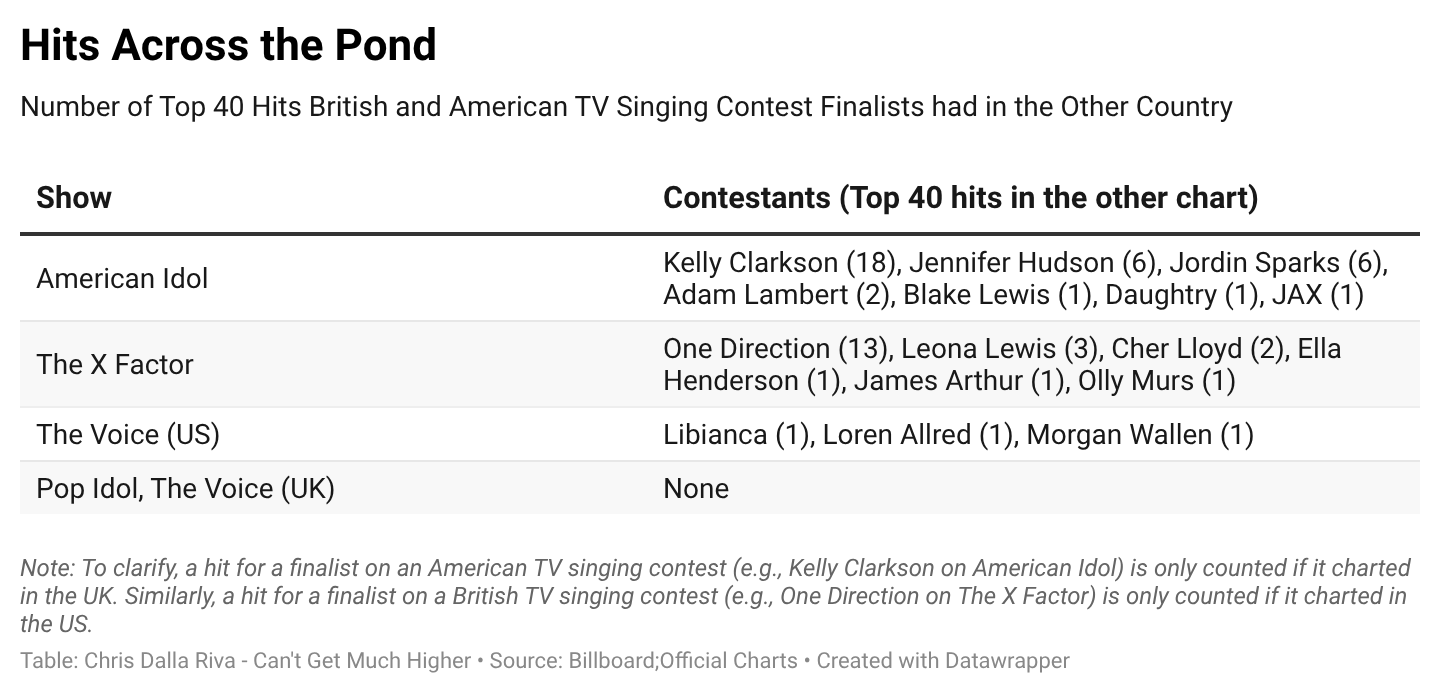
Another illustration of how much the success of the contestants on these shows was a product of television monoculture is how infrequently these performers crossed over from the country their competition aired in. Kelly Clarkson and One Direction are arguably the only true international stars to come out of the singing contest universe.
So, did any of these contests ever find a better singer than Kelly Clarkson? No. They launched some bigger careers than hers, but I don’t think anybody has matched her vocal prowess. If you think you can give Clarkson a run for her money, my one piece of advice is not to launch your career by auditioning for The Voice. Sure, you might get to sing a duet with Adam Levine, but nobody will have any idea who you are after the lights dim.
A New One
"Bittersweet" by Rachel Croft
2026 - Heartland Rock
Old media is dead. The nonexistent power of television singing competitions is evidence of that. But sometimes old media still has power, especially when it is enabled by new media.
Just a few days ago, I came across Rachel Croft on TikTok. She spent four months painstakingly making a stop-motion animation for recent single, “Bittersweet.” Though the video hearkens back to the MTV-era visuals of a-ha’s “Take On Me” and Peter Gabriel’s “Sledgehammer,” the song bears more resemblance to the riding-down-the-highway power of 1970s Bruce Springsteen and the equally propulsive 2010s work of The War on Drugs.
An Old One
"Feels Like Tonight" by Daughtry
2006 - Pop Rock
People were shocked when Chris Daughtry was eliminated from season five of American Idol. Even if you don’t like the strain of rock music that he makes—often derisively referred to as “butt rock”—you have to admit that the man can sing. Frankly, he was probably the best vocalist from that season, especially when you consider that Taylor Hicks ended up wearing the crown.
I’ve never been a huge fan of Chris Daughtry’s post-Idol music. 2000s recently-divorced radio rock, like “It’s Not Over,” doesn’t do much for me. That said, I was always struck by his “Feels Like Tonight” because it read as a pop song despite being dressed up with guitars. I wasn’t surprised when I found out who wrote it: Dr. Luke and Max Martin.
If Max Martin is certainly the most successful songwriter of the last 25 years, then the disgraced Dr. Luke isn’t far behind him. They’ve written hits for Katy Perry and Britney Spears and Kesha, among many others. For a moment in the earlier 2000s, they got involved with rock music, though. This Daughtry song is their best entry in the genre after Kelly Clarkson’s “Since U Been Gone” and Pink’s “Who Knew.”
Shout out to the paid subscribers who allow this newsletter to exist. Along with getting access to our entire archive, subscribers unlock biweekly interviews with people driving the music industry, monthly round-ups of the most important stories in music, and priority when submitting questions for our mailbag. Consider becoming a paid subscriber today!
Recent Paid Subscriber Interviews: Pitchfork’s Editor-in-Chief • Vinyl Specialist • Spotify’s Former Data Guru • Hall of Fame Songwriter• John Legend Collaborator • Broadway Arranger • Indie Label Founder• Fender Exec
Recent Newsletters: Two-Hit Wonders • The Lostwave Story • Forgotten Artists • Album Cover Colors • Bad Ways to Die • A Frank Sinatra Mystery • Slop Problems
Want more from Chris Dalla Riva? Get a copy of his book Uncharted Territory: What Numbers Tell Us about the Biggest Hit Songs and Ourselves wherever books are sold.