


Welcome back to Can’t Get Much Higher, the internet’s favorite place for music and data. If you enjoy this newsletter, check out my book Uncharted Territory: What Numbers Tell Us about the Biggest Hit Songs and Ourselves. It’s a data-driven history of popular music that I wrote as I spent years listening to every number one hit in history. Now, let’s talk about Africa.
Bless the Twang Down in Africa
By Chris Dalla Riva
When I first noticed that Dolly Parton was popular in Africa, I wasn’t terribly shocked. I work for the music streaming service Audiomack. Audiomack’s largest markets are in Africa. Most artists on Audiomack see the biggest slice of their listeners in Africa. But as I dug in, the data got weirder.
Despite 15% of Audiomack’s daily listeners being in Ghana, nearly 20% of her plays were coming from the country. In other words, she was over-indexing there. As I poked around, I realized that this was not unique to Dolly Parton.
56% of Jim Reeves’ plays were coming from Ghana even though only 15% of listeners were there
18% of Kenny Rogers’ plays were coming Tanzania even though only 3% of listeners were there
3% of Shania Twain’s plays were coming from Cameroon even though less than 1% of listeners were there
It seemed American country music was popular throughout Africa. Unexpected but not unbelievable. American popular culture has been exported around the globe for generations. There was no reason country music couldn’t find a home in Africa.
But then something even stranger happened. I took a look at Morgan Wallen’s listeners. Morgan Wallen is the biggest artist in contemporary American country music. 88% of his plays were coming from the United States. Very few were coming from Africa.
The same held for other contemporary country stars, like Jason Aldean and Luke Combs. While country stars of yore had fans in Africa, the current generation wasn’t crossing over. I wanted to find out why.
John Denver is Forever, Luke Bryan is for Today
Country music first came to Africa just as it was being recorded. In fact, some of country’s earliest stars, like Jimmie Rogers and The Carter Family, found an audience on the African continent.
But this largely isn’t the country music that you will find Africans listening to today. It’s the Nashville sound and its practitioners that found fame from the 1960s through the end of the 20th century. This sound traveled across Africa in a few ways.
Colonialism: Along with many horrors brought by colonial powers in Africa, cultural ideas were also exchanged, especially on work sites. Gold mining companies, for example, would occasionally screen westerns for workers, often as a means of propaganda.
Radio: Throughout the 20th century, radio became much more pervasive throughout Africa. Radio is one of the easiest ways to transmit music.
Christian Missionaries: Missionaries, especially those from the American south, came to African in droves throughout the 20th century. They brought along cultural pieces from their homes.
Regardless of the forces that brought the music, nothing would matter if Nigerians, Ghanaians, Tanzanians, South Africans, and others didn’t care for the genre. But they clearly identified with it. And there are two reasons as to why.
First, country music from the first half of the 20th century shared some overlap with some indigenous African music. The aforementioned Jimmie Rogers, for example, made a name for himself with his blue yodels. Some indigenous African styles used similar vocal approaches.
Second, Africans were able to identify with many of country’s lyrical themes. To understand why, we need to turn to China for a moment. John Denver, as author Yi-Ling Liu told me a few months ago, is huge in China because of how people were moved by his words in a time of social upheaval:
“Country Roads” is the [John Denver] song that really took off in China. I think people identified with the nostalgic simplicity of the song at a moment of rapid urbanization and economic upheaval.
We see a similar effect throughout the African nations that took to country music. In 1960, about 15% of Sub-Saharan Africans lived in urban areas as defined by the World Bank. By 1990, the urban share of the population had doubled and showed no signs of stopping.
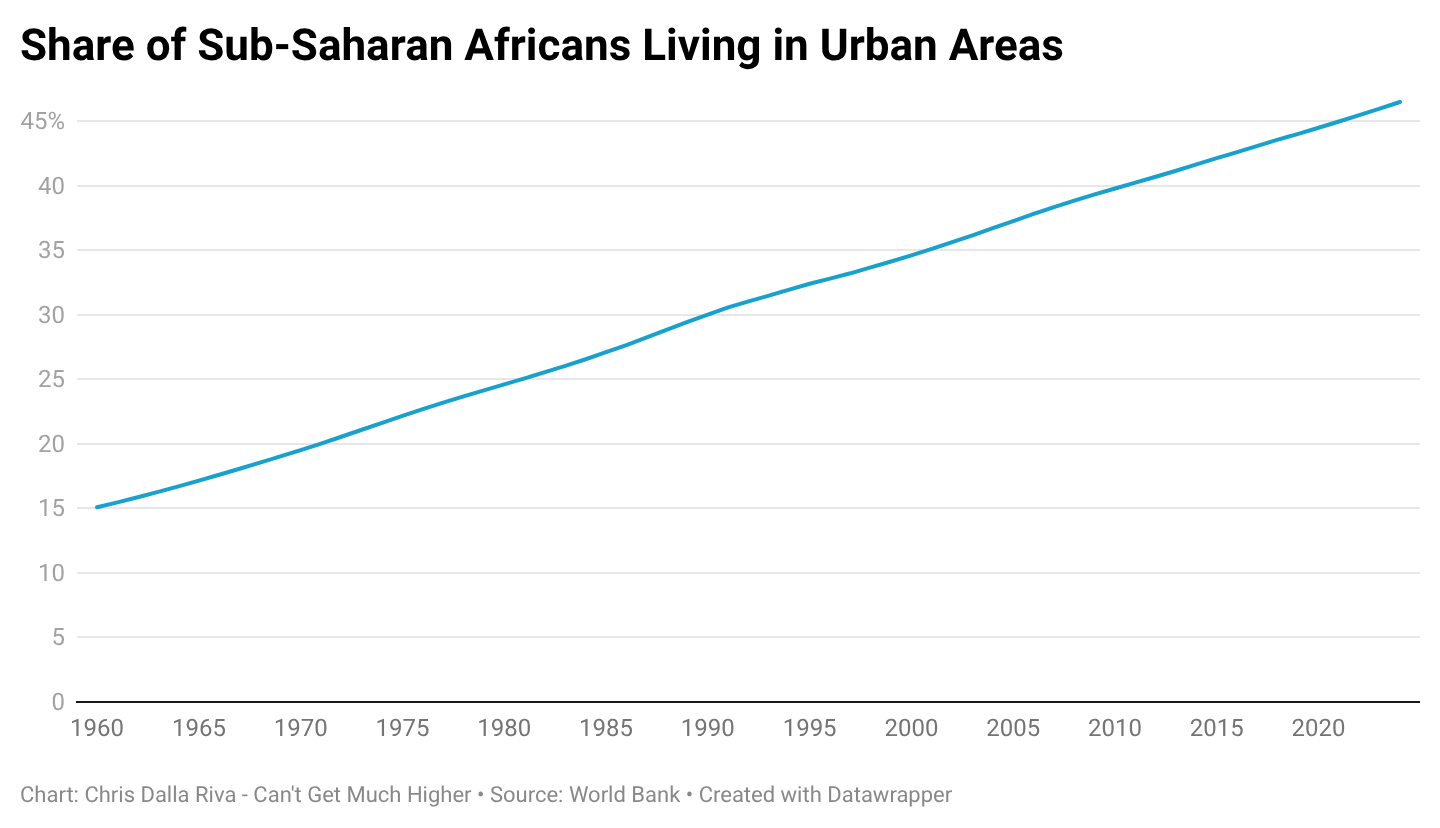
Just as country music arrived, Africans were beginning to leave rural areas for opportunities in the city. Country lyrics (almost stereotypically) focus on longing for the old ways—small towns and better days. That’s something you can identify with whether you’re from Nashville or Nairobi.
This phenomenon also explains why newer country acts, like Morgan Wallen and Luke Bryan, have not crossed over. Because they arose post-urbanization, their music doesn’t evoke nostalgia in the same way.
The Don Williams Effect
As I dug into the success of African country music on Audiomack, the ubiquity of one name surprised me: Don Williams. Don Williams is not obscure. He’s a member of the Country Music Hall of Fame. But in certain parts of Africa, he’s as famous as Johnny Cash and Dolly Parton.
When Williams died, comedian Ted Malanda quipped to The Standard, the oldest newspaper in Kenya, “Moment of silence for the thousands of Kenyan kids who were conceived with Don Williams crooning in the background.” When I asked my Nigerian coworker about Williams, he noted that his father “literally brainwashed us with his songs.” Beyond the positivity of much of his music, what was the appeal of Mr. Williams?
Many of the American country stars beloved by Africans never made a trip over to the continent. The two outliers were Jim Reeves and Don Williams. Reeves performed in South Africa in the early 1960s not long before dying in a plane crash. Williams performed in Zimbabwe in 1997 and documented his trip in a concert documentary, Into Africa.
When Don Williams sat down to write “Tulsa Time,” I doubt he was thinking about how it would connect with millions in Zimbabwe, Kenya, and Nigeria. I’m sure John Denver gave just as much thought to how “Take Me Home, Country Roads” would become an anthem in China.
But the success of those songs internationally is a great reminder of how powerful music can be. Unlike almost any other art form, music can easily transport across time and place. Its success is also a great reminder that when artists go on a “world tour,” they should look beyond the borders of North America and Europe. Your biggest fans may be hiding in the most unexpected places.
A New One
"Ngyakhumbula" by Dusty and Stones
2026 - Country
Though the classic country style has lost some favor in Africa over the last few decades, some artists are clearly still influenced by it. Dusty and Stones, an Eswatini duo, not only works in the style, but don all the required garb, cowboy hat included. Their latest single “Ngyakhumbula” has many of the signifiers that you would expect from a typical country song.
An Old One
"Guabi Guabi" by George Sibanda
~1950 - Folk
Not only did American country music have an impact on African musicians, but the relationship sometimes moved in the other direction too. George Sibanda, for example, became one of the first big recording stars in Sub-Saharan Africa. His “Guabi Guabi” was later recorded by American folk artists, like Ramblin’ Jack Elliot and Arlo Guthrie.
Shout out to the paid subscribers who allow this newsletter to exist. Along with getting access to our entire archive, subscribers unlock biweekly interviews with people driving the music industry, monthly round-ups of the most important stories in music, and priority when submitting questions for our mailbag. Consider becoming a paid subscriber today!
Recent Paid Subscriber Interviews: Pitchfork’s Editor-in-Chief • Vinyl Specialist • Spotify’s Former Data Guru • Hall of Fame Songwriter• John Legend Collaborator • Broadway Arranger • Indie Label Founder• Fender Exec
Recent Newsletters: Two-Hit Wonders • The Lostwave Story • Forgotten Artists • Album Cover Colors • Bad Ways to Die • A Frank Sinatra Mystery • Slop Problems
Want more from Chris Dalla Riva? Get a copy of his book Uncharted Territory: What Numbers Tell Us about the Biggest Hit Songs and Ourselves wherever books are sold.
There's (at least one!) wonderful episode of the podcast Afropop Worldwide about this phenomenon
From Nashville to Nairobi: A History of Country Music in Kenya | Afropop Worldwide https://share.google/lk5mHwxijGZjthTuZ
I love these instances of musical cross pollination
That's really cool.