


Welcome back to Can’t Get Much Higher, the internet’s favorite place for music and data. If you enjoy this newsletter, check out my book Uncharted Territory: What Numbers Tell Us about the Biggest Hit Songs and Ourselves. It’s a data-driven history of popular music that I wrote as I spent years listening to every number one hit in history.
Did Guitar Hero Change Classic Rock?
By Chris Dalla Riva
I could not tell you what I got for Christmas most years. The family meals and time with my cousins are more vivid in my mind than what was under the tree. That wasn’t the case in 2007, though. I know exactly what Santa left at my house: Guitar Hero III: Legends of Rock.
Video games weren’t really my thing growing up. But when I played Guitar Hero II on my friend’s PlayStation 2 not long before Christmas, I knew that I needed the next installment if Activision made a version for the only console I had, the Nintendo Wii. Luckily, they did.
Guitar Hero III had a big impact on a young Chris Dalla Riva. Not only did it make for hours of fun with friends, but it exposed me to scores of great rock songs. Yes, I was already a student of the game in 2007—my guitar lessons having begun a year or two earlier—but the Guitar Hero franchise put some incredible six-string work on my radar, like Blue Öyster Cult’s “Cities on Flame with Rock and Roll” and Living Colour’s “Cult of Personality.”
There’s no doubt that the Guitar Hero franchise impacted popular music. Many bands saw surges in sales after being featured in the game. The Rock & Roll Hall of Fame claimed there was new interest in the museum from younger people after the games came out. Activision CEO Bobby Kotick even noted that Aerosmith made more money from their installment of the game than any of their albums.
I’m not interested in those metrics, though. Those are short-term vanity statistics. Aerosmith making millions of dollars in 2008 doesn’t tell me how their legacy is evolving. I want to know if Guitar Hero changed how we think about classic rock.
LOU GRAMM VOICE: “TO BE A GUI-TAR HERO!”
In each of the last 21 years, the popular New York City classic rock station Q104.3 has polled their listeners on the top 1,043 greatest classic rock songs. This fun survey allows us to gauge how the classic rock canon has changed over time. “Kryptonite” by 3 Doors Down, for example, did not make regular appearances on the list throughout the 2000s. Now, it’s there every year. In short, 3 Doors Down is now a classic rock band.
This dataset, which I wrote about more extensively in my piece “Classic Rock is Changing,” can be put to good use here. First, we can see if songs were more likely to make the list after being included in Guitar Hero. Second, if that were the case, we could then see if the games helped those songs cement themselves in the classic rock canon by moving up the list. I regret to inform that neither of the things happened. Guitar Hero did not change the classic rock canon.
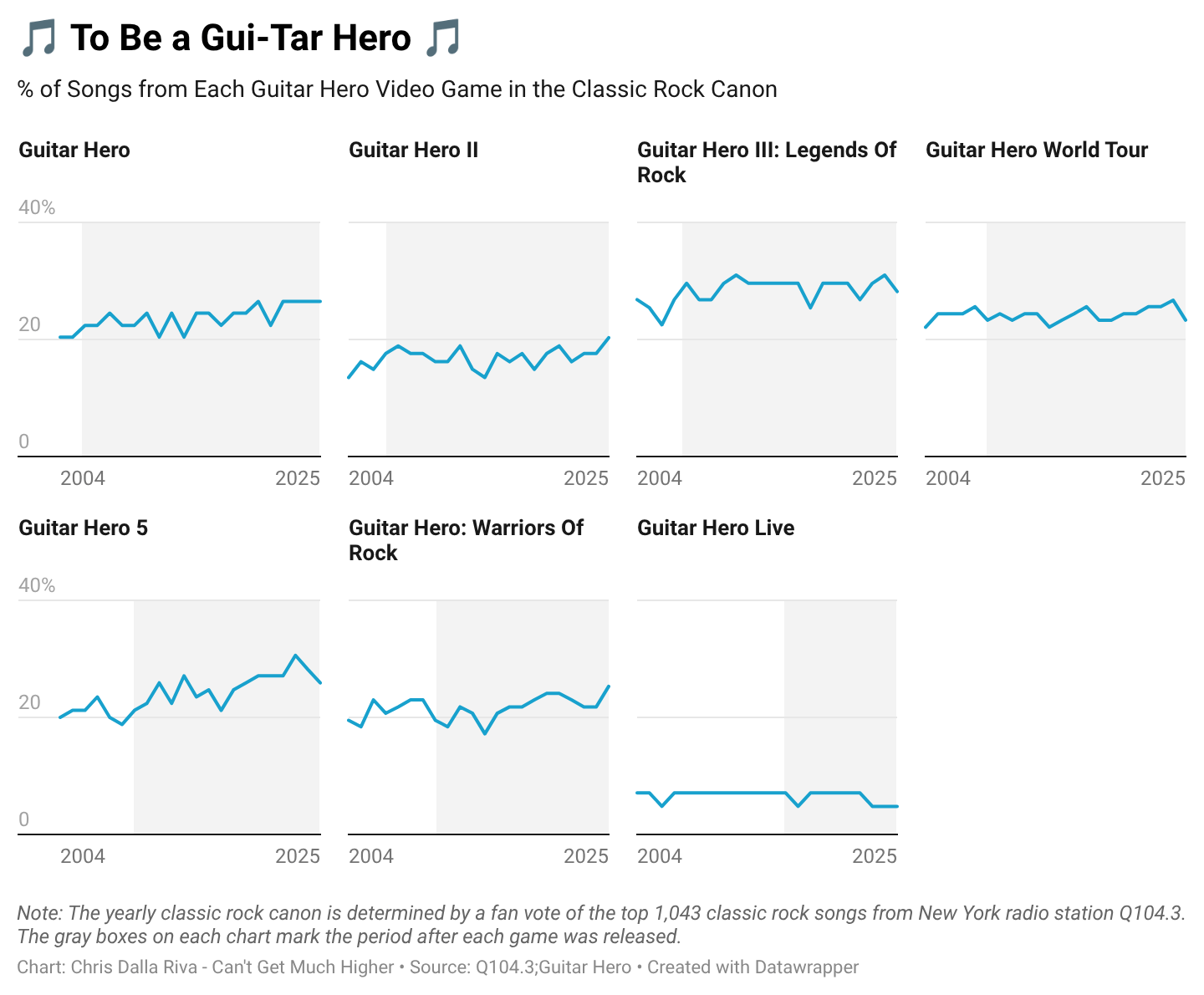
Above you can the percentage of songs from each Guitar Hero game that were included in each of Q104.3’s greatest classic rock songs lists. If these games had an impact on people’s perception of classic rock, then we would expect them to shape the list after their release. They do not.
For example, my beloved Guitar Hero III: Legends of Rock came out in late 2007. If the game affected listeners’ perceptions of the past, then we would expect more of the songs from the game to make Q104.3’s list in 2008 and each year after. In 2004, 26.8% of the songs that would be in the game were on the Q104.3 list. In 2008, 29.6% were.
Though you could try to make the case that the small increase is due to the game, it’s really just noise. The rate fluctuates up and down every year, only crossing 30% in a single year. A similar pattern holds for all the other games. They may have led to a short-term boost in sales, but they did not change what fans thought of as classics of the genre.
I found this result kind of upsetting. I really wanted these games to impact the general public—whether they knew it or not—just like they impacted me and my peers. But there’s just not much there.
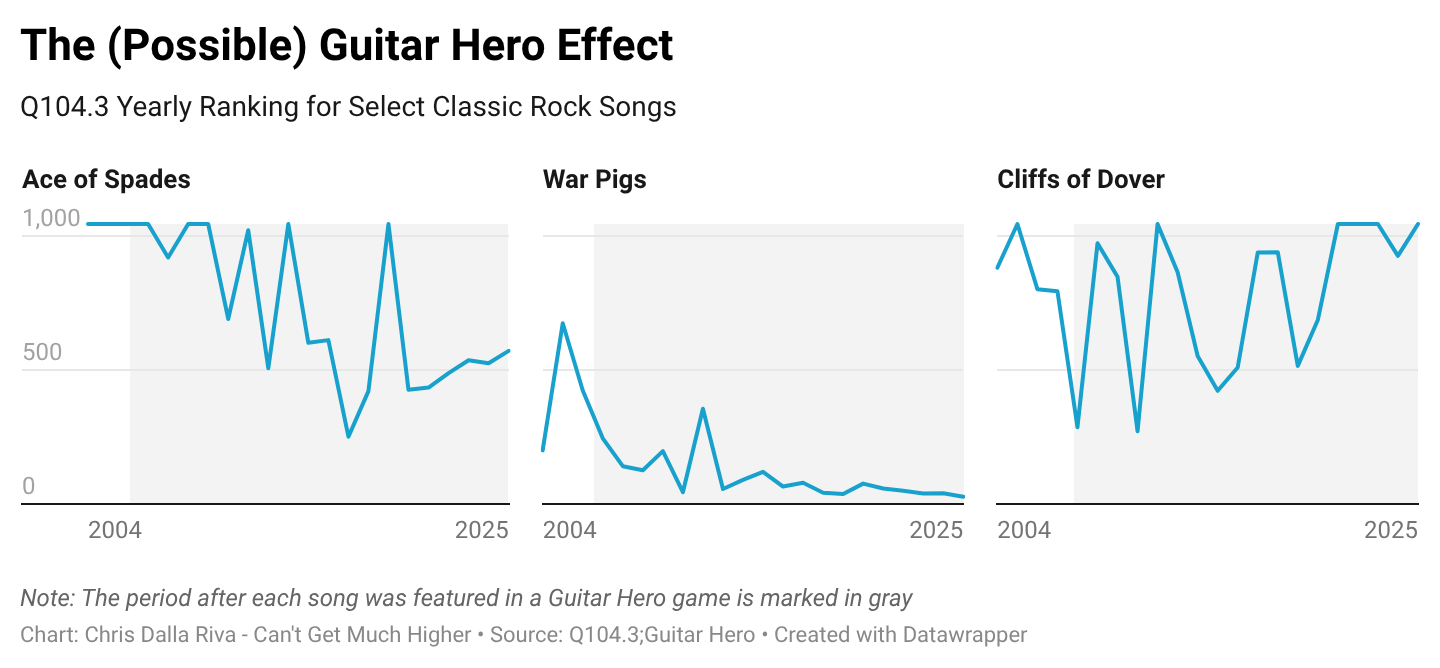
Maybe if you squint hard enough, you could make the case that certain songs saw some benefit. Eric Johnson’s“Cliffs of Dover” looks to have seen a bump after its inclusion in Guitar Hero III: Legends of Rock. The same goes for Motörhead’s “Ace of Spades” in the original Guitar Hero and Black Sabbath’s “War Pigs” in the follow up. Even so, I don’t think the data is compelling enough to really make those claims.
I Guess We Have to Make Classics the Old-Fashioned Way
In my original piece that I built this dataset for, I show how classic rock does indeed change. Tears for Fears’ “Everybody Wants to Rule the World,” for example, went from missing the list every year for a decade to making the top 100. A video game could inspire a similar trend. Guitar Hero didn’t, though. Why?
First, these games were not trying to be tastemakers. They were balancing recognizability with licensing and engineering constraints. In fact, between 20% (Guitar Hero II) and 45% (Guitar Hero Live) of songs in the games had previously cracked the Hot 100. To boot, those that failed to chart were usually not obscure (e.g., “Pride and Joy” by Stevie Ray Vaughn).
Second, the games always had a healthy serving of contemporary songs, especially as time went on. In the original Guitar Hero (2005), 55% of songs were released after the year 2000. In Guitar Hero Live (2015), 93% were. Songs don’t typically enter the classic rock canon until they’ve been out for at least 20 years. Most of these song aren’t old enough yet.
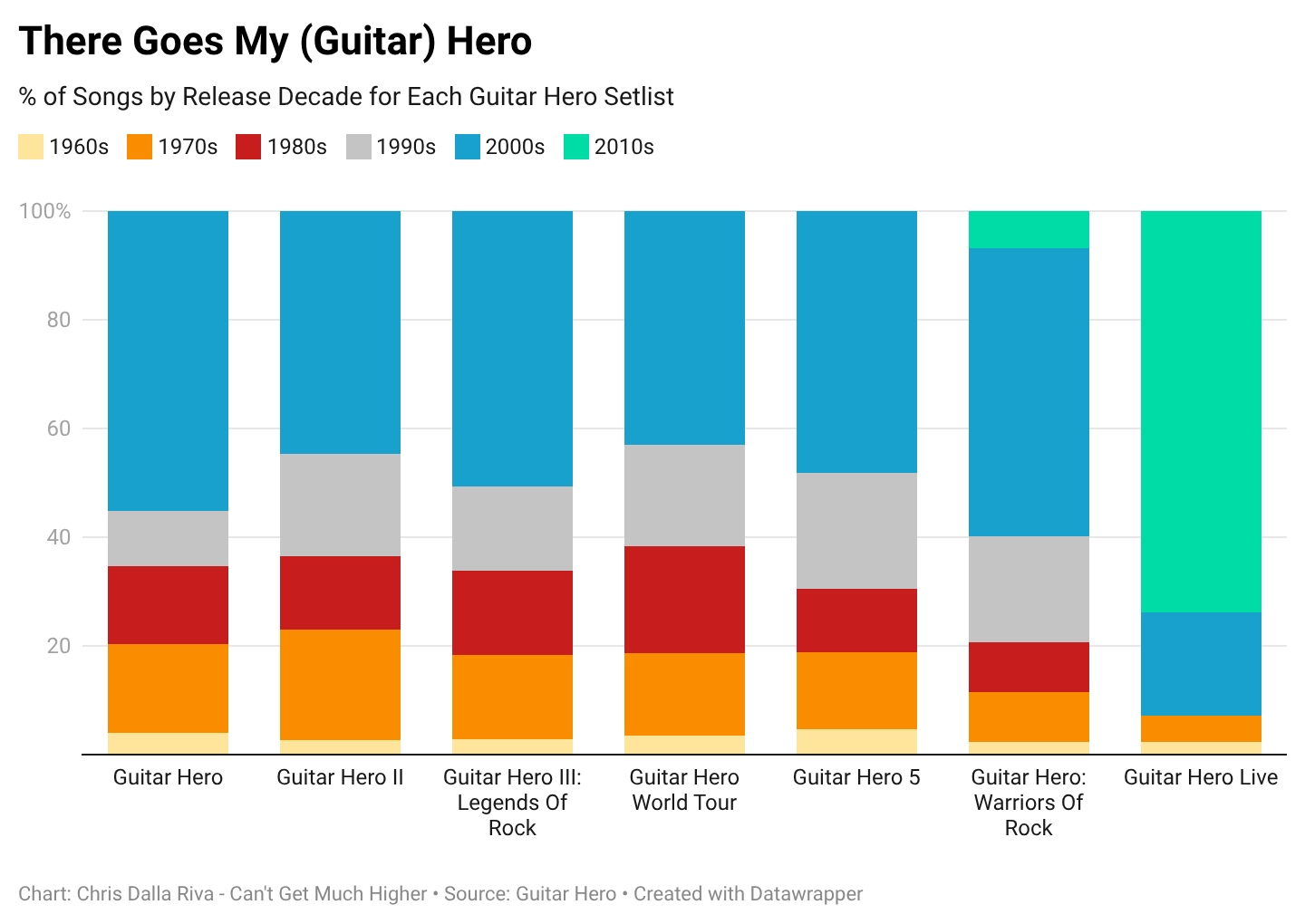
That may suggest that my analysis thus far is deficient. Once again, I’m sad to report that even if you limit just to songs released before 1996, these games had no notable impact on listener’s perception of classic rock.
Sticking to my favorite installment in the series, 45.7% of songs released before 1996 in Guitar Hero III: Legends of Rock were on Q104.3’s list the year before the game came out. The year after, 51.4% were. Looks like a notable bump, but the next year it was back down 45.7%. In other words, if you want to write a song that plays endlessly on your local classic rock station, you’ve got to try somewhere else than getting said song in a video game.
A New One
"Grease Baby" by Clutter
2026 - Indie Rock
The riffs that defined the Guitar Hero franchise are not common in the pop world these days. In fact, they’re not even that common in the rock world, the genre looking more to atmosphere than finger-twisting pyrotechnics to get the point across. But Clutter, a Swedish four-piece, has enough riffs on their song “Grease Baby” to satisfy your average Guitar Hero player. To quote Chris DeVille at Stereogum, “No wheels are reinvented here, but baby, they’re rolling fast.” That’s just alright by me.
An Old One
"Knights of Cydonia" by Muse
2006 - Progressive Rock
In 1962, The Tornados teamed up with the eccentric producer Joe Meek to make a wacky piece of space age pop that somehow went to the top of the charts: “Telstar.” “Telstar” is a curiosity. It’s an instrumental that sounds like it could soundtrack George Jetson flying to work. Because of that, it’s not a shock that The Tornados didn’t last much longer than their big hit.
But “Telstar” has left an impression in unexpected ways. George Bellamy, the rhythm guitarist on the track, would later have a son named Matthew. Matthew, in turn, would get into the family business, founding the band Muse. In 2006, Muse would score a big hit in the United Kingdom with “Knights of Cydonia,” an homage to Matthew’s father’s work in The Tornados.
Like “Telstar,” “Knights of Cydonia” has propulsive, alien energy. Unlike “Telstar,” it found its way into the Guitar Hero’s 2008 installment. That game did not make “Knights of Cydonia” a classic, but it did help bring the song to my ears.
Shout out to the paid subscribers who allow this newsletter to exist. Along with getting access to our entire archive, subscribers unlock biweekly interviews with people driving the music industry, monthly round-ups of the most important stories in music, and priority when submitting questions for our mailbag. Consider becoming a paid subscriber today!
Recent Paid Subscriber Interviews: Pitchfork’s Editor-in-Chief • Vinyl Specialist • Spotify’s Former Data Guru • Hall of Fame Songwriter• John Legend Collaborator • Broadway Arranger • Indie Label Founder• Fender Exec
Recent Newsletters: Two-Hit Wonders • The Lostwave Story • Forgotten Artists • Album Cover Colors • Bad Ways to Die • A Frank Sinatra Mystery • Slop Problems
Want more from Chris Dalla Riva? Get a copy of his book Uncharted Territory: What Numbers Tell Us about the Biggest Hit Songs and Ourselves wherever books are sold.
Betteridge's Law holds true. Would have been cool though.
Great article. Definitely made an impact. I always wonder if this is also why Paint It Black is The Rolling Stones most streamed song when it doesn't even make my top 20 stones' songs. Introduced me to a lot of great songs too.
Literally just the other day played it at an arcade and decided to go on Marketplace to pick up an old Wii and bring it back. Pretty serendipitous timing for you to post this!!!