


Welcome back to Can’t Get Much Higher, the internet’s favorite place for music and data. If you enjoy this newsletter, check out my book Uncharted Territory: What Numbers Tell Us about the Biggest Hit Songs and Ourselves. It’s a data-driven history of popular music that I wrote as I spent years listening to every number one hit in history. Now, let’s talk Drake.
Drake is the Past. Drake is the Future.
By Chris Dalla Riva
Last week, Drake surprised fans by not only releasing the album he’d previously announced, ICEMAN, but two others: MAID OF HONOR and HABIBTI. These three records amounted to a runtime of nearly 2.5 hours across 43 songs.
The commercial reaction to this onslaught of music has been quite positive, Drake clogging up nearly every slot on Spotify’s daily charts. The critical reaction has been a bit more mixed, though. The pop critics at The New York Times fawned over the trio of albums. Pitchfork, on the other hand, rated ICEMAN a 4.8 out of 10, noting, “As his relevance falters, Drake’s eye for slights and score-settling has grown so microscopic that even his stans need tweezers.”
I’m probably not the guy you want to turn to for Drake takes, but what I’ve found most interesting about the discourse around his records is fans suggesting that Aubrey Graham needs an editor. Why not pick your best 14 tracks instead of releasing 43?

As someone who sometimes convinces himself that every double album would be better if it were trimmed down to a single disc, I think this is a great question. But it’s not a question you should only pose to Drake.
In 2022, Future released the 22-track I NEVER LIKED YOU. Two years later, Taylor Swift dropped the 31-track THE TORTURED POETS DEPARTMENT. Morgan Wallen went even bigger the next year, putting out the 37-track behemoth I’m The Problem.
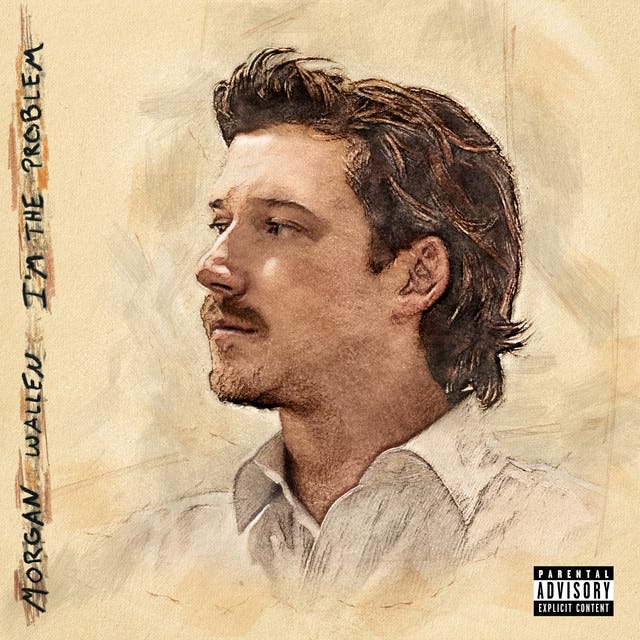
Maybe every pop star needs an editor. Outside of Stevie Wonder in 1976, almost nobody is releasing more than 15 masterful songs at once. But even if it’s a bad artistic decision, these endless albums make perfect sense in our current age.
If You’re Reading This, Just Know That I Never Thought I’d Have This Much to Say About Drake
Drake has always been a prolific artist. In the decade after the release of his 2006 debut mixtape, he released 8.5 hours of music across 135 tracks and 8 official full-length projects, bonus track excluded. As a point of comparison, fellow pop star Taylor Swift—who also happened to release her debut in 2006—released just under 5 hours of music across 71 tracks on 5 official full-length projects.
Even so, Drake wasn’t releasing an intractable amount of music. His most productive year during his first decade was 2015 when he released two mixtapes: If You’re Reading This It’s Too Late and What a Time to Be Alive. Those projects were released 6 months apart and had a digestible 28 tracks over two hours.
But even for a prolific artist, something has changed for Drake as his career has progressed. If we break up his career into 5-year chunks, the last half-decade is outpacing every other by a wide margin.
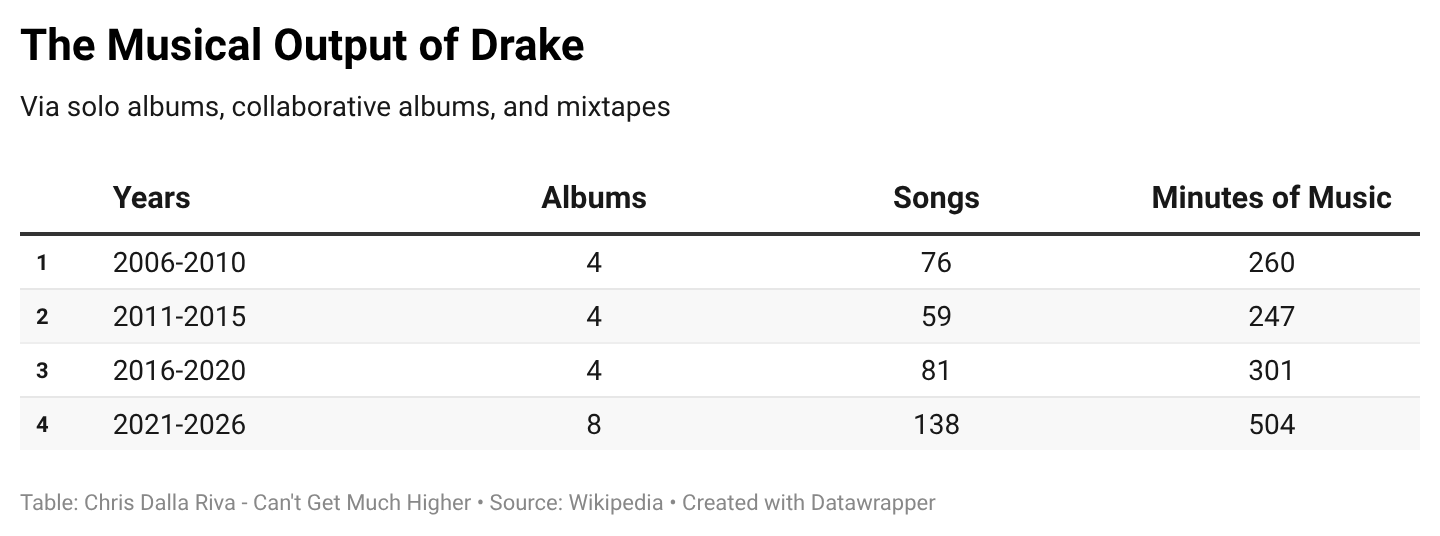
Between 2021 and 2026, Drake has released 8.4 hours of music across 138 tracks and 8 official full-length projects. That’s not only double the albums—and 67% more music—than the 5-year stretch immediately prior (i.e., 2016-2020), but effectively the same output as the first decade of his career.
What changed for Champagne Papi? Does he just have more to say? Probably. But Drake—the man who famously wrapped “Money over everything”—is really just playing by the rules of the music industry like he always has been.
Decades ago, there were limited vectors through which you could promote your music. You had radio, a few television shows, some magazines, and live tours. If you released too much music—even if fans could afford it—there was probably going to be no way to properly promote it. You could only be booked on a television show so often in a short period. Plus, you could only be in so many places at once.
The internet started to break down these barriers in the late 1990s and early 2000s. Physical shelf space was replaced by the limitlessness of the web. But the old promotional paradigm was tough to shake. Artists still hit many of the same media properties to get their music to fans.
Drake was borne in this world. And his early output reflects it. He would release a full-length project every year or so, and those projects would really only max out around 17 or 18 tracks. Through this model, Drake became an era defining superstar, a rare performer who could rap and sing with great facility. As I noted in the title of this piece, Drake is the past.
But Drake does not live in the past. And his last decade of output is proof of that. He’s released at least one full-length project ever year since 2020, many of which broach 20 tracks. This is the way pop stars now live. Why?
Promoting music has changed dramatically in the last decade. There are now endless ways to get your music to fans. At the same time, nobody seems to know what will work. Nobody knows which tracks will pop off on TikTok. Nobody knows which will spawn a meme. In a limitless world where no one knows anything, the best bet is to throw everything at the wall and see what sticks.
Curation doesn’t sell like it did in 1984. Drake, a man that feels like the last vestige of the 20th century’s monoculture, is pointing toward the future.
The Albums Lives Even if Curation Dies
A few weeks ago, I defended the album’s importance in the streaming age. “If you want a career,” I noted, “you need to make great albums.” Today’s newsletter may read like a point against that claim. If we’re just firing tons of songs off at once and seeing what people glom onto, isn’t that evidence that the album doesn’t matter anymore? I don’t think so.
First, even if we get these long, winding albums, they usually still have some level of sonic cohesion. Each album in Drake’s trio, for example, has a distinct feel. They respect the old-fashioned album format while also ushering us to something new.
Second, the multi-year gap between albums might have been a historical aberration. Mark Richardson asked me about the evolution of the length of time between album releases in a mailbag a few weeks ago. In the 1960s, you were regularly seeing pop stars release multiple albums within a single year.
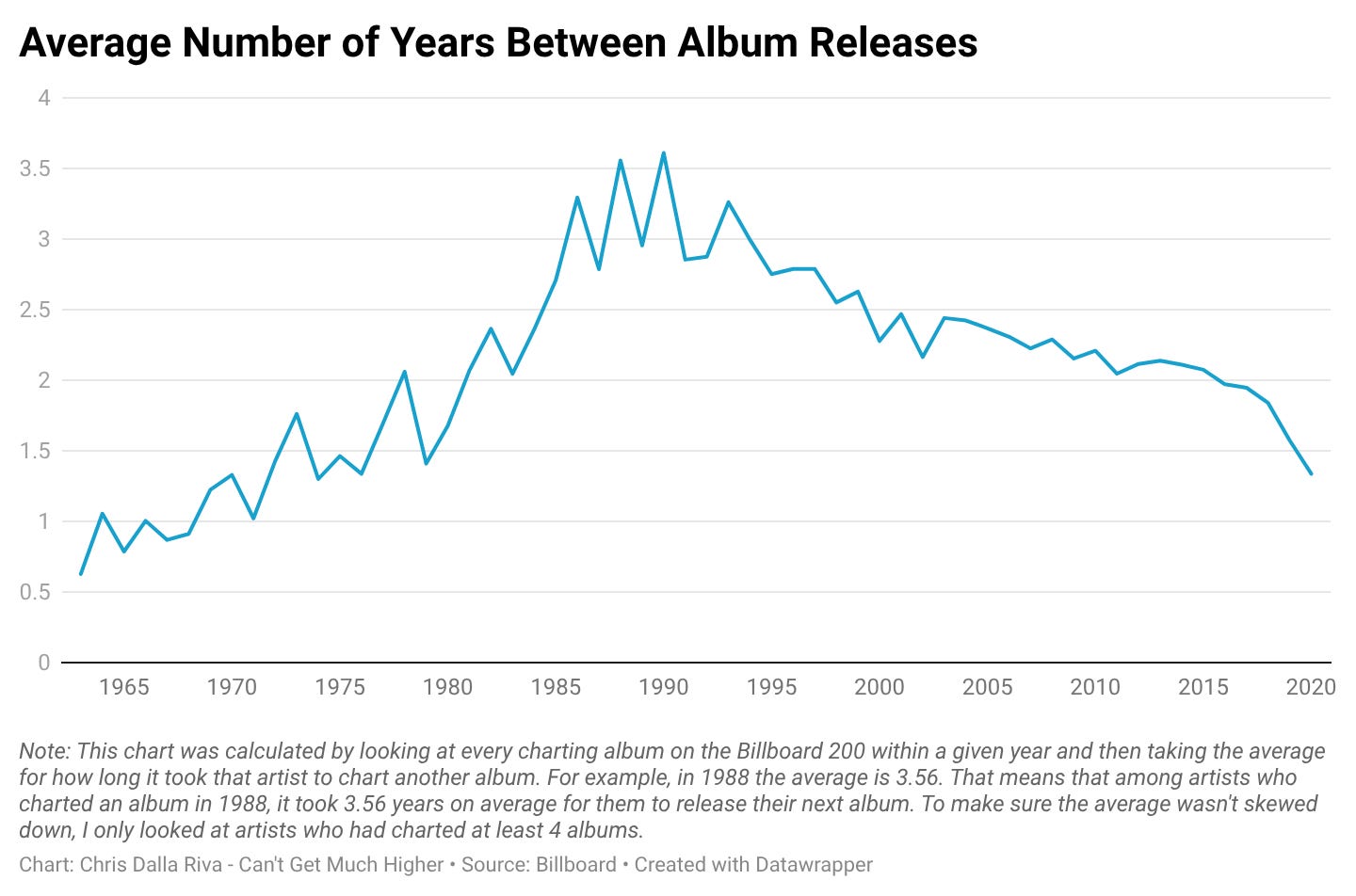
The three-year gap between albums that many middle-aged folks grew up with was a product of the 1980s. Since then, artists have been releasing more regularly with the time between albums shrinking faster during the streaming age. In many ways, it feels like we are headed back to the age of psychedelia.
That doesn’t have to be a bad thing. You might get tons of musical crap if artists are releasing music too often, but you also might get The Beatles. The Fab Four not only released two albums per year in 1963, 1964, and 1965, but their entire career was over in less than a decade. If they had waited, we would have missed out on a lot of great music.
A New One
"frog" by monica.com
2026 - Glitchy Electronic
When I stumbled upon the artist monica.com last week, I naturally sent it to my friend Monica telling her that I’d just found a new favorite artist. At that point, I hadn’t even clicked play. I just thought “monica.com” was a funny name. When I eventually got around to listening, I was happily surprised. Their latest single, “frog,” was weird and glitchy and playful, perfect for turning your bedroom into a lo-fi rave.
An Old One
"I’m Happy Just To Dance With You" by The Beatles
1964 - Merseybeat
The Beatles were remarkably prolific during their short run as a band. Even as a huge fan of the group, I’ll admit that they sometimes missed, especially on their early records. But because they weren’t limiting themselves, there are also so many underrated gems among those releases. “I’m Happy Just To Dance With You” is one of those gems.
It’s clear that this song was tossed off very quickly. It’s not even two minutes. But there are elements of sophistication hidden in this track. For a song about the joys of dancing with someone you’re coming to love, the minor key creates an unexpected tension. That tension is furthered by a rhythm guitar scratching along at breakneck pace. But above all that, George Harrison sounds relaxed on the microphone, capturing the heart-thumping rush of falling in love on the dancefloor.
Shout out to the paid subscribers who allow this newsletter to exist. Along with getting access to our entire archive, subscribers unlock biweekly interviews with people driving the music industry, monthly round-ups of the most important stories in music, and priority when submitting questions for our mailbag. Consider becoming a paid subscriber today!
Recent Paid Subscriber Interviews: Pitchfork’s Editor-in-Chief • Vinyl Specialist • Spotify’s Former Data Guru • Hall of Fame Songwriter• John Legend Collaborator • Broadway Arranger • Indie Label Founder• Fender Exec
Recent Newsletters: Two-Hit Wonders • The Lostwave Story • Forgotten Artists • Album Cover Colors • Bad Ways to Die • A Frank Sinatra Mystery • Slop Problems
Want more from Chris Dalla Riva? Get a copy of his book Uncharted Territory: What Numbers Tell Us about the Biggest Hit Songs and Ourselves wherever books are sold.
the lack of comments here is purely another example of the industry blackballing Drake
I saw something several years ago about how Drake was at that point the most successful artist ever (or something like that) and thought it was odd because I couldn't name a single Drake song. Well, I still can't.