


Welcome back to Can’t Get Much Higher, the internet’s favorite place for music and data. Before we talk about men metaphorically dying, I wanted to note that I’ve been doing some terrestrial radio spots to talk about my book, Uncharted Territory: What Numbers Us about the Biggest Hit Songs and Ourselves. Check those out if you get a chance. Now, onto the dude.
Is the Dude Dying?
By Chris Dalla Riva
Harry Styles recently released a new single for the first time in four years. “Aperture,” that single, debuted at number one before tumbling down the charts the following week. Still, Styles’ return was celebrated by his mob of adoring fans.
“BENSON BOONE IS SHAKING IN HIS BOOTS,” one of his fans joked online. Benson Boone, if you are not familiar, has scored four top 40 hits over the last couple years. And people online will sometimes joke that he only got famous because (a) he does backflips on stage and (b) Harry Styles was on hiatus when his music first dropped.
Part of the implication is that when it comes to male pop stars, Harry Styles is at the top of the food chain. Styles doesn’t seem to have much competition, though. While new women have come to dominate the pop scene, like Sabrina Carpenter and Chappell Roan, it feels like male pop stars are an endangered species.
Frankly, if somebody asked me to name a male pop star, the first people that would come to mind would be those that first arrived over a decade ago, like Drake, Ed Sheeran, Justin Bieber, and Bruno Mars. That seems odd. If you go back to, say, the 1980s, there were tons fresh male faces at the top of the pops. Maybe the male pop star is just a thing of the past.
How Men Measure Up
At the end of each year, Billboard magazine publishes a list of the hundred most popular songs. In 1967, for example, they listed Lulu’s “To Sir With Love” as the most popular. 40 years later, it was Beyoncé’s “Irreplaceable.” To see if the male pop star is actually a thing of the past, I grabbed each of Billboard’s year end lists since 1960 and flagged the gender of every artist who had a song on the list.
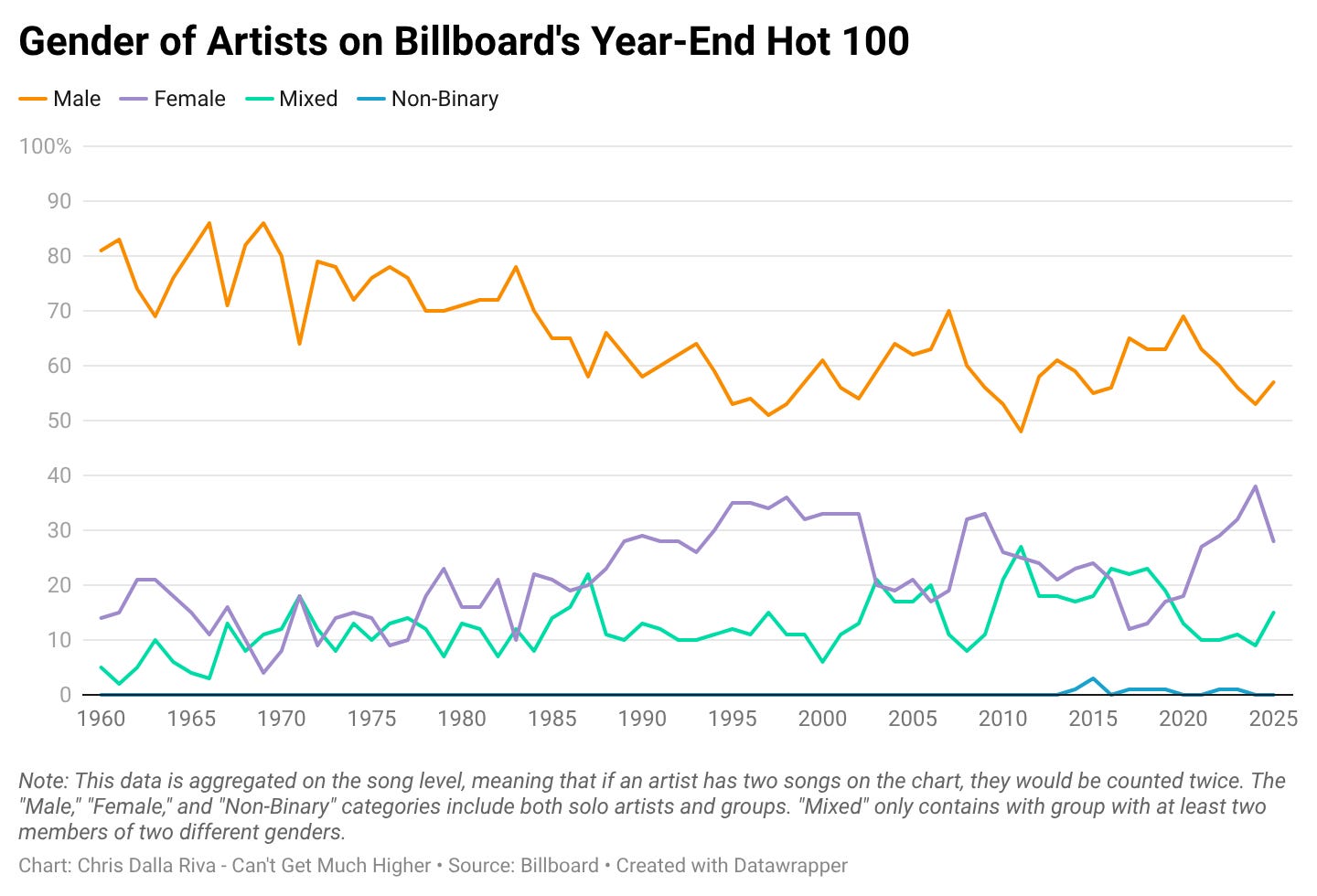
In 1960, 81% of songs on the year-end Hot 100 were by either solo men or groups made up of only men. In 2025, that rate had shrunk to 57%. In short, there are fewer male pop stars on a relative basis. But there has not been a complete collapse. Men and women have just been moving closer to parity, especially since 1980.
If we narrow it down to just top 40 hits, we see a similar pattern, albeit the gap between men and women is even smaller. In 1960, 82.5% of year-end top 40 hits were by either solo men or groups made up on only men. In 2025, that rate had shrunk to 52.5%. The rate for women, on the other hand, had risen from 18.8% to 41.4%.
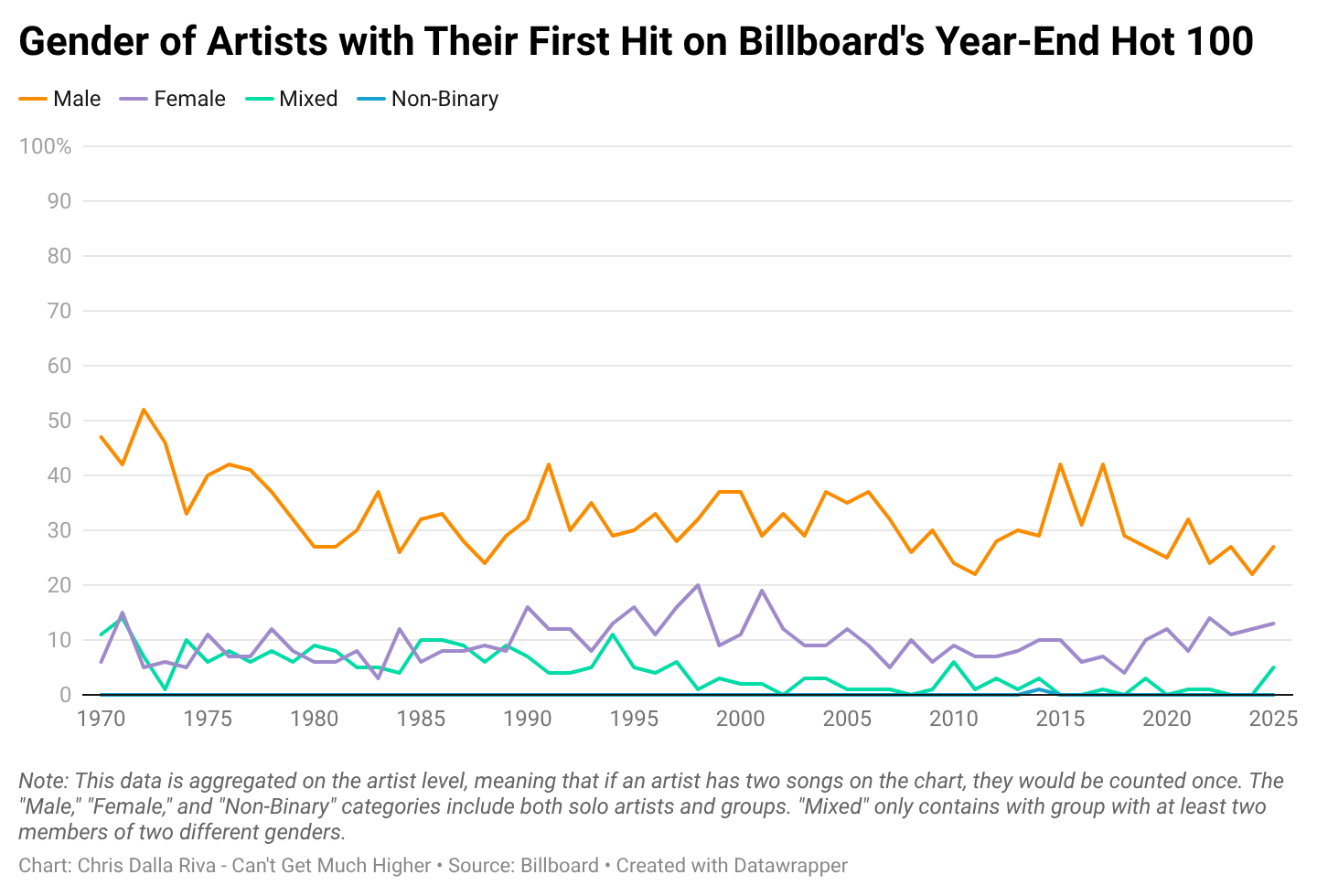
What about first time hits? Maybe all the popular male acts have been around for a while, like Harry Styles. That also doesn’t seem to be case. Though there are fewer first-time male hitmakers as compared to, say, the 1960s, the rate hasn’t changed much in the last 40 years. Between 20% and 35% of men on the year-end Hot 100 are there for the first time in any recent year.
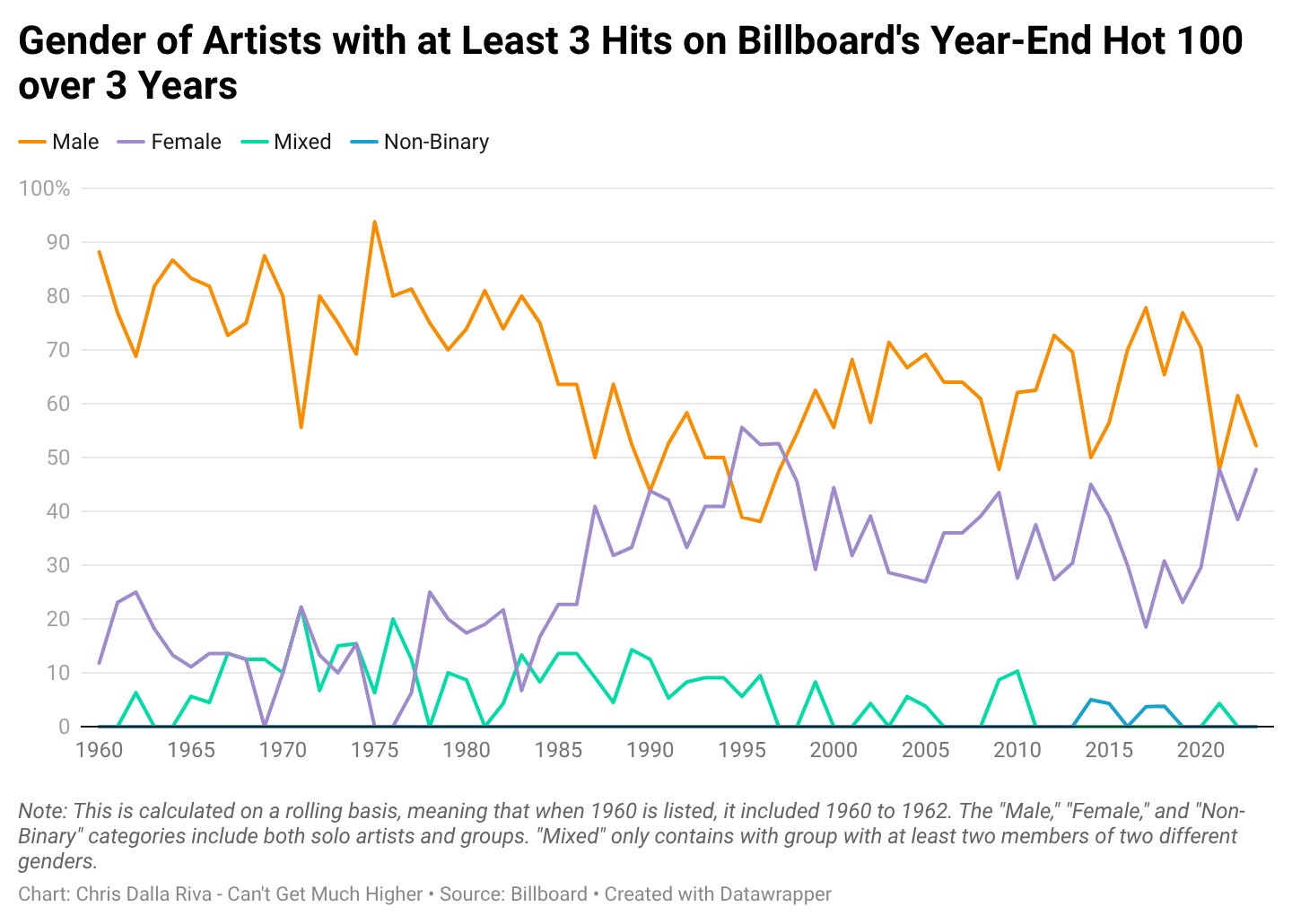
Maybe a single year isn’t enough to identify a pop star, though. Pop stardom usually takes a few years. If we look at the number of artists with at least three hits over a three-year period, we see a similar pattern to when looking at single years. Yes, men are less dominant than 60 years ago, but their domination ended in the 1980s. Nothing has really changed since the millennium.
If all the data tells us that the male pop star isn’t dead, yet people feel otherwise strongly enough that they are writing think-pieces about it, then what is going on? Let’s get a better sense of who current male pop stars are to understand.
Here is every male artist that made the year-end Hot 100 at least three times between 2022 and 2025:
Bad Bunny
Bailey Zimmerman
Benson Boone
Drake
Future
Jelly Roll
Kendrick Lamar
Luke Combs
Morgan Wallen
Post Malone
Shaboozey
Teddy Swims
The Weeknd
Zach Bryan
You will notice a few things about these artists. First, half are country artists. In the 2020s, country music and pop music have become equivalent. Country artists often try to give off an everyman quality. There’s something about that quality that feels antithetical to your typical pop star. Prince, for example, did not feel like your everyman. Neither do most of the contemporary female pop stars, like Lady Gaga, Sabrina Carpenter, and Dua Lipa.
Second, most of the non-country male pop stars are just kind of boring. Teddy Swims and Benson Boone are not that compelling. Of course, compelling male pop stars can still exist. The Weeknd has been making hits for a decade. But between country going pop and the median male superstar being kind of boring, it has given us the illusion that the male pop star is a dying breed.
In addition, gender parity might just be making us think that there are no men in the pop world anymore. Between 1960 and 1962, for example, nearly 90% of artists with at least three hits on the year-end Hot 100 were men. From 2023 to 2025, 52.2% were men and 47.8% were women. That’s a wild change. But it also reflects growing gender equality in society. That’s not a bad thing.
What Happened to the Band?
Along with identifying the gender of every artist to make the year-end Hot 100, I also identified the structure of the artist. By that I mean I noted if a hitmaker was a solo artist, duo, or group. Because musical groups have become an anachronism in the pop world, I wanted to see when they died.
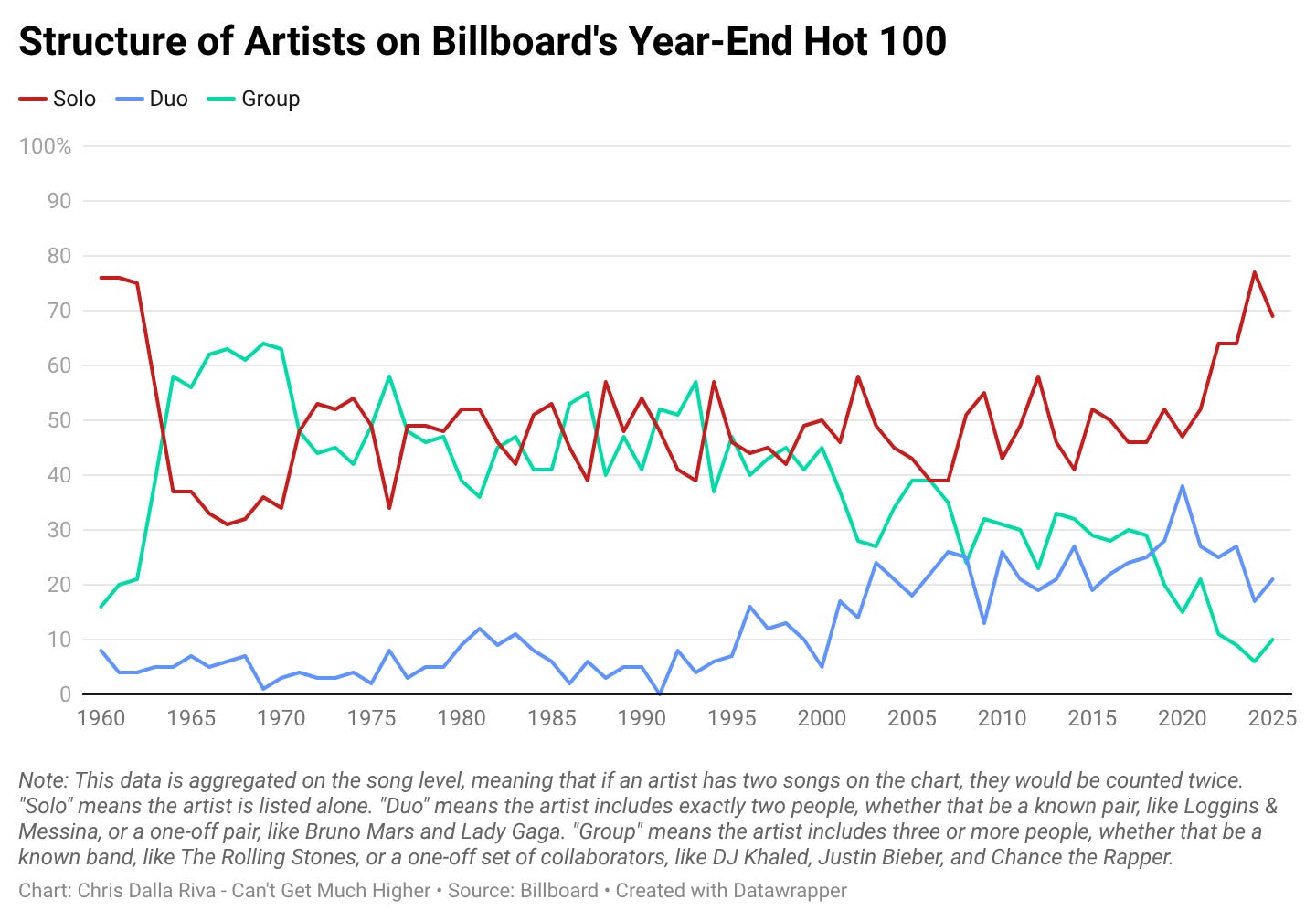
Our traditional notion of a musical group, or band, generally begins when The Beatles kicked off the British Invasion in 1964. As a popular entity, the band died around 2002, which happens to be when NSYNC broke up. Solo artists now reign supreme, like they did throughout the 1940s and 1950s.
You will notice something odd about this chart, though. There has been a surge in duos over the last 20 years. What’s going on? Has the ghost of Simon & Garfunkel returned? Not exactly. There has just been an increase in solo artists duetting. Bruno Mars and Lady Gaga. Bruno Mars and GloRilla. Bruno Mars and Rosé. You get the point. If you’re looking to do another duet next year, Bruno, please give me a call.
A New One
"other side." by Brent Faiyaz
2026 - R&B
The lack of interesting male superstars does not mean that there are no talented men out there. In fact, there are many men that I think could make the jump to the upper echelons of the pop world. Brent Faiyaz is one of those men.
Brent Faiyaz has been building a dedicated fanbase over the last decade. His voice is a big reason as to why. It’s silky smooth. But when I heard “other side.”, I thought that he might be able to ratchet things up to the next level. “other side.” grooves in a way that most male pop stars can’t.
An Old One
"Hold On, We’re Going Home" by Drake ft. Majid Jordan
2013 - R&B
Though he began his career as a child-actor-turned-rapper, Drake arguably became the biggest male pop star of my college years. The Canadian’s music can be cartoonish at times, but Drake’s ability to cross genre with ease is almost unparalleled. Yes, he raps with great facility, but he is also skilled melody maker. You can hear one of those melodies on “Hold On, We’re Going Home,” his 2013 collaboration with Majid Jordan.
Shout out to the paid subscribers who allow this newsletter to exist. Along with getting access to our entire archive, subscribers unlock biweekly interviews with people driving the music industry, monthly round-ups of the most important stories in music, and priority when submitting questions for our mailbag. Consider becoming a paid subscriber today!
Recent Paid Subscriber Interviews: Pitchfork’s Editor-in-Chief • Vinyl Specialist • Spotify’s Former Data Guru • Hall of Fame Songwriter• John Legend Collaborator • Broadway Arranger • Indie Label Founder• Fender Exec
Recent Newsletters: Two-Hit Wonders • The Lostwave Story • Forgotten Artists • Album Cover Colors • Bad Ways to Die • A Frank Sinatra Mystery • Slop Problems
Want more from Chris Dalla Riva? Get a copy of his book Uncharted Territory: What Numbers Tell Us about the Biggest Hit Songs and Ourselves wherever books are sold.
Don'y overlook this fella: https://www.youtube.com/watch?v=QDia3e12czc
Always so impressed by these posts! It feels like men are having a moment, esp in country and on Billboard, but weirdly not permeating the stan conversations outside of Harry (and Benson, who is believed to be a flop/flash in the pan).