


Welcome back to Can’t Get Much Higher, the internet’s favorite place for music and data. If you enjoy this newsletter, check out my book Uncharted Territory: What Numbers Tell Us about the Biggest Hit Songs and Ourselves. It’s a data-driven history of popular music that I wrote as I spent years listening to every number one hit in history.
The Death of the Broadway Orchestra
By Chris Dalla Riva
One thing that I’m grateful for in growing up near New York City is the proximity to Broadway. I’m no connoisseur, but I’ve seen a good deal of musicals over the years. And what’s nice is they are all pretty good. I don’t think I’ve ever walked out of a Broadway theater having not enjoyed my time.
Well, except one time. My dad got the entire family tickets to see a show for Christmas in 2017. It was a chilly, wonderful day in New York City. But after the show we all had the same reaction: The show was just okay. Imagine our surprise when we saw that the show, The Band’s Visit, not only won Best Musical at the Tony’s that year, but also took home Best Book, Best Score, Best Actor in a Musical, Best Actress in a Musical, and Best Direction of a Musical.
Maybe the Dalla Riva family is tasteless. Maybe we just needed to see the show again. Regardless, I do remember thinking one thing about the show was interesting: There was no pit orchestra. The music was all performed on stage by a small ensemble with the players integrated into the story.
This stood in contrast to most shows that I’d seen beforehand. Wicked, for example, had 24 people in their pit. That’s only seven people short of the show’s cast. The Band’s Visit, by contrast, only had 8—33% the size of Wicked’s musical ensemble. Even more interesting, it feels like every show I now see is closer to The Band’s Visit than Wicked.
& Juliet: 9 players
Hadestown: 7 players
Shucked: 6 players
Six: 6 players
Two Strangers (Carry a Cake Across New York): 5 players
Even shows that I’ve seen with a larger musical ensemble still pale in comparison to the large orchestra that played on Wicked. For example, Hamilton and MJ respectively topped out at 10 and 12 players.
Is this a legitimate trend? Or is the sample of shows that I’m going to be biased? Maybe if I went to see the big orchestras of The Lion King (23) or The Great Gatsby (19) I’d have a different opinion. I decided to take a closer look.
To Quote Billy Joel: “Where’s the Orchestra?”
To investigate this question, I turned to The Broadway League’s Internet Broadway Database, the theater equivalent of IMDb. The Internet Broadway Database tracks plays and musicals going back over a century. Relatively complete music credits only begin to appear in the middle of the 1980s, so I decided to start my analysis around there.
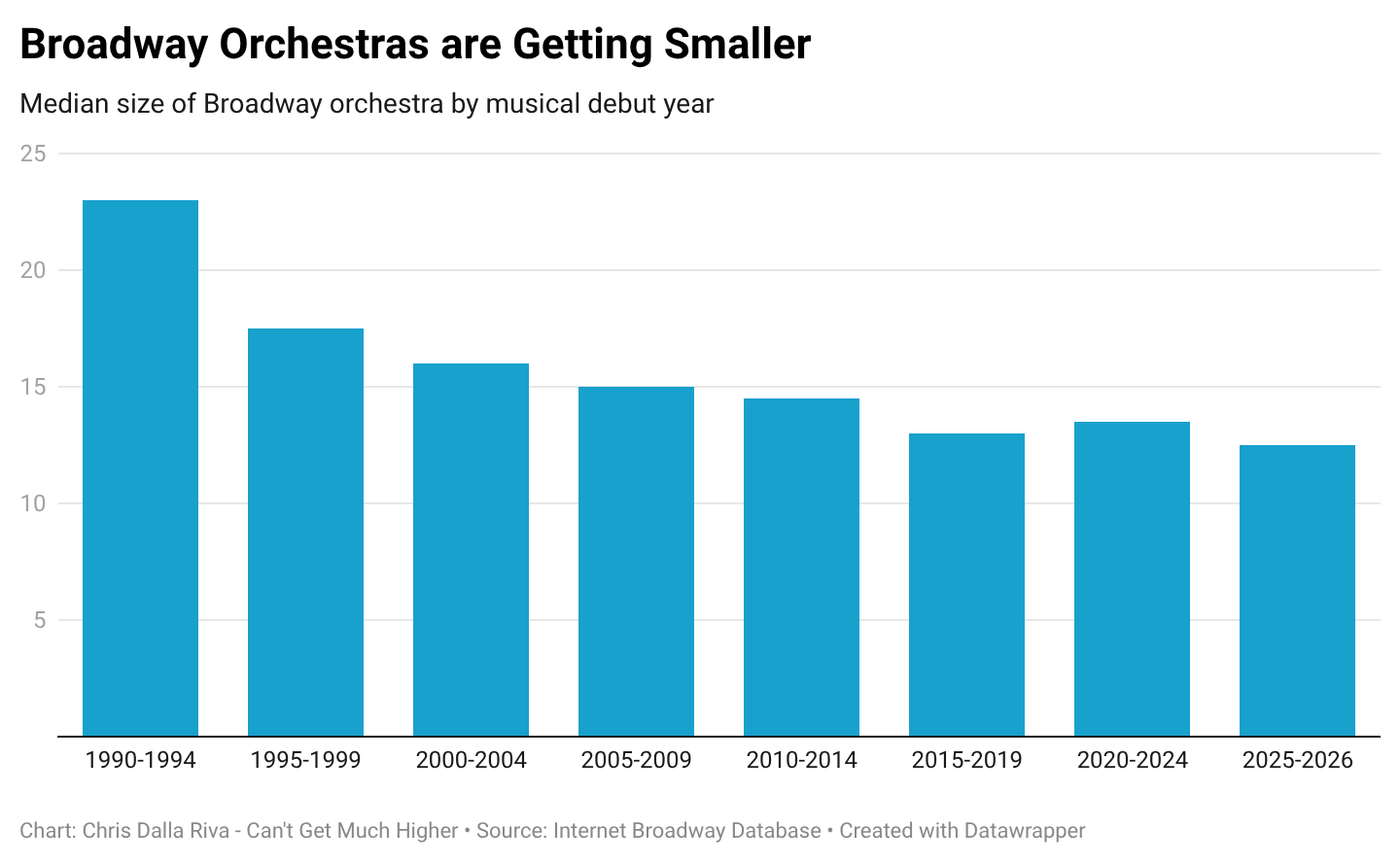
I wasn’t imagining things. Broadway orchestras have shrunk dramatically over the last few decades. Between 1990 and 1994, the median Broadway orchestra had 23 musicians. This was during the era of the big orchestras of Miss Saigon and Beauty and the Beast. From 2000 to 2024, the median orchestra had shrunk almost 60% down to 14 members.
This shift is further illustrated when we look at the distribution of Broadway orchestra sizes. Between 1990 and 1994, 54.1% of orchestras had at least 21 members. From 2020 to 2024, that rate had shrunk to 8.9%. Interestingly, the shift has not been toward ensembles of ten or fewer members. It is a shift to the mid-sized orchestra, the 11- to 20-member ensemble increasing from 13.5% to 51.8% over the last few decades.
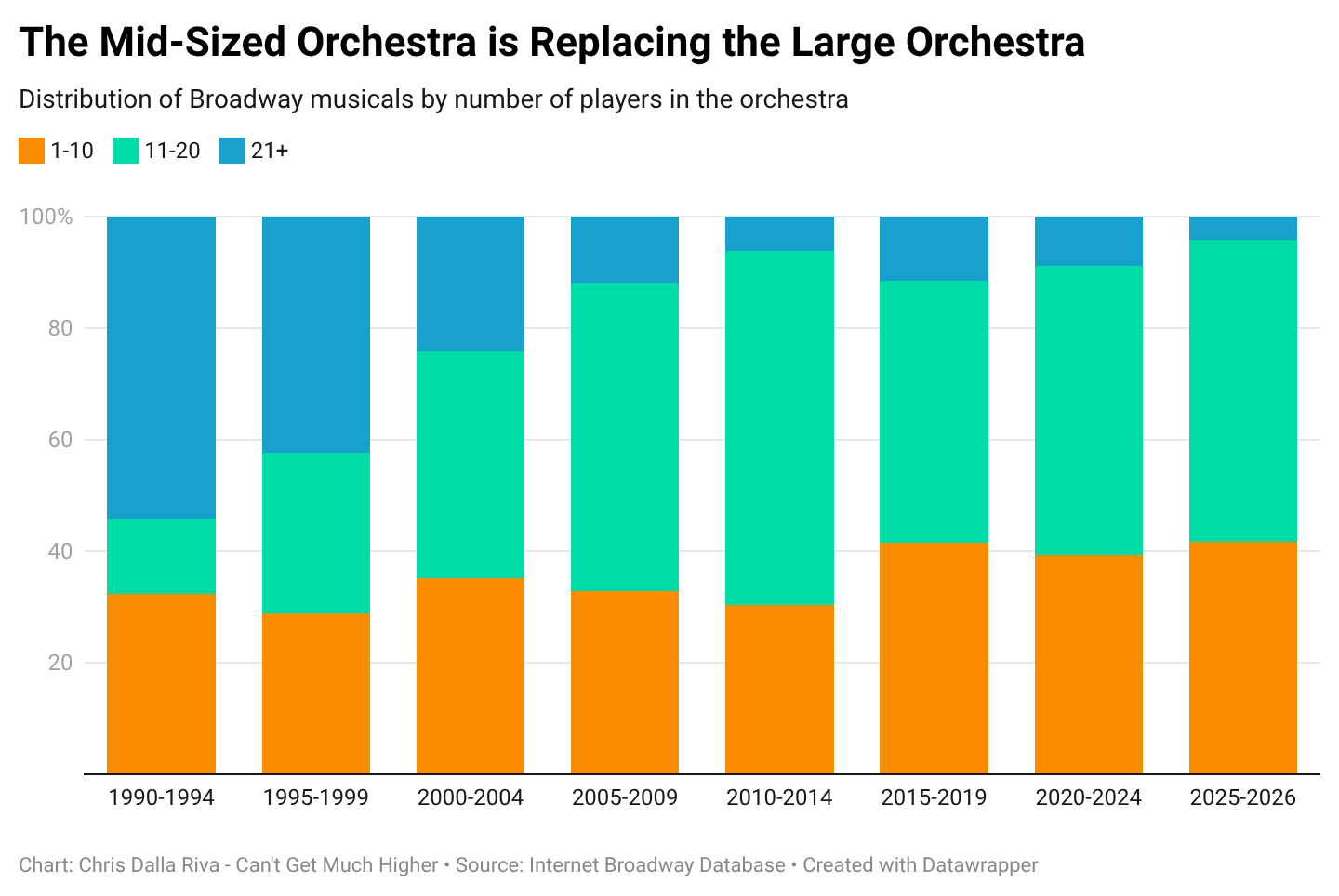
This is an astounding change. And it aligns with my experience. As a child in the 2000s, I saw a couple of big orchestra shows. Even if I wanted to see more shows like that today, there aren’t many options. The small- and mid-sized orchestras dominate Broadway. But why?
Various Dead Ends and Musical Trends
I thought a good way to understand this shift would be to first slice and dice musicals in a bunch of different ways. Maybe jukebox musicals use smaller ensembles and there are more musicals of that type. Maybe there are more musicals written by people from outside the theater (e.g., Cyndi Lauper → Kinky Boots) and those musicals tend to use smaller ensembles.
And there are some interesting trends when you start slicing and dicing. For example, source material has changed. Over the last few decades, there has been a steady increase in musicals respectively based on movies (e.g., Elf) or real events (e.g., Diana), although the former has cooled of late.
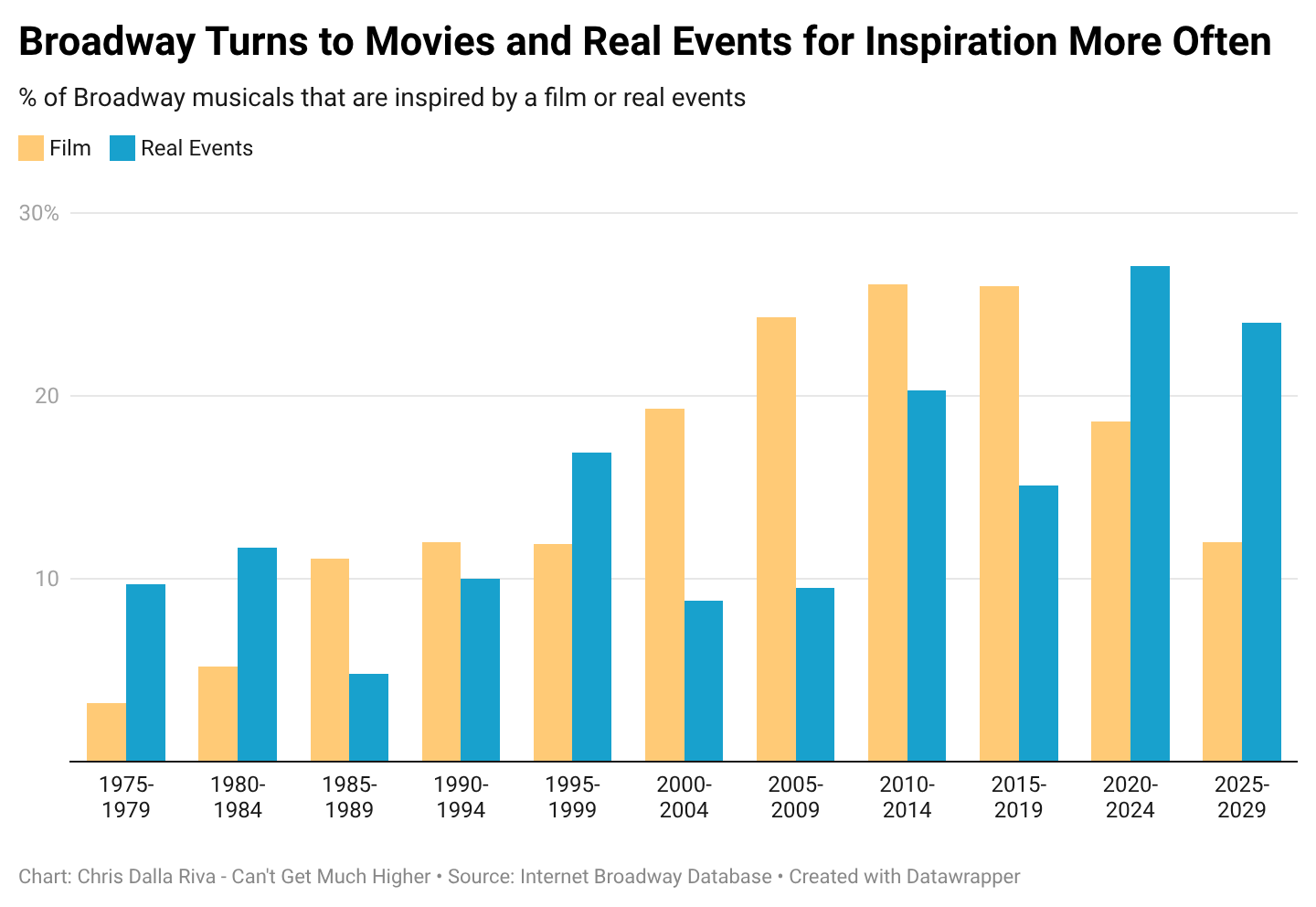
To get more specific, between 1990 and 1994, 10% of plays that debuted were based on real events and 12% were based on films. Between 2020 and 2024, those percentages had risen to 18.6% and 27.1%.
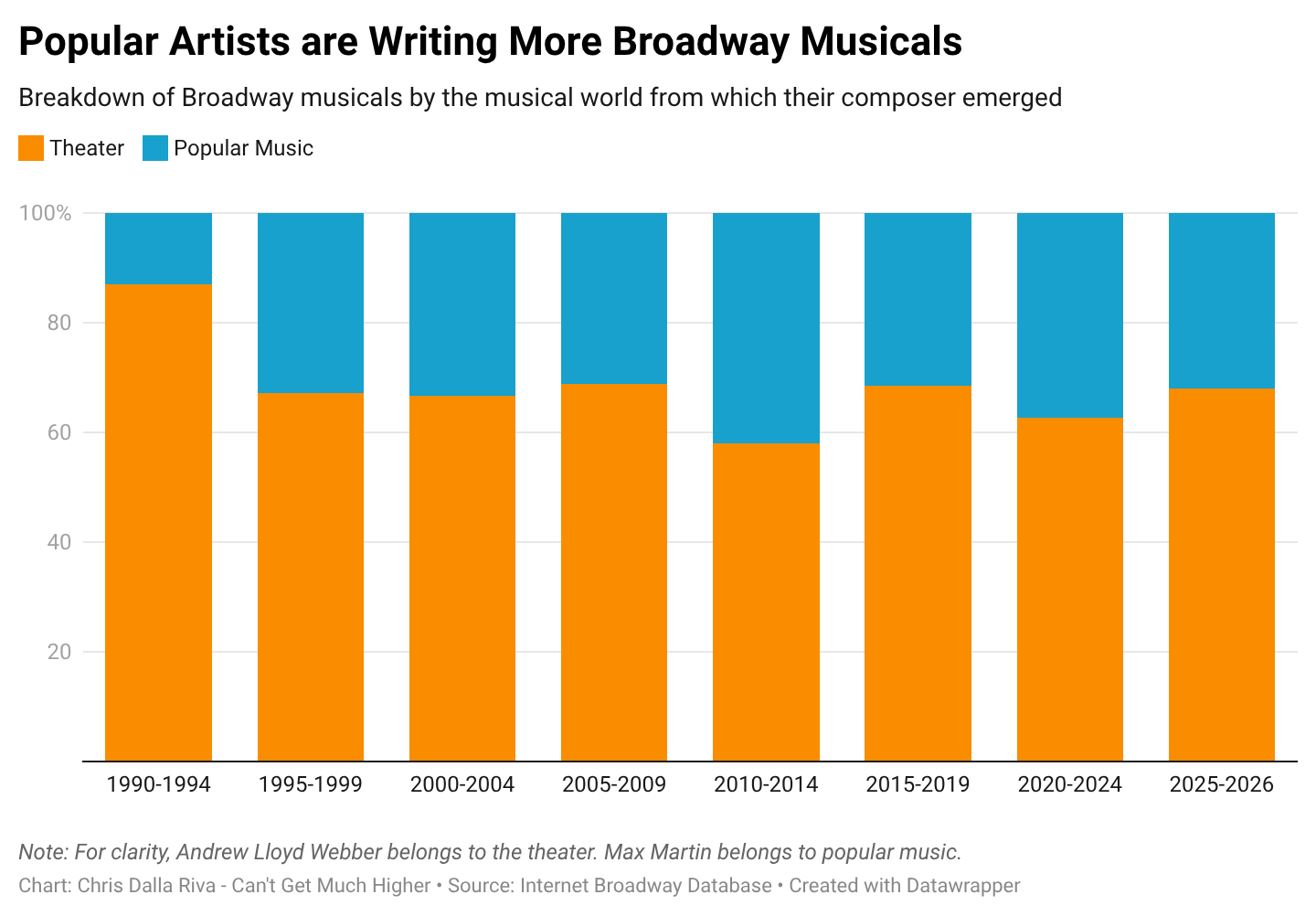
While the majority of musicals are still written by those historically associated with the theater (e.g., Andrew Lloyd Webber), there has been a surge in popular artists writing musicals (e.g., Sara Bareilles → Waitress, Alicia Keys → Hell’s Kitchen). In fact, between 1990 and 1994, 12% of musicals that debuted featured music written by popular artists (e.g., The Who’s Tommy). Between 2020 and 2024, that rate had risen to 30.5%.
Knowing this, it shouldn’t come as a shock that the genre of musicals has changed too. Between 1990 and 1994, 54% of musicals that debuted were what I would describe as a traditional musical. Think Meet Me in St. Louis or West Side Story. Between 2020 and 2024, only 33.9% were.
Those traditional musicals have mostly been replaced by rock and pop musicals, like Almost Famous, Six, and various jukebox musicals. Even some traditional composers have gotten in on the action too. Andrew Lloyd Webber, for example, wrote the music for 2015’s School of Rock.
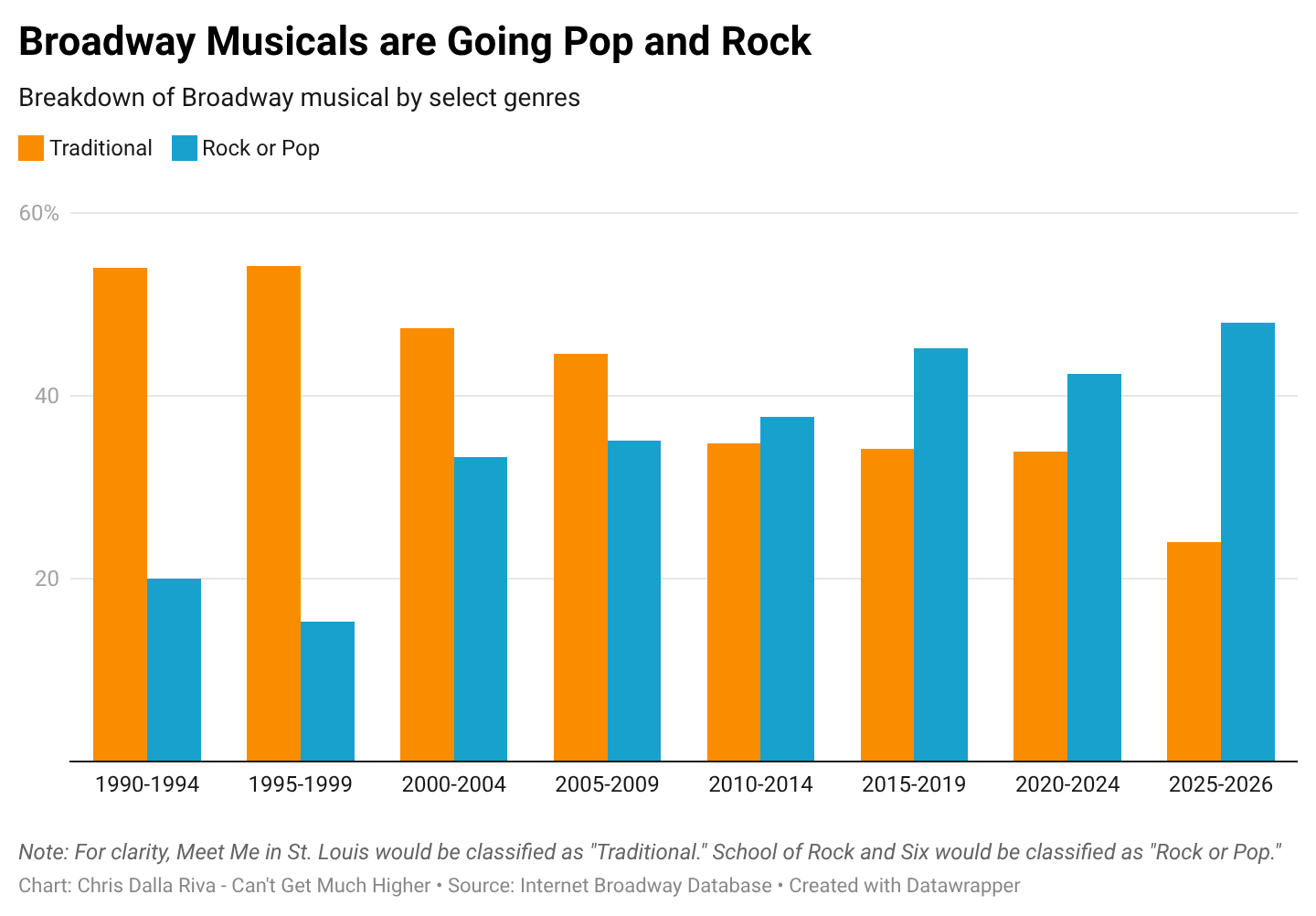
Some of these factors certainly play into the shrinking of the Broadway orchestra. Rock and pop are historically written for small ensembles. And Popular songwriters have more experience writing for ensembles of those sizes. But these aren’t the biggest factors driving this trend. It’s mostly related to labor.
The Answer is Always Economics
In 2003, Broadway went dark for four nights. It was over an argument between various musicians’ unions and Broadway’s association of theaters and producers. Going back decades, union contracts had stipulated that theaters require a certain number of musicians based on their size. For the biggest theaters at the time, that requirement was between 24 and 26. Producers said they wanted to bring that down to the range of 7 to 12 members.
“Can you imagine a union telling Arthur Miller that Death of a Salesman must have 24 actors onstage performing each night?” The League of American Theatres and Producers wrote at the time. “Should Local 802 be able to tell Sondheim or Hamlisch that they must write for 25 or 26 musicians?”
When things came to a standstill—producers threatening to use recordings if musicians failed to show up to work—Mayor Michael Bloomberg called for a summit at Gracie Mansion. An agreement was soon reached. The biggest theaters could move their minimums down to 18 or 19 musicians. Smaller theaters would also be adjusted as necessary.
This explains a large part of our trend. If we divide theaters into large and small groups (i.e., more or less than 1,100 seats), we see that there is a noted decline in the size of orchestras for larger theaters—those most affected by the 2003 labor agreement. Smaller theaters have largely had the same ensemble sizes for decades.
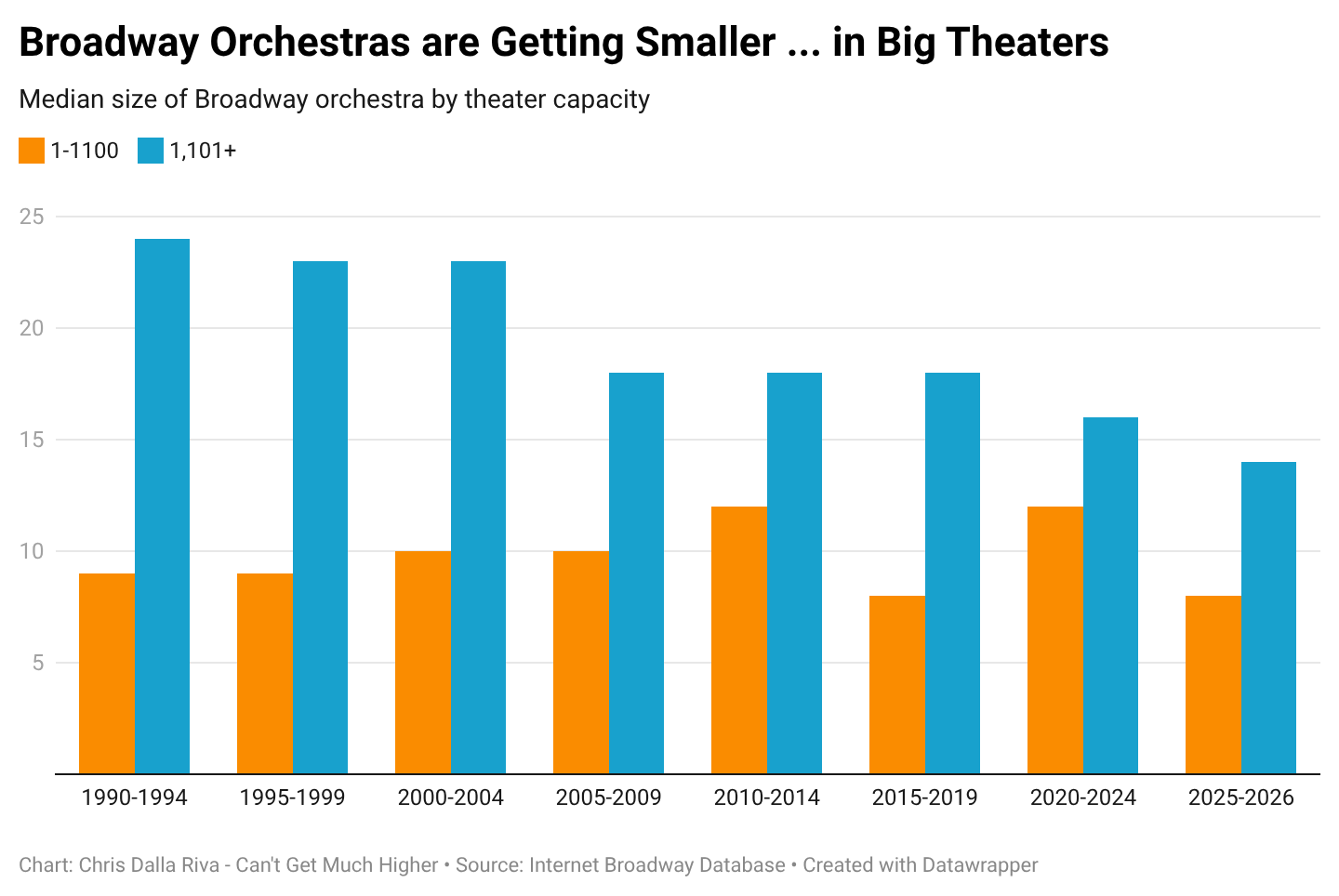
Any variation is largely related to specific dispensations by musicians’ unions. The 1,500-seat Neil Simon Theater, which technically falls into our large theaters group, only requires 14 musicians. Here Lies Love, a 2023 production, got away with 12 musicians after a dispute with the union where they tried to use prerecorded tracks. This is a trend of sorts. BroadwayWorld noted in 2025 that “11 of the 18 musicals that have had a musicians minimum waived in the last 10 years were for houses with a minimum of 18 or more.”
There is one more factor at play here. There are now more debuts—and thus more turnover—at smaller theaters. Between 1990 and 1994, only 27.3% of musicals debuts were in small theaters. That rate jumped to 44.8% between 2020 and 2024. So, even though the median small-theater musical has had a similar orchestra size for decade, there are more musicals of that type to pull down the average.
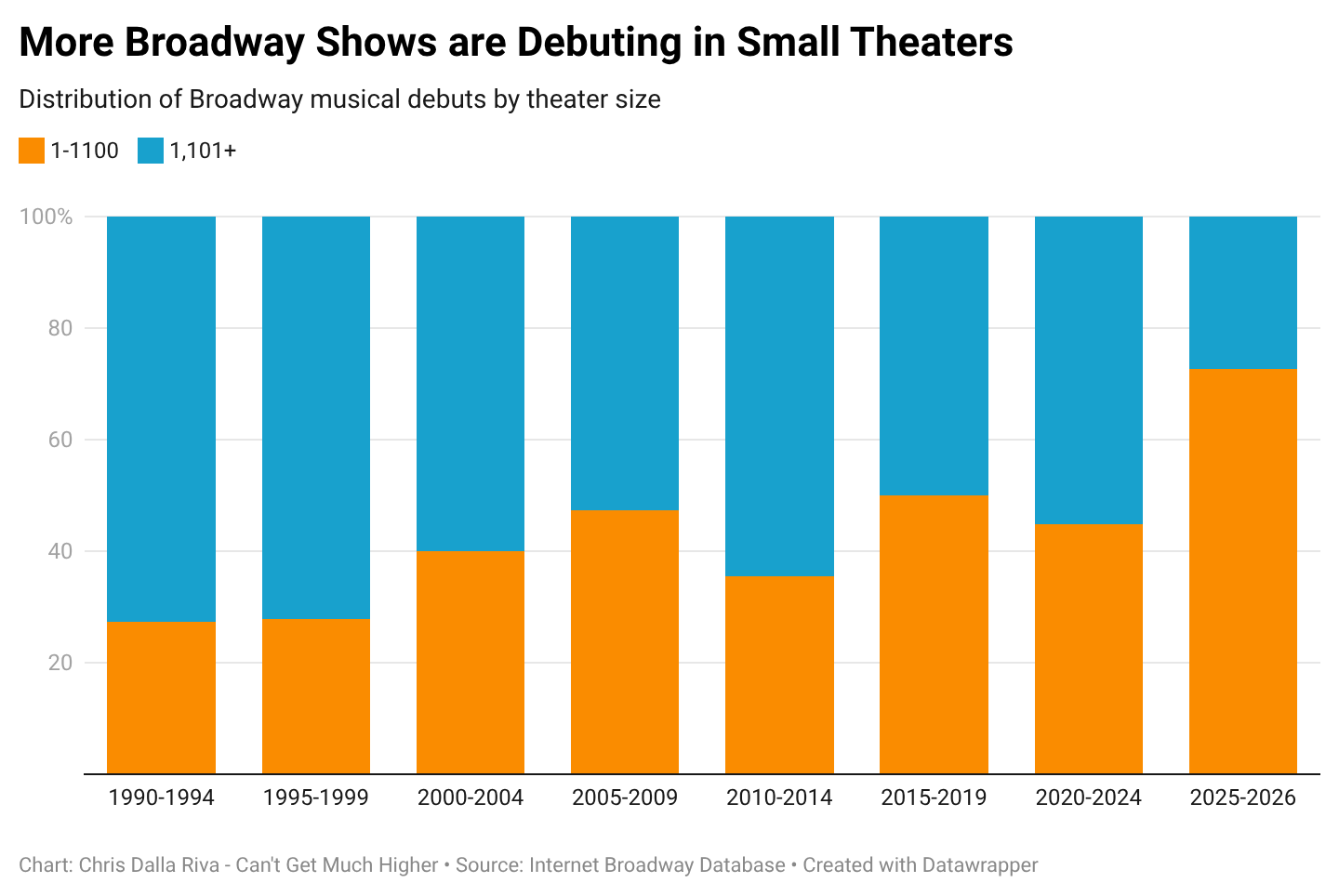
Given how many small-theater, small-ensemble musicals have debuted in the last decade, it’s no shock that those are the ones that I’ve been seeing. But maybe it’s time for me to sit down and watch a large-orchestra musical. The choices are slim and the tickets are pricey. But it’s usually worth it to hear great musicians play.
A New One
"Shall Rome" by Grace Yurchuk
2026 - Theatrical New Orleans Jazz
Last year, Grace Yurchuk got the idea to write an all-female musical adaptation of Shakespeare’s Julius Caesar. She started posting some of the music she was working on across social media. And it gained a dedicated audience. A Kickstarter was launched to raise money to record some of the songs. With $37,000 pledged, Yurchuk got to work.
And the songs are great! “Shall Rome” has the enunciation and diction you’d expect from a musical theater song, but it’s realized with hints of New Orleans jazz. Hopefully the show makes it to the stage one day.
An Old One
“Aretha, Sing One for Me” by George Jackson
1972 - Soul
This is the part of the newsletter where I’m supposed to recommend some old song with theatrical flair. Maybe something by Queen or Meat Loaf. But my cousin sent me this George Jackson song last week, and I’ve been addicted to it. So, I must share it with you.
In this soulful tune, Jackson and his woman break-up right before she heads off to “an Aretha Franklin show.” Jackson’s hope is that Franklin sings a song that makes his ex realize that he’s as “miserable as a man could be.” Maybe that realization is enough to bring her back. It’s a Hail Mary. But sometimes a song is powerful enough to change a person’s mind.
Shout out to the paid subscribers who allow this newsletter to exist. Along with getting access to our entire archive, subscribers unlock biweekly interviews with people driving the music industry, monthly round-ups of the most important stories in music, and priority when submitting questions for our mailbag. Consider becoming a paid subscriber today!
Recent Paid Subscriber Interviews: Pitchfork’s Editor-in-Chief • Vinyl Specialist • Spotify’s Former Data Guru • Hall of Fame Songwriter• John Legend Collaborator • Broadway Arranger • Indie Label Founder• Fender Exec
Recent Newsletters: Two-Hit Wonders • The Lostwave Story • Forgotten Artists • Album Cover Colors • Bad Ways to Die • A Frank Sinatra Mystery • Slop Problems
Want more from Chris Dalla Riva? Get a copy of his book Uncharted Territory: What Numbers Tell Us about the Biggest Hit Songs and Ourselves wherever books are sold.