


Welcome back to Can’t Get Much Higher, the internet’s favorite place for music and data. If you enjoy this newsletter, check out my book Uncharted Territory: What Numbers Us about the Biggest Hit Songs and Ourselves. It’s a data-driven history of popular music that I wrote as I spent years listening to every number one hit in history. A purchase allows me to keep doing the cool work in this newsletter, like using numbers to find the biggest (and most hated) band of the 2010s.
Critics Hate the Biggest Band of the 2010s
By Chris Dalla Riva
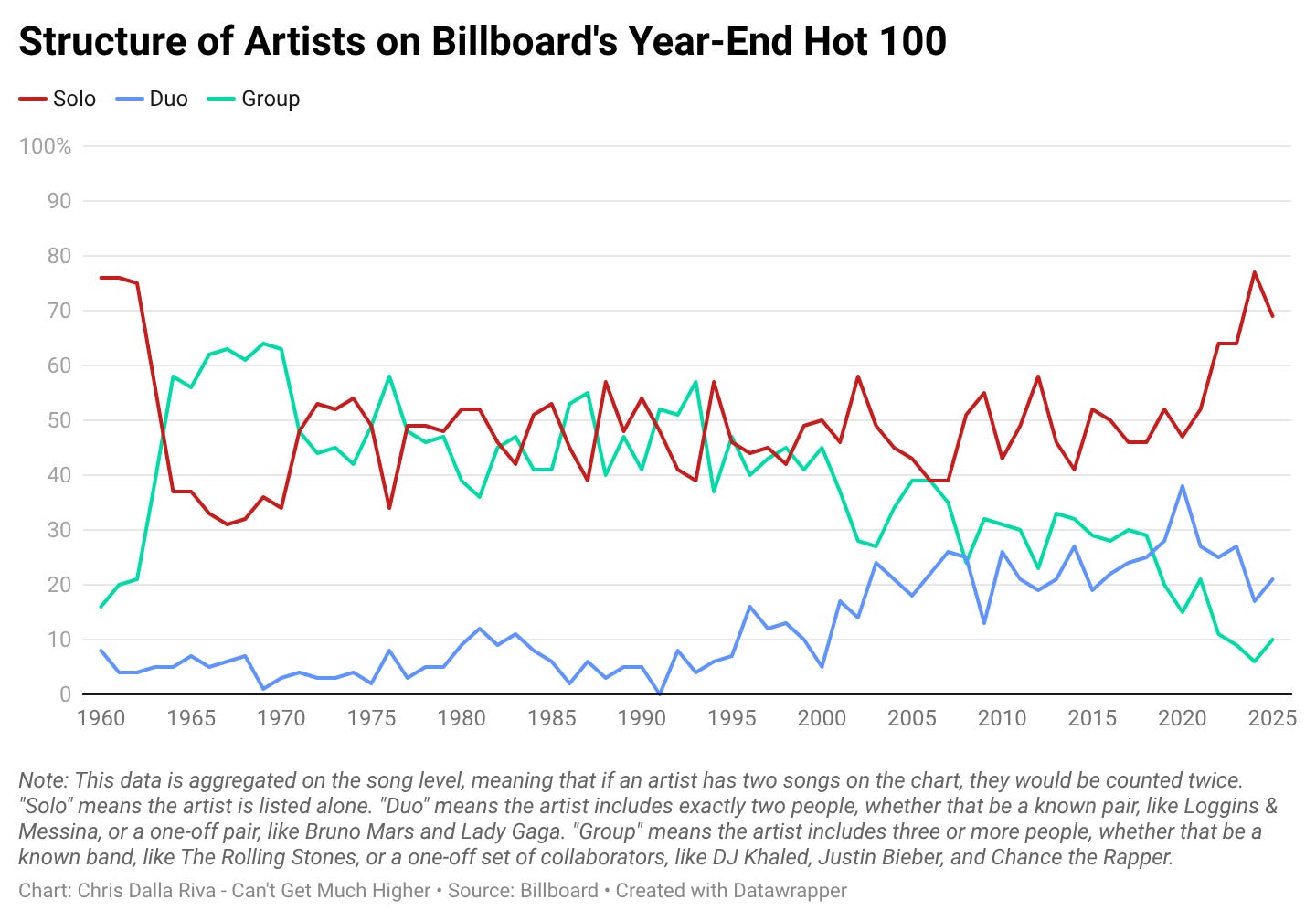
A few weeks ago, I reported that “As a popular entity, the band died around 2002.” No, I’m not talking about Levon Helm and friends. I’m talking about groups of musicians being pop stars, like The Beatles or The Police. According to Billboard, between 1970 and 1990, close to 50% of any year’s biggest hits were performed by a musical group, or band. Now, it’s closer to 10%.
If you pay a modicum of attention to popular music, I don’t think you’ll find this change shocking. Nearly any list of popular songs is dominated by solo artists rather than bands. Certain places will make you think otherwise, though.
Last weekend, I was down in Nashville for my bachelor party. As you stroll down the streets of Nashville, you would think that the concept of the band is alive and well. Nearly every bar has at least one entertaining patrons. And these bands are all incredible, ripping through some of the most difficult songs without a second thought.
This got me wondering who the biggest bands of 2010s were. Why the 2010s? Well, it’s easier to pick out the most popular bands from earlier decades because bands were so prevalent in popular culture (e.g., 1960s → The Beatles). Finding the most popular band of the 2010 felt like a more challenging task.
Which Band Won the 2010s?
Let’s get a few things straight. First, we will define a band as any musical act with at least three members. That means rock-oriented duos of the 2010s, like Twenty One Pilots, won’t make the cut. Second, this definition is genre agnostic. If no members of the group play an instrument in the traditional sense, like the three family members in the rap troupe Migos, that is fine. Finally, the band’s first album must have come out between 2009 and 2019.
With these definitions in mind, it’s almost certain that the biggest band of the 2010s is the Las Vegas quintet Imagine Dragons.
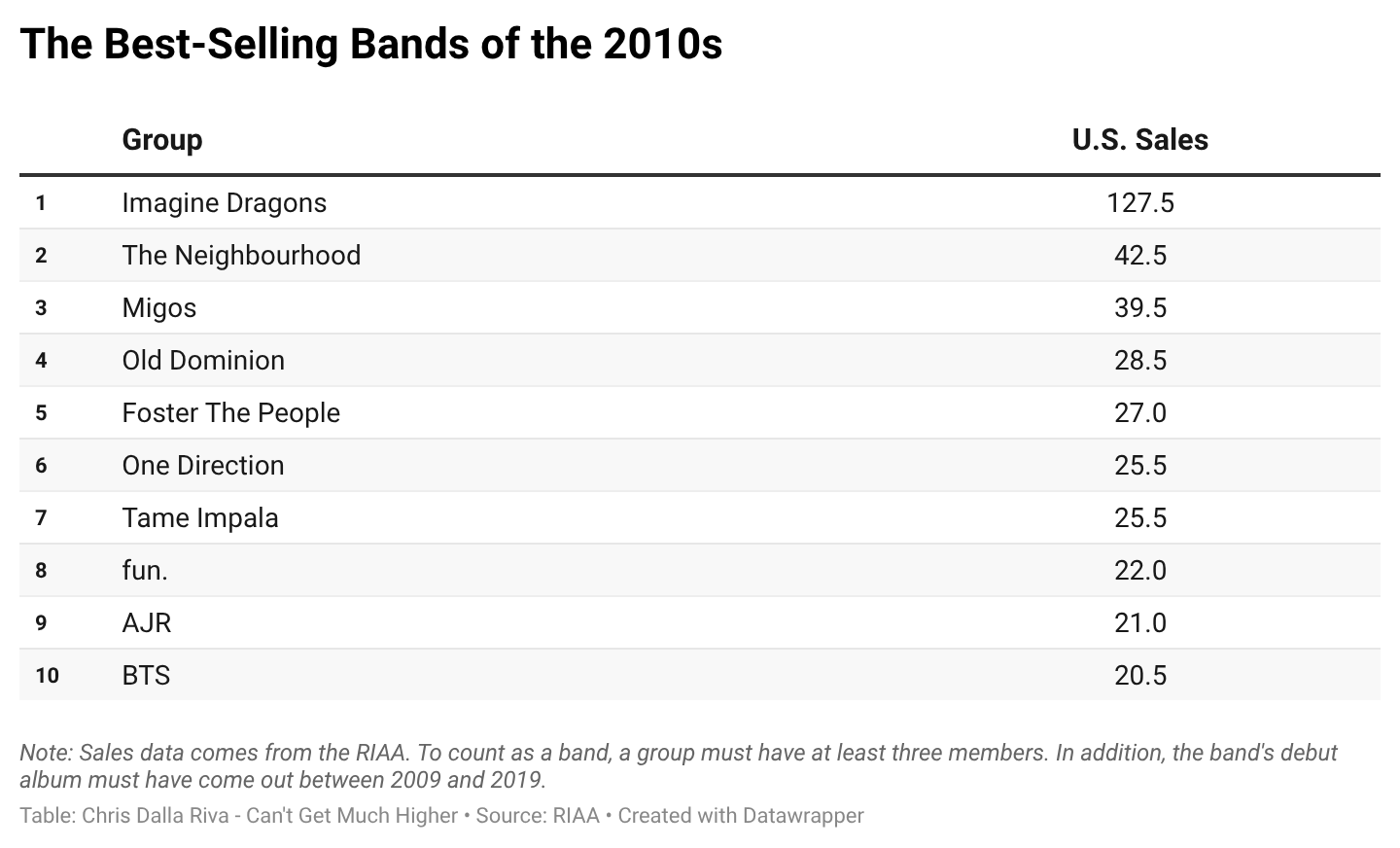
I knew Imagine Dragons was popular. But the RIAA lists them as having 127.5 million all-time record sales, more than Ed Sheeran, The Rolling Stones, Whitney Houston, and George Strait. In fact, the second best-selling group of the 2010s, The Neighbourhood, has only racked up 42.5 million, one-third of Imagine Dragon’s tally.
Could this really be right? Maybe my use of record sales according to the RIAA had some bias that I wasn’t thinking of. It doesn’t seem to matter where you look, though. Imagine Dragons always wins out.
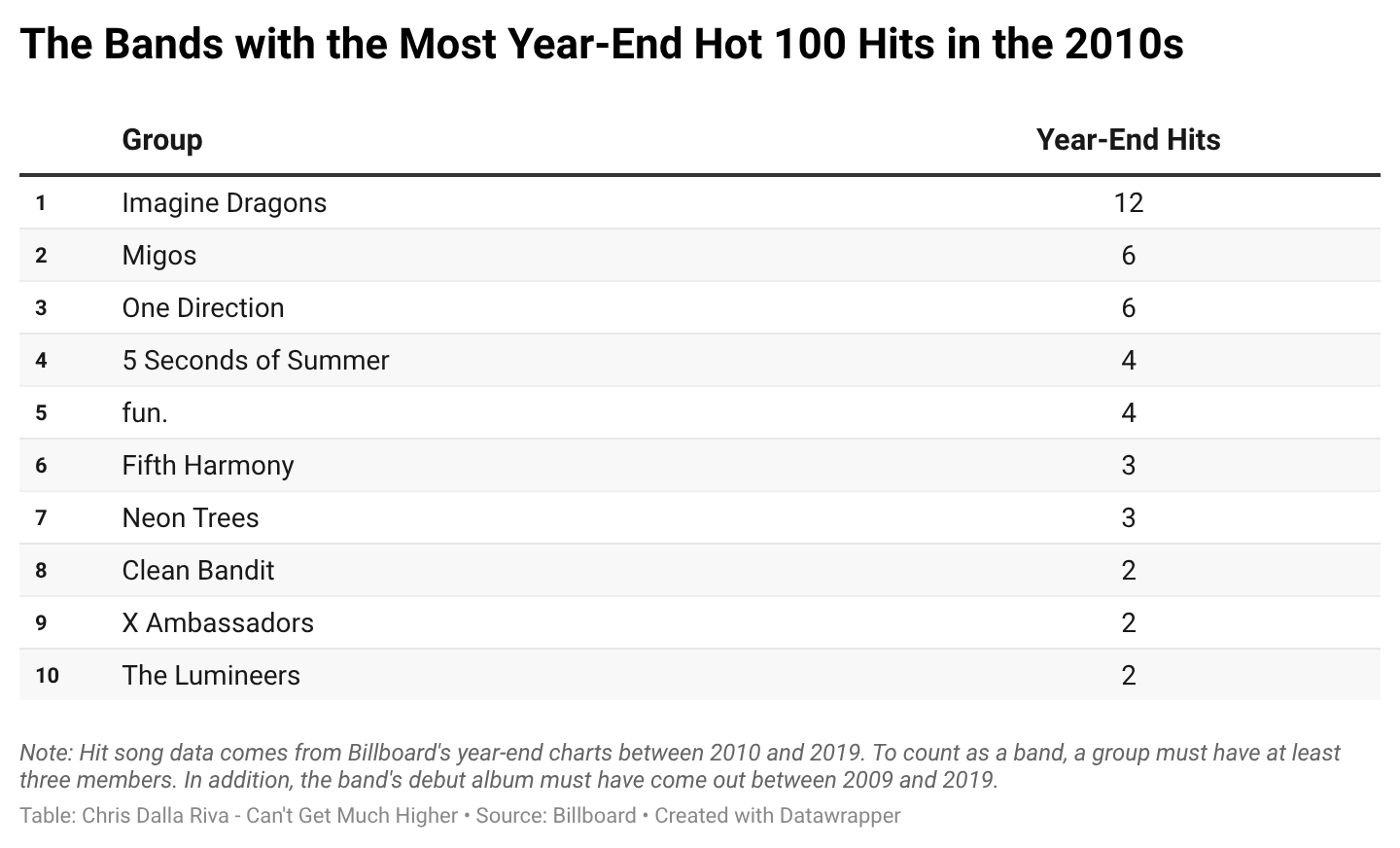
If you turn to Billboard’s year-end charts from 2010 to 2019, Imagine Dragons scored 12 hits as a lead artist, more than any other group. Migos, coming in second place, only had 6.
Even if you include every song featuring the trap trio, you still only get up to 10 hits. But to be fair, Imagine Dragons jumps up to 13 by that methodology. They featured on “Sucker for Pain” with Lil Wayne, Wiz Khalifa, Logic, Ty Dolla Sign, and X Ambassadors, an unlistenable song made for the movie Suicide Squad.
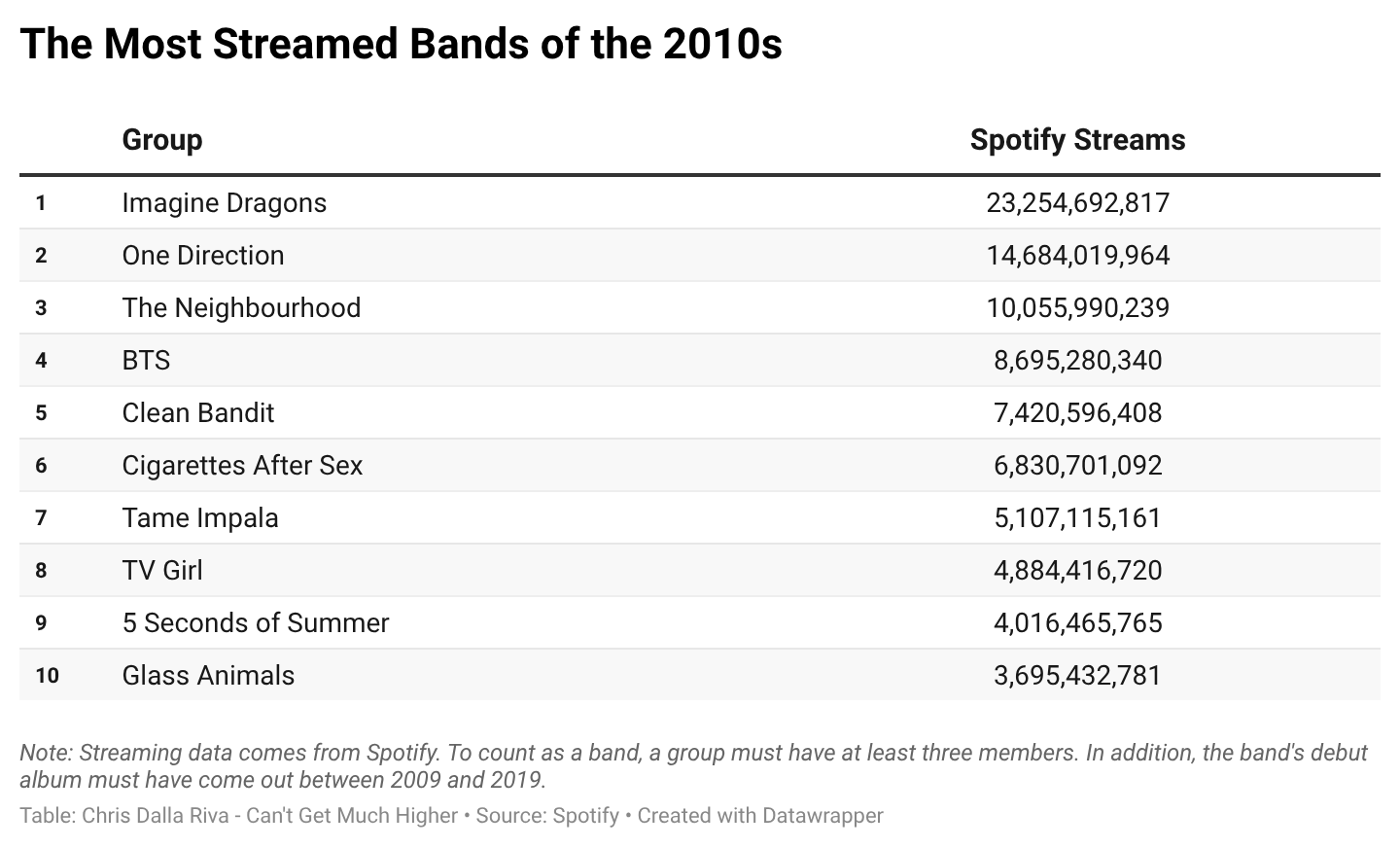
If you instead turn to Spotify streams, Imagine Dragons again wins out. Their 23 billion streams not only put them well ahead of any other group, but give them a similar listenership to major pop stars, like Lady Gaga, Justin Bieber, and Kendrick Lamar. This is generational popularity.
The Imagine Dragons’ Paradox
When I played my first gig during my senior year of high school, we performed a mix of covers and originals. I think I can still list the covers: “Prove It All Night” by Bruce Springsteen, “Burnin’ Love” by Elvis Presley, “Lonely Boy” by The Black Keys, and “It’s Time” by Imagine Dragons.
“It’s Time” was on Imagine Dragons’ debut EP. Given that we played “It’s Time,” you won’t be surprised that I liked a few songs on that EP. That’s where my Imagine Dragons’ fandom ended, though. Since then, I’ve disliked almost everything they’ve done. Most critics have too.
In 2019, Spin asked, “Is Imagine Dragons the Worst Band Ever?” Two years later, Pitchfork said that their Mercury – Act 1 sounded like the group was “firing their emotions out of a T-shirt cannon.” Listeners on RateYourMusic have also never given one of their albums anything higher than a 2.28.
Critics disliking something that your average music listener enjoys isn’t anything new. But something about Imagine Dragons’ staggering popularity as compared to their critical appeal stuck me as unexpected, especially as poptimism has taken over criticism. I think it’s explained by one final piece of data.
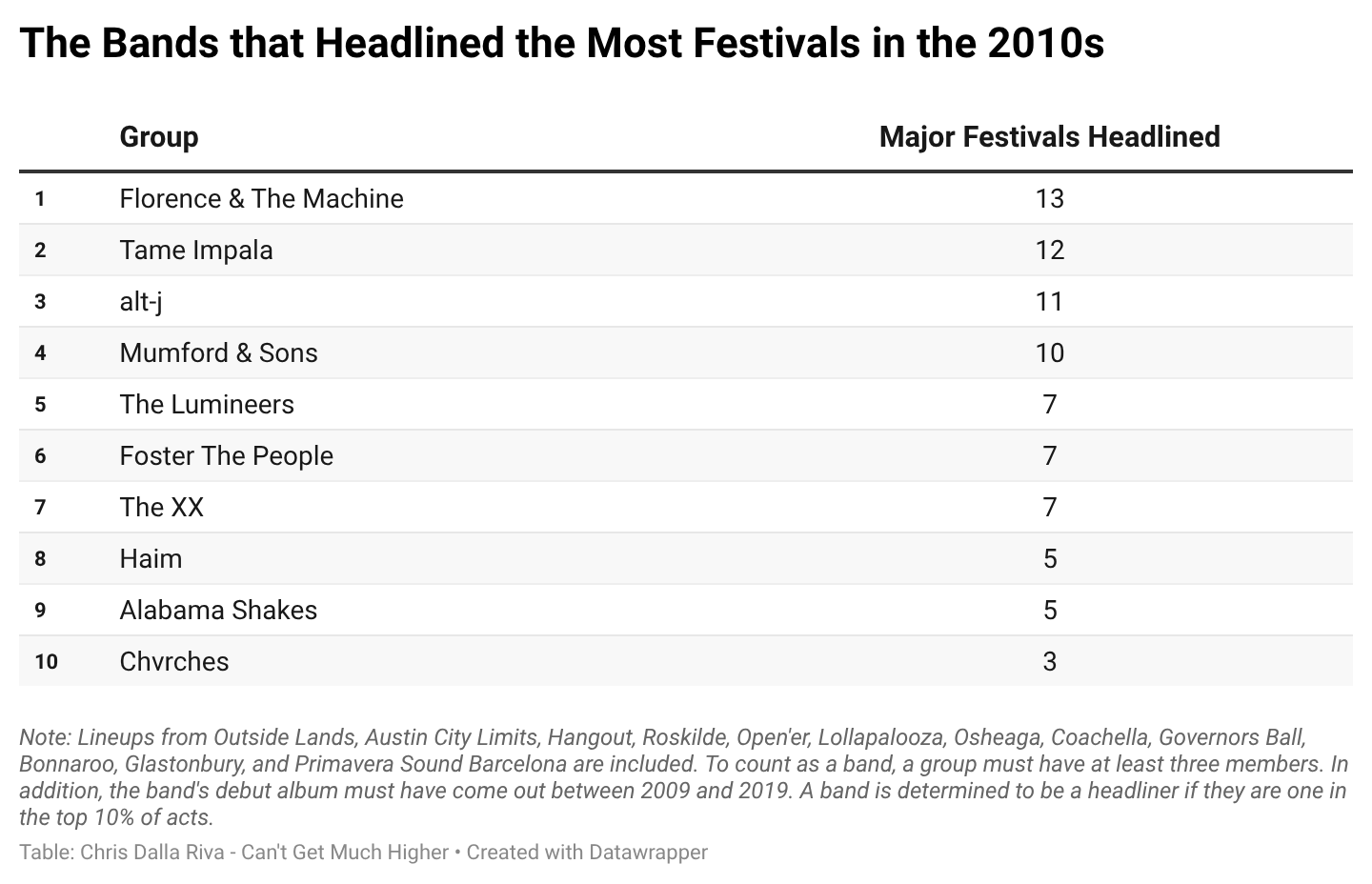
A few years ago, I aggregated a decade of music festival line-ups to see if those festivals were becoming homogenized. I decided to revisit that data while looking for the biggest bands of the 2010s. Oddly, Imagine Dragons is nowhere close to the most frequent headliners of the decade. Groups they’ve outsold by millions of records, like Tame Impala and Haim, book big slots at more major festivals than they do.
If you were organizing a major music festival and wanted to get as many people through the door as possible, wouldn’t you want to book the biggest band of the decade? Other pop stars get booked on these line-ups. The fact that Imagine Dragons doesn’t, says much about their fame.
People who go out to music festivals, especially those that require camping, are a specific breed. They are willing to shill out hundreds of dollars in order to risk bodily harm and dehydration all for the sake of checking out some music. Imagine Dragons’ fandom likely does not inspire that fervor.
My grand theory of Imagine Dragons is that they have managed to hit on a musical formula that maximizes casual fandom. Their songs often move across genre, making it easy for them to fit on streaming playlists of any style. And if you catch one of those songs in the wild, they’re often not offensive enough to bother you. They are a group that has perfected music for passive consumption. They are a group that a money-hungry executive would dream up if they had the chance. They are undoubtedly the biggest band of the 2010s.
A New One
"Fabienk" by Angine de Poitrine
2026 - Experimental Rock
Despite what anyone reports, the band—especially the rock band—is not dead. Maybe rock bands don’t have the popular impact that they once did, but they can still make a splash. Indie darlings Geese, for example, parlayed a buzzy album into an appearance on Saturday Night Live just last year.
If we’re talking buzzy rock groups today, few have been getting more love than Angine de Poitrine. Angine de Poitrine is one of the weirder buzzing bands you’ll ever hear, though. They play strange, microtonal music in costumes. And they are oddly compelling.
An Old One
"Moonbeam Woman" by Freak Power
1994 - Funk Rock
My friend Ken and I are listening to an album every day this year. Each week has a theme. And I’m documenting our listening in the Tuesday edition of this newsletter. Last week, I got to hear Drive-Thru Booty by Freak Power, an earlier group featuring big beat pioneer Fatboy Slim. That album’s first track, “Moonbeam Woman,” has one of the grooviest basslines I’ve ever heard. And I’m requiring you to listen to it.
Shout out to the paid subscribers who allow this newsletter to exist. Along with getting access to our entire archive, subscribers unlock biweekly interviews with people driving the music industry, monthly round-ups of the most important stories in music, and priority when submitting questions for our mailbag. Consider becoming a paid subscriber today!
Recent Paid Subscriber Interviews: Pitchfork’s Editor-in-Chief • Vinyl Specialist • Spotify’s Former Data Guru • Hall of Fame Songwriter• John Legend Collaborator • Broadway Arranger • Indie Label Founder• Fender Exec
Recent Newsletters: Two-Hit Wonders • The Lostwave Story • Forgotten Artists • Album Cover Colors • Bad Ways to Die • A Frank Sinatra Mystery • Slop Problems
Want more from Chris Dalla Riva? Get a copy of his book Uncharted Territory: What Numbers Tell Us about the Biggest Hit Songs and Ourselves wherever books are sold.
I wonder if there's a bit of a Herb Alpert Imagine Dragons parallel. A lot of people don't realize Alpert was a massive 1960s seller, outsold the Beatles for a bit, his stuff was pretty kitschy.
Their popularity with teen and pre-teen boys might explain this. Friend took his lad to a gig and it was packed with them. Imagine Dragons are like Taylor Swift for young males. Can’t explain it